
Inhaltsangabe
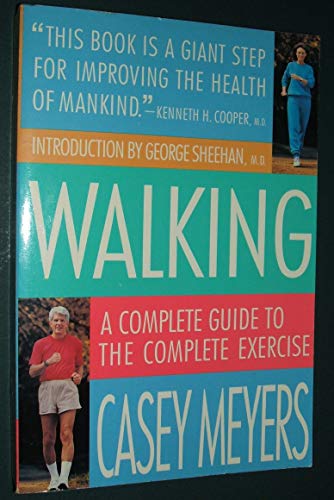
An authoritative guide to walking for maximum health explains exactly how it can be done, dispels the myths and clears up the misinformation surrounding walking, and presents successful case studies. Original. 50,000 first printing. Tour.
Die Inhaltsangabe kann sich auf eine andere Ausgabe dieses Titels beziehen.
Aus dem Klappentext
Draws on recent scientific studies documenting superior aerobic benefits of exercise walking. Black-and-white drawings and graphs throughout.
Auszug. © Genehmigter Nachdruck. Alle Rechte vorbehalten.
ONE
Do You Have a Healthy Lifestyle?
You may be wondering why a walking book is starting out talking about “lifestyle” instead of walking. As a 79-year-old with years of hindsight to draw from, I am certain that this chapter on lifestyle is the most important chapter in the book. If I can’t thoroughly convince you that you don’t have any other viable option than to start exercising consistently to preserve your health, maintain your quality of life, and (I hope) increase your longevity, then I have failed, and you have wasted your money on this book. Please read this chapter carefully.
The large conference room at Missouri Western State University was packed for an April 2005 breakfast meeting, provocatively titled “Our Lifestyles Are Killing Us.” The speaker, Lowell Kruse, CEO of Heartland Regional Medical Center, delivered a slide presentation that included a number of charts, graphs, and grim statistics about the current status of our population’s health at the regional, state, and national levels. It wasn’t a pretty picture.
The three leading causes of death in the United States continue to be heart disease, cancer, and stroke, in that order. A chart compiled by the Centers for Disease Control (CDC) and Heartland Regional Medical Center, titled “1990 & 2004 Leading Actual Causes of Death in the U.S. —Human Behaviors,” caught my eye (Figure 1.1). Tobacco use is still the number one cause of preventable death related to lifestyle, but, fortunately, the number of deaths has not increased from 1990 to 2004. Even so, cigarette smoking still accounts for about 400,000 needless deaths annually.
The alarming category in second place was “Poor Diet/Inactivity/ Obesity.” It shows a significant increase from 1990 to 2004 and is only about 2 percent behind tobacco. If its rate of acceleration in the last ten years continues, it will surpass tobacco before this decade is out as the primary cause of preventable death in the United States. As a nation, we are literally sitting and eating ourselves to death. Our self-indulgence and inactive lifestyle are a deadly duo (Figure 1.2).
Our daily lives are dominated by numerous reasons not to exercise. For baby boomers and all those born later, especially children born in the last ten years, what constitutes “normal” daily physical activity is vastly different from those of us born much earlier. I was a child in the thirties and a teenager in the forties, during World War II. In the thirties, obese people were uncommon in the general population, especially young obese people. Old films of World War II draftees in the early forties reveal lean groups of men. I was drafted in 1946, and there wasn’t one fat soldier in my basic training company. It is quite the opposite today and has been so for several decades—especially the last twenty years.
Let’s look at some of today’s reasons our daily energy expenditure has been greatly reduced. In the early 1900s the marriage between the wheel and the internal combustion engine brought us the automobile. Amid cries of “It will never replace the horse,” the automobile has become a dominant force in the American lifestyle. It has spawned drive-through banks, dry cleaners, pharmacies, and of course fast- food restaurants, just to name a few. We even have a drive-through Starbucks in my town. Other human energy savers include elevators, escalators, automatic washers and dryers, riding mowers, golf carts, power tools, automated assembly lines, moving walkways in airports, garage door openers, TV remote controls, and thermostats. With a furnace or stove, we used to carry in the coal and carry out the ashes, and in between we had to get up several times to stoke the fire. With today’s heating and cooling systems and a thermostat, you can keep your house at an even temperature year round without moving a muscle. And these modern conveniences are just the tip of the iceberg.
In addition, we have actually added to our inactivity by spending countless hours watching television, playing video games, and surfing the Internet. The obesity problem for children is skyrocketing, but no wonder. Television has become a babysitter for the very young, who then graduate to video games. Sitting and more sitting. This raises an obvious question: with all of these wonderful modern conveniences, why would anyone in their right mind go out each day and spend their valuable time exercising and, heaven forbid, maybe even work up a sweat? The answer can be summed up in two words—your health.
From the very young to the very old, we have engineered ourselves into a deleterious state of inactivity. Unless you become convinced that a sedentary lifestyle puts your health and longevity at risk, it is unlikely that you will break the bonds of inactivity and be a consistent exerciser. Let me try to convince you.
The American Heart Association’s (AHA) 2005 update “Heart Disease and Stroke Statistics” states, “Today, nearly seven of every 10 U.S. adults are overweight, and about three of every 10 are obese. And among children, overweight and obesity are rising at an alarming rate.” The report continues, “Since 1991, the prevalence of obesity increased 75 percent, and obesity has increased among every ethnic group.” According to the AHA, the estimated annual cost of obesity- related diseases in the United States is about $100 billion.
If I asked you to name the major risk factors for heart disease, you would probably say high cholesterol, high blood pressure, and cigarette smoking. You would be right, but there is one more that almost everyone misses. It is physical inactivity, also called sedentary living. In the mid-nineties the AHA added sedentary living to its list of major risk factors, giving it equal status with the most infamous cause of preventable death, cigarette smoking. If you are a nonsmoker but are sedentary, you are at a similarly high risk for heart disease. Sedentary living does its damage to the body slowly over an extended period of time just as cigarettes do. Most people in their 50s, 60s, and older tend to become more sedentary each passing year. And as the AHA report states, “While our level of activity declines, our rates of heart disease increase.”
I would be remiss if I didn’t emphasize that in terms of annual body count, the most destructive lifestyle of all is cigarette smoking. Year in and year out, it wins the death derby by a country mile. If you are a smoker, you can’t walk enough miles or eat enough heart- healthy foods to undo the damage caused to your body by smoking. Dr. Tedd Mitchell of the Cooper Clinic says, “Nothing even comes close to smoking as the biggest cause of preventable death. It is in a class by itself.” He added, “We know that smoking is a major contributor to premature death from heart disease, stroke, lung cancer, and emphysema, but cigarettes are also linked to many other diseases the public has not been warned about, such as pancreatic cancer.” Many smokers have been able to quit, but unfortunately, many others have tried and failed.
Nicotine in cigarettes is a highly addictive drug that develops a tenacious hold on the brain’s chemical receptors. Most cigarette smokers have great difficulty conquering this addiction when they try to quit. Cigarette companies have artfully characterized smokers as having the “smoking habit,” because they don’t want people to know that they are addicted to a pernicious drug. If you have tried unsuccessfully to quit smoking, keep trying. Nicotine addiction is far more difficult to overcome than breaking a “habit.” In a strange twist of logic, some people (particularly women)...
„Über diesen Titel“ kann sich auf eine andere Ausgabe dieses Titels beziehen.
Weitere beliebte Ausgaben desselben Titels

Suchergebnisse für Walking: A Complete Guide to the Complete Exercise

Beispielbild für diese ISBN
Walking: A Complete Guide to the Complete Exercise
Anbieter: World of Books (was SecondSale), Montgomery, IL, USA
Verkäuferbewertung 5 von 5 Sternen

Zustand: Good. Item in very good condition! Textbooks may not include supplemental items i.e. CDs, access codes etc. Artikel-Nr. 00074414995
Gebraucht kaufen
EUR 4,46
Versand gratis
Versand innerhalb von USA
Versand innerhalb von USA
Anzahl: 1 verfügbar
Beispielbild für diese ISBN
Walking: A Complete Guide to the Complete Exercise
Anbieter: World of Books (was SecondSale), Montgomery, IL, USA
Verkäuferbewertung 5 von 5 Sternen
Zustand: Very Good. Item in very good condition! Textbooks may not include supplemental items i.e. CDs, access codes etc. Artikel-Nr. 00074688158
Gebraucht kaufen
EUR 4,46
Versand gratis
Versand innerhalb von USA
Versand innerhalb von USA
Anzahl: 2 verfügbar
Beispielbild für diese ISBN
Walking: A Complete Guide to the Complete Exercise
Verlag:
Random House (edition 1), 1992
ISBN 10: 0679737774
ISBN 13: 9780679737773
Gebraucht
Paperback
Anbieter: BooksRun, Philadelphia, PA, USA
Verkäuferbewertung 5 von 5 Sternen
Paperback. Zustand: Very Good. 1. It's a well-cared-for item that has seen limited use. The item may show minor signs of wear. All the text is legible, with all pages included. It may have slight markings and/or highlighting. Artikel-Nr. 0679737774-11-6
Gebraucht kaufen
EUR 5,42
Versand gratis
Versand innerhalb von USA
Versand innerhalb von USA
Anzahl: 1 verfügbar
Beispielbild für diese ISBN
Walking: A Complete Guide to the Complete Exercise
Anbieter: ThriftBooks-Atlanta, AUSTELL, GA, USA
Verkäuferbewertung 5 von 5 Sternen
Paperback. Zustand: As New. No Jacket. Pages are clean and are not marred by notes or folds of any kind. ~ ThriftBooks: Read More, Spend Less. Artikel-Nr. G0679737774I2N00
Gebraucht kaufen
EUR 6,03
Versand gratis
Versand innerhalb von USA
Versand innerhalb von USA
Anzahl: 1 verfügbar
Beispielbild für diese ISBN
Walking: A Complete Guide to the Complete Exercise
Anbieter: ThriftBooks-Atlanta, AUSTELL, GA, USA
Verkäuferbewertung 5 von 5 Sternen
Paperback. Zustand: Fair. No Jacket. Readable copy. Pages may have considerable notes/highlighting. ~ ThriftBooks: Read More, Spend Less. Artikel-Nr. G0679737774I5N00
Gebraucht kaufen
EUR 6,03
Versand gratis
Versand innerhalb von USA
Versand innerhalb von USA
Anzahl: 1 verfügbar
Beispielbild für diese ISBN
Walking : A Complete Guide to the Complete Exercise
Verlag:
Random House Publishing Group, 1992
ISBN 10: 0679737774
ISBN 13: 9780679737773
Gebraucht
Softcover
Anbieter: Better World Books: West, Reno, NV, USA
Verkäuferbewertung 5 von 5 Sternen
Zustand: Very Good. Former library copy. Pages intact with possible writing/highlighting. Binding strong with minor wear. Dust jackets/supplements may not be included. Includes library markings. Stock photo provided. Product includes identifying sticker. Better World Books: Buy Books. Do Good. Artikel-Nr. 9471484-6
Gebraucht kaufen
EUR 6,42
Versand gratis
Versand innerhalb von USA
Versand innerhalb von USA
Anzahl: 1 verfügbar
Beispielbild für diese ISBN
Walking: A Complete Guide to the Complete Exercise
Anbieter: Wonder Book, Frederick, MD, USA
Verkäuferbewertung 5 von 5 Sternen
Zustand: Good. Good condition. A copy that has been read but remains intact. May contain markings such as bookplates, stamps, limited notes and highlighting, or a few light stains. Artikel-Nr. V06B-04911
Gebraucht kaufen
EUR 6,76
Versand gratis
Versand innerhalb von USA
Versand innerhalb von USA
Anzahl: 3 verfügbar
Beispielbild für diese ISBN
Walking: A Complete Guide to the Complete Exercise
Anbieter: Wonder Book, Frederick, MD, USA
Verkäuferbewertung 5 von 5 Sternen
Zustand: Very Good. Very Good condition. A copy that may have a few cosmetic defects. May also contain light spine creasing or a few markings such as an owner's name, short gifter's inscription or light stamp. Artikel-Nr. V14B-04441
Gebraucht kaufen
EUR 6,76
Versand gratis
Versand innerhalb von USA
Versand innerhalb von USA
Anzahl: 2 verfügbar
Beispielbild für diese ISBN
Walking: A Complete Guide to the Complete Exercise
Anbieter: medimops, Berlin, Deutschland
Verkäuferbewertung 5 von 5 Sternen
Zustand: very good. Gut/Very good: Buch bzw. Schutzumschlag mit wenigen Gebrauchsspuren an Einband, Schutzumschlag oder Seiten. / Describes a book or dust jacket that does show some signs of wear on either the binding, dust jacket or pages. Artikel-Nr. M00679737774-V
Gebraucht kaufen
EUR 3,84
EUR 10,00 Versand
Versand von Deutschland nach USA
Versand von Deutschland nach USA
Anzahl: 1 verfügbar
Beispielbild für diese ISBN
Walking: A Complete Guide to the Complete Exercise
Verlag:
Random, New York, 1992
ISBN 10: 0679737774
ISBN 13: 9780679737773
Gebraucht
Softcover
Erstausgabe
Anbieter: Between the Covers-Rare Books, Inc. ABAA, Gloucester City, NJ, USA
Verkäuferbewertung 5 von 5 Sternen
Softcover. Zustand: Very Good. First Edition. First edition. Paperback Very good in wrappers. Small sticker mark on covr. Artikel-Nr. 217950
Gebraucht kaufen
EUR 17,62
EUR 4,82 Versand
Versand innerhalb von USA
Versand innerhalb von USA
Anzahl: 1 verfügbar