
Verwandte Artikel zu The Leopard
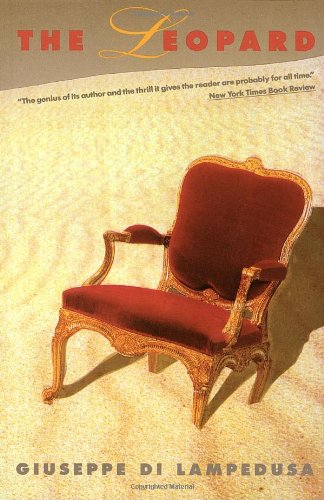
Inhaltsangabe
A classic of modern fiction. Set in the 1860s, THE LEOPARD is the spellbinding story of a decadent, dying Sicilian aristocracy threatened by the approaching forces of democracy and revolution.
Die Inhaltsangabe kann sich auf eine andere Ausgabe dieses Titels beziehen.
Über die Autorin bzw. den Autor
Giuseppe di Lampedeusa was born in Sicily in 1896 and died in 1957. The Leopard was his only novel.
Auszug. © Genehmigter Nachdruck. Alle Rechte vorbehalten.
May, 1860
Nunc et in hora mortis nostrae. Amen.
The daily recital of the Rosary was over. For half an hour the steady voice of the Prince had recalled the Glorious and the Sorrowful Mysteries; for half an hour other voices had interwoven a lilting hum from which, now and again, would chime some unlikely word: love, virginity, death; and during that hum the whole aspect of the rococo drawing room seemed to change; even the parrots spreading iridescent wings over the silken walls appeared abashed; even the Magdalen between the two windows looked a penitent and not just a handsome blonde lost in some dubious daydream, as she usually was.
Now, as the voices fell silent, everything dropped back into its usual order or disorder. Bendicò, the Great Dane, vexed at having been shut out, came barking through the door by which the servants had left. The women rose slowly to their feet, their oscillating skirts as they withdrew baring bit by bit the naked figures from mythology painted all over the milky depths of the tiles. Only an Andromeda remained covered by the soutane of Father Pirrone, still deep in extra prayer, and it was some time before she could sight the silvery Perseus swooping down to her aid and her kiss.
The divinities frescoed on the ceiling awoke. The troops of Tritons and Dryads, hurtling across from hill and sea amid clouds of cyclamen pink toward a transfigured Conca d’Oro,* and bent on glorifying the House of Salina, seemed suddenly so overwhelmed with exaltation as to discard the most elementary rules of perspective; meanwhile the major gods and goddesses, the Princes among gods, thunderous Jove and frowning Mars and languid Venus, had already preceded the mob of minor deities and were amiably supporting the blue armorial shield of the Leopard. They knew that for the next twenty-three and a half hours they would be lords of the villa once again. On the walls the monkeys went back to pulling faces at the cockatoos.
Beneath this Palermitan Olympus the mortals of the House of Salina were also dropping speedily from mystic spheres. The girls resettled the folds in their dresses, exchanged blue-eyed glances and snatches of schoolgirl slang; for over a month, ever since the “riots” of the Fourth of April, they had been home for safety’s sake from their convent, and regretting the canopied dormitories and collective coziness of the Holy Redeemer. The boys were already scuffling with each other for possession of a medal of San Francesco di Paola; the eldest, the heir, the young Duke Paolo, was longing to smoke and, afraid of doing so in his parents’ presence, was fondling the outside of his pocket in which lurked a braided-straw cigar case. His gaunt face was veiled in brooding melancholy it had been a bad day: Guiscard, his Irish sorrel, had seemed off form, and Fanny had apparently been unable (or unwilling) to send him her usual lilac-tinted billet-doux. Of what avail then, to him, was the Incarnation of his Savior?
Restless and domineering, the Princess dropped her rosary brusquely into her jet-fringed bag, while her fine crazy eyes glanced around at her slaves of children and her tyrant of a husband, over whom her diminutive body vainly yearned for loving dominion.
Meanwhile he himself, the Prince, had risen to his feet; the sudden movement of his huge frame made the floor tremble, and a glint of pride flashed in his light blue eyes at this fleeting confirmation of his lordship over both human beings and their works.
Now he was settling the huge scarlet missal on the chair which had been in front of him during his recitation of the Rosary, putting back the handkerchief on which he had been kneeling, and a touch of irritation clouded his brow as his eye fell on a tiny coffee stain which had had the presumption, since that morning, to fleck the vast white expanse of his waistcoat.
Not that he was fat; just very large and very strong; in houses inhabited by common mortals his head would touch the lowest rosette on the chandeliers; his fingers could twist a ducat coin as if it were mere paper; and there was constant coming and going between Villa Salina and a silversmith’s for the mending of forks and spoons which, in some fit of controlled rage at table, he had coiled into a hoop. But those fingers could also stroke and handle with the most exquisite delicacy, as his wife Maria Stella knew only too well; and up in his private observatory at the top of the house the gleaming screws, caps, and studs of the telescopes, lenses, and “comet-finders” would answer to his lightest touch.
The rays of the westering sun, still high on that May afternoon, lit up the Prince’s rosy skin and honey-colored hair; these betrayed the German origin of his mother, the Princess Carolina, whose haughtiness had frozen the easygoing Court of the Two Sicilies thirty years before. But in his blood also fermented other German strains particularly disturbing to a Sicilian aristocrat in the year 1860, however attractive his fair skin and hair amid all that olive and black: an authoritarian temperament, a certain rigidity in morals, and a propensity for abstract ideas; these, in the relaxing atmosphere of Palermo society, had changed respectively into capricious arrogance, recurring moral scruples, and contempt for his own relatives and friends, all of whom seemed to him mere driftwood in the languid meandering stream of Sicilian pragmatism.
In a family which for centuries had been incapable even of adding up their own expenditures and subtracting their own debts he was the first (and last) to have a genuine bent for mathematics; this he had applied to astronomy, and by his work gained a certain official recognition and a great deal of personal pleasure. In his mind, now, pride and mathematical analysis were so linked as to give him an illusion that the stars obeyed his calculations too (as, in fact, they seemed to be doing) and that the two small planets which he had discovered (“Salina” and “Speedy” he had called them, after his main estate and a shooting dog he had been particularly fond of) would spread the fame of his family through the empty spaces between Mars and Jupiter, thus transforming the frescoes in the villa from the adulatory to the prophetic.
Between the pride and intellectuality of his mother and the sensuality and irresponsibility of his father, poor Prince Fabrizio lived in perpetual discontent under his Jovelike frown, watching the ruin of his own class and his own inheritance without ever making, still less wanting to make, any move toward saving it.
That half hour between Rosary and dinner was one of the least irritating moments of his day, and for hours beforehand he would savor its rather uncertain calm.
With a wildly excited Bendicò bounding ahead of him he went down the short flight of steps into the garden. Enclosed between three walls and a side of the house, its seclusion gave it the air of a cemetery, accentuated by the parallel little mounds bounding the irrigation canals and looking like the graves of very tall, very thin giants. Plants were growing in thick disorder on the reddish clay; flowers sprouted in all directions, and the myrtle hedges seemed put there to prevent movement rather than guide it. At the end a statue of Flora speckled with yellow-black lichen exhibited her centuries-old charms with an air of resignation; on each side were benches holding quilted cushions, also of gray marble; and in a corner the gold of an acacia tree introduced a sudden note of gaiety. Every sod seemed to exude a yearning for beauty soon muted by languor.
But the garden, hemmed and almost squashed between these barriers, was exhaling scents that were cloying, fleshy, and slightly putrid, like the aromatic liquids distilled from the...
„Über diesen Titel“ kann sich auf eine andere Ausgabe dieses Titels beziehen.
Suchergebnisse für The Leopard

Foto des Verkäufers
The Leopard
Anbieter: Dream Books Co., Denver, CO, USA
Verkäuferbewertung 5 von 5 Sternen

Zustand: acceptable. This copy has clearly been enjoyedâ"expect noticeable shelf wear and some minor creases to the cover. Binding is strong, and all pages are legible. May contain previous library markings or stamps. Artikel-Nr. DBV.0679731210.A
Gebraucht kaufen
EUR 5,11
Versand gratis
Versand innerhalb von USA
Versand innerhalb von USA
Anzahl: 1 verfügbar
Beispielbild für diese ISBN
The Leopard
Verlag:
Pantheon (edition Later Printing (20th and over)), 1991
ISBN 10: 0679731210
ISBN 13: 9780679731214
Gebraucht
Paperback
Anbieter: BooksRun, Philadelphia, PA, USA
Verkäuferbewertung 5 von 5 Sternen
Paperback. Zustand: Very Good. Later Printing (20th and over). It's a well-cared-for item that has seen limited use. The item may show minor signs of wear. All the text is legible, with all pages included. It may have slight markings and/or highlighting. Artikel-Nr. 0679731210-11-1
Gebraucht kaufen
EUR 5,17
Versand gratis
Versand innerhalb von USA
Versand innerhalb von USA
Anzahl: 1 verfügbar
Foto des Verkäufers
The Leopard
Anbieter: Dream Books Co., Denver, CO, USA
Verkäuferbewertung 5 von 5 Sternen
Zustand: good. Gently used with minimal wear on the corners and cover. A few pages may contain light highlighting or writing, but the text remains fully legible. Dust jacket may be missing, and supplemental materials like CDs or codes may not be included. May be ex-library with library markings. Ships promptly! Artikel-Nr. DBV.0679731210.G
Gebraucht kaufen
EUR 6,78
Versand gratis
Versand innerhalb von USA
Versand innerhalb von USA
Anzahl: 1 verfügbar
Beispielbild für diese ISBN
The Leopard
Anbieter: World of Books (was SecondSale), Montgomery, IL, USA
Verkäuferbewertung 5 von 5 Sternen
Paperback. Zustand: Fair. NOW A NETFLIX SERIES - In this powerful novel, an aristocratic family grapples with societal upheaval and personal struggles against the backdrop of sweeping historical change. A majestic, melancholy, and beautiful novel.--The New Yorker - A masterwork . . . A superb novel.--Newsweek in 1860s Sicily, Don Fabrizio Corbera, Prince of Salina, remains skeptical and stoic as he faces civil war and his family's loss of wealth and status. The prince's favorite nephew, Tancredi, who opportunistically supports the unification efforts, marries Angelica, a beautiful woman from a lower social class, to secure his future. This marriage symbolizes the shifting social order and the decline of the aristocracy. As Don Fabrizio struggles to adapt, he retreats into his love of astronomy, finding solace in the unchanging stars while his world crumbles around him. Ultimately, he must decide to resist the forces of change or come to terms with them. Giuseppe Tomasi di Lampedusa, the last in a line of Sicilian princes, drew inspiration from his own family's decline to write this novel in the 1950s. The dramatic sweep and richness of Lampedusa's observation, his seamless intertwining of public and private worlds, and his sure grasp of human frailty imbue The Leopard with beauty and power. Artikel-Nr. 00109699559
Gebraucht kaufen
EUR 7,40
Versand gratis
Versand innerhalb von USA
Versand innerhalb von USA
Anzahl: 2 verfügbar
Beispielbild für diese ISBN
The Leopard
Anbieter: World of Books (was SecondSale), Montgomery, IL, USA
Verkäuferbewertung 5 von 5 Sternen
Paperback. Zustand: Good. NOW A NETFLIX SERIES - In this powerful novel, an aristocratic family grapples with societal upheaval and personal struggles against the backdrop of sweeping historical change. A majestic, melancholy, and beautiful novel.--The New Yorker - A masterwork . . . A superb novel.--Newsweek in 1860s Sicily, Don Fabrizio Corbera, Prince of Salina, remains skeptical and stoic as he faces civil war and his family's loss of wealth and status. The prince's favorite nephew, Tancredi, who opportunistically supports the unification efforts, marries Angelica, a beautiful woman from a lower social class, to secure his future. This marriage symbolizes the shifting social order and the decline of the aristocracy. As Don Fabrizio struggles to adapt, he retreats into his love of astronomy, finding solace in the unchanging stars while his world crumbles around him. Ultimately, he must decide to resist the forces of change or come to terms with them. Giuseppe Tomasi di Lampedusa, the last in a line of Sicilian princes, drew inspiration from his own family's decline to write this novel in the 1950s. The dramatic sweep and richness of Lampedusa's observation, his seamless intertwining of public and private worlds, and his sure grasp of human frailty imbue The Leopard with beauty and power. Artikel-Nr. 00110824980
Gebraucht kaufen
EUR 7,40
Versand gratis
Versand innerhalb von USA
Versand innerhalb von USA
Anzahl: 1 verfügbar
Beispielbild für diese ISBN
The Leopard
Verlag:
Knopf Doubleday Publishing Group, 1991
ISBN 10: 0679731210
ISBN 13: 9780679731214
Gebraucht
Softcover
Anbieter: Better World Books: West, Reno, NV, USA
Verkäuferbewertung 5 von 5 Sternen
Zustand: Very Good. Reissue. Pages intact with possible writing/highlighting. Binding strong with minor wear. Dust jackets/supplements may not be included. Stock photo provided. Product includes identifying sticker. Better World Books: Buy Books. Do Good. Artikel-Nr. 5257548-6
Gebraucht kaufen
EUR 9,27
Versand gratis
Versand innerhalb von USA
Versand innerhalb von USA
Anzahl: 1 verfügbar
Beispielbild für diese ISBN
The Leopard
Verlag:
Knopf Doubleday Publishing Group, 1991
ISBN 10: 0679731210
ISBN 13: 9780679731214
Gebraucht
Softcover
Anbieter: Better World Books, Mishawaka, IN, USA
Verkäuferbewertung 5 von 5 Sternen
Zustand: Very Good. Reissue. Pages intact with possible writing/highlighting. Binding strong with minor wear. Dust jackets/supplements may not be included. Stock photo provided. Product includes identifying sticker. Better World Books: Buy Books. Do Good. Artikel-Nr. 5257548-6
Gebraucht kaufen
EUR 9,27
Versand gratis
Versand innerhalb von USA
Versand innerhalb von USA
Anzahl: 1 verfügbar
Beispielbild für diese ISBN
The Leopard
Anbieter: Roundabout Books, Greenfield, MA, USA
Verkäuferbewertung 4 von 5 Sternen

paperback. Zustand: Very Good. Condition Notes: Clean, unmarked copy with some edge wear. Good binding. Dust jacket included if issued with one. We ship in recyclable American-made mailers. 100% money-back guarantee on all orders. Artikel-Nr. 1781039
Gebraucht kaufen
EUR 9,65
Versand gratis
Versand innerhalb von USA
Versand innerhalb von USA
Anzahl: 1 verfügbar
Foto des Verkäufers
The Leopard
Anbieter: True Oak Books, Highland, NY, USA
Verkäuferbewertung 5 von 5 Sternen
Paperback. Zustand: Good+. Reissue Edition; Eighth Printing. 5.12 X 0.68 X 7.96 inches; 320 pages; minor pen line in the margins of one page. Few minor, faint smudges and scratches on the exterior edges of textblock. Good condition otherwise. No other noteworthy defects. Covers in VG condition.; - Your satisfaction is our priority. We offer free returns and respond promptly to all inquiries. Your item will be packaged with care and ship on the same or next business day. Buy with confidence. Artikel-Nr. HVD-75953-A-0
Gebraucht kaufen
EUR 15,65
Versand gratis
Versand innerhalb von USA
Versand innerhalb von USA
Anzahl: 1 verfügbar
Beispielbild für diese ISBN
The Leopard
Anbieter: medimops, Berlin, Deutschland
Verkäuferbewertung 5 von 5 Sternen
Zustand: good. Befriedigend/Good: Durchschnittlich erhaltenes Buch bzw. Schutzumschlag mit Gebrauchsspuren, aber vollständigen Seiten. / Describes the average WORN book or dust jacket that has all the pages present. Artikel-Nr. M00679731210-G
Gebraucht kaufen
EUR 12,28
EUR 10,00 Versand
Versand von Deutschland nach USA
Versand von Deutschland nach USA
Anzahl: 1 verfügbar