
Verwandte Artikel zu Hitler and the Holocaust (Modern Library Chronicles)
Hitler and the Holocaust (Modern Library Chronicles) - Hardcover
Buch 8 von 33: Modern Library Chronicles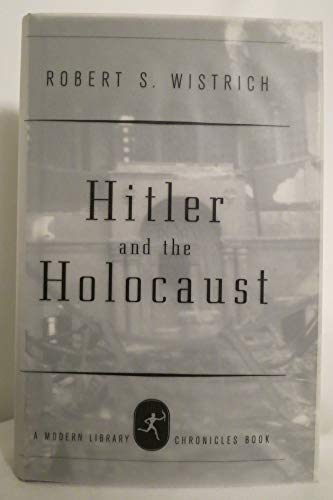
Inhaltsangabe
Hitler and the Holocaust is the product of a lifetime’s work by one of the world’s foremost authorities on the history of anti-Semitism and modern Jewry. Robert S. Wistrich begins by reckoning with Europe’s long history of violence against the Jews, and how that tradition manifested itself in Germany and Austria in the early twentieth century. He looks at the forces that shaped Hitler’s belief in a "Jewish menace" that must be eradicated, and the process by which, once Hitler gained power, the Nazi regime tightened the noose around Germany’s Jews. He deals with many crucial questions, such as when Hitler’s plans for mass genocide were finalized, the relationship between the Holocaust and the larger war, and the mechanism of authority by which power–and guilt–flowed out from the Nazi inner circle to "ordinary Germans," and other Europeans. He explains the infernal workings of the death machine, the nature of Jewish and other resistance, and the sad story of collaboration and indifference across Europe and America, and in the Church. Finally, Wistrich discusses the abiding legacy of the Nazi genocide, and the lessons that must be drawn from it. A work of commanding authority and insight, Hitler and the Holocaust is an indelible contribution to the literature of history.
Die Inhaltsangabe kann sich auf eine andere Ausgabe dieses Titels beziehen.
Über die Autorin bzw. den Autor
Robert S. Wistrich is professor of modern Jewish history at Jerusalem’s Hebrew University, visiting fellow at the Royal Institute of Advanced Studies in the Netherlands, and visiting professor of history at Brandeis and Harvard universities. A regular contributor to the Times Literary Supplement, he is the author of many books.
Von der hinteren Coverseite
and the Holocaust is the product of a lifetime’s work by one of the world’s foremost authorities on the history of anti-Semitism and modern Jewry. Robert S. Wistrich begins by reckoning with Europe’s long history of violence against the Jews, and how that tradition manifested itself in Germany and Austria in the early twentieth century. He looks at the forces that shaped Hitler’s belief in a "Jewish menace" that must be eradicated, and the process by which, once Hitler gained power, the Nazi regime tightened the noose around Germany’s Jews. He deals with many crucial questions, such as when Hitler’s plans for mass genocide were finalized, the relationship between the Holocaust and the larger war, and the mechanism of authority by which power–and guilt–flowed out from the Nazi inner circle to "ordinary Germans," and other Europeans. He explains the infernal workings of the death machine, the nature of Jewish and other resistanc
Aus dem Klappentext
and the Holocaust is the product of a lifetime s work by one of the world s foremost authorities on the history of anti-Semitism and modern Jewry. Robert S. Wistrich begins by reckoning with Europe s long history of violence against the Jews, and how that tradition manifested itself in Germany and Austria in the early twentieth century. He looks at the forces that shaped Hitler s belief in a "Jewish menace" that must be eradicated, and the process by which, once Hitler gained power, the Nazi regime tightened the noose around Germany s Jews. He deals with many crucial questions, such as when Hitler s plans for mass genocide were finalized, the relationship between the Holocaust and the larger war, and the mechanism of authority by which power and guilt flowed out from the Nazi inner circle to "ordinary Germans," and other Europeans. He explains the infernal workings of the death machine, the nature of Jewish and other resistanc
Auszug. © Genehmigter Nachdruck. Alle Rechte vorbehalten.
Excerpt
Anti-Semitism and the Jews
"After Satan Christians have no greater enemies than the Jews. . . . Theypray many times each day that God may destroy us through pestilence, famine andwar, aye, that all beings and creatures may rise up with them against theChristians."
?Abraham a Sancta Clara Viennese Catholic preacher (1683)
"I hold the Jewish race to be the born enemy of pure humanity andeverything noble in it. It is certain that it is running us Germans into theground, and I am perhaps the last German who knows how to hold himself uprightin the face of Judaism, which already rules everything."
?Richard Wagner (1881)
"Jewry is one of the great negative principles of world history and thuscan only be understood as a parasite within the opposing positive principle. Aslittle as Judas Iscariot with his thirty silver coins . . . can be understoodwithout the Lord whose community he sneeringly betrayed . . . that night side ofhistory called Jewry cannot be understood without being positioned in thetotality of the historical process where God and Satan, Creation and Destructionconfront each other in an eternal struggle."
?Walter Frank, “German Science in Its Struggle against World Jewry,” Germanradio broadcast, 11 and 13 January 1939
Throughout recorded time, there have been countless massacres, some on religiousgrounds, others for political or territorial reasons. Native peoples have beenexterminated in colonial wars. Millions of Africans were sold into slavery. Thecolonization of North America, Australia, Africa, and other parts of the globeby expanding Western societies involved constant displacement, despoliation, andsometimes even the genocide of indigenous populations in the name of empire,plunder, and “progress.” The Turkish massacre of more than a millionArmenians during the First World War marked a new scale of brutality. However,if the number of victims alone were to be our point of departure, then we shouldlook to those unfortunate Soviet citizens who were shot, starved, or worked todeath in the gulags of Stalinist Russia as “enemies of the people,”in the name of Marxist ideology. The victims of this “autogenocide,”which a totalitarian regime inflicted on its own subjects, may have numbered asmany as twenty million. (While staggeringly high, this was a much lowerpercentage of all Soviet citizens than the one third of all Jewish people in theworld who were killed by the Nazis.) No less horrifying were the events inMaoist China (the full story has yet to be told) and, on a smaller scale, inCommunist Cambodia during the 1970s. The slaughter in Rwanda and “ethniccleansing” in the former Yugoslavia in the 1990s demonstrate that thegenocidal chapter in human history is far from over.
Even during the Second World War, several genocides occurred, though ofdifferent magnitudes. Approximately three million Polish Gentiles fell victim tothe Nazis, as did a similar number of Russian POWs who were starved to death bythe Germans. Both groups were used as guinea pigs at Auschwitz-Birkenau beforethe gassing of Jews began. The German war in the east involved much more thanexterminating the Jews: it was initially conceived of as part of a larger designfor a radical racial restructuring in which Poles, Russians, and Ukrainianswould be expropriated, deported, or killed. Gypsies, too, were earmarked fordestruction; between 250,000 and half a million Gypsies were sent to theirdeaths between 1939 and 1945, coterminous with the Jewish Holocaust. Gypsies(Roma and Sinti) did not, of course, hold the same place either in Christianconsciousness or in the Nazi worldview as did Jews or Judaism, but prejudice andhostility toward their nomadic way of life was nonetheless widespread and insome ways comparable to the perception of Jews as alien to Christian Europe.
The Nazis were particularly hostile toward the Gypsies as an“antisocial” element and as “people of different blood”who fell under the Nuremberg race laws of 1935. (Heinrich Himmler’s decreeof December 1937 permitted their arrest on the extremely elastic grounds ofasocial behavior, even without the commission of any criminal act.) As early as1936, some groups of Gypsies were sent to the Dachau concentration camp. Furtherlegislation in 1938 to deal with the “Gypsy plague” aimed at astrict separation between “pure” (Sinti and Lalleri) and“mixed blood” Gypsies, as well as between Germans and Gypsies.According to the Nazi Office for Racial Hygiene and Population Biology, morethan 90 percent of the German Gypsies were defined as non-Aryan “mixedbloods,” the favored government policy toward which was sterilization.During the war, Nazi policy became even more radical, and in the fall of 1941,five thousand Austrian Gypsies were deported to the Lódz ghetto. Then, inearly 1942, some Gypsies were murdered along with Jews in the Chelmno deathcamp. Gypsies started arriving in Auschwitz-Birkenau on 26 February 1943; agreat many died from hunger, disease, and “medical experiments.” In1944, women and children were gassed. In the Baltic states and the Soviet Union,Gypsies were murdered by the Einsatzgruppen; in Yugoslavia, they were killed bythe Paveli´c regime; in Hungary, they were persecuted and rounded up byArrow Cross fascists. In France, they were interned and later sent to camps inGermany. Two thirds of the Polish Gypsies died under Nazi occupation.
The Nazis regarded “the fight against the Gypsy Menace” after 1935as “a matter of race” and insisted on the need to “separateonce and for all the Gypsy race (Zigeunertum) from the German nation(Volkstum),” to prevent the danger of miscegenation. In that respect,there was an ideological link between the murder of Jews and Gypsies in the Nazivision of radical ethnic cleansing or “purification” of theVolksgemeinschaft (people’s community). Indeed, the settlement of the“Gypsy question” was conceived from the outset in the framework of“knowledge stemming from ethnological research” under thejurisdiction of Heinrich Himmler as Reichsführer SS and chief of the Germanpolice. The fate of the Gypsies, as Himmler made clear in September 1942, wasnot a matter for the law or the courts, any more than was that of the Jews.Hence, they were totally at the mercy of the police and the SS and were liableto be thrown at any time into concentration camps. The accusations against themof hereditary racial inferiority, economic parasitism, or sexual“immorality,” all of which were seen as threatening to the generalGerman population, overlapped with the demagoguery of anti-Semitism. TheGypsies, however, were deemed a “social menace,” not a total anduniversal enemy like the Jews, engaged in a universal conspiracy against Germanyand the “Aryan” world. The “Gypsy question” had, forexample, only marginal importance in the Nazi political agenda, and Hitlerhimself referred publicly to Gypsies on only two occasions, in stark contrast tohis relentless obsession with the Jews. Moreover, those Gypsies who wereconsidered “racially pure” were never regarded as a danger to theGerman people and were even thought of as having noble blood. Thus, the horriblecrime against the Gypsies as a social group did not aim in principle at theirtotal annihilation.
The Jewish Holocaust was unprecedented—as compared to othergenocides—because it was the planned, deliberate policy decision of apowerful state that mobilized its resources to destroy the entire Jewish people.In this diabolical aim, the Germans were almost successful in Europe, and onlytheir military defeat prevented its gruesome completion. By 1945, two thirds ofEuropean Jewry...
„Über diesen Titel“ kann sich auf eine andere Ausgabe dieses Titels beziehen.
Suchergebnisse für Hitler and the Holocaust (Modern Library Chronicles)

Beispielbild für diese ISBN
Hitler and the Holocaust (Modern Library Chronicles)
Anbieter: Roundabout Books, Greenfield, MA, USA
Verkäuferbewertung 4 von 5 Sternen

Hardcover. Zustand: Very Good. Number of Volumes: 2 Clean, unmarked copy with some edge wear. Good binding. Dust jacket included if issued with one. We ship in recyclable American-made mailers. 100% money-back guarantee on all orders. Artikel-Nr. 1516882
Gebraucht kaufen
EUR 14,49
Versand gratis
Versand innerhalb von USA
Versand innerhalb von USA
Anzahl: 1 verfügbar
Beispielbild für diese ISBN
Hitler and the Holocaust (Modern Library Chronicles)
Anbieter: Robinson Street Books, IOBA, Binghamton, NY, USA
Verkäuferbewertung 4 von 5 Sternen
Hardcover. Prompt Shipment, shipped in Boxes, Tracking PROVIDEDEuropean History; Good ex library hardcover with dust jacket, pockets labels and stamps, stamp on front title page, dust jackets glued to boards, some creases and ware to dust jackets, clean pages, prompt shipping with tracking. Used: Good copy, some stains, ex. Artikel-Nr. Ware852NP004
Gebraucht kaufen
EUR 12,42
EUR 8,48 Versand
Versand innerhalb von USA
Versand innerhalb von USA
Anzahl: 1 verfügbar
Beispielbild für diese ISBN
Hitler and the Holocaust (Modern Library Chronicles)
Anbieter: Wonder Book, Frederick, MD, USA
Verkäuferbewertung 5 von 5 Sternen

Zustand: As New. Like New condition. Very Good dust jacket. A near perfect copy that may have very minor cosmetic defects. Artikel-Nr. Q16Q-00362
Gebraucht kaufen
EUR 119,52
Versand gratis
Versand innerhalb von USA
Versand innerhalb von USA
Anzahl: 1 verfügbar