
Verwandte Artikel zu Mark Twain's Library of Humor (Modern Library Humor...
Inhaltsangabe
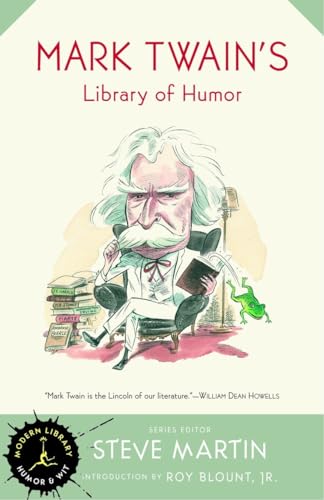
Beginning with the piece that made Mark Twain famous--"The Notorious Jumping Frog of Calaveras County"--and ending with his fanciful "How I Edited an Agricultural Paper," this treasure trove of an anthology, an abridgment of the 1888 original, collects twenty of Twain's own pieces, in addition to tall tales, fables, and satires by forty-three of Twain's contemporaries, including Washington Irving, Harriet Beecher Stowe, Ambrose Bierce, William Dean Howells, Joel Chandler Harris, Artemus Ward, and Bret Harte.
Die Inhaltsangabe kann sich auf eine andere Ausgabe dieses Titels beziehen.
Über die Autorin bzw. den Autor
Mark Twain (1835-1910) was born Samuel Clemens in Missouri. As a boy, he worked as a printer and a Mississippi River pilot. A leading literary influence in his own time and ever since, he is the author of many classics, including Roughing It, The Adventures of Tom Sawyer, Life on the Mississippi, The Adventures of Huckleberry Finn, and A Connecticut Yankee in King Arthur's Court.
Von der hinteren Coverseite
Beginning with the piece that made Mark Twain famous--"The Notorious Jumping Frog of Calaveras County"--and ending with his fanciful "How I Edited an Agricultural Paper," this treasure trove of an anthology, an abridgment of the 1888 original, collects twenty of Twain's own pieces, in addition to tall tales, fables, and satires by forty-three of Twain's contemporaries, including Washington Irving, Harriet Beecher Stowe, Ambrose Bierce, William Dean Howells, Joel Chandler Harris, Artemus Ward, and Bret Harte.
Aus dem Klappentext
th the piece that made Mark Twain famous--"The Notorious Jumping Frog of Calaveras County"--and ending with his fanciful "How I Edited an Agricultural Paper," this treasure trove of an anthology, an abridgment of the 1888 original, collects twenty of Twain's own pieces, in addition to tall tales, fables, and satires by forty-three of Twain's contemporaries, including Washington Irving, Harriet Beecher Stowe, Ambrose Bierce, William Dean Howells, Joel Chandler Harris, Artemus Ward, and Bret Harte.
Auszug. © Genehmigter Nachdruck. Alle Rechte vorbehalten.
THE WORST MAN AND THE STUPIDEST MAN IN TURKEY--SAMUEL S. COX
Samuel Sullivan Cox was born at Zanesville, O., September 30, 1824, and grew up in his native State. He entered journalistic life after graduating from Brown University, and has achieved distinction in politics as well as literature; his public services, in Congress and diplomacy, are as well-known as his books.
Several years ago the dragoman of our American Legation at Constantinople was asked to act as arbitrator in a dispute between a foreigner and an old Turkish doctor in law and theology. After several meetings with them, the dragoman concluded that the doctor was an ill-natured and unmanageable person. The latter had served for some years as cadi of the Civil Court at Smyrna. The dragoman related a story for his instruction. The story as to its place was in old Stamboul. As to its time, it does not matter much. Its moral is for every place and for all time. But it took place at the end of the sixteenth century, when the Turkish power was well established and growing. In other words, it was during the reign of Amurath III., the sixth emperor of the Ottomans, and grandson of Suleiman the Magnificent. This Sultan was not, as the sequel of the story shows, the worst of the Ottoman emperors. He was a tall, manly man, rather fat and quite pale, with a thin long beard. His face was not of a fierce aspect, like other Sultans. He was no rioter or reveler. He punished drunkards, and as for himself he indulged only in wormwood wine. His people knew that he loved justice, and although, according to an old chronicle, he caused his brothers to be strangled, "at which so tragicall a sight that he let some teares fall, as not delighting in such barbarous crueltie, but that the state and manner of his gouernment so required," still, he was, as the time was, a good prince.
But to the dragoman's story. Its moral had its uses, as the sequel reveals. This is the story, as it was told in one of the leisure hours at the Legation last summer:
"There was a man, Mustapha by name, who lived near the Golden Gate. He was well off, and when about to die, he called his son to him and said:
"'My dear boy, I am dying. Before I go, I want to give you my last will. Here are one hundred pounds. You will give it to the worst man you can find. Here are one hundred pounds more. This you will give to the stupidest man you can discover."
"A few days after, the father died. The son began to search for the bad man. Several men were pointed out, but he was not satisfied that they were the worst of men. Finally he hired a horse and went up to Yosgat, in Asia Minor. There the population unanimously pointed out their cadi as the worst man to be found anywhere. This information satisfied the son. He called on the cadi. He told the story of the will, and added:
" 'As I am desirous that the will of my father be accomplished, I beg you to receive these hundred pounds.'
"Said the cadi, 'How do you know that I am so bad as I am represented?'
" 'It is the testimony of the whole town,' said the son.
" 'I must tell you, young man, said the cadi, 'that it is contrary to my principles to accept any bribe or present. If I ever receive money, it is only for a con-sid-er-a-tion. Unless I give you the counter-value of your money, I cannot accept it!
"This reply of the cadi seemed just. It puzzled the young man. However, as he desired to fulfill his father's will, he continued to urge the cadi:
"'Mr. Judge,' said he, 'if you sell me something, could not the will of my father be fulfilled?'
"'Let me see,' said the cadi, looking around to find out what on earth he could sell to the youth, without destroying the spirit of the will. He reflected for a long time. Then all at once he was struck with a bright idea. Seeing that the courtyard of his house was filled with snow, about two feet deep, he said to the youth:
"'I will sell you yonder snow. Do you accept the bargain?'
"'Yes,' said the youth, seeing that there was nothing of value in the snow.
"The cadi then executed a regular deed, the fees of which were paid, of course, by the purchaser. The son then paid the hundred pounds for the snow.
"The boy went home; but he was not quite certain that he had strictly fulfilled the will of his father; for, after all, the cadi did not appear to him to be so very bad. Had he not decidedly refused to accept the money without a legal consideration?
"His perplexity was of short duration.
"The second day, early in the morning, the scribe of the cadi called on the youth and told him that the cadi wished to see him.
"'Well, I will go,' said the youth.
"'No,' said the scribe; 'I am ordered to take you there.'
"The youth resisted, and the scribe insisted. Finally the youth was compelled to submit, and went.
"'What do you want of me, Cadi Effendi,' said the boy.
"'Ah! you are welcome,' responded the cadi; 'I wanted you to come, because you have some snow in the courtyard which bothers me a great deal. The authorities cannot shoulder such a responsibility. Is not the deposit exposed? Can it be put under lock like other property? Besides, does it not occupy the road, to which the people have the right of easement? What follows? The result is, that your snow will be trampled or stolen, or it will melt, and then all the responsibility will rest on me. I am not prepared to assume it. I request you to carry away your snow.'
"'But, Cadi Effendi,' said the boy, 'I do not care. Let it melt; let it be stolen; let it be trampled on; I will make no claim for its value.'
"'Nothing of the kind,' said the cadi. 'You have no right to close the public way in that manner. Unless you take away your snow, I will confine you in prison, and make you answer for the nuisance, and for the decay of the property, which may be claimed by your heirs at some future time.'
"'Let it be swept out,' said the youth; 'I will defray the expense.'
"'Nonsense!' indignantly responded the cadi. 'Am I your servant? Besides, will it not take a great deal of money to have the snow swept out?'
"'I will pay the expense, whatever it is,' said the youth.
"'Well, it requires twenty pounds,' said the cadi.
"'I will pay that sum,' said the youth.
"Thus the cadi squeezed out twenty pounds more from the son of the deceased.
"The youth is, however, content. He is glad to find in this cadi a man of the meanness so indispensable to the fulfillment of the will of his father.
"After this experience the youth goes in search of the stupid man. He must filially fulfill the second clause of the will.
"While engaged in this search for stupidity, the son limits his efforts to his own fair city of Stamboul. He is on the street leading up to the Sublime Porte. He hears a band of music. It is moving toward the Sublime Porte. He is curious to know what it all means. He walks toward the music. When at a short distance he discovers a grand procession, with a display of soldiers. He notices a comparatively old man riding a white Arabian horse. He is dressed in a magnificent uniform. His breast is covered with decorations of every size, color and description. The trappings of the horse are covered with gold embroideries. The old man is surrounded by a dozen high officials of the government of Amurath III. They, too, are dressed finely; they have recently returned from the Caucasus laden with riches, and they display their grand robes and jewels. They have gorgeously embroidered uniforms and ride splendid horses. They are followed by an immense crowd. All Galata, as well as...
„Über diesen Titel“ kann sich auf eine andere Ausgabe dieses Titels beziehen.
Suchergebnisse für Mark Twain's Library of Humor (Modern Library Humor...

Beispielbild für diese ISBN
Mark Twain's Library of Humor (Modern Library Humor and Wit)
Anbieter: World of Books (was SecondSale), Montgomery, IL, USA
Verkäuferbewertung 5 von 5 Sternen

Zustand: Good. Item in good condition. Textbooks may not include supplemental items i.e. CDs, access codes etc. Artikel-Nr. 00091442068
Gebraucht kaufen
EUR 5,18
Versand gratis
Versand innerhalb von USA
Versand innerhalb von USA
Anzahl: 2 verfügbar
Beispielbild für diese ISBN
Mark Twain's Library of Humor (Modern Library Humor and Wit)
Anbieter: World of Books (was SecondSale), Montgomery, IL, USA
Verkäuferbewertung 5 von 5 Sternen
Zustand: Acceptable. Item in acceptable condition! Textbooks may not include supplemental items i.e. CDs, access codes etc. Artikel-Nr. 00089945124
Gebraucht kaufen
EUR 5,18
Versand gratis
Versand innerhalb von USA
Versand innerhalb von USA
Anzahl: 2 verfügbar
Beispielbild für diese ISBN
Mark Twain's Library of Humor (Modern Library Humor and Wit)
Verlag:
Modern Library (edition Later Printing), 2000
ISBN 10: 0679640363
ISBN 13: 9780679640363
Gebraucht
Paperback
Anbieter: BooksRun, Philadelphia, PA, USA
Verkäuferbewertung 5 von 5 Sternen
Paperback. Zustand: Very Good. Later Printing. It's a well-cared-for item that has seen limited use. The item may show minor signs of wear. All the text is legible, with all pages included. It may have slight markings and/or highlighting. Artikel-Nr. 0679640363-11-1
Gebraucht kaufen
EUR 5,19
Versand gratis
Versand innerhalb von USA
Versand innerhalb von USA
Anzahl: 1 verfügbar
Beispielbild für diese ISBN
Mark Twain's Library of Humor
Verlag:
Penguin Random House LLC (No Starch), 2000
ISBN 10: 0679640363
ISBN 13: 9780679640363
Gebraucht
Paperback
Anbieter: ThriftBooks-Dallas, Dallas, TX, USA
Verkäuferbewertung 5 von 5 Sternen
Paperback. Zustand: Good. No Jacket. Pages can have notes/highlighting. Spine may show signs of wear. ~ ThriftBooks: Read More, Spend Less. Artikel-Nr. G0679640363I3N00
Gebraucht kaufen
EUR 5,96
Versand gratis
Versand innerhalb von USA
Versand innerhalb von USA
Anzahl: 1 verfügbar
Beispielbild für diese ISBN
Mark Twain's Library of Humor
Verlag:
Penguin Random House LLC (No Starch), 2000
ISBN 10: 0679640363
ISBN 13: 9780679640363
Gebraucht
Paperback
Anbieter: ThriftBooks-Dallas, Dallas, TX, USA
Verkäuferbewertung 5 von 5 Sternen
Paperback. Zustand: Very Good. No Jacket. May have limited writing in cover pages. Pages are unmarked. ~ ThriftBooks: Read More, Spend Less. Artikel-Nr. G0679640363I4N00
Gebraucht kaufen
EUR 5,96
Versand gratis
Versand innerhalb von USA
Versand innerhalb von USA
Anzahl: 1 verfügbar
Beispielbild für diese ISBN
Mark Twain's Library of Humor (Modern Library Humor and Wit)
Anbieter: Wonder Book, Frederick, MD, USA
Verkäuferbewertung 5 von 5 Sternen
Zustand: Good. Good condition. A copy that has been read but remains intact. May contain markings such as bookplates, stamps, limited notes and highlighting, or a few light stains. Artikel-Nr. M10E-01801
Gebraucht kaufen
EUR 6,43
Versand gratis
Versand innerhalb von USA
Versand innerhalb von USA
Anzahl: 1 verfügbar
Beispielbild für diese ISBN
Mark Twain's Library of Humor
Verlag:
Random House Publishing Group, 2000
ISBN 10: 0679640363
ISBN 13: 9780679640363
Gebraucht
Softcover
Anbieter: Better World Books, Mishawaka, IN, USA
Verkäuferbewertung 5 von 5 Sternen
Zustand: Very Good. Modern Lib. Pages intact with possible writing/highlighting. Binding strong with minor wear. Dust jackets/supplements may not be included. Stock photo provided. Product includes identifying sticker. Better World Books: Buy Books. Do Good. Artikel-Nr. 5087973-6
Gebraucht kaufen
EUR 10,38
Versand gratis
Versand innerhalb von USA
Versand innerhalb von USA
Anzahl: 1 verfügbar
Beispielbild für diese ISBN
Mark Twain's Library of Humor
Verlag:
Random House Publishing Group, 2000
ISBN 10: 0679640363
ISBN 13: 9780679640363
Gebraucht
Softcover
Anbieter: Better World Books: West, Reno, NV, USA
Verkäuferbewertung 5 von 5 Sternen
Zustand: Good. Modern Lib. Pages intact with minimal writing/highlighting. The binding may be loose and creased. Dust jackets/supplements are not included. Stock photo provided. Product includes identifying sticker. Better World Books: Buy Books. Do Good. Artikel-Nr. 733768-6
Gebraucht kaufen
EUR 10,38
Versand gratis
Versand innerhalb von USA
Versand innerhalb von USA
Anzahl: 1 verfügbar
Beispielbild für diese ISBN
Mark Twain's Library of Humor (Modern Library Humor and Wit)
Anbieter: Eagle Eye Books, Decatur, GA, USA
Verkäuferbewertung 4 von 5 Sternen

Paper Back. Zustand: New. Artikel-Nr. 894764
Neu kaufen
EUR 24,83
EUR 3,56 Versand
Versand innerhalb von USA
Versand innerhalb von USA
Anzahl: 1 verfügbar
Beispielbild für diese ISBN
Mark Twain's Library of Humor (Modern Library Humor and Wit)
Anbieter: Revaluation Books, Exeter, Vereinigtes Königreich
Verkäuferbewertung 5 von 5 Sternen
Paperback. Zustand: Brand New. 560 pages. 8.00x5.50x1.50 inches. In Stock. Artikel-Nr. x-0679640363
Neu kaufen
EUR 29,07
EUR 14,77 Versand
Versand von Vereinigtes Königreich nach USA
Versand von Vereinigtes Königreich nach USA
Anzahl: 2 verfügbar