
Verwandte Artikel zu The Nature of Economies (Modern Library)
Inhaltsangabe
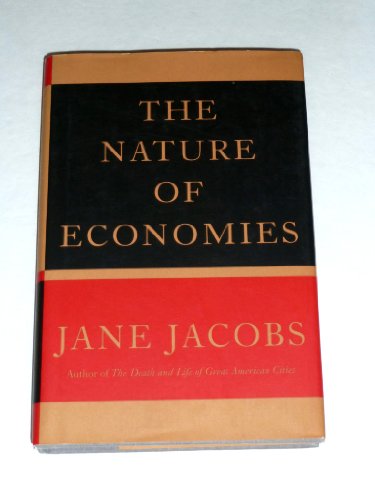
Looks at the connections between economics and nature and examines whether economic systems are shaped by the same forces at work in nature
Die Inhaltsangabe kann sich auf eine andere Ausgabe dieses Titels beziehen.
Über die Autorin bzw. den Autor
Jane Jacobs's previous books include The Death and Life of Great American Cities (1961), The Economy of Cities (1968), The Question of Separatism (1980), Cities and the Wealth of Nations (1984), and Systems of Survival (1993). Since 1968 she has lived in Toronto, where she has taken an active role in helping to shape the city.
Aus dem Klappentext
years after The Death and Life of Great American Cities forever changed the field of urban studies, Jane Jacobs--one of the few contemporary thinkers whose works will remain in print for generations--brings us a modern classic on economies and ecology. Original and eloquent, this new book looks at the connection between the economy and nature, arguing that the principles of development, common to both systems, are the proper subject of economic study.
The Nature of Economies is written in the form of a Platonic dialogue, a conversation over coffee among five contemporary New Yorkers. The question they discuss is: Does economic life obey the same rules as those governing the systems in nature? For example, can the way fields and forests maximize their intakes and uses of sunlight teach us something about how economies expand wealth and jobs and can do this in environmentally beneficial ways? The underlying question
Auszug. © Genehmigter Nachdruck. Alle Rechte vorbehalten.
From Chapter One: Damn, Another Ecologist
"Hortense and Ben have broken up," said Armbruster, waving a fax at Kate as she slid into the booth, balancing her cup of coffee.
"I'm sorry but not surprised," said Kate. "Remember how Ben used to gloat over industrial disasters? He thought everything industrial or technological was unnatural and that everything unnatural was bad."
"He meant well," Armbruster said. "We need Jeremiahs, but it must have been depressing for Hortense to live with one. It seems the breakup happened some time ago and she's gotten over it. She's interested in a new man. Mind if I finish this fax? I only got it as I was leaving the house."
In late morning they were sitting in an almost-empty coffee shop on lower Fifth Avenue, not far from Armbruster's Gramercy Square apartment. It was an unappealing restaurant in a stretch of New York rapidly going upscale. Armbruster liked it as his morning hangout because its well-deserved unpopularity guaranteed seats for acquaintances dropping by. He lived alone, and since his retirement from a small book publishing company, he missed his work and its daily give-and-take with colleagues.
"Damn, Hortense has found another ecologist," Armbruster grumbled as he continued reading the fax.
"That's not surprising, either," said Kate. "She's an environmental lawyer, so those are the people she talks to, consorts with. Those and other lawyers."
"But listen to this: His name is Hiram Murray IV. The Fourth! What an affectation."
"He's not to blame if his family ran out of names."
"You drop off the numbers when they die. I dropped off my Junior when my father died. Only kings and popes hang on to numbers."
"Maybe the other three are still alive--you don't know."
"Let's see," Armbruster mused aloud. "Number two would be his grandfather, and number one--" His eyes widened, exaggerating his customary owlish expression. "Good heavens, Hortense is fifty. You don't suppose--"
"No, I don't think Hortense is running around with a kid. Read on."
"Well, well, she's planning to come back from California," Armbruster read on. "He has a house in Hoboken. What's an ecologist doing in Hoboken? She says I'll like him and she's bringing him over a week from Thursday unless she hears otherwise, and so on."
"May I come too?" Kate asked. "It'll be wonderful to see Hortense again. And remember, Armbruster, I'm a fringe ecologist myself."
When Kate was denied tenure a few years previously in the biology department of the Long Island university where she taught and did neurobiological research, she found a job on a prospering science newsweekly, partly on the strength of her editing experience on Systems of Survival, a dialogue she and Armbruster had put together from conversations and reports by a little group Armbruster had got up to explore the different moral systems appropriate to different kinds of workers--such as police, legislators, clergy, and others holding positions of public trust, on the one hand, and manufacturers, bankers, merchants, and others in commercial pursuits, on the other. Hortense, who was Armbruster's niece, had been one of the group. During her first several months in her unfamiliar work on the weekly, Kate had frequently asked Armbruster for help and advice with her editing. After she no longer needed his guidance, she continued to drop in on him from time to time out of friendship.
A week from the following Thursday, at Armbruster's small apartment--crowded with books and signed photographs of authors on walls and tabletops--Hortense and Kate greeted each other affectionately and Hortense introduced Hiram. At tedious faculty meetings, Kate had learned to pass the time by imagining childhood versions of her colleagues' faces. Now, in Hiram, she saw a well-brought-up, thin-faced, eager boy grown into a good tweed suit and a receding hairline, his eagerness still intact.
As Hortense sat down on the sofa, Hiram remained standing, distractedly patting his jacket pockets. Kate glanced around the room in puzzlement. "Did you lose something, or mislay it?" she asked him.
"No, why--oh." He dropped his hands and smiled sheepishly. "I quit smoking five weeks and four days ago, and I still keep hunting for a cigarette." Hortense, Armbruster, and Kate, reformed smokers all, smiled sympathetically and Hortense patted his hand as he sat down beside her.
Knowing that Armbruster would be itching to deal with Hiram's dynastic pretensions, as soon as they were settled with drinks Kate remarked offhandedly to Hiram, "That Four after your name is unusual. Not unheard-of, of course, but unusual."
Hiram made room between a book and a photograph on an end table and set down his drink. "My father's a splendid old man, but he insists on being Three, so I have to be Four. He's an economist and he would've liked me to be an economist, too, but after a try I dropped it for environmental studies. Most people I knew--this was thirty years ago--thought that it was like majoring in canoeing or bird-watching, but Pop took what I was doing seriously. I just mention this to show how minor his crotchet about the numbers is. 'Live and let live' runs both ways. But I did draw a line. My own son is named Joel."
"What do you do as an ecologist?" asked Armbruster. "Rally people around to save the woods and punish polluters?" Hortense and Kate exchanged glances, as if to
acknowledge Armbruster's implicit, not very kindly, reference to Ben.
"No, although saving forests and reducing pollution are important. I'm a fund-raiser and facilitator. Specifically, I give organizational advice and help find grants for people-- scientists--most of whom are trying to develop products and production methods learned from nature. Biomimicry, that approach is called. There's a book about it by that name. I'll get you a copy if you're interested. Two copies," he added, turning to Kate.
"Oh, I have it. I reviewed it," said Kate. "It's a good book, Armbruster. Broadly speaking, the aims are to make better materials than we manufacture now, but to make them at life-friendly temperatures and without toxic ingredients, like the filaments spiders make or the shell material abalones construct, for instance. Ideally, by imitating the chemistry of nature, we should be able to make materials and products by methods that are benign and, at the end of their lives as products, return them to earth or sea to degrade benignly."
"So many other possibilities are being explored," said Hortense. "Think of the energy, soil, artificial fertilizer, and chemicals such as weed killers that could be saved if grain fields didn't require annual plowing or planting--if wheat or rye could grow like perennial grasses in prairies. All green plants capture sunlight, but it's a puzzle and wonder how duckweed captures sunlight so effectively and uses it so efficiently. That's worth learning from. You get the idea, Armbruster?"
"Interesting," Armbruster replied, "but it sounds like just another way for us to exploit nature--trying to get out of technological messes with more technological messes."
Kate suppressed a snicker at Armbruster's mischievous adoption of Ben's persona and glanced at Hortense to catch her reaction. Hortense, who usually remained cool and elegant under provocation, uncharacteristically bristled. "No! This isn't exploiting nature! It's learning from nature, with the object of undoing damage and getting along with nature more harmoniously. Biomimics are the last people deserving thoughtless dismissal, Armbruster. You have no idea how...
„Über diesen Titel“ kann sich auf eine andere Ausgabe dieses Titels beziehen.
Suchergebnisse für The Nature of Economies (Modern Library)

Beispielbild für diese ISBN
The Nature of Economies (Modern Library)
Verlag:
Modern Library (edition First Edition), 2000
ISBN 10: 0679603409
ISBN 13: 9780679603405
Gebraucht
Hardcover
Erstausgabe
Anbieter: BooksRun, Philadelphia, PA, USA
Verkäuferbewertung 5 von 5 Sternen

Hardcover. Zustand: Very Good. First Edition. With dust jacket. It's a well-cared-for item that has seen limited use. The item may show minor signs of wear. All the text is legible, with all pages included. It may have slight markings and/or highlighting. Artikel-Nr. 0679603409-8-22-29
Gebraucht kaufen
EUR 4,71
Versand gratis
Versand innerhalb von USA
Versand innerhalb von USA
Anzahl: 1 verfügbar
Beispielbild für diese ISBN
The Nature of Economies (Modern Library)
Anbieter: World of Books (was SecondSale), Montgomery, IL, USA
Verkäuferbewertung 5 von 5 Sternen
Zustand: Good. Item in good condition. Textbooks may not include supplemental items i.e. CDs, access codes etc. Artikel-Nr. 00110021960
Gebraucht kaufen
EUR 5,39
Versand gratis
Versand innerhalb von USA
Versand innerhalb von USA
Anzahl: 2 verfügbar
Beispielbild für diese ISBN
The Nature of Economies (Modern Library)
Anbieter: ThriftBooks-Dallas, Dallas, TX, USA
Verkäuferbewertung 5 von 5 Sternen
Hardcover. Zustand: Good. No Jacket. Former library book; Pages can have notes/highlighting. Spine may show signs of wear. ~ ThriftBooks: Read More, Spend Less. Artikel-Nr. G0679603409I3N10
Gebraucht kaufen
EUR 5,84
Versand gratis
Versand innerhalb von USA
Versand innerhalb von USA
Anzahl: 1 verfügbar
Beispielbild für diese ISBN
The Nature of Economies (Modern Library)
Anbieter: ThriftBooks-Dallas, Dallas, TX, USA
Verkäuferbewertung 5 von 5 Sternen
Hardcover. Zustand: Fair. No Jacket. Readable copy. Pages may have considerable notes/highlighting. ~ ThriftBooks: Read More, Spend Less. Artikel-Nr. G0679603409I5N00
Gebraucht kaufen
EUR 5,84
Versand gratis
Versand innerhalb von USA
Versand innerhalb von USA
Anzahl: 1 verfügbar
Beispielbild für diese ISBN
The Nature of Economies (Modern Library)
Anbieter: ThriftBooks-Atlanta, AUSTELL, GA, USA
Verkäuferbewertung 5 von 5 Sternen
Hardcover. Zustand: Very Good. No Jacket. Missing dust jacket; May have limited writing in cover pages. Pages are unmarked. ~ ThriftBooks: Read More, Spend Less. Artikel-Nr. G0679603409I4N01
Gebraucht kaufen
EUR 5,84
Versand gratis
Versand innerhalb von USA
Versand innerhalb von USA
Anzahl: 1 verfügbar
Beispielbild für diese ISBN
The Nature of Economies (Modern Library)
Anbieter: ThriftBooks-Dallas, Dallas, TX, USA
Verkäuferbewertung 5 von 5 Sternen
Hardcover. Zustand: Very Good. No Jacket. May have limited writing in cover pages. Pages are unmarked. ~ ThriftBooks: Read More, Spend Less. Artikel-Nr. G0679603409I4N00
Gebraucht kaufen
EUR 5,84
Versand gratis
Versand innerhalb von USA
Versand innerhalb von USA
Anzahl: 1 verfügbar
Beispielbild für diese ISBN
The Nature of Economies (Modern Library)
Anbieter: ThriftBooks-Atlanta, AUSTELL, GA, USA
Verkäuferbewertung 5 von 5 Sternen
Hardcover. Zustand: Good. No Jacket. Pages can have notes/highlighting. Spine may show signs of wear. ~ ThriftBooks: Read More, Spend Less. Artikel-Nr. G0679603409I3N00
Gebraucht kaufen
EUR 5,84
Versand gratis
Versand innerhalb von USA
Versand innerhalb von USA
Anzahl: 1 verfügbar
Beispielbild für diese ISBN
The Nature of Economies (Modern Library)
Anbieter: ThriftBooks-Phoenix, Phoenix, AZ, USA
Verkäuferbewertung 5 von 5 Sternen
Hardcover. Zustand: Good. No Jacket. Former library book; Pages can have notes/highlighting. Spine may show signs of wear. ~ ThriftBooks: Read More, Spend Less. Artikel-Nr. G0679603409I3N10
Gebraucht kaufen
EUR 6,00
Versand gratis
Versand innerhalb von USA
Versand innerhalb von USA
Anzahl: 1 verfügbar
Beispielbild für diese ISBN
The Nature of Economies (Modern Library)
Anbieter: ThriftBooks-Reno, Reno, NV, USA
Verkäuferbewertung 5 von 5 Sternen
Hardcover. Zustand: Good. No Jacket. Former library book; Pages can have notes/highlighting. Spine may show signs of wear. ~ ThriftBooks: Read More, Spend Less. Artikel-Nr. G0679603409I3N10
Gebraucht kaufen
EUR 6,00
Versand gratis
Versand innerhalb von USA
Versand innerhalb von USA
Anzahl: 1 verfügbar
Beispielbild für diese ISBN
The Nature of Economies (Modern Library)
Anbieter: ThriftBooks-Phoenix, Phoenix, AZ, USA
Verkäuferbewertung 5 von 5 Sternen
Hardcover. Zustand: Very Good. No Jacket. Former library book; May have limited writing in cover pages. Pages are unmarked. ~ ThriftBooks: Read More, Spend Less. Artikel-Nr. G0679603409I4N10
Gebraucht kaufen
EUR 6,00
Versand gratis
Versand innerhalb von USA
Versand innerhalb von USA
Anzahl: 1 verfügbar