
Verwandte Artikel zu The Basic Writings of Sigmund Freud: Psychopathology...
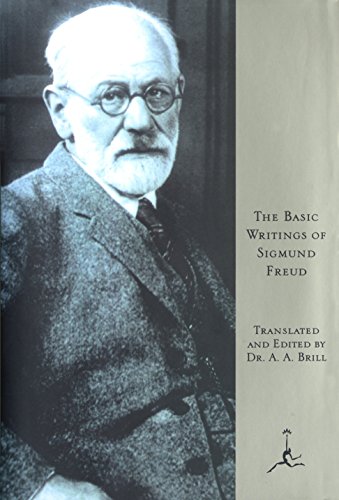
The Basic Writings of Sigmund Freud: Psychopathology of Everyday Life/the Interpretation of Dreams/Three Contributions to the Theory of Sex/Wit and (Modern Library) - Hardcover
Inhaltsangabe
This classic edition of The Basic Writings of Sigmund Freud includes complete texts of six works that have profoundly influenced our understanding of human behavior, presented here in the translation by Dr. A. A. Brill, who for almost forty years was the standard-bearer of Freudian theories in America.
• Psychopathology of Everyday Life is perhaps the most accessible of Freud’s books. An intriguing introduction to psychoanalysis, it shows how subconscious motives underlie even the most ordinary mistakes we make in talking, writing, and remembering.
• The Interpretation of Dreams records Freud’s revolutionary inquiry into the meaning of dreams and the power of the unconscious.
• Three Contributions to the Theory of Sex is the seminal work in which Freud traces the development of sexual instinct in humans from infancy to maturity.
• Wit and Its Relation to the Unconscious expands on the theories Freud set forth in The Interpretation of Dreams. It demonstrates how all forms of humor attest to the fundamental orderliness of the human mind.
• Totem and Taboo extends Freud’s analysis of the individual psyche to society and culture.
• The History of Psychoanalytic Movement makes clear the ultimate incompatibility of Freud’s ideas with those of his onetime followers Adler and Jung.
Die Inhaltsangabe kann sich auf eine andere Ausgabe dieses Titels beziehen.
Über die Autorin bzw. den Autor
Sigmund Freud was born in 1856 in Moravia, Austrian Empire (now the Czech Republic). Between the ages of four and eighty-two his home was in Vienna; in 1938 Hitler's invasion of Austria forced him to seek asylum in London, where he died in the following year.His career began with several years of brilliant work on the anatomy and physiology of the nervous system. He was almost thirty when, after a period of study under Charcot in Paris, his interests first turned to psychology, and another ten years of clinical work in Vienna (at first in collaboration with Breuer, an older colleague) saw the birth of his creation, psychoanalysis. This began simply as a method of treating neurotic patients by investigating their minds, but it quickly grew into an accumulation of knowledge about the workings of the mind in general, whether sick or healthy. Freud was thus able to demonstrate the normal development of the sexual instinct in childhood and, largely on the basis of an examination of dreams, arrived at his fundamental discovery of the unconscious forces that influence our everyday thoughts and actions. Freud's life was uneventful, but his ideas have shaped not only many specialist disciplines, but the whole intellectual climate of the last half century.
A. A. Brill (1874–1948) was the standard-bearer of Freudian theories in America for almost forty years.
Auszug. © Genehmigter Nachdruck. Alle Rechte vorbehalten.
1
FORGETTING OF PROPER NAMES
During the year 1898, I published a short essay, On the Psychic Mechanism of Forgetfullness.1 I shall now repeat its contents and take it as a starting-point for further discussion. I have there undertaken a psychologic analysis of a common case of temporary forgetfulness of proper names, and from a pregnant example of my own observation, I have reached the conclusion that this frequent and practically unimportant occurrence of a failure of a psychic function—of memory—admits an explanation which goes beyond the customary utilization of this phenomenon.
If an average psychologist should be asked to explain how it happens that we often fail to recall a name which we are sure we know, he would probably content himself with the answer that proper names are more apt to be forgotten than any other content of memory. He might give plausible reasons for this “forgetting preference” for proper names, but he would not assume any deep determinant for the process.
I was led to examine exhaustively the phenomenon of temporary forgetfulness through the observation of certain peculiarities, which, although not general, can, nevertheless, be seen clearly in some cases. In these, there is not only forgetfulness, but also false recollection; he who strives for the escaped name brings to consciousness others—substitutive names—which, although immediately recognized as false, nevertheless obtrude themselves with great tenacity. The process which should lead to the reproduction of the lost name is, as it were, displaced, and thus brings one to an incorrect substitute.
Now it is my assumption that the displacement is not left to psychic arbitrariness, but that it follows lawful and rational paths. In other words, I assume that the substitutive name (or names) stands in direct relation to the lost name, and I hope, if I succeed in demonstrating this connection, to throw light on the origin of the forgetting of names.
In the example which I selected for analysis in 1898, I vainly strove to recall the name of the master who made the imposing frescoes of the “Last Judgment” in the dome of Orvieto. Instead of the lost name—Signorelli—two other names of artists—Botticelli and Boltraffio—obtruded themselves, names which my judgment immediately and definitely rejected as being incorrect. When the correct name was imparted to me by an outsider, I recognized it at once without any hesitation. The examination of the influence and association paths which caused the displacement from Signorelli to Botticelli and Boltraffio led to the following results:
(a) The reason for the escape of the name Signorelli is neither to be sought in the strangeness in itself of this name nor in the psychologic character of the connection in which it was inserted. The forgotten name was just as familiar to me as one of the substitutive names—Botticelli—and somewhat more familiar than the other substitute—Boltraffio—of the possessor of which I could hardly say more than that he belonged to the Milanese School. The connection, too, in which the forgetting of the name took place appeared to me harmless, and led to no further explanation. I journeyed by carriage with a stranger from Ragusa, Dalmatia, to a station in Herzegovina. Our conversation drifted to travelling in Italy, and I asked my companion whether he had been in Orvieto and had seen there the famous frescoes of——.
(b) The forgetting of the name could not be explained until after I had recalled the theme discussed immediately before this conversation. This forgetting then made itself known as a disturbance of the newly emerging theme caused by the theme preceding it. In brief, before I asked my travelling companion if he had been in Orvieto, we had been discussing the customs of the Turks living in Bosnia and Herzegovina. I had related what I heard from a colleague who was practising medicine among them, namely, that they show full confidence in the physician and complete submission to fate. When one is compelled to inform them that there is no help for the patient, they answer: “Sir (Herr), what can I say? I know that if he could be saved, you would save him.” In these sentences alone we can find the words and names: Bosnia, Herzegovina, and Herr (Sir), which may be inserted in an association series between Signorelli, Botticelli and Boltraffio.
(c) I assume that the stream of thoughts concerning the customs of the Turks in Bosnia, etc., was able to disturb the next thought, because I withdrew my attention from it before it came to an end. For I recalled that I wished to relate a second anecdote which was next to the first in my memory. These Turks value sexual pleasure above all else, and at sexual disturbances merge into an utter despair which strangely contrasts with their resignation at the peril of losing their lives. One of my colleague’s patients once told him: “For you know, Sir (Herr), if that ceases, life no longer has any charm.”
I refrained from imparting this characteristic feature because I did not wish to touch upon such a delicate theme in conversation with a stranger. But I went still further; I also deflected my attention from the continuation of the thought which might have associated itself in me with the theme “Death and Sexuality.” I was at that time under the after-effects of a message which I had received a few weeks before, during a brief sojourn in Trafoi. A patient on whom I had spent much effort had ended his life on account of an incurable sexual disturbance. I know positively that this sad event, and everything connected with it, did not come to my conscious recollection on that trip in Herzegovina. However, the agreement between Trafoi and Boltraffio forces me to assume that this reminiscence was at that time brought into activity despite all the intentional deviation of my attention.
(d) I can no longer conceive the forgetting of the name Signorelli as an accidental occurrence. I must recognize in this process the influence of a motive. There were motives which actuated the interruption in the communication of my thoughts (concerning the customs of the Turks, etc.), which later influenced me to exclude from my consciousness the thoughts connected with them, and which might have led to the message concerning the incident in Trafoi—that is, I wanted to forget something, I repressed something. To be sure, I wished to forget something other than the name of the master of Orvieto; but this other thought brought about an associative connection between itself and this name, so that my act of volition missed the aim, and I forgot the one against my will, while I intentionally wished to forget the other. The disinclination to recall directed itself against the one content; the inability to remember appeared in another. The case would have been obviously simpler if this disinclination and the inability to remember had concerned the same content. The substitutive names no longer seem so thoroughly unjustified as they seemed before this explanation. They remind me (after the form of a compromise) as much of what I wished to forget as of what I wished to remember, and show me that my object to forget something was neither a perfect success nor a failure.
(e) The nature of the association formed between the lost name and the repressed theme (death and sexuality, etc.), containing the names of Bosnia, Herzegovina and Trafoi, is also very strange. In the scheme inserted here, which originally appeared in 1898, an attempt is made to graphically represent these associations.
The name Signorelli was thus divided into two parts. One pair of syllables (elli) returned...
„Über diesen Titel“ kann sich auf eine andere Ausgabe dieses Titels beziehen.
Suchergebnisse für The Basic Writings of Sigmund Freud: Psychopathology...

Beispielbild für diese ISBN
The Basic Writings of Sigmund Freud
Anbieter: World of Books (was SecondSale), Montgomery, IL, USA
Verkäuferbewertung 5 von 5 Sternen

Hardback. Zustand: Very Good. This classic edition of The Basic Writings of Sigmund Freud includes complete texts of six works that have profoundly influenced our understanding of human behavior, presented here in the translation by Dr. A. A. Brill, who for almost forty years was the standard-bearer of Freudian theories in America. * Psychopathology of Everyday Life is perhaps the most accessible of Freud's books. An intriguing introduction to psychoanalysis, it shows how subconscious motives underlie even the most ordinary mistakes we make in talking, writing, and remembering. * The Interpretation of Dreams records Freud's revolutionary inquiry into the meaning of dreams and the power of the unconscious. * Three Contributions to the Theory of Sex is the seminal work in which Freud traces the development of sexual instinct in humans from infancy to maturity. * Wit and Its Relation to the Unconscious expands on the theories Freud set forth in The Interpretation of Dreams. It demonstrates how all forms of humor attest to the fundamental orderliness of the human mind. * Totem and Taboo extends Freud's analysis of the individual psyche to society and culture. * The History of Psychoanalytic Movement makes clear the ultimate incompatibility of Freud's ideas with those of his onetime followers Adler and Jung. Artikel-Nr. CIN067960166XVG
Gebraucht kaufen
EUR 10,07
Versand gratis
Versand innerhalb von USA
Versand innerhalb von USA
Anzahl: 1 verfügbar
Beispielbild für diese ISBN
The Basic Writings of Sigmund Freud
Anbieter: World of Books (was SecondSale), Montgomery, IL, USA
Verkäuferbewertung 5 von 5 Sternen
Hardback. Zustand: Good. This classic edition of The Basic Writings of Sigmund Freud includes complete texts of six works that have profoundly influenced our understanding of human behavior, presented here in the translation by Dr. A. A. Brill, who for almost forty years was the standard-bearer of Freudian theories in America. * Psychopathology of Everyday Life is perhaps the most accessible of Freud's books. An intriguing introduction to psychoanalysis, it shows how subconscious motives underlie even the most ordinary mistakes we make in talking, writing, and remembering. * The Interpretation of Dreams records Freud's revolutionary inquiry into the meaning of dreams and the power of the unconscious. * Three Contributions to the Theory of Sex is the seminal work in which Freud traces the development of sexual instinct in humans from infancy to maturity. * Wit and Its Relation to the Unconscious expands on the theories Freud set forth in The Interpretation of Dreams. It demonstrates how all forms of humor attest to the fundamental orderliness of the human mind. * Totem and Taboo extends Freud's analysis of the individual psyche to society and culture. * The History of Psychoanalytic Movement makes clear the ultimate incompatibility of Freud's ideas with those of his onetime followers Adler and Jung. Artikel-Nr. 00106034000
Gebraucht kaufen
EUR 10,07
Versand gratis
Versand innerhalb von USA
Versand innerhalb von USA
Anzahl: 7 verfügbar
Beispielbild für diese ISBN
The Basic Writings of Sigmund Freud
Verlag:
Random House Publishing Group, 1995
ISBN 10: 067960166X
ISBN 13: 9780679601661
Gebraucht
Hardcover
Anbieter: Better World Books, Mishawaka, IN, USA
Verkäuferbewertung 5 von 5 Sternen
Zustand: Good. Pages intact with minimal writing/highlighting. The binding may be loose and creased. Dust jackets/supplements are not included. Stock photo provided. Product includes identifying sticker. Better World Books: Buy Books. Do Good. Artikel-Nr. 5541207-6
Gebraucht kaufen
EUR 10,24
Versand gratis
Versand innerhalb von USA
Versand innerhalb von USA
Anzahl: 3 verfügbar
Beispielbild für diese ISBN
The Basic Writings of Sigmund Freud (Psychopathology of Everyday Life, the Interpretation of Dreams, and Three Contributions To the Theory of Sex)
Anbieter: Eagle Eye Books, Decatur, GA, USA
Verkäuferbewertung 4 von 5 Sternen

Hardcover. Zustand: New. Artikel-Nr. 895804
Neu kaufen
EUR 23,91
EUR 3,56 Versand
Versand innerhalb von USA
Versand innerhalb von USA
Anzahl: 1 verfügbar
Beispielbild für diese ISBN
Basic Writings of Sigmund Freud (Modern Library): Psychopathology of Everyday Life/the Interpretation of Dreams/Three Contributions to the Theory of Sex/Wit and
Verlag:
Random House USA Inc, United States, New York, 1995
ISBN 10: 067960166X
ISBN 13: 9780679601661
Gebraucht
Paperback
Anbieter: WorldofBooks, Goring-By-Sea, WS, Vereinigtes Königreich
Verkäuferbewertung 5 von 5 Sternen
Paperback. Zustand: Very Good. The book has been read, but is in excellent condition. Pages are intact and not marred by notes or highlighting. The spine remains undamaged. Artikel-Nr. GOR002143041
Gebraucht kaufen
EUR 20,93
EUR 6,61 Versand
Versand von Vereinigtes Königreich nach USA
Versand von Vereinigtes Königreich nach USA
Anzahl: 5 verfügbar
Foto des Verkäufers
Basic Writings of Sigmund Freud (Modern Library): Psychopathology of Everyday Life/the Interpretation of Dreams/Three Contributions to the Theory of Sex/Wit and
Anbieter: WeBuyBooks, Rossendale, LANCS, Vereinigtes Königreich
Verkäuferbewertung 5 von 5 Sternen
Zustand: Good. Most items will be dispatched the same or the next working day. A copy that has been read but remains in clean condition. All of the pages are intact and the cover is intact and the spine may show signs of wear. The book may have minor markings which are not specifically mentioned. A few small marks or stains to the page edges/pages. Artikel-Nr. rev6859796402
Gebraucht kaufen
EUR 18,98
EUR 10,94 Versand
Versand von Vereinigtes Königreich nach USA
Versand von Vereinigtes Königreich nach USA
Anzahl: 1 verfügbar
Foto des Verkäufers
The Basic Writings of Sigmund Freud
Anbieter: ThriftBooksVintage, Tukwila, WA, USA
Verkäuferbewertung 5 von 5 Sternen
Hardcover. Zustand: Good. No Jacket. Shelf and handling wear to cover and binding, with general signs of previous use. Wear commensurate with age and use. Clean unmarked copy. Light bumping visible to corners of boards and ends of spine strip. Light scuffing and smudging to boards and spine strip. Corner clipped from front flap. Secure packaging for safe delivery. Artikel-Nr. 1869315148
Gebraucht kaufen
EUR 30,35
Versand gratis
Versand innerhalb von USA
Versand innerhalb von USA
Anzahl: 1 verfügbar
Foto des Verkäufers
The Basic Writings of Sigmund Freud
Anbieter: ThriftBooksVintage, Tukwila, WA, USA
Verkäuferbewertung 5 von 5 Sternen
Hardcover. Zustand: Good. No Jacket. Shelf and handling wear to cover and binding, with general signs of previous use. This is a 1950s printing. Boards betray fading and nicks and other signs of wear and imperfection commensurate with age. Binding remains structurally sound. Pages absent any extraneous marks. Sealed in plastic for shipping. Secure packaging for safe delivery. Artikel-Nr. 1572040943
Gebraucht kaufen
EUR 30,35
Versand gratis
Versand innerhalb von USA
Versand innerhalb von USA
Anzahl: 1 verfügbar
Foto des Verkäufers
The Basic Writings of Sigmund Freud
Anbieter: ThriftBooksVintage, Tukwila, WA, USA
Verkäuferbewertung 5 von 5 Sternen
Hardcover. Zustand: Good. Zustand des Schutzumschlags: Fair. Dust jacket in acceptable condition. Shelf and handling wear to cover and binding, with general signs of previous use. This is a 1940s printing. Boards betray fading and nicks and other signs of wear and imperfection commensurate with age. Binding is tight and structurally sound. Pages without any extraneous marks. New mylar added to ensure future enjoyment. Secure packaging for safe delivery. Artikel-Nr. 1565561988
Gebraucht kaufen
EUR 30,35
Versand gratis
Versand innerhalb von USA
Versand innerhalb von USA
Anzahl: 1 verfügbar
Foto des Verkäufers
The Basic Writings of Sigmund Freud
Anbieter: ThriftBooksVintage, Tukwila, WA, USA
Verkäuferbewertung 5 von 5 Sternen
Hardcover. Zustand: Good. No Jacket. Shelf and handling wear to cover and binding, with general signs of previous use. This is a 1950s printing. Boards betray fading and nicks and other signs of wear and imperfection commensurate with age. Binding is tight and structurally sound. Erstwhile owner's signature on front pastedown; interior pages with text without any extraneous marks. Sealed in plastic for shipping. Secure packaging for safe delivery. Artikel-Nr. 1565561120
Gebraucht kaufen
EUR 30,35
Versand gratis
Versand innerhalb von USA
Versand innerhalb von USA
Anzahl: 1 verfügbar