
Verwandte Artikel zu Les Misérables: A Novel (Modern Library)
Inhaltsangabe
Few novels ever swept across the world with such overpowering impact as Les Misérables. Within 24 hours, the first Paris edition was sold out. In other great cities of the world it was devoured with equal relish.
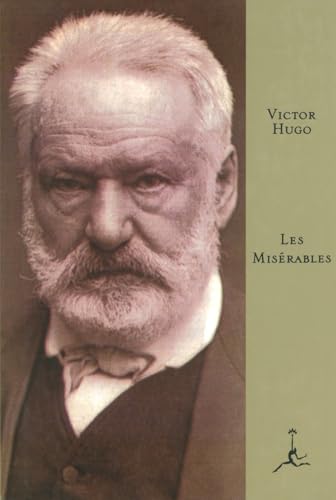
Sensational, dramatic, packed with rich excitement and filled with the sweep and violence of human passions, Les Misérables is not only superb adventure but a powerful social document. The story of how the convict Jean-Valjean struggled to escape his past and reaffirm his humanity, in a world brutalized by poverty and ignorance, became the gospel of the poor and the oppressed.
Die Inhaltsangabe kann sich auf eine andere Ausgabe dieses Titels beziehen.
Über die Autorin bzw. den Autor
Victor Hugo (1802-85), novelist, poet, playwright, and French national icon, is best known for two of today’s most popular world classics: Les Misérables and The Hunchback of Notre-Dame, as well as other works, including The Toilers of the Sea and The Man Who Laughs. Hugo was elected to the Académie Française in 1841. As a statesman, he was named a Peer of France in 1845. He served in France’s National Assemblies in the Second Republic formed after the 1848 revolution, and in 1851 went into self-imposed exile upon the ascendance of Napoleon III, who restored France’s government to authoritarian rule. Hugo returned to France in 1870 after the proclamation of the Third Republic.
Julie Rose’s acclaimed translations include Alexandre Dumas’s The Knight of Maison-Rouge and Racine’s Phèdre, as well as works by Paul Virilio, Jacques Rancière, Chantal Thomas, and many others. She is a recipient of the PEN medallion for translation and the New South Wales Premier’s Translation Prize.
Adam Gopnik is the author of Paris to the Moon and Through the Children’s Gate, and editor of the Library of America anthology Americans in Paris. He writes on various subjects for The New Yorker and has written introductions to works by Maupassant, Balzac, Proust, and Alain-Fournier.
Auszug. © Genehmigter Nachdruck. Alle Rechte vorbehalten.
I. Monsieur Myriel
In 1815, Monsieur Charles-François-Bienvenu Myriel was bishop of Digne.1 He was an elderly man of about seventy-five and he had occupied the seat of Digne since 1806.
There is something we might mention that has no bearing whatsoever on the tale we have to tell—not even on the background. Yet it may well serve some purpose, if only in the interests of precision, to jot down here the rumors and gossip that had circulated about him the moment he first popped up in the diocese. True or false, what is said about people often has as much bearing on their lives and especially on their destinies as what they do. Monsieur Myriel was the son of a councillor of the Aix parliament, a member of the noblesse de robe.2 They reckoned his father had put him down to inherit his position and so had married him off very early in the piece when he was only eighteen or twenty, as they used to do quite a lot in parliamentary families. Charles Myriel, married or no, had, they said, set tongues wagging. He was a good-looking young man, if on the short side, elegant, charming, and witty; he had given the best years of his life thus far to worldly pursuits and love affairs. Then the Revolution came along, events spiraled, parliamentary families were wiped out, chased away, hunted, scattered. Monsieur Charles Myriel emigrated to Italy soon after the Revolution broke out. His wife died there of the chest infection she’d had for ages. They had no children. What happened next in the destiny of Monsieur Myriel? The collapse of the old society in France, the fall of his own family, the tragic scenes of ’93,3 which were, perhaps, even more frightening for émigrés4 watching them from afar with the magnifying power of dread—did these things cause notions of renunciation and solitude to germinate in his mind? Was he, in the middle of the distractions and amorous diversions that filled his life, suddenly hit by one of those mysterious and terrible jolts that sometimes come and strike at the heart, bowling over the man public calamities couldn’t shake, threatening as these did only his existence and his fortune? No one could say; all that was known was that, when he came back from Italy, he was a priest.
In 1804,5 Monsieur Myriel was the curé of Brignolles.6 He was already old and lived like a real recluse in profound seclusion.
Around the time of the coronation, a small parish matter—who can remember what now?—took him to Paris. Among other powerful persons, he called on Cardinal Fesch,7 Napoléon’s uncle, to petition him on his parishioners’ behalf. One day when the emperor was visiting his uncle, the worthy curé, who was waiting in the anteroom, found himself in His Majesty’s path. Napoléon, seeing the old boy give him the once-over with a certain curiosity, wheeled round and said brusquely: “Who is this little man staring at me?”
“Your Majesty,” said Monsieur Myriel, “you see a little man, and I see a great man. Both of us may benefit.”
That very night, the emperor asked the cardinal what the curé’s name was and some time after that Monsieur Myriel was stunned to learn that he’d been named bishop of Digne.
But, when all’s said and done, what was true in the tales told about the first phase of Monsieur Myriel’s life? No one could tell. Few families had known the Myriel family before the Revolution.
Monsieur Myriel had to endure the fate of every newcomer in a small town, where there are always plenty of mouths blathering and not many brains working. He had to endure it even though he was the bishop, and because he was the bishop. But, after all, the talk in which his name cropped up was perhaps nothing more than talk; hot air, babble, words, less than words, pap, as the colorful language of the Midi8 puts it.
Whatever the case, after nine years as the resident bishop of Digne, all the usual gossip that initially consumes small towns and small people had died and sunk without a trace. No one would have dared bring it up, no one would have dared remember what it was.
Monsieur Myriel arrived in Digne accompanied by an old spinster, Mademoiselle Baptistine, who was his sister and ten years his junior.
They had only one servant, a woman the same age as Mademoiselle Baptistine, called Madame Magloire. Having been the servant of Monsieur le curé, she now went by the double title of personal maid to Mademoiselle and housekeeper to Monseigneur.9
Mademoiselle Baptistine was a tall, pale, thin, sweet person, the personification of that ideal expressed by the word respectable; for it seems a woman must be a mother to be esteemed. She had never been pretty, but her entire life, which had been merely a succession of holy works, had ended up laying a sort of whiteness and brightness over her; as she aged, she had gained what you could describe as the beauty of goodness. What had been skinniness in her youth had become transparency with maturity; and this diaphanous quality revealed the angel within. She was more of a spirit than a virgin. She seemed a mere shadow with scarcely enough of a body to have a gender; just a bit of matter bearing a light, with great big eyes always lowered to the ground, an excuse for a spirit to remain on earth.
Madame Magloire was a little old lady, white skinned, plump, round, busy, always wheezing, first because of always bustling about and second because of her asthma.
When he first arrived, Monsieur Myriel was set up in his episcopal palace with all the honors required by imperial decree, which ranked bishops immediately after field marshals.10 The mayor and the president of the local council were the first to visit him, and on his side, he made his first visits to the general and the chief of police.
Once he had moved in, the town waited to see their bishop on the job.
II. Monsieur Myriel Becomes Monseigneur Bienvenu
The episcopal palace of Digne was next door to the hospital. The episcopal palace was a vast and handsome town house built in stone at the beginning of the previous century by Monseigneur Henri Puget, doctor of theology of the faculty of Paris and abbé of Simore,1 who had been bishop of Digne in 1712. The palace was truly a mansion fit for a lord. Everything about it was on the grand scale, the bishop’s apartments, the drawing rooms, the bedrooms, the main courtyard, which was huge, with covered arcades in the old Florentine style, and the gardens planted with magnificent trees. It was in the dining room, which was a long and superb gallery on the ground floor opening onto the grounds, that Monseigneur Henri Puget had, on July 29, 1714, ceremoniously fed the ecclesiastical dignitaries, Charles Brûlart de Genlis, archbishop prince of Embrun, Antoine de Mesgrigny, Capuchin bishop of Grasse, Philippe de Vendôme, grand prior of France, abbé of Saint-Honoré de Lérins, François de Berton de Crillon, bishop baron of Vence, César de Sabran de Forcalquier, lord bishop and lord of Glandève, and Jean Soanen, priest of the oratory, preacher in ordinary to the king, lord bishop of Senez.2 The portraits of these seven reverend fathers embellished the dining room and the memorable date of July 29, 1714, was engraved there in gold lettering on a white marble panel.
The hospital was a low, narrow, single-story house with a small garden.
Three days after his arrival, the bishop visited the hospital. When his visit was over, he politely begged the director to accompany him back to his place.
“Monsieur le directeur, how many sick people do you have in your hospital at the moment?”
“Twenty-six, Monseigneur.”
“That’s what I counted,” said...
„Über diesen Titel“ kann sich auf eine andere Ausgabe dieses Titels beziehen.
Suchergebnisse für Les Misérables: A Novel (Modern Library)

Beispielbild für diese ISBN
Les Mis?rables: A Novel (Modern Library)
Anbieter: World of Books (was SecondSale), Montgomery, IL, USA
Verkäuferbewertung 5 von 5 Sternen

Zustand: Very Good. Item in very good condition! Textbooks may not include supplemental items i.e. CDs, access codes etc. Artikel-Nr. 00109980198
Gebraucht kaufen
EUR 5,35
Versand gratis
Versand innerhalb von USA
Versand innerhalb von USA
Anzahl: 1 verfügbar
Beispielbild für diese ISBN
Les Mis?rables: A Novel (Modern Library)
Anbieter: World of Books (was SecondSale), Montgomery, IL, USA
Verkäuferbewertung 5 von 5 Sternen
Zustand: Good. Item in good condition. Textbooks may not include supplemental items i.e. CDs, access codes etc. Artikel-Nr. 00109043802
Gebraucht kaufen
EUR 5,35
Versand gratis
Versand innerhalb von USA
Versand innerhalb von USA
Anzahl: 3 verfügbar
Beispielbild für diese ISBN
Les Misérables: A Novel (Modern Library)
Verlag:
Modern Library (edition First Edition), 1992
ISBN 10: 0679600124
ISBN 13: 9780679600121
Gebraucht
Hardcover
Erstausgabe
Anbieter: BooksRun, Philadelphia, PA, USA
Verkäuferbewertung 5 von 5 Sternen
Hardcover. Zustand: Fair. First Edition. With dust jacket. The item might be beaten up but readable. May contain markings or highlighting, as well as stains, bent corners, or any other major defect, but the text is not obscured in any way. Artikel-Nr. 0679600124-7-1-29
Gebraucht kaufen
EUR 5,55
Versand gratis
Versand innerhalb von USA
Versand innerhalb von USA
Anzahl: 1 verfügbar
Beispielbild für diese ISBN
Les Mis?rables
Anbieter: ThriftBooks-Phoenix, Phoenix, AZ, USA
Verkäuferbewertung 5 von 5 Sternen
Hardcover. Zustand: Good. No Jacket. Missing dust jacket; Pages can have notes/highlighting. Spine may show signs of wear. ~ ThriftBooks: Read More, Spend Less. Artikel-Nr. G0679600124I3N01
Gebraucht kaufen
EUR 5,90
Versand gratis
Versand innerhalb von USA
Versand innerhalb von USA
Anzahl: 1 verfügbar
Beispielbild für diese ISBN
Les Mis?rables
Anbieter: ThriftBooks-Dallas, Dallas, TX, USA
Verkäuferbewertung 5 von 5 Sternen
Hardcover. Zustand: Good. No Jacket. Pages can have notes/highlighting. Spine may show signs of wear. ~ ThriftBooks: Read More, Spend Less. Artikel-Nr. G0679600124I3N00
Gebraucht kaufen
EUR 5,90
Versand gratis
Versand innerhalb von USA
Versand innerhalb von USA
Anzahl: 1 verfügbar
Beispielbild für diese ISBN
Les Mis?rables
Anbieter: ThriftBooks-Reno, Reno, NV, USA
Verkäuferbewertung 5 von 5 Sternen
Hardcover. Zustand: Fair. No Jacket. Former library book; Readable copy. Pages may have considerable notes/highlighting. ~ ThriftBooks: Read More, Spend Less. Artikel-Nr. G0679600124I5N10
Gebraucht kaufen
EUR 5,90
Versand gratis
Versand innerhalb von USA
Versand innerhalb von USA
Anzahl: 1 verfügbar
Beispielbild für diese ISBN
Les Mis?rables
Anbieter: ThriftBooks-Atlanta, AUSTELL, GA, USA
Verkäuferbewertung 5 von 5 Sternen
Hardcover. Zustand: Fair. No Jacket. Former library book; Readable copy. Pages may have considerable notes/highlighting. ~ ThriftBooks: Read More, Spend Less. Artikel-Nr. G0679600124I5N10
Gebraucht kaufen
EUR 5,90
Versand gratis
Versand innerhalb von USA
Versand innerhalb von USA
Anzahl: 1 verfügbar
Beispielbild für diese ISBN
Les Mis?rables
Anbieter: ThriftBooks-Dallas, Dallas, TX, USA
Verkäuferbewertung 5 von 5 Sternen
Hardcover. Zustand: Good. No Jacket. Missing dust jacket; Pages can have notes/highlighting. Spine may show signs of wear. ~ ThriftBooks: Read More, Spend Less. Artikel-Nr. G0679600124I3N01
Gebraucht kaufen
EUR 5,90
Versand gratis
Versand innerhalb von USA
Versand innerhalb von USA
Anzahl: 1 verfügbar
Beispielbild für diese ISBN
Les Mis?rables
Anbieter: ThriftBooks-Dallas, Dallas, TX, USA
Verkäuferbewertung 5 von 5 Sternen
Hardcover. Zustand: Very Good. No Jacket. May have limited writing in cover pages. Pages are unmarked. ~ ThriftBooks: Read More, Spend Less. Artikel-Nr. G0679600124I4N00
Gebraucht kaufen
EUR 5,90
Versand gratis
Versand innerhalb von USA
Versand innerhalb von USA
Anzahl: 1 verfügbar
Beispielbild für diese ISBN
Les Mis?rables
Anbieter: ThriftBooks-Reno, Reno, NV, USA
Verkäuferbewertung 5 von 5 Sternen
Hardcover. Zustand: Good. No Jacket. Missing dust jacket; Pages can have notes/highlighting. Spine may show signs of wear. ~ ThriftBooks: Read More, Spend Less. Artikel-Nr. G0679600124I3N01
Gebraucht kaufen
EUR 5,90
Versand gratis
Versand innerhalb von USA
Versand innerhalb von USA
Anzahl: 1 verfügbar