
Verwandte Artikel zu Caprice and Rondo (House of Niccolo/Dorothy Dunnett)
Caprice and Rondo (House of Niccolo/Dorothy Dunnett) - Hardcover
Buch 7 von 8: House of Niccolo Series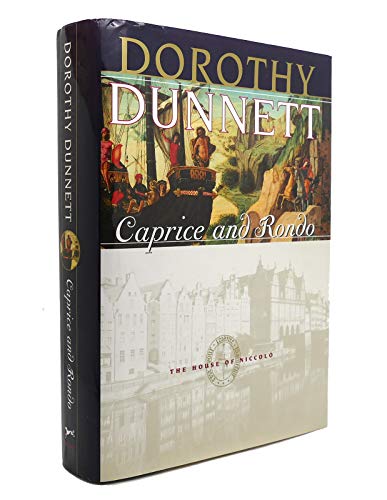
Inhaltsangabe
Recreating the world of the early Renaissance with cinematic vividness, the Scottish novelist continues the story of Nicholas de Fleury, an audacious merchant-adventurer who experiences the enormous changes sweeping fifteenth-century Europe. 17,500 first printing.
Die Inhaltsangabe kann sich auf eine andere Ausgabe dieses Titels beziehen.
Über die Autorin bzw. den Autor
Dorothy Dunnett is the author of many novels, including the six-volume Lymond Chronicles; King Hereafter; and the ongoing House of Niccolò sequence, of which <i>Caprice and Rondo</i> is Volume VII. Lady Dunnett and her husband live in Edinburgh.<br><br>Dorothy Dunnett's Lymond Chronicles <i>(The Game of Kings, Queens' Play, The Disorderly Knights, Pawn in Frankincense, The Ringed Castle,</i> and <i>Checkmate)</i> are available in Vintage paperback.
Aus dem Klappentext
: In the frozen port of Danzig, Nicholas de Fleury, one-time soldier, merchant, and banker to kings, leads his raffish companions on frivolous, drunken adventures that give little indication of the dark and complex events that have brought him among them--his activities as a spy; his shifts of allegiance from the Duke of Burgundy to the Holy Roman Emperor, and back; the mischief-making at the court of Scotland so vicious that his disgusted friends cast him into justifiable exile.<br><br> In six vivid novels (synopsized in an introduction to this volume), the peerless Dorothy Dunnett has shown us Nicholas's progress from humble dyeworks apprentice to merchant prince with his own private army, consultant to duchies and kingdoms--even as he strives to understand his origins and to come to terms with his independent, contrary wife, Gelis. And now, as the ice melts in Danzig, Nicholas must decide his own future: Will he make a new life working for the It
Auszug. © Genehmigter Nachdruck. Alle Rechte vorbehalten.
Chapter One
The wind blew from the north, from Siberia, and the clatter of hail on his shutters woke the captain. He had only been in bed for an hour, but land noises disturbed him. He grunted, considered, then dragged on his robe and, without taking a lamp, made his way to the leeward side of the villa. He had built this one only last year, and put in a brick chimney-wall: warmth from the stove below mellowed the air and his mood, although his throat was wrung dry, and he was still wearing his wrinkled day shirt and hose, as when he had dropped -- or been dropped -- on his bed. The sleeping rooms creaked and groaned as he passed them: his house was always full. Only the single chamber, as he half expected, was empty; the door ajar, the window unshuttered. Through it he could see a paring of moon, coarse as pomegranate. He walked over and looked down below, at the blood on the snow. Then he looked beyond his gates, at the city in which his fine house was set. At the walls, the watchtowers and the icy huddle of dwellings, above which reared the stiff-necked herd of her churches, scanning the west. Danzig, at four hours after midnight in the deep cold of January, 1474.
There were others awake. Beneath the congealed thatches there glimmered jointed hair-lines of light, fine as lettering. A squat figure, forced by the wind, plunged across a cake of pink light and disappeared. Here, the alleys were snow-filled and crooked. In the New Town, there were more lamps than shrines. In the New Town, the streets built by the Knights drove across and down to the river like prison-grilles, their crowns rutted and black with wheeled traffic. The Knights, the bastards. He was still celebrating Danzig's victory over the Knights. Everyone was celebrating.
Within the room, the quality of the air underwent a change. He smiled. He said, his back to the door, 'So, how was she?'
'Whetting her claws,' Colà said. He was the only man known to the captain who could move as silently as himself, despite his height. They engaged in these exercises sometimes, stalking one another, testing, deceiving. It was part of the return the captain compelled from his guests. In winter, a seaman required to be entertained. Der harte Seevogel, Tough Seabird, they called him.
Colà said, 'Is there some problem? You need a friend to help with your buttons?' He had picked up tinder, and was lighting the lamp by his bed. Paúel closed the shutters and turned.
'I was contemplating the scene of the slaughter. You look as if the girl got to you first, then the father.'
Colà blinked. His eyes were like pewter platters, and his real name was not Colà. The captain knew what it was, and had called him by it throughout the campaign in the north, where they had met. Then, after the better part of two years, a merchant's train coming in from the west had insisted on bringing their friend to the guild hall, even though they had only just met him in Lübeck two weeks ago -- such a lively, remarkable fellow was he. Name of Colà z Brugge. A one-time merchant who had decided to let his business go hang and see the world. And Captain Paúel Benecke, looking up at this bland, bristle-chinned figure, had said slowly, 'Oh, yes? Decided to give up your business?'
'Yes,' had said the newcomer meekly.
'And come to Poland?'
'Why not?' had said the big man in a reasonable voice. 'I could see, from the little experience I had, that its people needed advice. Some hints about etiquette. A touch of help as to manners and culture. A bit of --'
Here, he had been forced to desist by the pack of genial, hard-fisted arms that rose and fell on him: it had evidently happened often before, and he accepted it amiably. When, at last, the two were alone, the captain had set himself to pin the newcomer down in another way. 'So, what's the point of all this? Of course they will find out who you are. You have an agent here, haven't you?'
'Straube, yes. He's gone to Portugal for the winter. Oh, they'll find out,' said the man they called Colà. 'But they'll also know by the time
he comes back that he isn't my agent any more. I've retired from my company.'
'Why?' had said Benecke. He remembered trying to kill this man once. He remembered that the first time they met, this man had broken his arm, and later his leg.
'Why do you think?' the newcomer had said.
Benecke considered. So far as he knew, the fellow had been good at his job. The business had prospered. If he'd cheated, he hadn't been found out. That left only women. There had been two: a harridan of a wife, so he'd heard, and a little virgin who thought she was a boy. That is, there had been a lot more than two, but none spoken of seriously. The captain said, 'I think you just wanted some fun. But since you ask, I'll guess you killed the wife and raped the little girl-brother Kathi. I liked her,' said the captain with a catch in his voice. 'If you've raped her, I'll kill you.' They were both, by this time, quite full of ale.
'You think you could?' Colà said; and ducked as the captain got out his knife. Someone took it from him quite soon, and they settled to drink again. Eventually Paúel had to ask. 'So what happened?'
'You weren't far wrong,' Colà had said. 'The wife flung me out, and the girl married somebody else. So I thought I'd get out.'
'So why here?'
'I thought I'd get out to where somebody owed me a favour. Are you busy this winter?'
The captain sat up. 'You want a job?' There were no jobs in winter. Danzig was sealed in by ice. There would be no ships in the port until March.
'No,' said Colà. 'Or not until spring. Or not until I decide where I'm going. I just want to pass an entertaining winter with my inferiors.'
Ten minutes later, picking themselves up from the snow outside the Artushof: 'They'll never let you back in,' Benecke said.
'Yes, they will. Anyway, you started the fight, and they'll forgive you. Do I get a bed?'
'No,' had said Paúel Benecke. 'You'd spoil my winter complaining about your women.'
'I shouldn't,' said Colà.
'You'd get into bed with my women.'
'Of course,' had said Colà. 'You couldn't stop me. That's why you don't want me to come.'
That time, no one separated them, and it was three days before either of them could talk without lisping. Colà had been living in his house ever since, and Danzig would never forget him, nor would Paúel Benecke. He would never have to forget him. He was going to keep him in Danzig for the rest of his life. Despite the blood on the snow.
Now he said, 'So where have you left her?'
'Never mind. Anyway, she's not yours, she's mine. I got a doctor to see to the boy.'
'I thought his arm was going to come off. You ought to be chained up and put in a lazar house.'
'Come on,' Colà said. 'I'm going to tame her. Then I'm going to sell her to you.'
'Before or after you pay me for your lodging?' Paúel Benecke said. He gazed with fascination at the scratches all over the other man's neck and arms. He said, 'What if she's diseased?'
'You're worried?'
'No,' said Benecke. 'But I'm thirsty, and the look of you is spoiling my thirst. Good night, fool.'
He left, slamming the door. You found a man you could enjoy winters with, and he still behaved, at times, like an idiot. In their first weeks together, he had discovered it. Ingenuity, yes; lunacy even, to a degree -- those were acceptable, those were what the merchants from Lübeck had enjoyed. But these escapades led by Colà were suicidal.
Three weeks after he came, the situation had come to a head over the bison hunt. Then they had been out of the city, travelling over snow to the forests, with their dogs, their...
„Über diesen Titel“ kann sich auf eine andere Ausgabe dieses Titels beziehen.
Suchergebnisse für Caprice and Rondo (House of Niccolo/Dorothy Dunnett)

Beispielbild für diese ISBN
Caprice and Rondo: The Seventh Book in the House of Niccolo (House of Niccolo/Dorothy Dunnett)
Anbieter: World of Books (was SecondSale), Montgomery, IL, USA
Verkäuferbewertung 5 von 5 Sternen

Zustand: Good. Item in good condition. Textbooks may not include supplemental items i.e. CDs, access codes etc. Artikel-Nr. 00095187482
Gebraucht kaufen
EUR 5,89
Versand gratis
Versand innerhalb von USA
Versand innerhalb von USA
Anzahl: 4 verfügbar
Beispielbild für diese ISBN
Caprice and Rondo: The Seventh Book in the House of Niccolo (House of Niccolo/Dorothy Dunnett)
Anbieter: BooksRun, Philadelphia, PA, USA
Verkäuferbewertung 5 von 5 Sternen
Hardcover. Zustand: Fair. The item might be beaten up but readable. May contain markings or highlighting, as well as stains, bent corners, or any other major defect, but the text is not obscured in any way. Artikel-Nr. 0679454772-7-1
Gebraucht kaufen
EUR 5,90
Versand gratis
Versand innerhalb von USA
Versand innerhalb von USA
Anzahl: 1 verfügbar
Beispielbild für diese ISBN
Caprice and Rondo: The Seventh Book in the House of Niccolo (House of Niccolo/Dorothy Dunnett)
Anbieter: Wonder Book, Frederick, MD, USA
Verkäuferbewertung 5 von 5 Sternen
Zustand: Good. Good condition. Good dust jacket. A copy that has been read but remains intact. May contain markings such as bookplates, stamps, limited notes and highlighting, or a few light stains. Artikel-Nr. B02A-04133
Gebraucht kaufen
EUR 6,87
Versand gratis
Versand innerhalb von USA
Versand innerhalb von USA
Anzahl: 2 verfügbar
Beispielbild für diese ISBN
Caprice and Rondo: The Seventh Book in the House of Niccolo (House of Niccolo/Dorothy Dunnett)
Anbieter: Wonder Book, Frederick, MD, USA
Verkäuferbewertung 5 von 5 Sternen
Zustand: Very Good. Very Good condition. Good dust jacket. A copy that may have a few cosmetic defects. May also contain light spine creasing or a few markings such as an owner's name, short gifter's inscription or light stamp. Artikel-Nr. M14B-01442
Gebraucht kaufen
EUR 6,87
Versand gratis
Versand innerhalb von USA
Versand innerhalb von USA
Anzahl: 1 verfügbar
Beispielbild für diese ISBN
Caprice and Rondo: The Seventh Book in the House of Niccolo (House of Niccolo/Dorothy Dunnett)
Anbieter: ThriftBooks-Atlanta, AUSTELL, GA, USA
Verkäuferbewertung 5 von 5 Sternen
Hardcover. Zustand: Good. No Jacket. Pages can have notes/highlighting. Spine may show signs of wear. ~ ThriftBooks: Read More, Spend Less. Artikel-Nr. G0679454772I3N00
Gebraucht kaufen
EUR 6,94
Versand gratis
Versand innerhalb von USA
Versand innerhalb von USA
Anzahl: 1 verfügbar
Beispielbild für diese ISBN
Caprice and Rondo: The Seventh Book in the House of Niccolo (House of Niccolo/Dorothy Dunnett)
Anbieter: ThriftBooks-Dallas, Dallas, TX, USA
Verkäuferbewertung 5 von 5 Sternen
Hardcover. Zustand: Very Good. No Jacket. May have limited writing in cover pages. Pages are unmarked. ~ ThriftBooks: Read More, Spend Less. Artikel-Nr. G0679454772I4N00
Gebraucht kaufen
EUR 6,94
Versand gratis
Versand innerhalb von USA
Versand innerhalb von USA
Anzahl: 1 verfügbar
Beispielbild für diese ISBN
Caprice and Rondo: The Seventh Book in the House of Niccolo (House of Niccolo/Dorothy Dunnett)
Anbieter: ThriftBooks-Phoenix, Phoenix, AZ, USA
Verkäuferbewertung 5 von 5 Sternen
Hardcover. Zustand: Very Good. No Jacket. May have limited writing in cover pages. Pages are unmarked. ~ ThriftBooks: Read More, Spend Less. Artikel-Nr. G0679454772I4N00
Gebraucht kaufen
EUR 6,94
Versand gratis
Versand innerhalb von USA
Versand innerhalb von USA
Anzahl: 1 verfügbar
Beispielbild für diese ISBN
Caprice and Rondo
Verlag:
Knopf Doubleday Publishing Group, 1998
ISBN 10: 0679454772
ISBN 13: 9780679454779
Gebraucht
Hardcover
Anbieter: Better World Books, Mishawaka, IN, USA
Verkäuferbewertung 5 von 5 Sternen
Zustand: Good. 1st American Ed. Pages intact with minimal writing/highlighting. The binding may be loose and creased. Dust jackets/supplements are not included. Stock photo provided. Product includes identifying sticker. Better World Books: Buy Books. Do Good. Artikel-Nr. 2415214-75
Gebraucht kaufen
EUR 7,75
Versand gratis
Versand innerhalb von USA
Versand innerhalb von USA
Anzahl: 1 verfügbar
Beispielbild für diese ISBN
Caprice and Rondo
Verlag:
Knopf Doubleday Publishing Group, 1998
ISBN 10: 0679454772
ISBN 13: 9780679454779
Gebraucht
Hardcover
Anbieter: Better World Books, Mishawaka, IN, USA
Verkäuferbewertung 5 von 5 Sternen
Zustand: Very Good. 1st American Ed. Former library copy. Pages intact with possible writing/highlighting. Binding strong with minor wear. Dust jackets/supplements may not be included. Includes library markings. Stock photo provided. Product includes identifying sticker. Better World Books: Buy Books. Do Good. Artikel-Nr. GRP69557521
Gebraucht kaufen
EUR 7,75
Versand gratis
Versand innerhalb von USA
Versand innerhalb von USA
Anzahl: 1 verfügbar
Beispielbild für diese ISBN
Caprice and Rondo
Verlag:
Alfred a Knopf Inc, Westminister, Maryland, U.S.A., 1998
ISBN 10: 0679454772
ISBN 13: 9780679454779
Gebraucht
Hardcover
Erstausgabe
Anbieter: Lazy S Books, Austin, TX, USA
Verkäuferbewertung 4 von 5 Sternen

Hardcover. Zustand: Fine. Zustand des Schutzumschlags: Very Good - Fine. First Edition. The seventh House of Niccolo novel. Very mild edge wear to the DJ. A very good to fine copy. Artikel-Nr. 002394
Gebraucht kaufen
EUR 18,30
EUR 6,22 Versand
Versand innerhalb von USA
Versand innerhalb von USA
Anzahl: 1 verfügbar