
Verwandte Artikel zu Ghost Light: A Memoir
Inhaltsangabe
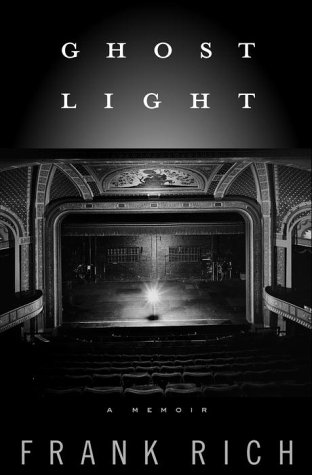
The "New York Times" drama critic describes growing up in Washington, D.C., during the 1950s and 1960s and explains how he found refuge from the turmoil of childhood and his own parents' divorce in the great Broadway musicals.
Die Inhaltsangabe kann sich auf eine andere Ausgabe dieses Titels beziehen.
Über die Autorin bzw. den Autor
Frank Rich served from 1980 to 1993 as the chief drama critic of <i>The New York Times</i>, and is now an op-ed columnist at the paper as well as senior writer for <i>The New York Times Magazine</i>. He lives in New York City with his wife, the writer Alex Witchel.
Aus dem Klappentext
uperstition that if an emptied theater is ever left completely dark, a ghost will take up residence. To prevent this, a single "ghost light" is left burning at center stage after the audience and all of the actors and musicians have gone home. Frank Rich's eloquent and moving boyhood memoir reveals how theater itself became a ghost light and a beacon of security for a child finding his way in a tumultuous world. <br><br>Rich grew up in the small-townish Washington, D.C., of the 1950s and early '60s, a place where conformity seemed the key to happiness for a young boy who always felt different. When Rich was seven years old, his parents separated--at a time when divorce was still tantamount to scandal--and thereafter he and his younger sister were labeled "children from a broken home." Bouncing from school to school and increasingly lonely, Rich became terrified of the dark and the uncertainty of his future. But there was one thing in his life that made him sublimely happy: th
Auszug. © Genehmigter Nachdruck. Alle Rechte vorbehalten.
To be an American kid in the fifties was to live in a sparkling, hopeful world where ignorance really was bliss. Parents spoke in euphemistic private codes rather than say anything that might mar the tableaux of contentment they tirelessly constructed for wide young eyes.
We lived in Somerset, where the streets were called Dorset and Warwick and Uppingham and Trent--their very names a farcical affront to reality. The English did not dwell in our bonny Somerset, and neither did their local heirs, the Protestants, who had their own, restricted neighborhoods barely miles away. Somerset, a subdivision built just across the District line in Maryland but not far enough from a city turning black to be among the most desirable of suburbs, was mainly the province of Jews. The houses were not baronial estates but mostly small and new, inhabited by men who had come back from the war to build careers and families and to tend continually to their front lawns and backyards, also small but, as a point of honor, impeccably green. Inside the houses was a riot of wallpaper, some of it depicting scenes more in keeping with the neighborhood's cosmopolitan aspirations. April in Paris? The Weinsteins' dining room was a fanciful rendering of a Parisian boulevard sketched in broad lines and pastels, the kiosks and flower stalls circled by a profusion of dancing pink and black poodles. Even this scene had a recognizable air of American domesticity; it was the cartoon Paree we'd glimpsed in Looney Tunes.
Our universe was as buoyant and tightly sealed as a balloon. After we walked down the hill from the redbrick Somerset Elementary School each weekday at three, we played tag and ball in the street without fear that a stranger or stray car might intrude, secure in the knowledge that our mothers were only one loud shout away and that the worst that could happen to us would be to fall off a bike after the training wheels were removed. The only temptation to danger was provided by a forest that hadn't yet been cleared for new houses; it was a handy laboratory for our earliest experiments with matches, one of which led to the arrival of a fire engine and a rare outbreak of mass parental recrimination in a neighborhood whose kids were not the kind to get into trouble.
The best hope for a daring adventure worthy of our Bobbsey Twins books was the occasional foray into what we took to be a haunted house--any house that had just been built or had just changed hands, and whose new tenants had yet to move in. It was easy to identify these haunted houses: The realtors marked them with red-and-white metal signs planted in the center of their lawns. And it was easy to enter them and commandeer their unfurnished rooms for games of hide-and-seek, all the creepier for the absence of lights and for the reverberant effect on our screams of the bare floors and walls, especially in that fast-dimming twilight just before dinner. We told ourselves there must be ghosts in residence in these houses, that spirits haunted the shadows of the vacant dens and bedrooms and rec rooms with their acrid fragrance of fresh paint.
When darkness fell, we retreated reluctantly from the horseplay in our front yards, each according to his assigned bedtime, until the whole neighborhood was tucked in for the night. But muffled behind the venetian blinds of each house there might still be a flicker of light, a visual echo of the fireflies we collected in Mason jars in our backyards each summer, now emanating from the magical hearth of television.
Sitting before the TV sets in our living rooms--they hadn't invaded bedrooms yet--we watched our neighborhood in a faithful black-and-white replication: the same driveways jutting like tongues from garage to street, the same lawns awaiting the next weekend mowing, the same father with his genial grin and firm but calming voice, the same perpetually amused, slightly distracted, occasionally flustered, but resolutely uncomplaining mother poking around in the kitchen preparing the next meal, the same mischievous but fundamentally good brothers and sisters committing only the most innocuous infractions of their parents' painstakingly codified rules. Sometimes it was hard to figure out where Somerset ended and the TV neighborhoods, with their similarly pastoral place-names, began. If there was a man in the moon--the opening credits of one of our favorite TV comedies, The Honeymooners, promised us one--what would he make of these look-alike families in their look-alike homes staring each night at other look-alike families in their own look-alike homes on small cathode-ray tubes burning through the inky shadows of our living rooms?
Contentment and prosperity smiled back at us from everywhere we looked then, as shiny as our reflections in the voluptuous curves of our parents' bright new cars.
Not unlike Lucy and Desi, Mom and Dad had moved from their small newlyweds' apartment in the city to their first house right after I was born. They had landed in Somerset from culturally conflicting ports of origin. Mom, a grandchild of Russian immigrant families, had been born in Brooklyn--in Manhattan Beach, at the end of Coney Island, in a house just a block from the shore where crates of bootleg liquor were dropped by boat to make their way to New York during Prohibition. But the Depression ended this beach idyll when Mom was seven, sending her father, Nat, and mother, Lil, into the provincial swamp of Washington, D.C. There Nat took what remained of his savings and bought his way into a paper-goods wholesaler of Dixie cups and big brown envelopes and paper clips and glistening mass-produced miracles like Scotch tape. In Washington, the Aaronsons had to settle for raising Mom and her sister in an apartment--on Connecticut Avenue, on the city side of the District line.
By contrast, Dad and his parents, Herbert and Rose, were true Washingtonians. Dad was fonder of telling stories about how his ancestors had fought only dozens of miles away in the Civil War than he was of recounting his own adventures as an Air Force commander in the China-Burma-India theater in World War II. The Riches were German Jews who would have found Brooklyn as foreign as Madagascar. It would have been hard to guess that the Riches were Jewish, since they spoke no Hebrew, ate pork chops, and, in further defiance of their nominal religion's practice, named their firstborn sons after their living fathers: I was Frank, Jr., as Dad's older brother was Herbert, Jr. When Grandma Rose, at our Wednesday-night family dinners at her and Grandpa Herbert's apartment, wanted to identify anyone as Jewish, she lowered her usual booming decibel level--she had been near deaf since Dad was a boy--and spoke cryptically, sotto voce, of "one of us" or "a member of our tribe." I always wondered from whom she was keeping our Jewishness a secret. The only outsider within earshot was Irene, the black maid who had worked for Grandma Rose since before the Depression and who seemed to be more cognizant of Jewish holidays and rituals than her employers were. As my Rich grandparents refused to acknowledge their Jewishness, so they never spoke of anti-Semites or pogroms or Nazis. Each spring, Grandpa would drive his Packard to tour the splendid front lawns in the suburban enclave of Kenwood, where Grandma, having only potted plants and no yard to tend, would cluck over the newly blooming azaleas and cherry blossoms she longed for, never acknowledging the neighborhood's notorious antipathy to Jewish residents, no matter how lofty their provenance.
Dad grew up in a more affluent Washington than Mom's, in a house off Sixteenth Street, the prosperous Jewish district near downtown. His childhood home was only a short trolley ride from the store his great-grandfather had started near Ford's Theatre four years after Lincoln was shot. B. Rich & Sons had been the store's...
„Über diesen Titel“ kann sich auf eine andere Ausgabe dieses Titels beziehen.
Weitere beliebte Ausgaben desselben Titels

Suchergebnisse für Ghost Light: A Memoir

Beispielbild für diese ISBN
Ghost Light: A Memoir
Anbieter: World of Books (was SecondSale), Montgomery, IL, USA
Verkäuferbewertung 5 von 5 Sternen

Zustand: Acceptable. Item in acceptable condition! Textbooks may not include supplemental items i.e. CDs, access codes etc. Artikel-Nr. 00086714736
Gebraucht kaufen
EUR 4,63
Versand gratis
Versand innerhalb von USA
Versand innerhalb von USA
Anzahl: 1 verfügbar
Beispielbild für diese ISBN
Ghost Light: A Memoir
Anbieter: World of Books (was SecondSale), Montgomery, IL, USA
Verkäuferbewertung 5 von 5 Sternen
Zustand: Good. Item in good condition. Textbooks may not include supplemental items i.e. CDs, access codes etc. Artikel-Nr. 00107670784
Gebraucht kaufen
EUR 4,63
Versand gratis
Versand innerhalb von USA
Versand innerhalb von USA
Anzahl: 1 verfügbar
Beispielbild für diese ISBN
Ghost Light: A Memoir
Anbieter: World of Books (was SecondSale), Montgomery, IL, USA
Verkäuferbewertung 5 von 5 Sternen
Zustand: Good. Good condition ex-library book with usual library markings and stickers. Artikel-Nr. 00107737128
Gebraucht kaufen
EUR 4,76
Versand gratis
Versand innerhalb von USA
Versand innerhalb von USA
Anzahl: 1 verfügbar
Beispielbild für diese ISBN
Ghost Light: A Memoir
Verlag:
Random House (edition First Edition), 2000
ISBN 10: 0679452990
ISBN 13: 9780679452997
Gebraucht
Hardcover
Erstausgabe
Anbieter: BooksRun, Philadelphia, PA, USA
Verkäuferbewertung 5 von 5 Sternen
Hardcover. Zustand: Very Good. First Edition. With dust jacket. It's a well-cared-for item that has seen limited use. The item may show minor signs of wear. All the text is legible, with all pages included. It may have slight markings and/or highlighting. Artikel-Nr. 0679452990-11-1-29
Gebraucht kaufen
EUR 5,30
Versand gratis
Versand innerhalb von USA
Versand innerhalb von USA
Anzahl: 1 verfügbar
Beispielbild für diese ISBN
Ghost Light: A Memoir
Anbieter: ThriftBooks-Dallas, Dallas, TX, USA
Verkäuferbewertung 5 von 5 Sternen
Hardcover. Zustand: As New. No Jacket. Pages are clean and are not marred by notes or folds of any kind. ~ ThriftBooks: Read More, Spend Less. Artikel-Nr. G0679452990I2N00
Gebraucht kaufen
EUR 6,12
Versand gratis
Versand innerhalb von USA
Versand innerhalb von USA
Anzahl: 1 verfügbar
Beispielbild für diese ISBN
Ghost Light: A Memoir
Anbieter: ThriftBooks-Atlanta, AUSTELL, GA, USA
Verkäuferbewertung 5 von 5 Sternen
Hardcover. Zustand: As New. No Jacket. Pages are clean and are not marred by notes or folds of any kind. ~ ThriftBooks: Read More, Spend Less. Artikel-Nr. G0679452990I2N00
Gebraucht kaufen
EUR 6,12
Versand gratis
Versand innerhalb von USA
Versand innerhalb von USA
Anzahl: 1 verfügbar
Beispielbild für diese ISBN
Ghost Light: A Memoir
Anbieter: Wonder Book, Frederick, MD, USA
Verkäuferbewertung 5 von 5 Sternen
Zustand: As New. Like New condition. Very Good dust jacket. A near perfect copy that may have very minor cosmetic defects. Artikel-Nr. X05A-03364
Gebraucht kaufen
EUR 6,22
Versand gratis
Versand innerhalb von USA
Versand innerhalb von USA
Anzahl: 1 verfügbar
Beispielbild für diese ISBN
Ghost Light: A Memoir
Anbieter: Wonder Book, Frederick, MD, USA
Verkäuferbewertung 5 von 5 Sternen
Zustand: Very Good. Very Good condition. Good dust jacket. A copy that may have a few cosmetic defects. May also contain light spine creasing or a few markings such as an owner's name, short gifter's inscription or light stamp. Artikel-Nr. Q15P-01053
Gebraucht kaufen
EUR 6,22
Versand gratis
Versand innerhalb von USA
Versand innerhalb von USA
Anzahl: 1 verfügbar
Beispielbild für diese ISBN
Ghost Light : A Memoir
Verlag:
Random House, Incorporated, 2000
ISBN 10: 0679452990
ISBN 13: 9780679452997
Gebraucht
Hardcover
Erstausgabe
Anbieter: Better World Books, Mishawaka, IN, USA
Verkäuferbewertung 5 von 5 Sternen
Zustand: Very Good. 1st. Former library copy. Pages intact with possible writing/highlighting. Binding strong with minor wear. Dust jackets/supplements may not be included. Includes library markings. Stock photo provided. Product includes identifying sticker. Better World Books: Buy Books. Do Good. Artikel-Nr. GRP75658997
Gebraucht kaufen
EUR 8,29
Versand gratis
Versand innerhalb von USA
Versand innerhalb von USA
Anzahl: 1 verfügbar
Beispielbild für diese ISBN
Ghost Light : A Memoir
Verlag:
Random House, Incorporated, 2000
ISBN 10: 0679452990
ISBN 13: 9780679452997
Gebraucht
Hardcover
Erstausgabe
Anbieter: Better World Books, Mishawaka, IN, USA
Verkäuferbewertung 5 von 5 Sternen
Zustand: Good. 1st. Pages intact with minimal writing/highlighting. The binding may be loose and creased. Dust jackets/supplements are not included. Stock photo provided. Product includes identifying sticker. Better World Books: Buy Books. Do Good. Artikel-Nr. 732737-6
Gebraucht kaufen
EUR 8,29
Versand gratis
Versand innerhalb von USA
Versand innerhalb von USA
Anzahl: 1 verfügbar