
Verwandte Artikel zu Turnaround: How America's Top Cop Reversed the...
Inhaltsangabe
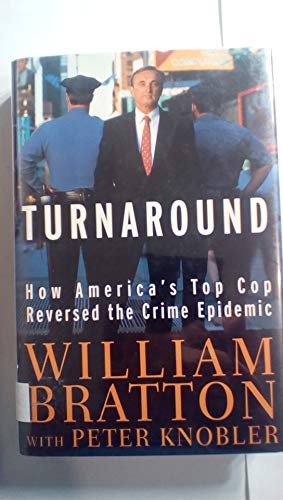
The former New York City police commissioner explains why and how his neighborhood-by-neighborhood strategies succeeded in dramatically reducing New York's violent crime rate, and discusses the City Hall politics that ended his time in office. 75,000 first printing. Tour.
Die Inhaltsangabe kann sich auf eine andere Ausgabe dieses Titels beziehen.
Über die Autorinnen und Autoren
William Bratton is the former police commissioner of New York City and Boston. Currently working in the private sector, he is a frequent lecturer on the issues of crime-reduction techniques, management, and leadership. He lives with his wife Cheryl Fiandaca, in New York City.
William Bratton is the former police commissioner of New York City and Boston.
Auszug. © Genehmigter Nachdruck. Alle Rechte vorbehalten.
MY MOTHER COULDN'T FIND ME.
I was only a year and a half old, barely a toddler, and there were a very limited number of places I could be. My parents and I lived in a small basement apartment in Cambridge, Massachusetts, it was the dead of winter, and she and I had been playing in the yard out back. She went inside for only a moment. When she came out I was gone. My mother was just starting to panic when she heard cars honking. For a second, she paid no attention; her son was missing, that's all that mattered. I had been born with a collapsed lung and had been given last rites at the hospital when I was two days old. I had survived, and my mother never wanted to risk losing me again. When the honking grew as frantic as she was, she ran up the alley and out onto the street.
There I was, in my snowsuit and cap, standing a foot and a half tall in the middle of Massachusetts Avenue, directing traffic. Cars were stopped. There was a crowd around me. She ran across four lanes and swept me up in her arms.
I don't remember any of this, but family lore has it that that's when they knew I wanted to be a police officer.
My father, Bill, and my mother, June, had been high school sweethearts in the Charlestown projects in Boston. They were married when my father got out of the service after World War II, and I was born on October 6, 1947. My father was Big Bill; I was always Little Billy. He worked as a longshoreman on the Boston docks. Two years after I was born, he used benefits he had coming to him through the G.I. Bill and, with my mother's father, Joe DeViller, bought what was called a three-decker house at 62 Hecla Street in the Dorchester section of Boston.
Three-deckers were a Boston housing phenomenon--entire neighborhoods were made up of them. They were three-story, wood-frame houses, with each story a five-and-a-half-room floor-through apartment, the equivalent of what in New York are called railroad flats. They were inexpensive and functional.
Dorchester was a working-class neighborhood. We didn't think of ourselves as poor, but no one in the neighborhood had a lot of money. My mother, father, my younger sister Pat, and I lived on the second floor. If we wanted hot water, we had to heat it in pans. For years, my mother cooked on a four-legged cast-iron stove, one of those old black monstrosities that today are retro and all the rage but back then were just old-fashioned. I was already a teenager the day they hauled that huge, smelly thing out and put in a hot-water tank and a real gas stove. We didn't get hot running water in our home until the early sixties, and that was a big day for the Brattons.
The house was heated by coal. Once a year, a truck backed up to the side of the building and tilted five tons of it into the chute. At five o'clock every morning, my father had to go down to the basement and temper the flames in the furnace to get it going for the day. He did the same thing as soon as he came home at night and then again at eleven
o'clock before he went to bed. It was quite an art just staying warm.
Wednesday was ash day, when the city came to pick up the ashes that a week of coal had produced. This was different from Ash Wednesday, when Catholics would ponder their mortality. This was Wednesday ash day, when a cloud of soot rose all over the neighborhood. An old truck with wooden slats on the side showed up, and a city employee, the ash man, shoveled us out. That was a job.
Coal ceased being the municipal heating fuel of choice in the 1950s, and at some point its use had dwindled to the point where the city wouldn't pick up ashes anymore; there wasn't enough work to support the ash men. But we had the coal furnace well into the 1960s, and for about ten years the men of the three families in our building--my father, my grandfather, and Mr. McNulty, who lived on the first floor--began spreading the ashes under the back porch. After a couple of years, the whole underside of the porch was packed in solid. We lived near the corner with an empty lot on one side and an alley on the other, and when we filled up our porch, we arranged with other houses on the alley to take them. We shoveled our own soot for a decade.
For extra heat we had a kerosene stove. It was a fire hazard, but it was necessary. Everybody had one, and throughout the neighborhood everybody's back hall smelled of kerosene because when you poured it from the can to the heater, the fuel would spill over and seep into the linoleum.
When you entered our apartment, you came into a hallway that ran the length of the creaky wood house. First door on the right was the bathroom with an old cast-iron claw-foot tub and pull-chain toilet with a wooden seat. Diagonally across from that was my room. It had two entrances: a door from the hall on one side but only a curtain between me and the kitchen. I never understood that.
Everything revolved around the kitchen with its cast-iron stove and black stone sink with the big brass fittings. The washing machine was in there as well, with a wooden hand-operated wringer and the revolving tub that shook wildly and made a thumping racket as it spun. My grandparents lived upstairs, and every morning my grandmother Ann would come down and hang out in the kitchen with my mother. They'd have coffee or tea, and the next-door neighbor, Dot Gorham, would come over and sit. Dinner, supper, all the important moments of the day happened there.
If you went left down the hall, my sister Pat's room was on the right. She is a year younger than I am. From there, you had to pass directly through my parents' bedroom to get to the living room at the front of the house. The living room had three windows facing out on the street; it was the perfect place to keep an eye on what was going on in the neighborhood. That was where I waited for my father.
From the time I can remember, my father worked a couple of blocks from home at a chrome-plating firm on Freeport Street. He would be out the door first thing in the morning for the eight o'clock shift and every afternoon at five past four I would look out that window, see my father walking up the block, and go running out to meet him.
I didn't have much time with my dad. In 1951, he got a full-time job as a mail sorter at the post office and from then on worked two jobs for the rest of his life. This was a much-coveted civil-service position, the kind a working-class family counted on for security, but it also meant I didn't see him a lot. My dad came home for supper, which we ate at four-thirty in the afternoon, and then either went off to work the six-to-two shift at the post office or went to bed so he could wake up at eleven-thirty and head over there at midnight. From the post office, he went directly to the plating plant.
Money was always tight. I don't think my parents to this day have a checking account. My father brought home his pay in cash and gave it to my mother, and she gave him some money back. They worked out of envelopes. My father kept his in the top bureau of their five-drawer dresser; my mother kept hers in the lower. There was an envelope for the egg man, who delivered every week and came up the back stairs on Friday nights to collect. An envelope for the milkman, who came every day. We had accounts at some of the local stores at the Field's Corner shopping area about a half-mile from the house, and a dollar or two a week went into those envelopes.
Like a lot of people in the neighborhood, my parents played the numbers each week, and once in a long while my father's number hit and he came home with three or six hundred extra dollars in his pocket. He was making forty or fifty dollars a week at the time, so you can imagine what that was like. The only reason the old Boston Record-American sold every day was that people all over the city needed it to find out the winning...
„Über diesen Titel“ kann sich auf eine andere Ausgabe dieses Titels beziehen.
Suchergebnisse für Turnaround: How America's Top Cop Reversed the...

Beispielbild für diese ISBN
The Turnaround
Anbieter: World of Books (was SecondSale), Montgomery, IL, USA
Verkäuferbewertung 5 von 5 Sternen

Zustand: Very Good. Item in very good condition! Textbooks may not include supplemental items i.e. CDs, access codes etc. Artikel-Nr. 00102498947
Gebraucht kaufen
EUR 3,76
Versand gratis
Versand innerhalb von USA
Versand innerhalb von USA
Anzahl: 3 verfügbar
Beispielbild für diese ISBN
The Turnaround
Anbieter: World of Books (was SecondSale), Montgomery, IL, USA
Verkäuferbewertung 5 von 5 Sternen
Zustand: Good. Item in good condition. Textbooks may not include supplemental items i.e. CDs, access codes etc. Artikel-Nr. 00088617277
Gebraucht kaufen
EUR 3,76
Versand gratis
Versand innerhalb von USA
Versand innerhalb von USA
Anzahl: 5 verfügbar
Beispielbild für diese ISBN
The Turnaround: How America's Top Cop Reversed the Crime Epidemic
Verlag:
Random House (edition First Edition), 1998
ISBN 10: 0679452516
ISBN 13: 9780679452515
Gebraucht
Hardcover
Erstausgabe
Anbieter: BooksRun, Philadelphia, PA, USA
Verkäuferbewertung 5 von 5 Sternen
Hardcover. Zustand: Very Good. First Edition. With dust jacket. It's a well-cared-for item that has seen limited use. The item may show minor signs of wear. All the text is legible, with all pages included. It may have slight markings and/or highlighting. Artikel-Nr. 0679452516-8-6-29
Gebraucht kaufen
EUR 5,84
Versand gratis
Versand innerhalb von USA
Versand innerhalb von USA
Anzahl: 1 verfügbar
Beispielbild für diese ISBN
The Turnaround: How America's Top Cop Reversed the Crime Epidemic
Anbieter: ThriftBooks-Dallas, Dallas, TX, USA
Verkäuferbewertung 5 von 5 Sternen
Hardcover. Zustand: Very Good. No Jacket. May have limited writing in cover pages. Pages are unmarked. ~ ThriftBooks: Read More, Spend Less. Artikel-Nr. G0679452516I4N00
Gebraucht kaufen
EUR 5,86
Versand gratis
Versand innerhalb von USA
Versand innerhalb von USA
Anzahl: 1 verfügbar
Beispielbild für diese ISBN
The Turnaround: How America's Top Cop Reversed the Crime Epidemic
Anbieter: ThriftBooks-Atlanta, AUSTELL, GA, USA
Verkäuferbewertung 5 von 5 Sternen
Hardcover. Zustand: Very Good. No Jacket. May have limited writing in cover pages. Pages are unmarked. ~ ThriftBooks: Read More, Spend Less. Artikel-Nr. G0679452516I4N00
Gebraucht kaufen
EUR 5,86
Versand gratis
Versand innerhalb von USA
Versand innerhalb von USA
Anzahl: 1 verfügbar
Beispielbild für diese ISBN
The Turnaround: How America's Top Cop Reversed the Crime Epidemic
Anbieter: ThriftBooks-Reno, Reno, NV, USA
Verkäuferbewertung 5 von 5 Sternen
Hardcover. Zustand: Very Good. No Jacket. May have limited writing in cover pages. Pages are unmarked. ~ ThriftBooks: Read More, Spend Less. Artikel-Nr. G0679452516I4N00
Gebraucht kaufen
EUR 5,86
Versand gratis
Versand innerhalb von USA
Versand innerhalb von USA
Anzahl: 1 verfügbar
Beispielbild für diese ISBN
The Turnaround: How America's Top Cop Reversed the Crime Epidemic
Anbieter: ThriftBooks-Dallas, Dallas, TX, USA
Verkäuferbewertung 5 von 5 Sternen
Hardcover. Zustand: Very Good. No Jacket. Missing dust jacket; May have limited writing in cover pages. Pages are unmarked. ~ ThriftBooks: Read More, Spend Less. Artikel-Nr. G0679452516I4N01
Gebraucht kaufen
EUR 5,86
Versand gratis
Versand innerhalb von USA
Versand innerhalb von USA
Anzahl: 1 verfügbar
Beispielbild für diese ISBN
The Turnaround : How America's Top Cop Reversed the Crime Epidemic
Verlag:
Random House, Incorporated, 1998
ISBN 10: 0679452516
ISBN 13: 9780679452515
Gebraucht
Hardcover
Erstausgabe
Anbieter: Better World Books, Mishawaka, IN, USA
Verkäuferbewertung 5 von 5 Sternen
Zustand: Good. 1st ed. Former library copy. Pages intact with minimal writing/highlighting. The binding may be loose and creased. Dust jackets/supplements are not included. Includes library markings. Stock photo provided. Product includes identifying sticker. Better World Books: Buy Books. Do Good. Artikel-Nr. GRP77951720
Gebraucht kaufen
EUR 6,09
Versand gratis
Versand innerhalb von USA
Versand innerhalb von USA
Anzahl: 1 verfügbar
Beispielbild für diese ISBN
The Turnaround : How America's Top Cop Reversed the Crime Epidemic
Verlag:
Random House, Incorporated, 1998
ISBN 10: 0679452516
ISBN 13: 9780679452515
Gebraucht
Hardcover
Erstausgabe
Anbieter: Better World Books, Mishawaka, IN, USA
Verkäuferbewertung 5 von 5 Sternen
Zustand: Good. 1st ed. Pages intact with minimal writing/highlighting. The binding may be loose and creased. Dust jackets/supplements are not included. Stock photo provided. Product includes identifying sticker. Better World Books: Buy Books. Do Good. Artikel-Nr. GRP102325285
Gebraucht kaufen
EUR 6,09
Versand gratis
Versand innerhalb von USA
Versand innerhalb von USA
Anzahl: 6 verfügbar
Beispielbild für diese ISBN
The Turnaround : How America's Top Cop Reversed the Crime Epidemic
Verlag:
Random House, Incorporated, 1998
ISBN 10: 0679452516
ISBN 13: 9780679452515
Gebraucht
Hardcover
Erstausgabe
Anbieter: Better World Books, Mishawaka, IN, USA
Verkäuferbewertung 5 von 5 Sternen
Zustand: Very Good. 1st ed. Pages intact with possible writing/highlighting. Binding strong with minor wear. Dust jackets/supplements may not be included. Stock photo provided. Product includes identifying sticker. Better World Books: Buy Books. Do Good. Artikel-Nr. 4079903-6
Gebraucht kaufen
EUR 6,09
Versand gratis
Versand innerhalb von USA
Versand innerhalb von USA
Anzahl: 2 verfügbar