
Verwandte Artikel zu My First 79 Years
Inhaltsangabe
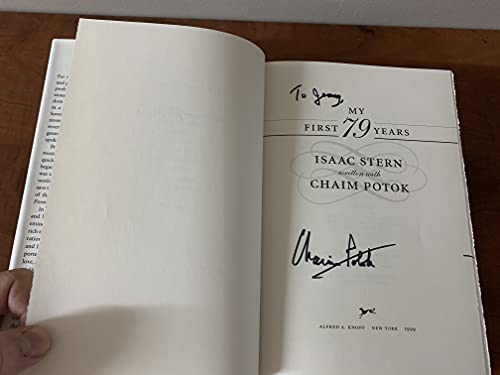
The world famous violinist describes his decades-long love affair with the world of music, his friendships with such notable colleagues as Leonard Bernstein and Pablo Casals, his ideas and beliefs about art and life, and his dedicated work with younger musicians
Die Inhaltsangabe kann sich auf eine andere Ausgabe dieses Titels beziehen.
Über die Autorin bzw. den Autor
Isaac Stern is one of the most celebrated violinists of the century. He lives in Connecticut with his wife, Linda, and Gracie, the cat.<br><br>Chaim Potok is an ordained rabbi and has written many best-selling books, including <b>The Chosen</b> and <b>My Name Is Asher Lev</b>. He lives in Pennsylvania.
Aus dem Klappentext
ur years, Isaac Stern has been a great--and greatly loved--performing artist, famous for his profound music-making, his gusto for life, his passionate dedication to sharing his knowledge and wisdom with younger musicians, and his determination in a good cause (Stern is, after all, The Man Who Saved Carnegie Hall). Indeed, there is no more revered musician in the world than Isaac Stern, revered not only as a great violinist but as a warm and generous personality and as a crucial figure and spokesperson in the world of the arts.<br><br>Brought to America from Russia when he was ten months old, Stern grew up in San Francisco and was quickly recognized as an extraordinary talent. He began performing publicly while still very young, and was soon touring across the country and around the world. His fame escalated when he led the fight to save Carnegie Hall, and again when he was the subject of the Academy Award-winning documentary film <i>From Mao to Mozart</i>.<br><br>In this book he shar
Auszug. © Genehmigter Nachdruck. Alle Rechte vorbehalten.
Early one October morning in 1937 I boarded a double-decker bus at 72nd Street in Manhattan and disappeared. I was seventeen years old.
For the next six hours, no one knew where I was: not my mother, whom I had left at our apartment without informing her that I was going out, nor our friends. The bus traveled up and down the length of Manhattan, from Washington Square to Washington Heights and back again, and I rode and rode, entirely unaware of what I was doing.
I sat on the top deck, gazing out at the streets but not taking in what my eyes were seeing. I had to face a critical moment in my life, and I needed to be alone. My head was filled with the reviews of my debut performance at Town Hall on the evening of October 10. The reviews, I thought, were disastrous.
One critic, writing that I had "sailed into Tartini's 'Devil's Trill' Sonata with the greatest aplomb, revealing a big, beautiful tone of the G string and a pleasant one on the others," added a tart comment about my "generally erratic understanding of the structure and the musical content of the ancient and honorable composition." About my playing of the Glazunov Concerto in G Minor, that same critic wrote that "the work brought no new elements from the violinist's equipment to the surface" and alluded to "a few technical smears."
Another critic began his review with these condescending words: "From that far away land of violinistic prodigies, movie 'yes-men' and sunshine, California, there comes yet another violinist"; and then went on to mention, as if in passing, that I had "definite possibilities." A third wrote, "His tone is good, especially in the lower part of the scale," but added, concerning my technique, "it can scarcely be called transcendent."
I remember yet another critic mentioning that violinists seemed to be "as prevalent in California as oranges," and while conceding that "his talent is indubitable," nevertheless concluded that "one was not wholly convinced that he has actually traversed the Great Divide that separates the promising player from the artist."
I had hoped that my Town Hall debut would be the moment of breakthrough for me, the beginning of a career as a solo concert violinist. Instead, the New York critics were telling me to go home and practice some more, to learn how to ride the horse better. And, riding that bus, I was asking myself repeatedly: Should I keep on trying to become a concert violinist, or should I take one of the many jobs I had been offered by symphony orchestras in New York for more money than I had ever dreamed of making, money that would have meant security for my family?
The hours went by. I didn't know it at the time, but there was a huge panic developing over my disappearance. My mother was telephoning friends to find out where I was. She called the concert manager's office and was beginning to consider calling the police.
In the meantime, I was riding back and forth, trying to decide. My mind was churning. I sat there, letting it churn.
I had come for that Town Hall performance from San Francisco, where I grew up and still lived with my parents and my younger sister, Eva. My father, Solomon -- a dour man, then in his mid-forties -- was born in Kiev. There are pictures of him as a dashing young man with a goatee, wearing high boots and an open silk shirt and holding an easel and a paintbrush. He came from the upper-middle class, as did my mother, Clara, who was seven years younger than he. Her birthplace was Kreminiecz, a town on the Russian-Polish border. My parents told me that they and their families, who had been there for at least a generation or two, always considered the town Russian. And during the week of my birth, my mother had received a scholarship to study singing at the conservatory in St. Petersburg, which was then headed by the famous composer Alexander Glazunov. In order to study in St. Petersburg at that time, she'd had to wear a yellow star, a rule for Jews living outside what was called the Pale. During the turbulent years of 1918-1920, following the Bolshevik Revolution, Kreminiecz changed hands about every two weeks. I was born there on July 21, 1920. It was the Polish two-week period.
In the midst of the Russian Civil War and shortly after the failed Bolshevik invasion of Poland, my father obtained a Polish passport and a visa to the United States. The passport showed his profession to be artist-painter, and his domicile Kreminiecz. After months of travel through Siberia and across the Pacific, we arrived in San Francisco, where my mother's older brother had settled some years before. I was ten months old.
My parents' language was Russian; neither spoke English. They knew a little Yiddish, but it was not a language we used in the house. It's a very expressive language, with many untranslatable phrases, and my parents would use it only to heighten or color certain comments. There was no hint, in anything my parents said, of their having lived anything remotely resembling a traditional Jewish life in Kreminiecz.
I doubt that my father ever had a bar mitzvah, and he felt no inclination to insist that I should, so I didn't. The traditional Jewish home -- challah every Friday night, candles, prayers -- did not exist for us. Religion played no part in my family's life.
Politics, yes -- we were refugees from Russia. My parents were well educated, and naturally liberal. I was impressed then, and still am, by the truth that you can take a Russian out of Russia but you can never take Russia out of a Russian. My parents had nothing to do with Soviet life or the Communist cause. There were long political discussions between them and with other Russian émigrés; they were part of a large group of people to whom everything Russian was familiar and necessary.
My father wasn't trained in a profession. As an artist of sorts, he knew a little bit about paints, so he became a house painter and was quite ill in later life with lead poisoning. He loved stewed prunes and hot chocolate, and he drank coffee; no, he drank sugar with a touch of coffee in it. A normal breakfast for him consisted of eggs, sausage, hotcakes, cheeses -- which might have contributed to the ulcers he developed. During the Depression years, he started going from house to house, selling MJB coffee. Occasionally during the worst times of the Depression, when we didn't have enough money for food, we received the day's version of food stamps: boxes of cans without labels, whose contents we never knew until we opened them.
We moved a number of times during our early years in San Francisco. The two houses I remember best were the Buchanan Street house and the one at 383 29th Avenue. The house on Buchanan Street had a long series of steps that went up to the front door; it was situated on one of those typically steep San Francisco hills that always scare anyone who has never lived in a city like that. The 29th Avenue house, pale yellow or dirty white, was located in the Sunset district, about five blocks from the bay, and two or three miles from the Pacific Ocean and the beach, where there was a seal house and seal rocks and an enormous building, Fleischaker Pool, that had three or four pools, some with salt water and some heated -- quite an exciting structure and for many years a great meeting place. Nearby was the Palace of Fine Arts, built for the 1915 World's Fair.
That was the normal topography of my life. As a child, I would go with my parents and sister, and with cousins and uncles and aunts, for Sunday picnics in Golden Gate Park, one of the largest and most beautiful urban parks in the country, and I remember all our drives through it. There was the area for buffalo, and the large aquarium, and a Japanese teahouse and garden with...
„Über diesen Titel“ kann sich auf eine andere Ausgabe dieses Titels beziehen.
Suchergebnisse für My First 79 Years

Beispielbild für diese ISBN
My First 79 Years
Anbieter: World of Books (was SecondSale), Montgomery, IL, USA
Verkäuferbewertung 5 von 5 Sternen

Hardback. Zustand: Good. There is no more beloved musician in the classical world than Isaac Stern, revered not only as a great violinist but also as a generous personality and a crucial figure in the world of the arts. One of the few people who has known every major classical musician of the last two-thirds of the twentieth century, he shares his personal and artistic experiences in this warm, passionate account of his life: the story of his rise to eminence; his feelings about music and the violin; and his great friendships and collaborations with colleagues such as Leonard Bernstein and Pablo Casals. Stern the man, the musician, and the cultural institution come alive in the most readable and revealing musical autobiography of the decade. Artikel-Nr. 00099326730
Gebraucht kaufen
EUR 4,88
Versand gratis
Versand innerhalb von USA
Versand innerhalb von USA
Anzahl: 7 verfügbar
Beispielbild für diese ISBN
My First 79 Years
Anbieter: ThriftBooks-Atlanta, AUSTELL, GA, USA
Verkäuferbewertung 5 von 5 Sternen
Hardcover. Zustand: As New. No Jacket. Pages are clean and are not marred by notes or folds of any kind. ~ ThriftBooks: Read More, Spend Less. Artikel-Nr. G0679451307I2N00
Gebraucht kaufen
EUR 5,93
Versand gratis
Versand innerhalb von USA
Versand innerhalb von USA
Anzahl: 1 verfügbar
Beispielbild für diese ISBN
My First 79 Years
Anbieter: ThriftBooks-Dallas, Dallas, TX, USA
Verkäuferbewertung 5 von 5 Sternen
Hardcover. Zustand: Very Good. No Jacket. Former library book; May have limited writing in cover pages. Pages are unmarked. ~ ThriftBooks: Read More, Spend Less. Artikel-Nr. G0679451307I4N10
Gebraucht kaufen
EUR 5,93
Versand gratis
Versand innerhalb von USA
Versand innerhalb von USA
Anzahl: 1 verfügbar
Beispielbild für diese ISBN
My First 79 Years
Anbieter: ThriftBooks-Dallas, Dallas, TX, USA
Verkäuferbewertung 5 von 5 Sternen
Hardcover. Zustand: Very Good. No Jacket. May have limited writing in cover pages. Pages are unmarked. ~ ThriftBooks: Read More, Spend Less. Artikel-Nr. G0679451307I4N00
Gebraucht kaufen
EUR 5,93
Versand gratis
Versand innerhalb von USA
Versand innerhalb von USA
Anzahl: 1 verfügbar
Beispielbild für diese ISBN
My First 79 Years
Anbieter: ThriftBooks-Dallas, Dallas, TX, USA
Verkäuferbewertung 5 von 5 Sternen
Hardcover. Zustand: Very Good. No Jacket. Missing dust jacket; May have limited writing in cover pages. Pages are unmarked. ~ ThriftBooks: Read More, Spend Less. Artikel-Nr. G0679451307I4N01
Gebraucht kaufen
EUR 5,93
Versand gratis
Versand innerhalb von USA
Versand innerhalb von USA
Anzahl: 1 verfügbar
Beispielbild für diese ISBN
My First 79 Years
Anbieter: BooksRun, Philadelphia, PA, USA
Verkäuferbewertung 5 von 5 Sternen
Hardcover. Zustand: Very Good. With dust jacket. It's a well-cared-for item that has seen limited use. The item may show minor signs of wear. All the text is legible, with all pages included. It may have slight markings and/or highlighting. Artikel-Nr. 0679451307-11-1-29
Gebraucht kaufen
EUR 5,95
Versand gratis
Versand innerhalb von USA
Versand innerhalb von USA
Anzahl: 1 verfügbar
Beispielbild für diese ISBN
My First 79 Years
Anbieter: Wonder Book, Frederick, MD, USA
Verkäuferbewertung 5 von 5 Sternen
Zustand: Very Good. Very Good condition. Good dust jacket. A copy that may have a few cosmetic defects. May also contain light spine creasing or a few markings such as an owner's name, short gifter's inscription or light stamp. Bundled media such as CDs, DVDs, floppy disks or access codes may not be included. Artikel-Nr. P11G-01812
Gebraucht kaufen
EUR 6,35
Versand gratis
Versand innerhalb von USA
Versand innerhalb von USA
Anzahl: 1 verfügbar
Beispielbild für diese ISBN
My First 79 Years
Anbieter: Wonder Book, Frederick, MD, USA
Verkäuferbewertung 5 von 5 Sternen
Zustand: Very Good. Very Good condition. Very Good dust jacket. A copy that may have a few cosmetic defects. May also contain light spine creasing or a few markings such as an owner's name, short gifter's inscription or light stamp. Artikel-Nr. K04E-01635
Gebraucht kaufen
EUR 6,35
Versand gratis
Versand innerhalb von USA
Versand innerhalb von USA
Anzahl: 2 verfügbar
Beispielbild für diese ISBN
My First 79 Years
Verlag:
Knopf Doubleday Publishing Group, 1999
ISBN 10: 0679451307
ISBN 13: 9780679451303
Gebraucht
Hardcover
Anbieter: Better World Books, Mishawaka, IN, USA
Verkäuferbewertung 5 von 5 Sternen
Zustand: Good. 2nd printing. Former library copy. Pages intact with minimal writing/highlighting. The binding may be loose and creased. Dust jackets/supplements are not included. Includes library markings. Stock photo provided. Product includes identifying sticker. Better World Books: Buy Books. Do Good. Artikel-Nr. GRP78803612
Gebraucht kaufen
EUR 6,84
Versand gratis
Versand innerhalb von USA
Versand innerhalb von USA
Anzahl: 1 verfügbar
Beispielbild für diese ISBN
My First 79 Years
Verlag:
Knopf Doubleday Publishing Group, 1999
ISBN 10: 0679451307
ISBN 13: 9780679451303
Gebraucht
Hardcover
Anbieter: Better World Books: West, Reno, NV, USA
Verkäuferbewertung 5 von 5 Sternen
Zustand: Very Good. 2nd printing. Pages intact with possible writing/highlighting. Binding strong with minor wear. Dust jackets/supplements may not be included. Stock photo provided. Product includes identifying sticker. Better World Books: Buy Books. Do Good. Artikel-Nr. 11413079-6
Gebraucht kaufen
EUR 6,84
Versand gratis
Versand innerhalb von USA
Versand innerhalb von USA
Anzahl: 1 verfügbar