
Verwandte Artikel zu Princesses: The Six Daughters of George III
Inhaltsangabe
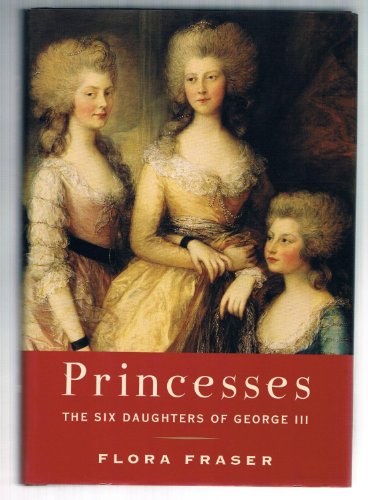
From acclaimed biographer Flora Fraser, a brilliant group biography of the six daughters of “Mad” King George III.
Fraser takes us into the heart of the British royal family during the tumultuous period of the American and French revolutions and beyond, illuminating the complicated lives of these exceptional women: Princess Royal, the eldest, constantly at odds with her mother; home-loving, family-minded Augusta; plump Elizabeth, a gifted amateur artist; Mary, the bland beauty of the family; Sophia, emotional and prone to take refuge in illness; and Amelia, “the most turbulent and tempestuous of all the Princesses.” Weaving together letters and historical accounts, Fraser re-creates their world in all its frustrations and excitements.
The six sisters, though handsome, accomplished and extremely well educated, were kept from marrying by George III, and Fraser describes how they remained subject to their father for many years, while he teetered on the brink of mental collapse. The King may have believed that his six daughters were happy to live celibately at Windsor, but secretly, as Fraser’s absorbing narrative of royal repression and sexual license shows, the sisters enjoyed startling freedom. Several of them, torn between love for their ailing father and longing for independence, forged their own scandalous and subversive lives within the castle walls. With a discerning eye for psychological detail and a keen feminist sensibility, Fraser delves into these clandestine love affairs, revealing the truth about Sophia’s illegitimate baby; examining Amelia's intimate correspondence with her soldier-lover; and investigating the eventual marriages of Princesses Royal, Elizabeth and Mary.
Never before has the historical searchlight been turned with such sympathy and acuity on George III and his family. With unparalleled access to royal and private family papers, Flora Fraser has created a revelatory portrait of six fascinating women and their place in history.
Die Inhaltsangabe kann sich auf eine andere Ausgabe dieses Titels beziehen.
Über die Autorin bzw. den Autor
Flora Fraser is the author of biographies of Emma Hamilton, Beloved Emma, and Queen Caroline, The Unruly Queen. She lives in London with her husband and three children.
Flora Fraser’s Beloved Emma is available in Anchor paperback.
Auszug. © Genehmigter Nachdruck. Alle Rechte vorbehalten.
Chapter 1
Early Days
Towards the end of September 1766 the Prince of Wales, who was only four, told a lady at Court that “about next week” he reckoned they should have “a little princess.” George Augustus Frederick, the eldest son of King George III and Queen Charlotte, was known to be precocious. His mother’s Mistress of the Robes called him “the forwardest child in understanding” that she ever saw. And so, far from doubting the child’s prediction, his confidante, Lady Mary Coke, added in her journal, “I find the King and Queen are very desirous it should be one [a girl] and hope they shall have no more sons.”
The additional information probably issued from Lady Mary’s friend Lady Charlotte Finch, who had been appointed royal governess the day after the Prince of Wales’s birth on 12 August 1762. Lady Charlotte and her deputy, or sub-governess, Mrs. Cotesworth had since received into the nursery establishment two further princes, Frederick and William, in 1763 and 1765. To these ladies, who looked after their boisterous charges in the summer at Richmond and Kew, and in the winter at the Queen’s House in London, as much as to the royal parents, a baby girl represented a hope of dulcet peace and feminine charms.
In the event, George, Prince of Wales was confirmed as a prophet in the land when his mother Queen Charlotte, at the age of twenty-two, gave birth in London to a baby princess the following Monday—Michaelmas Day, 29 September. The celebrated anatomist and royal obstetrician Dr. William Hunter hovered with the King and the King’s mother, the Dowager Princess of Wales, in an adjoining room at the Queen’s House, the royal family’s private residence overlooking the Mall and St. James’s Park.* But nothing untoward took place in the crimson damask bedchamber next door to require their presence. Lady Charlotte Finch, who had moved up to nearby apartments at St. James’s Palace the evening before to oversee the practical arrangements for the new baby, wrote in her journal that night: “At a quarter past eight this morning the Queen was safely delivered of a Princess Royal. Passed all morning at the Queen’s House . . .” That date, 29 September—the quarter-day when, in the greater world, rents became due and, in the royal household, salaries were paid—was to be long dear to the Queen, who was not sentimental by nature, as the day she gave birth to her “Michaelmas goose.”
Names were awaiting the baby Princess: Charlotte, for her mother; Augusta, for her father’s mother; and Matilda, for the King’s sister Caroline Matilda, who, aged fifteen, was leaving England within a few days to marry the King of Denmark. (The English Houses of Parliament gave economical thanks on the same occasion for the birth of the Princess and the marriage of her aunt.) But, as her new governess’s journal entry indicates, by none of her Christian names was King George III and Queen Charlotte’s eldest daughter to be known. At birth, her proud father and sovereign of England had bestowed on her for life the style of Princess Royal, and this (shortened to Royal by her family) is how she was always known in England—although, curiously, the style was only officially granted her years later on 22 June 1789.
The Stuart King Charles I’s eldest daughter Mary had been, in 1642, the first English princess to have been styled Princess Royal. She was eleven and leaving England to be the bride of William of Orange, the future Stadholder in Holland. No other princess was so honoured until 1727, when the Hanoverian King George II of England styled his daughter Anne—who also became a princess of Orange and lived until 1759—Princess Royal, when she was nineteen years old. King George III’s decision in 1766 to make his daughter while still a baby a princess royal in part reflected England’s recent surge in prestige since his accession in 1760, notably with the successful outcome of the Seven Years War in 1763. But it also reflected the unreserved and almost awestruck delight that he exhibited as a young father—some felt, to the detriment of royal dignity—in his infant daughter.
The day after the Princess Royal’s birth, her three brothers, George, Prince of Wales, Prince Frederick and thirteen-month-old William, came up to London to inspect their new sister. Prince William, till now the baby of the family, was a general favourite at Richmond Lodge, the King’s house in woods adjacent to Kew Gardens, where the royal children generally lived during the summer months. As it was not a large house, the children’s attendants—their governess Lady Charlotte Finch among them—were mostly lodged in houses grouped around the King’s mother’s house, the White House in Kew Gardens, and the children spent much of their time there.
A few weeks before the Princess Royal was born in September 1766, Miss Henrietta Finch, one of Lady Charlotte’s daughters, wrote to an absent sister:
We saw the King and Queen last night, they was in Mama’s parlour. We stayed in the room the whole time, they was vastly good humoured and enquired vastly after you. Little Prince William was undressed quite naked and laid upon a cushion, the King made him stand up upon it. I thought I should have died with laughing at his little ridiculous white figure.
The King adored Prince William’s sturdy elder brother Prince Frederick, who was aged three when his sister was born. A year earlier Lady Charlotte Finch recorded the royal father’s close involvement in all his second son’s doings in the autumn of 1765:
Mr. Glenton the tailor is the happiest man in the kingdom. He has been sent for to make a coat for Prince Frederick, and when he came, was ordered to go and take measure of him in the room where the King was. At which he was so astonished and so terrified that his knees knocked together so, they could hardly persuade him to go in. And when he was there, he did not know what he did. And when he came upstairs, he begged he might stay till the prince came up, for he owned he did not know anything of his measures. However, he has made the clothes so excessively neat and fit, that when he brought them home, the King spoke to him himself and commended them. And he is now so happy you cannot conceive anything like his spirits. He is now making another suit for Prince Frederick. However, it is only by way of dressing him in them sometimes, as the King is fond of seeing him in breeches . . . The Queen likes to keep him a little longer in petticoats.
It was evident that the King did not dote on his heir, a less manly child than Frederick. In this sultry summer of 1766, Miss Henrietta Finch noted encouragingly, “I think the King grows very fond of the Prince of Wales, though he does certainly snap [at] him sometimes.” The King’s coolness towards his heir was not lamented as it might have been. It was understood by all that, in the Hanoverian succession, there was an unfortunate tendency for the monarch and his heir to have differences. And the Prince of Wales’s sophistication and insouciant charm continued to attract many admirers, not least his mother and governess. Queen Charlotte was always to love her firstborn best of all her children, and Lady Charlotte recounted her eldest royal charge’s bons mots with pride.
Asked earlier that year if he found tedious the hours spent in a darkened room that custom prescribed following inoculation against smallpox, the Prince replied, “Not at all, I lie awake and make reflections.” Lady Mary...
„Über diesen Titel“ kann sich auf eine andere Ausgabe dieses Titels beziehen.
Suchergebnisse für Princesses: The Six Daughters of George III

Beispielbild für diese ISBN
Princesses: The Six Daughters of George III
Anbieter: World of Books (was SecondSale), Montgomery, IL, USA
Verkäuferbewertung 5 von 5 Sternen

Hardback. Zustand: Good. From acclaimed biographer Flora Fraser, a brilliant group biography of the six daughters of Mad King George I. Fraser takes us into the heart of the British royal family during the tumultuous period of the American and French revolutions and beyond, illuminating the complicated lives of these exceptional women: Princess Royal, the eldest, constantly at odds with her mother; home-loving, family-minded Augusta; plump Elizabeth, a gifted amateur artist; Mary, the bland beauty of the family; Sophia, emotional and prone to take refuge in illness; and Amelia, the most turbulent and tempestuous of all the Princesses. Weaving together letters and historical accounts, Fraser re-creates their world in all its frustrations and excitements. The six sisters, though handsome, accomplished and extremely well educated, were kept from marrying by George I, and Fraser describes how they remained subject to their father for many years, while he teetered on the brink of mental collapse. The King may have believed that his six daughters were happy to live celibately at Windsor, but secretly, as Fraser's absorbing narrative of royal repression and sexual license shows, the sisters enjoyed startling freedom. Several of them, torn between love for their ailing father and longing for independence, forged their own scandalous and subversive lives within the castle walls. With a discerning eye for psychological detail and a keen feminist sensibility, Fraser delves into these clandestine love affairs, revealing the truth about Sophia's illegitimate baby; examining Amelia's intimate correspondence with her soldier-lover; and investigating the eventual marriages of Princesses Royal, Elizabeth andMary. Never before has the historical searchlight been turned with such sympathy and acuity on George I and his family. With unparalleled access to royal and private family papers, Flora Fraser has created a revelatory portrait of six fascinating women and their place in history. From the Hardcover edition. Artikel-Nr. 00097987844
Gebraucht kaufen
EUR 5,91
Versand gratis
Versand innerhalb von USA
Versand innerhalb von USA
Anzahl: 2 verfügbar
Beispielbild für diese ISBN
Princesses: The Six Daughters of George III
Anbieter: World of Books (was SecondSale), Montgomery, IL, USA
Verkäuferbewertung 5 von 5 Sternen
Hardback. Zustand: Fair. From acclaimed biographer Flora Fraser, a brilliant group biography of the six daughters of Mad King George I. Fraser takes us into the heart of the British royal family during the tumultuous period of the American and French revolutions and beyond, illuminating the complicated lives of these exceptional women: Princess Royal, the eldest, constantly at odds with her mother; home-loving, family-minded Augusta; plump Elizabeth, a gifted amateur artist; Mary, the bland beauty of the family; Sophia, emotional and prone to take refuge in illness; and Amelia, the most turbulent and tempestuous of all the Princesses. Weaving together letters and historical accounts, Fraser re-creates their world in all its frustrations and excitements. The six sisters, though handsome, accomplished and extremely well educated, were kept from marrying by George I, and Fraser describes how they remained subject to their father for many years, while he teetered on the brink of mental collapse. The King may have believed that his six daughters were happy to live celibately at Windsor, but secretly, as Fraser's absorbing narrative of royal repression and sexual license shows, the sisters enjoyed startling freedom. Several of them, torn between love for their ailing father and longing for independence, forged their own scandalous and subversive lives within the castle walls. With a discerning eye for psychological detail and a keen feminist sensibility, Fraser delves into these clandestine love affairs, revealing the truth about Sophia's illegitimate baby; examining Amelia's intimate correspondence with her soldier-lover; and investigating the eventual marriages of Princesses Royal, Elizabeth andMary. Never before has the historical searchlight been turned with such sympathy and acuity on George I and his family. With unparalleled access to royal and private family papers, Flora Fraser has created a revelatory portrait of six fascinating women and their place in history. From the Hardcover edition. Artikel-Nr. 00097764172
Gebraucht kaufen
EUR 5,91
Versand gratis
Versand innerhalb von USA
Versand innerhalb von USA
Anzahl: 1 verfügbar
Beispielbild für diese ISBN
Princesses: The Six Daughters of George III
Anbieter: ThriftBooks-Dallas, Dallas, TX, USA
Verkäuferbewertung 5 von 5 Sternen
Hardcover. Zustand: Fair. No Jacket. Missing dust jacket; Readable copy. Pages may have considerable notes/highlighting. ~ ThriftBooks: Read More, Spend Less. Artikel-Nr. G0679451188I5N01
Gebraucht kaufen
EUR 6,00
Versand gratis
Versand innerhalb von USA
Versand innerhalb von USA
Anzahl: 1 verfügbar
Beispielbild für diese ISBN
Princesses: The Six Daughters of George III
Anbieter: ThriftBooks-Atlanta, AUSTELL, GA, USA
Verkäuferbewertung 5 von 5 Sternen
Hardcover. Zustand: Good. No Jacket. Pages can have notes/highlighting. Spine may show signs of wear. ~ ThriftBooks: Read More, Spend Less. Artikel-Nr. G0679451188I3N00
Gebraucht kaufen
EUR 6,00
Versand gratis
Versand innerhalb von USA
Versand innerhalb von USA
Anzahl: 1 verfügbar
Beispielbild für diese ISBN
Princesses: The Six Daughters of George III
Anbieter: ThriftBooks-Dallas, Dallas, TX, USA
Verkäuferbewertung 5 von 5 Sternen
Hardcover. Zustand: Good. No Jacket. Missing dust jacket; Pages can have notes/highlighting. Spine may show signs of wear. ~ ThriftBooks: Read More, Spend Less. Artikel-Nr. G0679451188I3N01
Gebraucht kaufen
EUR 6,00
Versand gratis
Versand innerhalb von USA
Versand innerhalb von USA
Anzahl: 1 verfügbar
Beispielbild für diese ISBN
Princesses: The Six Daughters of George III
Anbieter: ThriftBooks-Phoenix, Phoenix, AZ, USA
Verkäuferbewertung 5 von 5 Sternen
Hardcover. Zustand: Fair. No Jacket. Former library book; Readable copy. Pages may have considerable notes/highlighting. ~ ThriftBooks: Read More, Spend Less. Artikel-Nr. G0679451188I5N10
Gebraucht kaufen
EUR 6,00
Versand gratis
Versand innerhalb von USA
Versand innerhalb von USA
Anzahl: 1 verfügbar
Beispielbild für diese ISBN
Princesses : The Six Daughters of George III
Verlag:
Knopf Doubleday Publishing Group, 2005
ISBN 10: 0679451188
ISBN 13: 9780679451181
Gebraucht
Hardcover
Erstausgabe
Anbieter: Better World Books, Mishawaka, IN, USA
Verkäuferbewertung 5 von 5 Sternen
Zustand: Good. 1ST. Former library copy. Pages intact with minimal writing/highlighting. The binding may be loose and creased. Dust jackets/supplements are not included. Includes library markings. Stock photo provided. Product includes identifying sticker. Better World Books: Buy Books. Do Good. Artikel-Nr. GRP87086199
Gebraucht kaufen
EUR 6,51
Versand gratis
Versand innerhalb von USA
Versand innerhalb von USA
Anzahl: 1 verfügbar
Beispielbild für diese ISBN
Princesses : The Six Daughters of George III
Verlag:
Knopf Doubleday Publishing Group, 2005
ISBN 10: 0679451188
ISBN 13: 9780679451181
Gebraucht
Hardcover
Erstausgabe
Anbieter: Better World Books, Mishawaka, IN, USA
Verkäuferbewertung 5 von 5 Sternen
Zustand: Very Good. 1ST. Former library copy. Pages intact with possible writing/highlighting. Binding strong with minor wear. Dust jackets/supplements may not be included. Includes library markings. Stock photo provided. Product includes identifying sticker. Better World Books: Buy Books. Do Good. Artikel-Nr. 3387358-75
Gebraucht kaufen
EUR 6,51
Versand gratis
Versand innerhalb von USA
Versand innerhalb von USA
Anzahl: 1 verfügbar
Beispielbild für diese ISBN
Princesses: The Six Daughters of George III
Anbieter: Wonder Book, Frederick, MD, USA
Verkäuferbewertung 5 von 5 Sternen
Zustand: Good. Good condition. Good dust jacket. A copy that has been read but remains intact. May contain markings such as bookplates, stamps, limited notes and highlighting, or a few light stains. Artikel-Nr. G10L-0898
Gebraucht kaufen
EUR 6,62
Versand gratis
Versand innerhalb von USA
Versand innerhalb von USA
Anzahl: 1 verfügbar
Beispielbild für diese ISBN
Princesses: The Six Daughters of George III
Anbieter: Wonder Book, Frederick, MD, USA
Verkäuferbewertung 5 von 5 Sternen
Zustand: Very Good. Very Good condition. Good dust jacket. A copy that may have a few cosmetic defects. May also contain light spine creasing or a few markings such as an owner's name, short gifter's inscription or light stamp. Artikel-Nr. I17A-04824
Gebraucht kaufen
EUR 6,62
Versand gratis
Versand innerhalb von USA
Versand innerhalb von USA
Anzahl: 1 verfügbar