
Verwandte Artikel zu Altered States
Inhaltsangabe
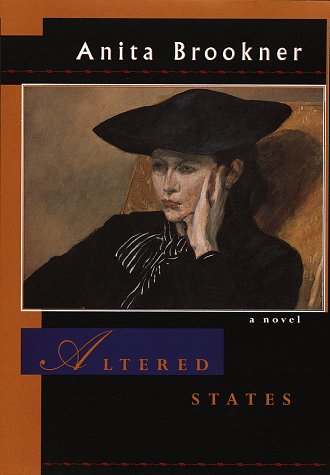
Lonely, shocked by his mother's remarriage, and haunted by memories of a passionate and destructive affair with Sarah Miller, Alan Sherwood becomes engaged to Angela, a fragile, needy woman, until Sarah unexpectedly reenters his life. 30,000 first printing.
Die Inhaltsangabe kann sich auf eine andere Ausgabe dieses Titels beziehen.
Über die Autorinnen und Autoren
Anita Brookner was born in London in 1928. She received a B.A. from King's College, University of London, and a Ph.D. in the history of art from the Courtauld Institute. Brookner taught at the University of Reading from 1959 to 1964, and since 1967 has been a Lecturer in Art History at the Courtauld. From 1967 to 1968 she was Slade Professor at Cambridge, the first woman to hold that position.
Since her first novel was published in 1981, Brookner has had a dual career as an art historian and a novelist. She has been remarkably successful in both fields and has published fourteen novels in as many years. Hotel du Lac, her fourth novel, won the Booker Prize, England's highest honor for fiction.
From the Trade Paperback edition.
Anita Brookner became the first female Slade Professor at Cambridge University in 1968.
Aus dem Klappentext
f Hotel du Lac explores the conflicting needs of men and women, and the lack of understanding that divides them. Following the remarriage of his mother, Alan relectantly becomes engaged to fragile, needy Angela. When Sarah, the object of a previous, destructive affair, reenters his life, Alan embarks on an act of betrayal, the tragic consequences of which will change his life forever. 240 pp. Print ads. 30,000 print.
Auszug. © Genehmigter Nachdruck. Alle Rechte vorbehalten.
The woman on the station platform had her back to me. If she had turned round I would have been able to satisfy myself that she was not someone I had once known. Even at this distance of time and place I should have known that other woman anywhere. As it was I could only contemplate this particular back view and once again return my memories to the oubliette to which I had consigned them. I was in any case reluctant to proceed to an identification. The woman on the station platform was smartly but not fashionably dressed in a sober chestnut-coloured suit and the sort of brown felt hat still favoured by certain middle-aged middle-class women in Germany. I doubted whether this woman was German, although she certainly looked European. This much was attested by her shoes, which again were smart without being fashionable: narrow brown brogues, with a medium heel. I noticed that they were brilliantly polished.
That I was able to contemplate this woman at such length no doubt says something about myself, but I am averse to falsely intelligent summaries, such as seem to be prevalent nowadays, and prefer long moments of reverie and speculation, which seem to me more conducive to satisfactory conclusions. We were the only two people on this particular platform, and I was only there because I had come down to the station to buy the English papers, which usually arrived at about four o'clock. The light was already going: it was a misty dusky afternoon, still quite mild, but with that particular stillness that speaks so eloquently of the decline of the year, and with it all hopes one had had in the spring, season of false promises. Behind me, in the town, I had left the subdued comfort of the English Tea Rooms: beyond, at the end of the main street, at the foot of the steep path leading up to the hilly suburbs where all the more prosperous villas stood, was the Hotel Eden, and my small and dreadfully quiet room. This was too like a monastic cell to convey any prospect other than that of austere rest, such as might be appreciated by those who had spent the day walking, as I was supposed to have done. Sometimes I managed to coax some whispery music out of the bedside radio; that, if I were particularly tired, was generally distraction enough. But on this quiet afternoon I was bored, and had felt the need of some human presence, or at least of newsprint. If I lingered on this station platform it was because it seemed an appropriate place to be at the end of an uneventful afternoon. And because, for one shocking moment, I had thought the woman with her back to me, with her sensible hat and shoes, might be Sarah Miller, or Sarah de Leuze, as she now presumably was, who had the gift of turning up when least expected. It was part of her ravaging charm to disarm one with her presence when one had thought her lost for ever, only to disappear again when one's need had turned to the most intense and hopeless longing.
I felt that longing now. That was why I lingered, in the misty half light, in my bulky English clothes: Burberry and tweed cap, woollen socks and walking shoes. I tend to wear everything when I travel, so as not to carry much. With my small bag I can pick up and disappear quite easily. I had nothing much to do with my time, and no one was expecting me, which was why I lingered, a substantial English ghost, haunting the woman in the German hat, until it became borne in on me that she was not at all like Sarah, was older (though Sarah would now be nearly my age), was more settled, with a fantastic air of capability conveyed by her back.
A housewife, I concluded, although that term is anachronistic these days, or perhaps just a wife, married to one of those silent substantial peaceable men in whom this region abounds. The woman too had an air of peaceable worth about her, and in my fantasy I endowed her not only with an excellent digestion but a good conscience, the one usually contingent upon the other, in no particular order. Then the woman shifted her weight from one ankle to the other, and the way her knees came together reminded me again of Sarah, and her habit of swaying from one foot to the other, a mocking smile on her face, as if enjoying one's too fervent gaze. If this woman were Sarah I would fold my arms around her, as I had always tried to do, and sometimes succeeded in doing, before she escaped. There was of course no question of my touching this utterly respectable woman, whose face I still had not seen. It was simply that the combination of dull weather and grave silence, the thin white mist that so often descends without warning here and seems to lay delicate fingers on the skin of one's face, and the benign emptiness of this quiet little town might have emboldened me, not to embark on any crude adventure, but to remember the woman for whom I had been searching, and not only metaphorically but in pursuit of a mission. That was the fruitless task which I had undertaken in order to pacify a poor sick woman, not quite a relative, on what was too obviously her deathbed.
I felt that this person on the platform might hold the key to the mystery, might in some extraordinary way enlighten me as to where Sarah might be, for although I tended to see her everywhere I had not yet laid eyes on her in ways that might be construed as physical, verifiable, even disappointing, as the end of certain stories sometimes turns out to be. This woman in the brown hat, this very real woman, would no doubt have a settled existence and many friends: she could ask questions, might already know a certain amount. The fact that her presence, or rather what I could intuit from her back view, was so compelling, awoke in me the suspicious feeling that if she were not Sarah herself, restored to me in this strange manner after an absence of fifteen years, then she might possibly know where Sarah might be. My desire to address her, so that she would turn and show me her face, was negated by my immobility, my inability to move, and by the weight of memory that I allowed to overwhelm me for a brief moment. I felt that even if I managed to open my mouth no sound would come. Besides, the silence of that still afternoon laid a kind of enchantment on the scene which was not unpleasant to me: to break it would have seemed unmannerly. I felt that the woman and I were contained in this enchantment, and that the station of this little town was the setting for some drama that would eventually unfold, and in which we would both be bidden to speak, although our lines had not yet been written.
Then the guard came out and posted the sign for the Geneva train, and within seconds people arrived from nowhere, some of them dragging suitcases on wheels, and I lost sight of the woman who was probably-undoubtedly-not Sarah. When the train disappeared and silence was restored she was nowhere to be seen. In an hour's time she would be in Geneva, perhaps in an apartment in the rue des Bains-the last address I had for Sarah-drinking a cup of coffee, raising a forkful of cake to her mouth. I stood for a few minutes, feeling heavy in my raincoat, feeling too a regret that nevertheless had something anticipatory about it, a very small dawning of excitement that was less like an ending than a beginning. Then I turned, and with my papers under my arm, began the long and by now chilly walk back to my hotel.
I usually take my holiday late in the year, leaving current matters in the capable hands of my partner, Brian Smith. I am, as ever, beguiled by the prospect of a golden October, trees still full but changing colour, thoughts of the vintage occupying one's mind. In my politically incorrect way I like to think of smiling inhabitants ready to welcome me. These people would once have been described as peasants, though if peasants still exist they are mostly indoors watching television. What I invariably encounter is this curious sense of withdrawal, this...
„Über diesen Titel“ kann sich auf eine andere Ausgabe dieses Titels beziehen.
Suchergebnisse für Altered States

Beispielbild für diese ISBN
Altered States
Verlag:
Random House (edition ), 1996
ISBN 10: 0679449736
ISBN 13: 9780679449737
Gebraucht
Hardcover
Anbieter: BooksRun, Philadelphia, PA, USA
Verkäuferbewertung 5 von 5 Sternen

Hardcover. Zustand: Very Good. With dust jacket. It's a well-cared-for item that has seen limited use. The item may show minor signs of wear. All the text is legible, with all pages included. It may have slight markings and/or highlighting. Artikel-Nr. 0679449736-11-1-29
Gebraucht kaufen
EUR 5,36
Versand gratis
Versand innerhalb von USA
Versand innerhalb von USA
Anzahl: 1 verfügbar
Beispielbild für diese ISBN
Altered States
Anbieter: World of Books (was SecondSale), Montgomery, IL, USA
Verkäuferbewertung 5 von 5 Sternen
Zustand: Good. Item in good condition. Textbooks may not include supplemental items i.e. CDs, access codes etc. Artikel-Nr. 00110635363
Gebraucht kaufen
EUR 5,38
Versand gratis
Versand innerhalb von USA
Versand innerhalb von USA
Anzahl: 1 verfügbar
Beispielbild für diese ISBN
Altered States
Verlag:
Random House Publishing Group, 1996
ISBN 10: 0679449736
ISBN 13: 9780679449737
Gebraucht
Hardcover
Erstausgabe
Anbieter: Better World Books: West, Reno, NV, USA
Verkäuferbewertung 5 von 5 Sternen
Zustand: Good. 1st ed. Former library copy. Pages intact with minimal writing/highlighting. The binding may be loose and creased. Dust jackets/supplements are not included. Includes library markings. Stock photo provided. Product includes identifying sticker. Better World Books: Buy Books. Do Good. Artikel-Nr. 12742464-75
Gebraucht kaufen
EUR 6,04
Versand gratis
Versand innerhalb von USA
Versand innerhalb von USA
Anzahl: 1 verfügbar
Beispielbild für diese ISBN
Altered States
Verlag:
Random House Publishing Group, 1996
ISBN 10: 0679449736
ISBN 13: 9780679449737
Gebraucht
Hardcover
Erstausgabe
Anbieter: Better World Books, Mishawaka, IN, USA
Verkäuferbewertung 5 von 5 Sternen
Zustand: Good. 1st ed. Pages intact with minimal writing/highlighting. The binding may be loose and creased. Dust jackets/supplements are not included. Stock photo provided. Product includes identifying sticker. Better World Books: Buy Books. Do Good. Artikel-Nr. 9544878-6
Gebraucht kaufen
EUR 6,04
Versand gratis
Versand innerhalb von USA
Versand innerhalb von USA
Anzahl: 1 verfügbar
Beispielbild für diese ISBN
Altered States
Anbieter: ThriftBooks-Atlanta, AUSTELL, GA, USA
Verkäuferbewertung 5 von 5 Sternen
Hardcover. Zustand: As New. No Jacket. Pages are clean and are not marred by notes or folds of any kind. ~ ThriftBooks: Read More, Spend Less. Artikel-Nr. G0679449736I2N00
Gebraucht kaufen
EUR 6,19
Versand gratis
Versand innerhalb von USA
Versand innerhalb von USA
Anzahl: 1 verfügbar
Beispielbild für diese ISBN
Altered States
Anbieter: Wonder Book, Frederick, MD, USA
Verkäuferbewertung 5 von 5 Sternen
Zustand: Very Good. Very Good condition. Good dust jacket. A copy that may have a few cosmetic defects. May also contain light spine creasing or a few markings such as an owner's name, short gifter's inscription or light stamp. Bundled media such as CDs, DVDs, floppy disks or access codes may not be included. Artikel-Nr. Q12A-01395
Gebraucht kaufen
EUR 6,27
Versand gratis
Versand innerhalb von USA
Versand innerhalb von USA
Anzahl: 1 verfügbar
Beispielbild für diese ISBN
Altered States
Anbieter: Wonder Book, Frederick, MD, USA
Verkäuferbewertung 5 von 5 Sternen
Zustand: Very Good. Very Good condition. Very Good dust jacket. A copy that may have a few cosmetic defects. May also contain light spine creasing or a few markings such as an owner's name, short gifter's inscription or light stamp. Artikel-Nr. E01B-01268
Gebraucht kaufen
EUR 6,27
Versand gratis
Versand innerhalb von USA
Versand innerhalb von USA
Anzahl: 1 verfügbar
Beispielbild für diese ISBN
Altered States
Anbieter: Visible Voice Books, Cleveland, OH, USA
Verkäuferbewertung 5 von 5 Sternen
hardcover. Zustand: Very Good. Random House (NY) December 1996 Hardcover with jacket. Scuffing to jacket. Clean text block. Tight binding. Artikel-Nr. 170370
Gebraucht kaufen
EUR 4,49
EUR 3,92 Versand
Versand innerhalb von USA
Versand innerhalb von USA
Anzahl: 1 verfügbar
Beispielbild für diese ISBN
Altered States
Anbieter: AwesomeBooks, Wallingford, Vereinigtes Königreich
Verkäuferbewertung 5 von 5 Sternen
Hardcover. Zustand: Very Good. Altered States This book is in very good condition and will be shipped within 24 hours of ordering. The cover may have some limited signs of wear but the pages are clean, intact and the spine remains undamaged. This book has clearly been well maintained and looked after thus far. Money back guarantee if you are not satisfied. See all our books here, order more than 1 book and get discounted shipping. Artikel-Nr. 7719-9780679449737
Gebraucht kaufen
EUR 3,71
EUR 4,81 Versand
Versand von Vereinigtes Königreich nach USA
Versand von Vereinigtes Königreich nach USA
Anzahl: 2 verfügbar
Foto des Verkäufers
Altered States
Anbieter: WeBuyBooks, Rossendale, LANCS, Vereinigtes Königreich
Verkäuferbewertung 5 von 5 Sternen
hardcover. Zustand: Very Good. Most items will be dispatched the same or the next working day. A copy that has been read, but is in excellent condition. Pages are intact and not marred by notes or highlighting. The spine remains undamaged. Artikel-Nr. rev9843657422
Gebraucht kaufen
EUR 1,63
EUR 7,26 Versand
Versand von Vereinigtes Königreich nach USA
Versand von Vereinigtes Königreich nach USA
Anzahl: 1 verfügbar