
Verwandte Artikel zu Snow Falling on Cedars
Inhaltsangabe
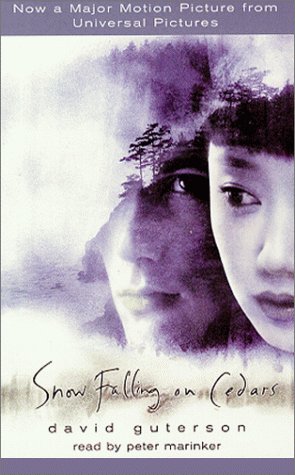
A Japanese-American fisherman's 1954 murder trial becomes the backdrop of a story that follows a doomed love affair between a white boy and a Japanese girl, a simmering land dispute, and the wartime internment of San Piedro's Japanese residents. Book available.
Die Inhaltsangabe kann sich auf eine andere Ausgabe dieses Titels beziehen.
Über die Autorin bzw. den Autor
David Guterson's Snow Falling on Cedars won the PEN/Faulkner Award and the American Booksellers Association Book of the Year Award, among others. He is a contributing editor at Harper's magazine and lives on an island in Puget Sound.
Auszug. © Genehmigter Nachdruck. Alle Rechte vorbehalten.
At the intersection of Center Valley Road and South Beach Drive Ishmael spied, ahead of him in the bend, a car that had failed to negotiate the grade as it coiled around a grove of snow-hung cedars. Ishmael recognized it as the Willys station wagon that belonged to Fujiko and Hisao Imada; in fact, Hisao was working with a shovel at its rear right wheel, which had dropped into the roadside drainage ditch.
Hisao Imada was small enough most of the time, but he looked even smaller bundled up in his winter clothes, his hat pulled low and his scarf across his chin so that only his mouth, nose, and eyes showed. Ishmael knew he would not ask for help, in part because San Piedro people never did, in part because such was his character. Ishmael decided to park at the bottom of the grade beside Gordon Ostrom's mailbox and walk the fifty yards up South Beach Drive, keeping his DeSoto well out of the road while he convinced Hisao Imada to accept a ride from him.
Ishmael had known Hisao a long time. When he was eight years old he'd seen the Japanese man trudging along behind his swaybacked white plow horse: a Japanese man who carried a machete at his belt in order to cut down vine maples. His family lived in two canvas tents while they cleared their newly purchased property. They drew water from a feeder creek and warmed themselves at a slash pile kept burning by his children--girls in rubber boots, including Hatsue--who dragged branches and brought armfuls of brush to it. Hisao was lean and tough and worked methodically, never altering his pace. He wore a shoulder strap T-shirt, and this, coupled with the sharp-honed weapon at his belt, put Ishmael in mind of the pirates he'd read about in illustrated books his father had brought him from the Amity Harbor Public Library. But all of this was more than twenty years ago now, so that as he approached Hisao Imada in the South Beach Drive, Ishmael saw the man in another light: hapless, small in the storm, numb with the cold and ineffective with his shovel while the trees threatened to come down around him.
Ishmael saw something else, too. On the far side of the car, with her own shovel in hand, Hatsue worked without looking up. She was digging through the snow to the black earth of the cedar woods and throwing spadefuls of it underneath the tires.
Fifteen minutes later the three of them walked down the road toward his DeSoto. The Willys station wagon's rear right tire had been perforated by a fallen branch still wedged up under both axles. The rear length of exhaust pipe had been crushed, too. The car wasn't going anywhere--Ishmael could see that--but it took Hisao some time to accept this truth. With his shovel he'd struggled defiantly, as if the tool could indeed change the car's fate. After ten minutes of polite assistance Ishmael wondered aloud if his DeSoto wasn't the answer and persisted in this vein for five minutes more before Hisao yielded to it as an unavoidable evil. He opened his car door, put in his shovel, and came out with a bag of groceries and a gallon of kerosene. Hatsue, for her part, went on with her digging, saying nothing and keeping to the far side of the car, and throwing black earth beneath the tires.
At last her father rounded the Willys and spoke to her once in Japanese. She stopped her work and came into the road then, and Ishmael was granted a good look at her. He had spoken to her only the morning before in the second-floor hallway of the Island County Courthouse, where she'd sat on a bench with her back to an arched window just outside the assessor's office. Her hair had been woven then, as now, into a black knot against the nape of her neck. She'd told him four times to go away.
"Hello, Hatsue," said Ishmael. "I can give you a lift home, if you want."
"My father says he's accepted," Hatsue replied. "He says he's grateful for your help."
She followed her father and Ishmael down the hill, still carrying her shovel, to the DeSoto. When they were well on their way down South Beach Drive, easing through the flats along the salt water, Hisao explained in broken English that his daughter was staying with him during the trial; Ishmael could drop them at his house. Then he described how a branch had hurled down into the road in front of him; to avoid it he'd hit his brake pedal. The Willys had fishtailed while it climbed the snapped branch and nudged down into the drainage ditch.
Only once, driving and listening, nodding politely and inserting small exclamations of interest--"I see, I see, yes, of course, I can understand"--did Ishmael risk looking at Hatsue Miyamoto in the rectangle of his rearview mirror: a risk that filled all of two seconds. He saw then that she was staring out the side window with enormous deliberation, with intense concentration on the world outside his car--she was making it a point to be absorbed by the storm--and that her black hair was wringing wet with snow. Two strands had escaped from their immaculate arrangement and lay pasted against her frozen cheek.
"I know it's caused you trouble," Ishmael said. "But don't you think the snow is beautiful? Isn't it beautiful coming down?"
The boughs in the fir trees hung heavy with it, the fence rails and mailboxes wore mantles of it, the road before him lay filled with it, and there was no sign, anywhere, of people. Hisao Imada agreed that it was so--ah, yes, beautiful, he commented softly--and at the same moment his daughter turned swiftly forward so that her eyes met Ishmael's in the mirror. It was the cryptic look, he recognized, that she'd aimed at him fleetingly on the second floor of the courthouse when he'd tried to speak to her before her husband's trial. Ishmael still could not read what her eyes meant--punishment, sorrow, perhaps buried anger, perhaps all three simultaneously. Perhaps some sort of disappointment.
For the life of him, after all these years, he couldn't read the expression on her face. If Hisao wasn't present, he told himself, he'd ask her flat out what she was trying to say by looking at him with such detached severity and saying nothing at all. What, after all, had he done to her? What had she to be angry about? The anger, he thought, ought to be his own; yet years ago now the anger about her had finished gradually bleeding out of him and had slowly dried up and blown away. Nothing had replaced it, either. He had not found anything to take its place. When he saw her, as he sometimes did, in the aisles of Petersen's Grocery or on the street in Amity Harbor, he turned away from seeing her with just a little less hurry than she turned away from seeing him; they avoided one another rigorously. It had come to him one day three years before how immersed she was in her own existence. She'd knelt in front of Fisk's Hardware Center tying her daughter's shoelaces in bows, her purse on the sidewalk beside her. She hadn't known he was watching. He'd seen her kneeling and working on her daughter's shoes, and it had come to him what her life was. She was a married woman with children. She slept in the same bed every night with Kabuo Miyamoto. He had taught himself to forget as best he could. The only thing left was a vague sense of waiting for Hatsue--a fantasy--to return to him. How, exactly, this might be achieved he could not begin to imagine, but he could not keep himself from feeling that he was waiting and that these years were only an interim between other years he had passed and would pass again with Hatsue.
She spoke now, from the backseat, having turned again to look out the window. "Your newspaper," she said. That was all.
"Yes," answered Ishmael. "I'm listening."
"The trial, Kabuo's trial, is unfair," said Hatsue. "You should talk about that in your...
„Über diesen Titel“ kann sich auf eine andere Ausgabe dieses Titels beziehen.
Suchergebnisse für Snow Falling on Cedars

Beispielbild für diese ISBN
Snow Falling on Cedars
Anbieter: ThriftBooks-Atlanta, AUSTELL, GA, USA
Verkäuferbewertung 5 von 5 Sternen

Unknown. Zustand: Very Good. No Jacket. May have limited writing in cover pages. Pages are unmarked. ~ ThriftBooks: Read More, Spend Less. Artikel-Nr. G067944775XI4N00
Gebraucht kaufen
EUR 8,07
Versand gratis
Versand innerhalb von USA
Versand innerhalb von USA
Anzahl: 1 verfügbar
Beispielbild für diese ISBN
Snow Falling on Cedars
Verlag:
Random House Audio, UNITED STATES, 1995
ISBN 10: 067944775X
ISBN 13: 9780679447757
Gebraucht
Anbieter: The Yard Sale Store, Narrowsburg, NY, USA
Verkäuferbewertung 5 von 5 Sternen
AUDIO CASSETTE. Zustand: Good. 2 AUDIO CASSETTE EDITION. We test each cassette prior to shipping for reliable sound. You will receive a worthwhile set. Enjoy this AUDIO CASSETTE PERFORMANCE for your home and library. Artikel-Nr. 010720201407004
Gebraucht kaufen
EUR 3,09
EUR 5,21 Versand
Versand innerhalb von USA
Versand innerhalb von USA
Anzahl: 3 verfügbar
Beispielbild für diese ISBN
Snow Falling on Cedars
Anbieter: The Yard Sale Store, Narrowsburg, NY, USA
Verkäuferbewertung 5 von 5 Sternen
AUDIO CASSETTE. Zustand: Good. 2 AUDIO CASSETTES in the original printed box. Some shelf wear and fold mark to the box. Each Audio Cassette is tested, prior to shipping, for good sound quality. Enjoy this reliable AUDIO CASSETTE performance. Artikel-Nr. 117508152014381
Gebraucht kaufen
EUR 3,51
EUR 5,21 Versand
Versand innerhalb von USA
Versand innerhalb von USA
Anzahl: 1 verfügbar
Beispielbild für diese ISBN
Snow Falling on Cedars
Verlag:
Random House Audio, UNITED STATES, 1995
ISBN 10: 067944775X
ISBN 13: 9780679447757
Gebraucht
Anbieter: The Yard Sale Store, Narrowsburg, NY, USA
Verkäuferbewertung 5 von 5 Sternen
AUDIO CASSETTE. Zustand: Good. 2 AUDIO CASSETTES in the original printed box. Some shelf wear to the case. We will test each of the cassettes, prior to shipping, for a good sound quality. Enjoy this reliable AUDIO CASSETTE performance. Artikel-Nr. 122520147228183
Gebraucht kaufen
EUR 4,42
EUR 5,21 Versand
Versand innerhalb von USA
Versand innerhalb von USA
Anzahl: 1 verfügbar
Beispielbild für diese ISBN
Snow Falling On Cedars (2 Cassettes)
Anbieter: SZ Global, Toronto, ON, Kanada
Verkäuferbewertung 5 von 5 Sternen
Audio Cassette. Zustand: Collectible-Very Good. Fighting the distrust and prejudice of his neighbors on a remote island in Puget Sound, a Japanese-American man who spent time in an internment camp during World War II, finds himself on trial for murder. The histories of the accused and the victim, both fishermen and residents of the small town of San Piedro, unfold as newspaperman Ishmael Chambers embarks on a quest for the truth. Lonely and war-scarred, Chambers strives for justice and inner strength, while coming to terms with his ill-fated love for Hatsue Miyamoto, the wife of the accused. Evocative and beautifully written, Snow Falling on Cedars won the 1995 PEN/Faulkner Award. Artikel-Nr. 9780679447757
Gebraucht kaufen
EUR 45,46
EUR 32,46 Versand
Versand von Kanada nach USA
Versand von Kanada nach USA
Anzahl: 1 verfügbar