
Verwandte Artikel zu A House for Mr. Biswas: Introduction by Karl Miller...
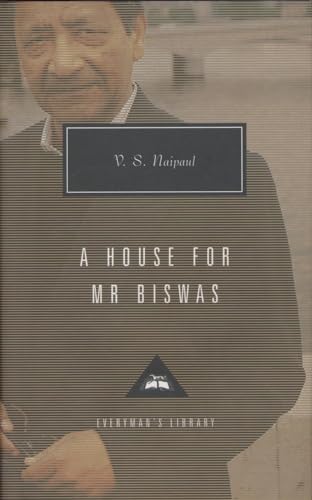
A House for Mr. Biswas: Introduction by Karl Miller (Everyman's Library Contemporary Classics Series) - Hardcover
Inhaltsangabe
From the Nobel Prize-winning author comes a tragicomic masterpiece of social manners in a postcolonial society—and “arguably Mr. Naipaul's finest novel” (The New York Times). • The book that turned the gentle satirist of the Caribbean into a major literary figure, in a hardcover edition with an introduction by Karl Miller.
His birth ill-omened, his life dominated by fitful, comic struggles and resentful truces with those to whom he is obligated, Mr. Mohun Biswas of Trinidad, toward the end of his forty-sixth year on earth, triumphantly purchases his own house and becomes his own man. Around this supremely simple story, V. S. Naipaul builds one of the few virtually perfect novels in our language, a book that is—in the balance struck between its small incidents and its large, overarching patterns, in the ironic beauty of its prose—at once compelling, mysterious, and classical. It is also one of the few novels in any language that transcend their own genre. By the end of A House for Mr. Biswas we are reading a tremendous parable about the individual self in its enslavement to time and change, and in its search for freedom.
Die Inhaltsangabe kann sich auf eine andere Ausgabe dieses Titels beziehen.
Über die Autorin bzw. den Autor
V.S. NAIPAUL was born in Trinidad in 1932. He came to England on a scholarship in 1950. He spent four years at University College, Oxford, and began to write, in London, in 1954. He pursued no other profession.
His novels include A House for Mr Biswas, The Mimic Men, Guerrillas, A Bend in the River, and The Enigma of Arrival. In 1971 he was awarded the Booker Prize for In a Free State. His works of nonfiction, equally acclaimed, include Among the Believers, Beyond Belief, The Masque of Africa, and a trio of books about India: An Area of Darkness, India: A Wounded Civilization and India: A Million Mutinies Now.
In 1990, V.S. Naipaul received a knighthood for services to literature; in 1993, he was the first recipient of the David Cohen British Literature Prize. He received the Nobel Prize in Literature in 2001. He died in 2018.
Auszug. © Genehmigter Nachdruck. Alle Rechte vorbehalten.
I. Pastoral
Shortly before he was born there had been another quarrel between Mr Biswas's mother Bipti and his father Raghu, and Bipti had taken her three children and walked all the way in the hot sun to the village where her mother Bissoondaye lived. There Bipti had cried and told the old story of Raghu's miserliness: how he kept a check on every cent he gave her, counted every biscuit in the tin, and how he would walk ten miles rather than pay a cart a penny.
Bipti's father, futile with asthma, propped himself up on his string bed and said, as he always did on unhappy occasions, 'Fate. There is nothing we can do about it.'
No one paid him any attention. Fate had brought him from India to the sugar-estate, aged him quickly and left him to die in a crumbling mud hut in the swamplands; yet he spoke of Fate often and affectionately, as though, merely by surviving, he had been particularly favoured.
While the old man talked on, Bissoondaye sent for the midwife, made a meal for Bipti's children and prepared beds for them. When the midwife came the children were asleep. Some time later they were awakened by the screams of Mr Biswas and the shrieks of the midwife.
'What is it?' the old man asked. 'Boy or girl?'
'Boy, boy,' the midwife cried. 'But what sort of boy? Six-fingered, and born in the wrong way.'
The old man groaned and Bissoondaye said, 'I knew it. There is no luck for me.'
At once, though it was night and the way was lonely, she left the hut and walked to the next village, where there was a hedge of cactus. She brought back leaves of cactus, cut them into strips and hung a strip over every door, every window, every aperture through which an evil spirit might enter the hut.
But the midwife said, 'Whatever you do, this boy will eat up his own mother and father.'
The next morning, when in the bright light it seemed that all evil spirits had surely left the earth, the pundit came, a small, thin man with a sharp satirical face and a dismissing manner. Bissoondaye seated him on the string bed, from which the old man had been turned out, and told him what had happened.
'Hm. Born in the wrong way. At midnight, you said.'
Bissoondaye had no means of telling the time, but both she and the midwife had assumed that it was midnight, the inauspicious hour.
Abruptly, as Bissoondaye sat before him with bowed and covered head, the pundit brightened, 'Oh, well. It doesn't matter. There are always ways and means of getting over these unhappy things.' He undid his red bundle and took out his astrological almanac, a sheaf of loose thick leaves, long and narrow, between boards. The leaves were brown with age and their musty smell was mixed with that of the red and ochre sandalwood paste that had been spattered on them. The pundit lifted a leaf, read a little, wet his forefinger on his tongue and lifted another leaf.
At last he said, 'First of all, the features of this unfortunate boy. He will have good teeth but they will be rather wide, and there will be spaces between them. I suppose you know what that means. The boy will be a lecher and a spendthrift. Possibly a liar as well. It is hard to be sure about those gaps between the teeth. They might mean only one of those things or they might mean all three.'
'What about the six fingers, pundit?'
'That's a shocking sign, of course. The only thing I can advise is to keep him away from trees and water. Particularly water.'
'Never bath him?'
'I don't mean exactly that.' He raised his right hand, bunched the fingers and, with his head on one side, said slowly, 'One has to interpret what the book says.' He tapped the wobbly almanac with his left hand. 'And when the book says water, I think it means water in its natural form.'
'Natural form.'
'Natural form,' the pundit repeated, but uncertainly. 'I mean,' he said quickly, and with some annoyance, 'keep him away from rivers and ponds. And of course the sea. And another thing,' He added with satisfaction. 'He will have an unlucky sneeze.' He began to pack the long leaves of his almanac. 'Much of the evil this boy will undoubtedly bring will be mitigated if his father is forbidden to see him for twenty-one days.'
'That will be easy,' Bissoondaye said, speaking with emotion for the first time.
'On the twenty-first day the father must see the boy. But not in the flesh.'
'In a mirror, pundit?'
'I would consider that ill-advised. Use a brass plate. Scour it well.'
'Of course.'
'You must fill this brass plate with coconut oil--which, by the way, you must make yourself from coconuts you have collected with your own hands--and in the reflection on this oil the father must see his son's face.' He tied the almanac together and rolled it in the red cotton wrapper which was also spattered with sandalwood paste. 'I believe that is all.'
'We forgot one thing, punditji. The name.'
'I can't help you completely there. But it seems to me that a perfectly safe prefix would be Mo. It is up to you to think of something to add to that.'
'Oh, punditji, you must help me. I can only think of hun.'
The pundit was surprised and genuinely pleased. 'But that is excellent. Excellent. Mohun. I couldn't have chosen better myself. For Mohun, as you know, means the beloved, and was the name given by the milkmaids to Lord Krishna.' His eyes softened at the thought of the legend and for a moment he appeared to forget Bissoondaye and Mr Biswas.
From the knot at the end of her veil Bissoondaye took out a florin and offered it to the pundit, mumbling her regret that she could not give more. The pundit said that she had done her best and was not to worry. In fact he was pleased; he had expected less.
Mr Biswas lost his sixth finger before he was nine days old. It simply came off one night and Bipti had an unpleasant turn when, shaking out the sheets one morning, she saw this tiny finger tumble to the ground. Bissoondaye thought this an excellent sign and buried the finger behind the cowpen at the back of the house, not far from where she had buried Mr Biswas's navel-string.
In the days that followed Mr Biswas was treated with attention and respect. His brothers and sisters were slapped if they disturbed his sleep, and the flexibility of his limbs was regarded as a matter of importance. Morning and evening he was massaged with coconut oil. All his joints were exercised; his arms and legs were folded diagonally across his red shining body; the big toe of his right foot was made to touch his left shoulder, the big toe of his left foot was made to touch his right shoulder, and both toes were made to touch his nose; finally, all his limbs were bunched together over his belly and then, with a clap and a laugh, released.
Mr Biswas responded well to these exercises, and Bissoondaye became so confident that she decided to have a celebration on the ninth day. She invited people from the village and fed them. The pundit came and was unexpectedly gracious, though his manner suggested that but for his intervention there would have been no celebration at all. Jhagru, the barber, brought his drum, and Selochan did the Shiva dance in the cowpen, his body smeared all over with ash.
There was an unpleasant moment when Raghu, Mr Biswas's father, appeared. He had walked; his dhoti and jacket were sweated and dusty. 'Well, this is very nice,' he said. 'Celebrating. And where is the father?'
'Leave this house at once,' Bissoondaye said, coming out of the kitchen at the side. 'Father! What sort of father do you call yourself, when you drive your wife away every time she gets heavy-footed?'
'That is none of your business,' Raghu said. 'Where is my son?'
'Go ahead. God has paid you back for your boasting and your meanness. Go and see your son. He will eat you up....
„Über diesen Titel“ kann sich auf eine andere Ausgabe dieses Titels beziehen.
Weitere beliebte Ausgaben desselben Titels

Suchergebnisse für A House for Mr. Biswas: Introduction by Karl Miller...

Beispielbild für diese ISBN
A House for Mr. Biswas: Introduction by Karl Miller (Everyman's Library Contemporary Classics Series)
Verlag:
Everyman's Library (edition ), 1995
ISBN 10: 0679444580
ISBN 13: 9780679444589
Gebraucht
Hardcover
Anbieter: BooksRun, Philadelphia, PA, USA
Verkäuferbewertung 5 von 5 Sternen

Hardcover. Zustand: Very Good. With dust jacket. It's a well-cared-for item that has seen limited use. The item may show minor signs of wear. All the text is legible, with all pages included. It may have slight markings and/or highlighting. Artikel-Nr. 0679444580-11-1-29
Gebraucht kaufen
EUR 5,88
Versand gratis
Versand innerhalb von USA
Versand innerhalb von USA
Anzahl: 1 verfügbar
Beispielbild für diese ISBN
A House for Mr. Biswas: Introduction by Karl Miller
Anbieter: ThriftBooks-Reno, Reno, NV, USA
Verkäuferbewertung 5 von 5 Sternen
Hardcover. Zustand: Good. No Jacket. Pages can have notes/highlighting. Spine may show signs of wear. ~ ThriftBooks: Read More, Spend Less. Artikel-Nr. G0679444580I3N00
Gebraucht kaufen
EUR 7,75
Versand gratis
Versand innerhalb von USA
Versand innerhalb von USA
Anzahl: 1 verfügbar
Beispielbild für diese ISBN
A House for Mr. Biswas: Introduction by Karl Miller
Anbieter: ThriftBooks-Dallas, Dallas, TX, USA
Verkäuferbewertung 5 von 5 Sternen
Hardcover. Zustand: Good. No Jacket. Pages can have notes/highlighting. Spine may show signs of wear. ~ ThriftBooks: Read More, Spend Less. Artikel-Nr. G0679444580I3N00
Gebraucht kaufen
EUR 7,75
Versand gratis
Versand innerhalb von USA
Versand innerhalb von USA
Anzahl: 1 verfügbar
Beispielbild für diese ISBN
A House for Mr. Biswas: Introduction by Karl Miller
Anbieter: ThriftBooks-Dallas, Dallas, TX, USA
Verkäuferbewertung 5 von 5 Sternen
Hardcover. Zustand: Good. No Jacket. Former library book; Pages can have notes/highlighting. Spine may show signs of wear. ~ ThriftBooks: Read More, Spend Less. Artikel-Nr. G0679444580I3N10
Gebraucht kaufen
EUR 7,75
Versand gratis
Versand innerhalb von USA
Versand innerhalb von USA
Anzahl: 1 verfügbar
Beispielbild für diese ISBN
A House for Mr. Biswas: Introduction by Karl Miller
Anbieter: ThriftBooks-Dallas, Dallas, TX, USA
Verkäuferbewertung 5 von 5 Sternen
Hardcover. Zustand: Fair. No Jacket. Former library book; Readable copy. Pages may have considerable notes/highlighting. ~ ThriftBooks: Read More, Spend Less. Artikel-Nr. G0679444580I5N10
Gebraucht kaufen
EUR 7,75
Versand gratis
Versand innerhalb von USA
Versand innerhalb von USA
Anzahl: 1 verfügbar
Beispielbild für diese ISBN
A House for Mr. Biswas : Introduction by Karl Miller
Verlag:
Knopf Doubleday Publishing Group, 1995
ISBN 10: 0679444580
ISBN 13: 9780679444589
Gebraucht
Hardcover
Anbieter: Better World Books, Mishawaka, IN, USA
Verkäuferbewertung 5 von 5 Sternen
Zustand: Very Good. Former library copy. Pages intact with possible writing/highlighting. Binding strong with minor wear. Dust jackets/supplements may not be included. Includes library markings. Stock photo provided. Product includes identifying sticker. Better World Books: Buy Books. Do Good. Artikel-Nr. 2900769-6
Gebraucht kaufen
EUR 10,90
Versand gratis
Versand innerhalb von USA
Versand innerhalb von USA
Anzahl: 2 verfügbar
Beispielbild für diese ISBN
A House for Mr. Biswas : Introduction by Karl Miller
Verlag:
Knopf Doubleday Publishing Group, 1995
ISBN 10: 0679444580
ISBN 13: 9780679444589
Gebraucht
Hardcover
Anbieter: Better World Books Ltd, Dunfermline, Vereinigtes Königreich
Verkäuferbewertung 5 von 5 Sternen
Zustand: Good. Former library copy. Pages intact with minimal writing/highlighting. The binding may be loose and creased. Dust jackets/supplements are not included. Includes library markings. Stock photo provided. Product includes identifying sticker. Better World Books: Buy Books. Do Good. Artikel-Nr. 2900768-6
Gebraucht kaufen
EUR 6,18
EUR 5,82 Versand
Versand von Vereinigtes Königreich nach USA
Versand von Vereinigtes Königreich nach USA
Anzahl: 1 verfügbar
Beispielbild für diese ISBN
A House for Mr. Biswas: Introduction by Karl Miller
Anbieter: Kennys Bookstore, Olney, MD, USA
Verkäuferbewertung 5 von 5 Sternen
Zustand: New. Artikel-Nr. V9780679444589
Neu kaufen
EUR 32,95
EUR 8,99 Versand
Versand innerhalb von USA
Versand innerhalb von USA
Anzahl: 15 verfügbar
Beispielbild für diese ISBN
A House for Mr. Biswas (Everyman's Library (Cloth))
Anbieter: Revaluation Books, Exeter, Vereinigtes Königreich
Verkäuferbewertung 5 von 5 Sternen
Hardcover. Zustand: Brand New. fourth printing edition. 564 pages. 8.50x5.25x1.25 inches. In Stock. Artikel-Nr. __0679444580
Neu kaufen
EUR 27,98
EUR 14,56 Versand
Versand von Vereinigtes Königreich nach USA
Versand von Vereinigtes Königreich nach USA
Anzahl: 1 verfügbar
Beispielbild für diese ISBN
A House for Mr. Biswas (Everyman's Library (Cloth))
Anbieter: Revaluation Books, Exeter, Vereinigtes Königreich
Verkäuferbewertung 5 von 5 Sternen
Hardcover. Zustand: Brand New. fourth printing edition. 564 pages. 8.50x5.25x1.25 inches. In Stock. Artikel-Nr. 0679444580
Neu kaufen
EUR 42,82
EUR 14,56 Versand
Versand von Vereinigtes Königreich nach USA
Versand von Vereinigtes Königreich nach USA
Anzahl: 1 verfügbar