
Verwandte Artikel zu An Unquiet Mind
Inhaltsangabe
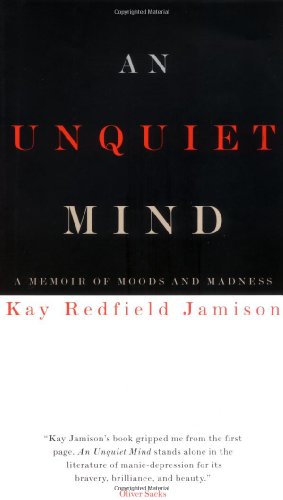
The personal story of a manic depressive and a world-renowned authority on the subject describes the onset of the illness during her teenage years and her determined journey through the realm of available treatments. 75,000 first printing. Tour.
Die Inhaltsangabe kann sich auf eine andere Ausgabe dieses Titels beziehen.
Über die Autorinnen und Autoren
Kay Redfield Jamison is the Dalio Family Professor in Mood Disorders and Professor of Psychiatry at the Johns Hopkins University School of Medicine. She is codirector of the Johns Hopkins Mood Disorders Center and a member of the governing board of the National Network of Depression Centers. She is also Honorary Professor of English at the University of St. Andrews in Scotland and the author of the national bestsellers An Unquiet Mind and Night Falls Fast, as well as Touched with Fire, Exuberance, and Nothing Was the Same. Dr. Jamison is the coauthor of the standard medical text on bipolar illness, Manic-Depressive Illness: Bipolar Disorders and Recurrent Depression, and the recipient of numerous national and international literary and scientific honors, including a MacArthur Award. In 2010 she married Thomas Traill, a cardiologist and Professor of Medicine at Johns Hopkins.
From the Trade Paperback edition.
Kay Redfield Jamison is Professor of Psychiatry at the Johns Hopkins University School of Medicine.
Auszug. © Genehmigter Nachdruck. Alle Rechte vorbehalten.
Into the Sun
I was standing with my head back, one pigtail caught between my teeth, listening to the jet overhead. The noise was loud, unusually so, which meant that it was close. My elementary school was near Andrews Air Force Base, just outside Washington; many of us were pilots' kids, so the sound was a matter of routine. Being routine, however, didn't take away from the magic, and I instinctively looked up from the playground to wave. I knew, of course, that the pilot couldn't see me-I always knew that-just as I knew that even if he could see me the odds were that it wasn't actually my father. But it was one of those things one did, and anyway I loved any and all excuses just to stare up into the skies. My father, a career Air Force officer, was first and foremost a scientist and only secondarily a pilot. But he loved to fly, and, because he was a meteorologist, both his mind and his soul ended up being in the skies. Like my father, I looked up rather more than I looked out.
When I would say to him that the Navy and the Army were so much older than the Air Force, had so much more tradition and legend, he would say, Yes, that's true, but the Air Force is the future. Then he would always add: And-we can fly. This statement of creed would occasionally be followed by an enthusiastic rendering of the Air Force song, fragments of which remain with me to this day, nested together, somewhat improbably, with phrases from Christmas carols, early poems, and bits and pieces of the Book of Common Prayer: all having great mood and meaning from childhood, and all still retaining the power to quicken the pulses.
So I would listen and believe and, when I would hear the words "Off we go into the wild blue yonder," I would think that "wild" and "yonder" were among the most wonderful words I had ever heard; likewise, I would feel the total exhilaration of the phrase "Climbing high, into the sun" and know instinctively that I was a part of those who loved the vastness of the sky.
The noise of the jet had become louder, and I saw the other children in my second-grade class suddenly dart their heads upward. The plane was coming in very low, then it streaked past us, scarcely missing the playground. As we stood there clumped together and absolutely terrified, it flew into the trees, exploding directly in front of us. The ferocity of the crash could be felt and heard in the plane's awful impact; it also could be seen in the frightening yet terrible lingering loveliness of the flames that followed. Within minutes, it seemed, mothers were pouring onto the playground to reassure children that it was not their fathers; fortunately for my brother and sister and myself, it was not ours either. Over the next few days it became clear, from the release of the young pilot's final message to the control tower before he died, that he knew he could save his own life by bailing out. He also knew, however, that by doing so he risked that his unaccompanied plane would fall onto the playground and kill those of us who were there.
The dead pilot became a hero, transformed into a scorchingly vivid, completely impossible ideal for what was meant by the concept of duty. It was an impossible ideal, but all the more compelling and haunting because of its very unobtainability. The memory of the crash came back to me many times over the years, as a reminder both of how one aspires after and needs such ideals, and of how killingly difficult it is to achieve them. I never again looked at the sky and saw only vastness and beauty. From that afternoon on I saw that death was also and always there.
Although, like all military families, we moved a lot-by the fifth grade my older brother, sister, and I had attended four different elementary schools, and we had lived in Florida, Puerto Rico, California, Tokyo, and Washington, twice-our parents, especially my mother, kept life as secure, warm, and constant as possible. My brother was the eldest and the steadiest of the three of us children and my staunch ally, despite the three-year difference in our ages. I idolized him growing up and often trailed along after him, trying very hard to be inconspicuous, when he and his friends would wander off to play baseball or cruise the neighborhood. He was smart, fair, and self-confident, and I always felt that there was a bit of extra protection coming my way whenever he was around. My relationship with my sister, who was only thirteen months older than me, was more complicated. She was the truly beautiful one in the family, with dark hair and wonderful eyes, who from the earliest times was almost painfully aware of everything around her. She had a charismatic way, a fierce temper, very black and passing moods, and little tolerance for the conservative military lifestyle that she felt imprisoned us all. She led her own life, defiant, and broke out with abandon whenever and wherever she could. She hated high school and, when we were living in Washington, frequently skipped classes to go to the Smithsonian or the Army Medical Museum or just to smoke and drink beer with her friends.
She resented me, feeling that I was, as she mockingly put it, "the fair-haired one"-a sister, she thought, to whom friends and schoolwork came too easily-passing far too effortlessly through life, protected from reality by an absurdly optimistic view of people and life. Sandwiched between my brother, who was a natural athlete and who never seemed to see less-than-perfect marks on his college and graduate admission examinations, and me, who basically loved school and was vigorously involved in sports and friends and class activities, she stood out as the member of the family who fought back and rebelled against what she saw as a harsh and difficult world. She hated military life, hated the constant upheaval and the need to make new friends, and felt the family politeness was hypocrisy.
Perhaps because my own violent struggles with black moods did not occur until I was older, I was given a longer time to inhabit a more benign, less threatening, and, indeed to me, a quite wonderful world of high adventure. This world, I think, was one my sister had never known. The long and important years of childhood and early adolescence were, for the most part, very happy ones for me, and they afforded me a solid base of warmth, friendship, and confidence. They were to be an extremely powerful amulet, a potent and positive countervailing force against future unhappiness. My sister had no such years, no such amulets. Not surprisingly, perhaps, when both she and I had to deal with our respective demons, my sister saw the darkness as being within and part of herself, the family, and the world. I, instead, saw it as a stranger; however lodged within my mind and soul the darkness became, it almost always seemed an outside force that was at war with my natural self.
My sister, like my father, could be vastly charming: fresh, original, and devastatingly witty, she also was blessed with an extraordinary sense of aesthetic design. She was not an easy or untroubled person, and as she grew older her troubles grew with her, but she had an enormous artistic imagination and soul. She also could break your heart and then provoke your temper beyond any reasonable level of endurance. Still, I always felt a bit like pieces of earth to my sister's fire and flames.
For his part, my father, when involved, was often magically involved: ebullient, funny, curious about almost everything, and able to describe with delight and originality the beauties and phenomena of the natural world. A snowflake was never just a snowflake, nor a cloud just a cloud. They became events and characters, and part of a lively and oddly ordered universe. When times were good and his moods were at high tide, his infectious enthusiasm would touch everything. Music would fill the...
„Über diesen Titel“ kann sich auf eine andere Ausgabe dieses Titels beziehen.
Suchergebnisse für An Unquiet Mind

Beispielbild für diese ISBN
An Unquiet Mind
Anbieter: World of Books (was SecondSale), Montgomery, IL, USA
Verkäuferbewertung 5 von 5 Sternen

Zustand: Good. Item in good condition. Textbooks may not include supplemental items i.e. CDs, access codes etc. Artikel-Nr. 00105294621
Gebraucht kaufen
EUR 3,66
Versand gratis
Versand innerhalb von USA
Versand innerhalb von USA
Anzahl: 17 verfügbar
Foto des Verkäufers
An Unquiet Mind: A Memoir of Moods and Madness
Anbieter: Dream Books Co., Denver, CO, USA
Verkäuferbewertung 5 von 5 Sternen
Zustand: acceptable. This copy has clearly been enjoyedâ"expect noticeable shelf wear and some minor creases to the cover. Binding is strong, and all pages are legible. May contain previous library markings or stamps. Artikel-Nr. DBV.0679443746.A
Gebraucht kaufen
EUR 3,67
Versand gratis
Versand innerhalb von USA
Versand innerhalb von USA
Anzahl: 2 verfügbar
Beispielbild für diese ISBN
An Unquiet Mind: A Memoir of Moods and Madness
Anbieter: BooksRun, Philadelphia, PA, USA
Verkäuferbewertung 5 von 5 Sternen
Hardcover. Zustand: Very Good. 1. With dust jacket. It's a well-cared-for item that has seen limited use. The item may show minor signs of wear. All the text is legible, with all pages included. It may have slight markings and/or highlighting. Artikel-Nr. 0679443746-11-18-29
Gebraucht kaufen
EUR 5,21
Versand gratis
Versand innerhalb von USA
Versand innerhalb von USA
Anzahl: 1 verfügbar
Beispielbild für diese ISBN
An Unquiet Mind: A Memoir of Moods and Madness
Anbieter: ThriftBooks-Reno, Reno, NV, USA
Verkäuferbewertung 5 von 5 Sternen
Hardcover. Zustand: Good. No Jacket. Missing dust jacket; Pages can have notes/highlighting. Spine may show signs of wear. ~ ThriftBooks: Read More, Spend Less. Artikel-Nr. G0679443746I3N01
Gebraucht kaufen
EUR 5,75
Versand gratis
Versand innerhalb von USA
Versand innerhalb von USA
Anzahl: 2 verfügbar
Beispielbild für diese ISBN
An Unquiet Mind: A Memoir of Moods and Madness
Anbieter: ThriftBooks-Dallas, Dallas, TX, USA
Verkäuferbewertung 5 von 5 Sternen
Hardcover. Zustand: Good. No Jacket. Former library book; Pages can have notes/highlighting. Spine may show signs of wear. ~ ThriftBooks: Read More, Spend Less. Artikel-Nr. G0679443746I3N10
Gebraucht kaufen
EUR 5,75
Versand gratis
Versand innerhalb von USA
Versand innerhalb von USA
Anzahl: 2 verfügbar
Beispielbild für diese ISBN
An Unquiet Mind: A Memoir of Moods and Madness
Anbieter: ThriftBooks-Dallas, Dallas, TX, USA
Verkäuferbewertung 5 von 5 Sternen
Hardcover. Zustand: Good. No Jacket. Pages can have notes/highlighting. Spine may show signs of wear. ~ ThriftBooks: Read More, Spend Less. Artikel-Nr. G0679443746I3N00
Gebraucht kaufen
EUR 5,75
Versand gratis
Versand innerhalb von USA
Versand innerhalb von USA
Anzahl: Mehr als 20 verfügbar
Beispielbild für diese ISBN
An Unquiet Mind: A Memoir of Moods and Madness
Anbieter: ThriftBooks-Atlanta, AUSTELL, GA, USA
Verkäuferbewertung 5 von 5 Sternen
Hardcover. Zustand: Fair. No Jacket. Readable copy. Pages may have considerable notes/highlighting. ~ ThriftBooks: Read More, Spend Less. Artikel-Nr. G0679443746I5N00
Gebraucht kaufen
EUR 5,75
Versand gratis
Versand innerhalb von USA
Versand innerhalb von USA
Anzahl: 12 verfügbar
Beispielbild für diese ISBN
An Unquiet Mind: A Memoir of Moods and Madness
Anbieter: ThriftBooks-Reno, Reno, NV, USA
Verkäuferbewertung 5 von 5 Sternen
Hardcover. Zustand: Good. No Jacket. Former library book; Pages can have notes/highlighting. Spine may show signs of wear. ~ ThriftBooks: Read More, Spend Less. Artikel-Nr. G0679443746I3N10
Gebraucht kaufen
EUR 5,75
Versand gratis
Versand innerhalb von USA
Versand innerhalb von USA
Anzahl: 1 verfügbar
Beispielbild für diese ISBN
An Unquiet Mind: A Memoir of Moods and Madness
Anbieter: ThriftBooks-Dallas, Dallas, TX, USA
Verkäuferbewertung 5 von 5 Sternen
Hardcover. Zustand: Good. No Jacket. Missing dust jacket; Pages can have notes/highlighting. Spine may show signs of wear. ~ ThriftBooks: Read More, Spend Less. Artikel-Nr. G0679443746I3N01
Gebraucht kaufen
EUR 5,75
Versand gratis
Versand innerhalb von USA
Versand innerhalb von USA
Anzahl: 2 verfügbar
Beispielbild für diese ISBN
An Unquiet Mind: A Memoir of Moods and Madness
Anbieter: ThriftBooks-Phoenix, Phoenix, AZ, USA
Verkäuferbewertung 5 von 5 Sternen
Hardcover. Zustand: Good. No Jacket. Former library book; Pages can have notes/highlighting. Spine may show signs of wear. ~ ThriftBooks: Read More, Spend Less. Artikel-Nr. G0679443746I3N10
Gebraucht kaufen
EUR 5,75
Versand gratis
Versand innerhalb von USA
Versand innerhalb von USA
Anzahl: 1 verfügbar