
Inhaltsangabe
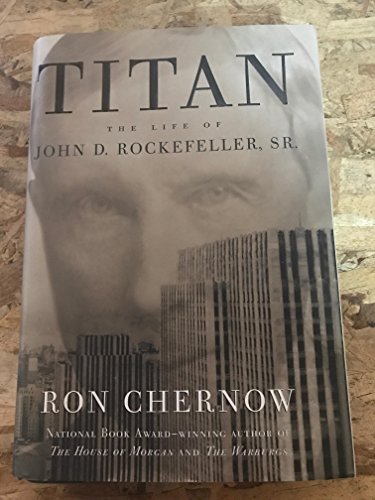
The author of The House of Morgan, a winner of the National Book Award, presents a monumental biography of the legendary oilman, capitalist, Baptist, and philanthropist, the first portrait to draw on Rockefeller's own papers. 75,000 first printing. Tour.
Die Inhaltsangabe kann sich auf eine andere Ausgabe dieses Titels beziehen.
Über die Autorin bzw. den Autor
Ron Chernow's first book, The House of Morgan, won the National Book Award and the Ambassador Award for the year's best study of American culture. His second book, The Warburgs, won the Eccles Prize as the Best Business Book of 1993 and was also selected by the American Library Association as one of that year's best nonfiction books. In reviewing his recent collection of essays, The Death of the Banker, The New York Times called the author "as elegant an architect of monumental histories as we've seen in decades and chose the paperback original as one of the year's Notable Books.
Aus dem Klappentext
John D. Rockefeller, Sr.--history's first billionaire and the patriarch of America's most famous dynasty--is an icon whose true nature has eluded three generations of historians. Now Ron Chernow, the National Book Award-winning biographer of the Morgan and Warburg banking families, gives us a history of the mogul "etched with uncommon objectivity and literary grace . . . as detailed, balanced, and psychologically insightful a portrait of the tycoon as we may ever have" (Kirkus Reviews). Titan is the first full-length biography based on unrestricted access to Rockefeller's exceptionally rich trove of papers. A landmark publication full of startling revelations, the book will indelibly alter our image of this most enigmatic capitalist.
Born the son of a flamboyant, bigamous snake-oil salesman and a pious, straitlaced mother, Rockefeller rose from rustic origins to become the world's richest man by creating America's most powerful and feared monopoly, Standard Oil. Branded "the Octopus" by legions of muckrakers, the trust refined and marketed nearly 90 percent of the oil produced in America.
Rockefeller was likely the most controversial businessman in our nation's history. Critics charged that his empire was built on unscrupulous tactics: grand-scale collusion with the railroads, predatory pricing, industrial espionage, and wholesale bribery of political officials. The titan spent more than thirty years dodging investigations until Teddy Roosevelt and his trustbusters embarked on a marathon crusade to bring Standard Oil to bay.
While providing abundant new evidence of Rockefeller's misdeeds, Chernow discards the stereotype of the cold-blooded monster to sketch an unforgettably human portrait of a quirky, eccentric original. A devout Baptist and temperance advocate, Rockefeller gave money more generously--his chosen philanthropies included the Rockefeller Foundation, the University of Chicago, and what is today Rockefeller University--than anyone before him. Titan presents a finely nuanced portrait of a fascinating, complex man, synthesizing his public and private lives and disclosing numerous family scandals, tragedies, and misfortunes that have never before come to light.
John D. Rockefeller's story captures a pivotal moment in American history, documenting the dramatic post-Civil War shift from small business to the rise of giant corporations that irrevocably transformed the nation. With cameos by Joseph Pulitzer, William Randolph Hearst, Jay Gould, William Vanderbilt, Ida Tarbell, Andrew Carnegie, Carl Jung, J. Pierpont Morgan, William James, Henry Clay Frick, Mark Twain, and Will Rogers, Titan turns Rockefeller's life into a vivid tapestry of American society in the late nineteenth and early twentieth centuries. It is Ron Chernow's signal triumph that he narrates this monumental saga with all the sweep, drama, and insight that this giant subject deserves.
Auszug. © Genehmigter Nachdruck. Alle Rechte vorbehalten.
The Flimflam Man
In the early 1900s, as Rockefeller vied with Andrew Carnegie for the title of the world's richest man, a spirited rivalry arose between France and Germany, with each claiming to be Rockefeller's ancestral land. Assorted genealogists stood ready, for a sizable fee, to manufacture a splendid royal lineage for the oilman. "I have no desire to trace myself back to the nobility," he said honestly. "I am satisfied with my good old American stock."
1
The most ambitious search for Rockefeller's roots traced them back to a ninth-century French family, the Roquefeuilles, who supposedly inhabited a Languedoc chbteau. The clan's departure from France is much better documented than its origins. After Louis XIV revoked the Edict of Nantes in 1685, the Huguenot family fled from religious persecution and emigrated to Sagendorf, near the Rhenish town of Koblenz, and Germanized their surname to Rockefeller.
Around 1723, Johann Peter Rockefeller, a miller, gathered up his wife and five children, set sail for Philadelphia, and settled on a farm in Somerville and then Amwell, New Jersey, where he evidently flourished and acquired large landholdings. More than a decade later, his cousin Diell Rockefeller left southwest Germany and moved to Germantown, New York.
Diell's granddaughter Christina married her distant relative William, one of Johann's grandsons. (Never particularly sentimental about his European forebears, John D. Rockefeller did erect a monument to the patriarch, Johann Peter, at his burial site in Flemington, New Jersey.) The marriage of William and Christina produced a son named Godfrey Rockefeller, who was
the grandfather of the oil titan and a most unlikely progenitor of the clan. In 1806, Godfrey married Lucy Avery in Great Barrington, Massachusetts, despite the grave qualms of her family.
Establishing a pattern that would be replicated by Rockefeller's own mother, Lucy had, in her family's disparaging view, married down. Her ancestors had emigrated from Devon, England, to Salem, Massachusetts, around 1630, forming part of the Puritan tide. As they became settled and gentrified, the versatile Averys spawned ministers, soldiers, civic leaders, explorers, and traders, not to mention a bold clutch of Indian fighters. During the American Revolution, eleven Averys perished gloriously in the battle of Groton.
While the Rockefellers' "noble" roots required some poetic license and liberal embellishment, Lucy could justly claim
descent from Edmund Ironside, the English king, who was crowned in 1016. Godfrey Rockefeller was sadly mismatched with his enterprising wife. He had a stunted, impoverished look and a hangdog air of perpetual defeat. Taller than her husband, a fiery Baptist of commanding presence, Lucy was rawboned and confident, with a vigorous step and alert blue eyes. A former schoolteacher, she was better educated than Godfrey. Even John D., never given to invidious comments about relatives, tactfully conceded, "My
grandmother was a brave woman. Her husband was not so brave as she."
2
If Godfrey contributed the Rockefeller coloring-bluish gray eyes, light brown hair-Lucy introduced the rangy frame later notable among the men. Enjoying robust energy and buoyant health, Lucy had ten children, with the third, William Avery Rockefeller, born in Granger, New York, in 1810. While it is easy enough to date the birth of Rockefeller's father, teams of frazzled reporters would one day exhaust themselves trying to establish the date of his death.
As a farmer and businessman, Godfrey enjoyed checkered success, and his aborted business ventures exposed his family to an insecure, peripatetic life. They were forced to move to Granger and Ancram, New York, then to Great Barrington, before doubling back to Livingston, New York. John D. Rockefeller's upbringing would be fertile with cautionary figures of weak
men gone astray. Godfrey must have been invoked frequently as a model to be avoided. By all accounts, Grandpa was a jovial, good-natured man but feckless and addicted to drink, producing in Lucy an everlasting hatred of liquor that she must have drummed into her grandson. Grandpa Godfrey was the first to establish in John D.'s mind an enduring equation between bonhomie and lax character, making the latter prefer the society of sober, tight-lipped men in full command of their emotions.
The Rockefeller records offer various scenarios of why Godfrey and Lucy packed their belongings into an overloaded Conestoga wagon and headed west between 1832 and 1834. By one account, the Rockefellers, along with several neighbors, were dispossessed of their land in a heated title dispute with some English investors. Another account has an unscrupulous businessman gulling Godfrey into swapping his farm for allegedly richer turf in Tioga County. (If this claim was in fact made, it proved a cruel hoax.) Some
relatives later said that Michigan was Godfrey's real destination but that Lucy vetoed such a drastic relocation, preferring the New England culture of upstate New York to the wilds of Michigan.
Whatever the reason, the Rockefellers reenacted the primordial American rite of setting out in search of fresh opportunity. In the 1830s, many settlers from Massachusetts and Connecticut were swarming excitedly into wilderness areas of western New York, a migration that Alexis de Tocqueville described as "a game of chance" pursued for "the emotions it excites, as much as for the gain it procures."
3
The construction of the Erie Canal in the 1820s had lured many settlers to the area. Godfrey and Lucy heaped up their worldly possessions in a canvas-topped prairie schooner, drawn by oxen, and headed toward the sparsely settled territory.
For two weeks, they traveled along the dusty Albany-Catskill turnpike, creeping through forests as darkly forbidding as
the setting of a Grimms' fairy tale. With much baggage and little passenger space, the Rockefellers had to walk for much of the journey, with Lucy and the children (except William, who did not accompany them) taking turns sitting in the wagon whenever they grew weary. As they finally reached their destination, Richford, New York, the last three and a half miles were especially arduous, and the oxen negotiated the stony, rutted path with difficulty. At the end, they had to lash their exhausted team up a nearly
vertical hillside to possess their virgin sixty acres. As family legend has it, Godfrey got out, tramped to the property's peak, inspected the vista, and said mournfully, "This is as close as we shall ever get to Michigan."
So, in a memorial to dashed hopes, the spot would forever bear the melancholy name of Michigan Hill.
Even today scarcely more than a crossroads, Richford was then a stagecoach stop in the wooded country southeast of Ithaca and northwest of Binghamton. The area's original inhabitants, the Iroquois, had been chased out after the American Revolution and replaced by revolutionary army veterans. Still an uncouth frontier when the Rockefellers arrived, this backwater had
recently attained township status, its village square dating from 1821. Civilization had taken only a tenuous hold. The dense forests on all sides teemed with game-bear, deer, panther, wild turkey, and cottontail rabbit-and people carried flaring torches at night to frighten away the roaming packs of wolves.
By the time that John D. Rockefeller was born in 1839, Richford was acquiring the amenities of a small town. It had some nascent
industries-sawmills, gristmills, and a whiskey distillery-plus a schoolhouse and a church. Most inhabitants scratched out a living from hardscrabble farming, yet these newcomers were hopeful and enterprising.
Notwithstanding their frontier trappings, they had carried with them the...
„Über diesen Titel“ kann sich auf eine andere Ausgabe dieses Titels beziehen.
Weitere beliebte Ausgaben desselben Titels

Suchergebnisse für Titan: The Life of John D. Rockefeller, Sr.

Beispielbild für diese ISBN
Titan : The Life of John D. Rockefeller, Sr.
Verlag:
Random House, Incorporated, 1998
ISBN 10: 0679438084
ISBN 13: 9780679438083
Gebraucht
Hardcover
Anbieter: Better World Books: West, Reno, NV, USA
Verkäuferbewertung 5 von 5 Sternen

Zustand: Good. Pages intact with minimal writing/highlighting. The binding may be loose and creased. Dust jackets/supplements are not included. Stock photo provided. Product includes identifying sticker. Better World Books: Buy Books. Do Good. Artikel-Nr. 732815-6
Gebraucht kaufen
EUR 9,15
Versand gratis
Versand innerhalb von USA
Versand innerhalb von USA
Anzahl: 1 verfügbar
Beispielbild für diese ISBN
Titan : The Life of John D. Rockefeller, Sr.
Verlag:
Random House, Incorporated, 1998
ISBN 10: 0679438084
ISBN 13: 9780679438083
Gebraucht
Hardcover
Anbieter: Better World Books, Mishawaka, IN, USA
Verkäuferbewertung 5 von 5 Sternen
Zustand: Good. Pages intact with minimal writing/highlighting. The binding may be loose and creased. Dust jackets/supplements are not included. Stock photo provided. Product includes identifying sticker. Better World Books: Buy Books. Do Good. Artikel-Nr. 732815-6
Gebraucht kaufen
EUR 9,15
Versand gratis
Versand innerhalb von USA
Versand innerhalb von USA
Anzahl: 3 verfügbar
Beispielbild für diese ISBN
Titan The Life of John D. Rockefeller, Sr.
Verlag:
Random House, New York, NY, 1998
ISBN 10: 0679438084
ISBN 13: 9780679438083
Gebraucht
Hardcover
Erstausgabe
Anbieter: True Oak Books, Highland, NY, USA
Verkäuferbewertung 5 von 5 Sternen
Hardcover. Zustand: Good+. Zustand des Schutzumschlags: Very Good. First Edition; Third Printing. 7 X 2 X 10 inches; 774 pages; light pen markings in the margins of some pages. Quite minor. Previous owner's name on front free endpaper. Very Good condition otherwise. No other noteworthy defects. DJ is not price-clipped. ; - Your satisfaction is our priority. We offer free returns and respond promptly to all inquiries. Your item will be carefully cushioned in bubble wrap and securely boxed. All orders ship on the same or next business day. Buy with confidence. Artikel-Nr. HVD-76480-A-0
Gebraucht kaufen
EUR 22,11
Versand gratis
Versand innerhalb von USA
Versand innerhalb von USA
Anzahl: 1 verfügbar
Foto des Verkäufers
Titan: The Life of John D. Rockefeller, Sr.
Anbieter: WeBuyBooks, Rossendale, LANCS, Vereinigtes Königreich
Verkäuferbewertung 5 von 5 Sternen
Zustand: Good. Most items will be dispatched the same or the next working day. A copy that has been read but remains in clean condition. All of the pages are intact and the cover is intact and the spine may show signs of wear. The book may have minor markings which are not specifically mentioned. A few small stains. Artikel-Nr. wbs1233887598
Gebraucht kaufen
EUR 17,32
EUR 16,11 Versand
Versand von Vereinigtes Königreich nach USA
Versand von Vereinigtes Königreich nach USA
Anzahl: 1 verfügbar
Beispielbild für diese ISBN
Titan: The Life of John D. Rockefeller, Sr
Verlag:
Random House, New York, 1998
ISBN 10: 0679438084
ISBN 13: 9780679438083
Gebraucht
Hardcover
Erstausgabe
Signiert
Anbieter: Main Street Fine Books & Mss, ABAA, Galena, IL, USA
Verkäuferbewertung 5 von 5 Sternen
Hardcover. Small 4to. Quarter black cloth with gilt spine lettering and brown paper over boards. xxii, 774pp. Illustrations. Very good. Quite minor binding wear only, while text block is tight and near fine; lacks dust jacket. Nice first edition of this thick biography of the Standard Oil magnate (1839-1937), boldly signed by Chernow in black fineline on title page. From the library of Adlai E. Stevenson III (1930-2021), U.S. Senator from Illinois (1969-81). Artikel-Nr. 52206
Gebraucht kaufen
EUR 66,45
EUR 5,16 Versand
Versand innerhalb von USA
Versand innerhalb von USA
Anzahl: 1 verfügbar
Foto des Verkäufers
Titan: The Life of John D. Rockefeller, Sr
Verlag:
Random House, New York, 1998
ISBN 10: 0679438084
ISBN 13: 9780679438083
Gebraucht
Hardcover
Signiert
Anbieter: Argosy Book Store, ABAA, ILAB, New York, NY, USA
Verkäuferbewertung 5 von 5 Sternen
hardcover. Zustand: fine. Zustand des Schutzumschlags: near fine. Reprint. Illustrated. 774 pages, thick 8vo, cloth-backed boards, d.w. New York: Random House, (1998). Ninth printing. A fine copy in a near fine dust wrapper. Signed and dated by Chernow on title page. Artikel-Nr. 333939
Gebraucht kaufen
EUR 84,17
EUR 5,16 Versand
Versand innerhalb von USA
Versand innerhalb von USA
Anzahl: 1 verfügbar
Foto des Verkäufers
Titan: The Life of John D. Rockefeller, Sr.
Verlag:
Random House, New York, 1998
ISBN 10: 0679438084
ISBN 13: 9780679438083
Gebraucht
Hardcover
Erstausgabe
Signiert
Anbieter: Jusara Book Shop IOBA, Canandaigua, NY, USA
Verkäuferbewertung 4 von 5 Sternen

Hardcover. Zustand: Near Fine. Zustand des Schutzumschlags: Very Good. 1st Edition. Flatsigned by Ron Chernow on the title page. Volume in Near Fine condition with a few shallow bumps to the top and bottom board edges, Faint soiling to top and bottom edges. Clean and bright internally; seemingly unread. Jacket in VG condition with edge creasing and wear and shelf wear (mainly rubbing). Signed by Author(s). Artikel-Nr. 001032
Gebraucht kaufen
EUR 243,66
EUR 6,88 Versand
Versand innerhalb von USA
Versand innerhalb von USA
Anzahl: 1 verfügbar