
Verwandte Artikel zu Is That a Gun in Your Pocket?: Women's Experience...
Inhaltsangabe
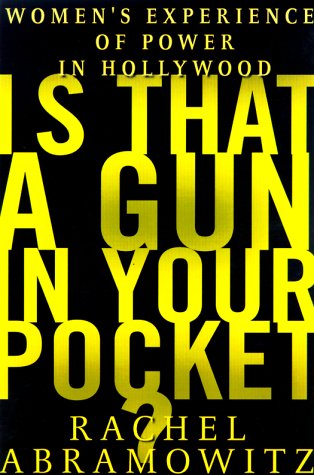
Chronicling the lives of Hollywood's revolutionary female filmmakers, the author looks at the movie industry's women power brokers and how they got where they are.
Die Inhaltsangabe kann sich auf eine andere Ausgabe dieses Titels beziehen.
Über die Autorin bzw. den Autor
<br><b>Rachel Abramowitz</b> has covered Hollywood for the last decade, primarily for <i>Premiere</i> magazine. Her work has also appeared in <i>Mirabella</i> and <i>The New York Times Magazine</i>. She graduated from Yale and lives in Los Angeles, California, with her husband and son.
Aus dem Klappentext
;Women and power-perhaps no other confluence of subjects has launched as many myths, or stirred as much gossip."<br><br>Eight years ago, a remarkably talented reporter named Rachel Abramowitz began interviewing the women of Hollywood to, in her words, "puncture the mythology and to circumvent the silence" of this rarefied world. At the time, women directors, agents, producers and studio executives made up only a tiny minority of the industry. Abramowitz wanted to find out what had allowed this handful of women to infiltrate the male-dominated world of moviemaking-and what was keeping other women out. <b>Is That a Gun in Your Pocket?</b> is a vibrant social history that brings to light the previously untold saga of the rise of women in Hollywood over the past forty years. <br> <br>In these pages, some of the most famous, most powerful, and most outrageous members of the film industry go on record with their war stories. Fro
Auszug. © Genehmigter Nachdruck. Alle Rechte vorbehalten.
INTRODUCTION
The day of Dawn Steel's funeral was one of those bright, wintry days the smog recedes and the palm trees with their jagged fronds stand like paper cutouts against a cloudless blue sky. It was December 23, 1997, and the studio lots were bare. The phones had ceased to ring. The only members of the Hollywood elite left in town were the eighty who gathered that clear morning at Mount Sinai Cemetery, an unnaturally lush green cliff overlooking the candy-colored buildings of the Disney lot. They had come to bury the diminutive former studio chieftain, a colorful and determinedly outrageous figure, famed for her name, which sounded like a moniker in a trashy novel, her viteruperative mouth, which popped off swearwords like fireworks, and her thick, lustrous tresses, to whom celebrity hairdressers routinely paid homage.
The mourners included the billionaire David Geffen, who used to commiserate with Steel about their respective issues with anger; and former beau Richard Dreyfuss, whom she had once bullied out of a depressive funk. There was the director Joel Schumacher, who had made the New Age thriller Flatliners, one of the few hits to emerge from her tenure as chairman of Columbia Pictures; and Ray Stark, the wily, Machiavellian power broker producer who had helped place her in that job. Close to eighty, Stark looked old and withered, while the producer Dan Melnick, the onetime Hollywood smoothie who had deciphered the town's mores for Steel, looked shattered.
When Steel arrived in L.A. in 1978, she was a thirty-two-year-old college dropout who wanted nothing more than to be accepted by the men who ran Hollywood. That Dawn Steel would have been overjoyed by the appearance of so many members of the boys' club at her funeral. It was a narcissist's fantasy, the ultimate validation that she had mattered in a town where significance was as fleeting as your last hit movie.
That Dawn Steel, however, would have been shocked by the women, the female industry titans arrayed in dark business suits who lined up to carry her casket. In those days, if she thought of women at all, it was usually as competitors. For years Steel had felt competitive with Sherry Lansing, the first woman to be named president of a studio. She had feuded with Lynda Obst over Flashdance and had Ignored Lucy Fisher until the two became the highest-ranking women in the business to bear children. Amy Pascal had been her protege, her kid sister who had grown up and become a studio president in her own right, an inversion of roles that had created its own stresses. Indeed, many of the women present at the funeral had warred at one time or another with Steel, who tended to treat relationships like a high-contact sport, with head-on confrontations representing the only sign of authenticity and true intimacy.
Her ten-year-old daughter was the first to speak. She was poised, blunt, and uncannily Dawn-like.
"My mother could do anything," she told the well-heeled crowd. "She was the first woman ever to run a studio. She wrote a book. She even found time to have me. That's because my mother thought she could do anything." She paused. "I want to tell you a story about my mother. She couldn't figure out how to work anything. She was never able to turn on the TV. She couldn't make the phone work. She could never make the VCR work. You can imagine what life was like at our house. Every other minute, she would be yelling, 'Rebecca. the TV's broken. Chuck. the phone's broken. Rebecca, the VCR's broken. 'You see, those things had to be broken because my mother could do anything. If she didn't know how to work it, it had to be broken."
Steel's death had not been unexpected. When the news had filtered out over a year earlier that Dawn Steel had developed a brain tumor, the town had roiled with shock. For those who liked her, it was unthinkable that someone so vital should be so cruelly smote. For those who didn't-and there were many-it was divine retribution caused undoubtedly by the ubiquitous cell phone, and -roundly deserved for a lifetime of temper tantrums, of heaping humiliation on a legion of secretaries, assistants, maitre d's, generally anyone less powerful than she, and certainly anyone who didn't meet her exacting standards.
There was a tendency to look upon Steel's life and death as a Hollywood fable. In her heyday she had represented for many of her peers the shadow self, the female fury, the woman unsexed. She was someone who aped the testosterone-fueled antics of the town's men-yelling, screaming, controlling, demanding fealty and obeisance from all who came into her purview. She was the ultimate ball buster. Now the angry woman-the woman who had it all-was being punished. What was essentially a freak occurrence was being cast as a moral comeuppance.
It was a neat narrative but a flawed one, and certainly not an explanation for cancer or for Dawn Steel, a flawed. charismatic figure who often turned to aggressiveness out of fear. Ironically, if she had been a man, her death would have been not the stuff of myth but just another one of life's tragedies.
Women and power-perhaps no other confluence of subjects has launched as many myths, or stirred as much gossip.
When I began reporting this book, almost every woman I met came with a kind of urban legend attached, usually a pejorative back story that purported to be the secret key to her identity or success. Most of the stories were about sex, or sexual attractiveness. The Fatal Attraction producer Sherry Lansing, more than a few people assured me, had slept her way to the top. Penny Marshall hadn't gotten over the fact that she wasn't as pretty as the starlets who stocked Hollywood. Steel, of course, had simply become a man. A number of Hollywood players confessed to me that they had had long conversations with their therapists over whether they "were turning into Dawn Steel."
It was 1992, and I had been asked by Susan Lyne, then the editor in chief of Premiere magazine, to write an article about women in the movie business. The rise of the women's movement had coincided with the death of the studio system, and the baby boomers (and a handful of those a bit older) had systematically infiltrated the entertainment industry. While there was a plethora of material devoted to the representation of women in films, not much had been written about the women trying to make films.
Nineteen ninety-two was an odd lull for women In Hollywood. It was a time when women were prevalent enough in the motion picture business that no one was alone in her foxhole, yet expectations seemed curiously diminished.
No one had followed in the wake of Steel, who had been pushed out of her job when Sony bought Columbia in 1990. "Women as studio chiefs. It's a novelty act that only happens once," quipped the agent Elaine Goldsmith. There was no female Rupert Murdoch, and not one of the seven major studios boasted a female studio chief. Many of the women who were considered for that job or even president of production had pointedly taken their names out of the running. They ostensibly weren't interested In that kind of power, or that kind of headache. "Women really don't care about the hierarchy. They don't feel the thrill that a man feels when they are top dog," posited the producer Lindsay Doran. "When I was asked to run a studio, I felt really thrilled. It was really flattering, and it lasted about twenty seconds before [I realized]. The power was of no interest to me. The money was of no interest to me, not if it meant selling my life down the river," she said adamantly at the time (although later she became president of United Artists). On the talent side, the ranks were even thinner. Only Penny Marshall, the former sitcom star, was considered an A-list director....
„Über diesen Titel“ kann sich auf eine andere Ausgabe dieses Titels beziehen.
Suchergebnisse für Is That a Gun in Your Pocket?: Women's Experience...

Beispielbild für diese ISBN
Is That a Gun in Your Pocket?: Women's Experience of Power in Hollywood
Anbieter: World of Books (was SecondSale), Montgomery, IL, USA
Verkäuferbewertung 5 von 5 Sternen

Zustand: Good. Item in good condition. Textbooks may not include supplemental items i.e. CDs, access codes etc. Artikel-Nr. 00095823295
Gebraucht kaufen
EUR 4,57
Versand gratis
Versand innerhalb von USA
Versand innerhalb von USA
Anzahl: 2 verfügbar
Beispielbild für diese ISBN
Is That a Gun in Your Pocket?: Women's Experience of Power in Hollywood
Anbieter: World of Books (was SecondSale), Montgomery, IL, USA
Verkäuferbewertung 5 von 5 Sternen
Zustand: Very Good. Item in very good condition! Textbooks may not include supplemental items i.e. CDs, access codes etc. Artikel-Nr. 00093127711
Gebraucht kaufen
EUR 4,57
Versand gratis
Versand innerhalb von USA
Versand innerhalb von USA
Anzahl: 3 verfügbar
Beispielbild für diese ISBN
Is That a Gun in Your Pocket?: Women's Experience of Power in Hollywood
Verlag:
Random House (edition First Edition), 2000
ISBN 10: 0679437541
ISBN 13: 9780679437543
Gebraucht
Hardcover
Erstausgabe
Anbieter: BooksRun, Philadelphia, PA, USA
Verkäuferbewertung 5 von 5 Sternen
Hardcover. Zustand: Very Good. First Edition. With dust jacket. It's a well-cared-for item that has seen limited use. The item may show minor signs of wear. All the text is legible, with all pages included. It may have slight markings and/or highlighting. Artikel-Nr. 0679437541-8-1-29
Gebraucht kaufen
EUR 5,90
Versand gratis
Versand innerhalb von USA
Versand innerhalb von USA
Anzahl: 1 verfügbar
Beispielbild für diese ISBN
Is That a Gun in Your Pocket?: Women's Experience of Power in Hollywood
Anbieter: Wonder Book, Frederick, MD, USA
Verkäuferbewertung 5 von 5 Sternen
Zustand: Good. Good condition. Very Good dust jacket. A copy that has been read but remains intact. May contain markings such as bookplates, stamps, limited notes and highlighting, or a few light stains. Bundled media such as CDs, DVDs, floppy disks or access codes may not be included. Artikel-Nr. M06R-00735
Gebraucht kaufen
EUR 6,43
Versand gratis
Versand innerhalb von USA
Versand innerhalb von USA
Anzahl: 1 verfügbar
Beispielbild für diese ISBN
Is That a Gun in Your Pocket?: Women's Experience of Power in Hollywood
Anbieter: Wonder Book, Frederick, MD, USA
Verkäuferbewertung 5 von 5 Sternen
Zustand: Very Good. Very Good condition. Good dust jacket. A copy that may have a few cosmetic defects. May also contain light spine creasing or a few markings such as an owner's name, short gifter's inscription or light stamp. Bundled media such as CDs, DVDs, floppy disks or access codes may not be included. Artikel-Nr. G10J-00998
Gebraucht kaufen
EUR 6,43
Versand gratis
Versand innerhalb von USA
Versand innerhalb von USA
Anzahl: 1 verfügbar
Beispielbild für diese ISBN
Is That a Gun in Your Pocket? : Women's Experience of Power in Hollywood
Verlag:
Random House, Incorporated, 2000
ISBN 10: 0679437541
ISBN 13: 9780679437543
Gebraucht
Hardcover
Erstausgabe
Anbieter: Better World Books, Mishawaka, IN, USA
Verkäuferbewertung 5 von 5 Sternen
Zustand: Good. 1st. Pages intact with minimal writing/highlighting. The binding may be loose and creased. Dust jackets/supplements are not included. Stock photo provided. Product includes identifying sticker. Better World Books: Buy Books. Do Good. Artikel-Nr. 2415067-6
Gebraucht kaufen
EUR 6,93
Versand gratis
Versand innerhalb von USA
Versand innerhalb von USA
Anzahl: 2 verfügbar
Beispielbild für diese ISBN
Is That a Gun in Your Pocket?: Women's Experience of Power in Hollywood
Anbieter: ThriftBooks-Atlanta, AUSTELL, GA, USA
Verkäuferbewertung 5 von 5 Sternen
Hardcover. Zustand: As New. No Jacket. Pages are clean and are not marred by notes or folds of any kind. ~ ThriftBooks: Read More, Spend Less. Artikel-Nr. G0679437541I2N00
Gebraucht kaufen
EUR 7,16
Versand gratis
Versand innerhalb von USA
Versand innerhalb von USA
Anzahl: 1 verfügbar
Beispielbild für diese ISBN
Is That a Gun in Your Pocket?: Women's Experience of Power in Hollywood
Anbieter: ThriftBooks-Dallas, Dallas, TX, USA
Verkäuferbewertung 5 von 5 Sternen
Hardcover. Zustand: Good. No Jacket. Pages can have notes/highlighting. Spine may show signs of wear. ~ ThriftBooks: Read More, Spend Less. Artikel-Nr. G0679437541I3N00
Gebraucht kaufen
EUR 7,16
Versand gratis
Versand innerhalb von USA
Versand innerhalb von USA
Anzahl: 1 verfügbar
Beispielbild für diese ISBN
Is That a Gun in Your Pocket?: Women's Experience of Power in Hollywood
Anbieter: WorldofBooks, Goring-By-Sea, WS, Vereinigtes Königreich
Verkäuferbewertung 5 von 5 Sternen
Paperback. Zustand: Very Good. The book has been read, but is in excellent condition. Pages are intact and not marred by notes or highlighting. The spine remains undamaged. Artikel-Nr. GOR006199200
Gebraucht kaufen
EUR 6,48
EUR 6,62 Versand
Versand von Vereinigtes Königreich nach USA
Versand von Vereinigtes Königreich nach USA
Anzahl: 1 verfügbar
Beispielbild für diese ISBN
Is That A Gun In Your Pocket?: Women's Experience of Power In Hollywood (Review Copy)
Verlag:
Random House (New York), 2000
ISBN 10: 0679437541
ISBN 13: 9780679437543
Gebraucht
Hardcover
Erstausgabe
Anbieter: Dan Pope Books, West Hartford, CT, USA
Verkäuferbewertung 5 von 5 Sternen
Hardcover. Zustand: As New. Zustand des Schutzumschlags: As New. 1st Edition. First edition. First printing. Hardbound. AS NEW/AS NEW. A tight unread copy. Film. REVIEW COPY, with slip and press release. (C-FERRY). Artikel-Nr. aaa
Gebraucht kaufen
EUR 9,20
EUR 4,02 Versand
Versand innerhalb von USA
Versand innerhalb von USA
Anzahl: 1 verfügbar