
Verwandte Artikel zu Catch-22: Introduction by Malcolm Bradbury (Everyman's...
Catch-22: Introduction by Malcolm Bradbury (Everyman's Library Contemporary Classics Series, Band 220) - Hardcover
Buch 1 von 2: Catch-22 Series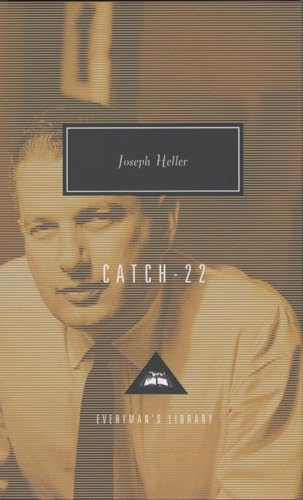
Inhaltsangabe
Named one of America’s best-loved novels by PBS’s The Great American Read • One of The Atlantic’s Great American Novels of the Past 100 Years
One of the funniest books ever written, Joseph Heller's masterpiece about a bomber squadron in the Second World War's Italian theater features a gallery of magnificently strange characters seething with comic energy. The malingering hero, Yossarian, is endlessly inventive in his schemes to save his skin from the horrible chances of war, and his story is studded with incidents and devices (including the Glorious Loyalty Oath Crusade and the hilariously sinister bureaucratic rule that gives the book its title) that propel the narrative in a headlong satiric rush. But the reason Catch-22's satire never weakens and its jokes never date stems not from the comedy itself but from the savage, unerring, Swiftian indignation out of which that comedy springs. This fractured anti-epic, with all its aggrieved humanity, has given us the most enduring image we have of modern warfare.
This hardcover Everyman's Library edition includes an introduction by Malcolm Bradbury, a chronology of the author's life and times, and a select bibliography. It is printed on acid-free paper, with sewn bindings, full-cloth covers, foil stamping, and a silk ribbon marker.
Die Inhaltsangabe kann sich auf eine andere Ausgabe dieses Titels beziehen.
Über die Autorin bzw. den Autor
Joseph Heller was born in 1923 in Brooklyn, New York. He served as a bombardier in the Second World War and then attended New York University, Columbia, and Oxford University, the last on a Fulbright scholarship. He taught for two years at Pennsylvania State University, before returning to New York, where he began a successful career in the advertising departments of Time, Look, and McCall's magazines. It was during this time that he had the idea for Catch-22. Working on the novel in spare moments and evenings at home, it took him eight years to complete and was first published in 1961. His second novel, Something Happened, was published in 1974, Good As Gold in 1979 and Closing Time in 1994. He is also the author of the play We Bombed in New Haven. Joseph Heller died in 1999.
Auszug. © Genehmigter Nachdruck. Alle Rechte vorbehalten.
INTRODUCTION by Malcolm Bradbury
'When people our age speak of the war it is not of Vietnam but of the one that broke out half a century ago and raged in almost all the world. It was raging more than two years before we even got into it.' So begins Joseph Heller's Closing Time (1994), his later life sequel to his first and still most famous novel, Catch-22, a remarkable story about a piece of that war that raged in almost all the world. Thirty-three years after it appeared, the later book starts by reintroducing us to a number of the characters who have survived the earlier novel, and who now live not just in a postwar but a post-Cold War America, where the triumph of capitalism is complete. This is a story of the struggle of their ageing, the later stirs of their sexuality, the waning of their energies, and the fading of their lives. It ends apocalyptically, but closes with a playing of Mahler's Fifth Symphony—'so sweetly mournful and Jewish,' thinks one of the characters, who admits that these days he much prefers the melancholic to the heroic. And Closing Time is in fact a quirky, bold, sometimes moving revisiting of the characters, and many of the events, of the book we today recognize as a twentieth-century classic. Catch-22 was the American book that—perhaps more than any other of its time—voiced the anxious, absurdist, outrageous reaction of a generation to a dark conflict that had taken American soldiers and airmen to Europe, and concluded not just in the defeat of totalitarianism, but in a victory on behalf of the world of our glossy, often alienating, post-modern affluence. And the book was not just a satire on war but a story of that age of burgeoning affluence and all it brought with it - the grim period of arctic hostilities called the Cold War, the affluent society, and finally the post-modern phase of confident, narcissistic, consumptionist late capitalism in which we, and Heller's elderly survivors of wartime, have ended up.
Catch-22 is, first of all, a war novel. And there is little doubt that the war novel, for obvious and tragic reasons, has itself ended up as one of the dominant and shaping literary forms of the troubled twentieth century. It has not only played its part in defining the historical story of the century, but has also shaped the techniques, the flavour, the artistic essence of the modern and modernist novel. In the years after the Great War of 1914-18, the entire sensibility of the horror that had happened seeped into the nature of fiction. This was hardly surprising, for the Great War was a cultural apocalypse. It upturned empires, overthrew entire ruling castes and classes, changed the nature of world hegemony, and had a massive impact on the entire nature of Western and world culture and history. It changed Europe from a bastion of Western civilization into a shattered and unstable modern battlefield, and handed on to unwilling Americans a sense of responsibility for the direction of history. It shattered settled notions of civilization and social order, old hopes for the advance of history, established faiths in humanism and heroism and sacrifice. It also helped create a revolution in artistic and literary forms. It is true that the real avant garde revolt of the modern had begun earlier in the century, in the period between the twentieth century's dawn, the beginning of the calendar of 'modern times', and the great European crisis of 1914. Thus the avant garde experiments of modern painting, writing, architecture and philosophy, and the powerful movements and campaigns that developed them (Cubism, Expressionism, Futurism and so on), mostly came before the war. They upset the classic orders of the arts, broke the frame ofrealism, rendered art neomechanical, fragmentary and abstract. But it took the war itself to ensure the inevitability of their revolt - to shatter traditional forms, enforce the sense of cultural destruction, change the narrative and tone of modern experience.
Hence the 1920s strike us now both as an era of postwar crisis and an era of artistic experiment, perhaps the most experimental decade the century has seen. And inevitably one of the essential forms of its expression was the war novel, the novel that either dealt with the facts of war directly or else with its profound consequences. From the wartime years themselves and through into the 1930s, a sequence of novels appeared which came fresh from the experience of the front and the battlefield, directly capturing the life of the troops in the trenches, on whatever side of the eternal mud or barbed wire they happened to be. There were works like Henri Barbusse's realistic and immediate Le Feu (1916), John Dos Passos' idealistic Three Soldiers (1921), Jaroslav Hasek's grotesque, dark-comic The Good Soldier Svejk (1921-3), Ford Madox Ford's massive four-volume epic of war and society, Parade's End (1924-8), Erich Maria Remarque's German epic of the trenches, All Quiet on the Western Front (1929), Ernest Hemingway's very personal story of an American soldier and a separate peace in the Italian campaign, A Farewell to Arms (1929), Frederic Manning's vivid, disturbing tale of the experiences of an ordinary British soldier, The Middle Parts of Fortune, also called Her Privates We (1930). Such books did not simply recreate the horrific experiences of a war that had taken so many lives, and had so plainly failed to be the war to end wars, or create a world fit for heroes to live in. They also emphasized the revulsion, the futility, the failure, the folly; and often the enemy was to be found not only in the opposite trenches but also on one's own side. But no less important were the novels which, without representing the war directly, showed the profound changes in consciousness, mores and values it had generated. Nearly all the great modernist works showed the power of its effect. The delicate, decadent, belle epoque world of Marcel Proust's A la recherche du temps perdu is transformed by the conflict; the anxious sickness of bourgeois society in Thomas Mann's The Magic Mountain leads us onward down the mountain and into the European battlefield; the great envelope of consciousness in Virginia Woolf's fiction is repeatedly broken open by the shattering impact of war. It was not merely the experience of those who had served at the front, encountered violence, mechanical death and the pathetic weakness of the human body, or sensed the general futility, that shaped the climate of modern fiction. War had shattered older notions of art, of form and representation; it had transformed notions of reality, the rules of perception, the structures of artistic expression. It fragmented, hardened, modernized the voice of modern fiction, increased its sense of extremity, of irony, of tragedy, passing its critical lesson on into the history of modern fiction, and the whole literary and cultural tradition.
Strangely, when a quarter of a century further on a second war broke out in Europe, and then, when Americans and Japanese entered after the bombing of Pearl Harbor, became a Second World War, its impact was nowhere near as great. Rather it produced, especially in Europe, a weary sense of repetition and a feeling of grim inevitability, as if the Great War of 1914-18 had never really ceased. Yet its horrors were even greater, its impact on modern history even more massive. Once more the direction of the world was fundamentally reshaped, the nature of modern consciousness and conscience even more profoundly challenged. The horrific revelations that came at the war's end - the facts of the Holocaust, in which six million Jews perished in the German extermination camps; the hideous impact of the dropping of atomic bombs on the Japanese cities of Hiroshima...
„Über diesen Titel“ kann sich auf eine andere Ausgabe dieses Titels beziehen.
Suchergebnisse für Catch-22: Introduction by Malcolm Bradbury (Everyman's...

Beispielbild für diese ISBN
Catch-22: Introduction by Malcolm Bradbury
Anbieter: World of Books (was SecondSale), Montgomery, IL, USA
Verkäuferbewertung 5 von 5 Sternen

Hardback. Zustand: Fair. This fiftieth-anniversary edition commemorates Joseph Heller's masterpiece with a new introduction; critical essays and reviews by Norman Mailer, Alfred Kazin, Anthony Burgess, and others; rare papers and photos; and much more. Nominated as one of America's best-loved novels by PBS's The Great American Read. Soon to be a Hulu limited series starring Christopher Abbott, George Clooney, Kyle Chandler, and Hugh Laurie. Fifty years after its original publication, Catch-22 remains a cornerstone of American literature and one of the funniest--and most celebrated--books of all time. In recent years it has been named to best novels lists by Time, Newsweek, the Modern Library, and the London Observer. Set in Italy during World War I, this is the story of the incomparable, malingering bombardier, Yossarian, a hero who is furious because thousands of people he has never met are trying to kill him. But his real problem is not the enemy--it is his own army, which keeps increasing the number of missions the men must fly to complete their service. Yet if Yossarian makes any attempt to excuse himself from the perilous missions he's assigned, he'll be in violation of Catch-22, a hilariously sinister bureaucratic rule: a man is considered insane if he willingly continues to fly dangerous combat missions, but if he makes a formal request to be removed from duty, he is proven sane and therefore ineligible to be relieved. This fiftieth-anniversary edition commemorates Joseph Heller's masterpiece with a new introduction by Christopher Buckley; a wealth of critical essays and reviews by Norman Mailer, Alfred Kazin, Anthony Burgess, and others; rare papers and photos from Joseph Heller's personal archive; and much more. Here, at last, is the definitive edition of a classic of world literature. Artikel-Nr. CIN0679437223A
Gebraucht kaufen
EUR 4,61
Versand gratis
Versand innerhalb von USA
Versand innerhalb von USA
Anzahl: 1 verfügbar
Beispielbild für diese ISBN
Catch-22 : Introduction by Malcolm Bradbury
Verlag:
Knopf Doubleday Publishing Group, 1995
ISBN 10: 0679437223
ISBN 13: 9780679437222
Gebraucht
Hardcover
Anbieter: Better World Books: West, Reno, NV, USA
Verkäuferbewertung 5 von 5 Sternen
Zustand: Good. Former library copy. Pages intact with minimal writing/highlighting. The binding may be loose and creased. Dust jackets/supplements are not included. Includes library markings. Stock photo provided. Product includes identifying sticker. Better World Books: Buy Books. Do Good. Artikel-Nr. 5651463-6
Gebraucht kaufen
EUR 7,42
Versand gratis
Versand innerhalb von USA
Versand innerhalb von USA
Anzahl: 1 verfügbar
Beispielbild für diese ISBN
Catch-22 : Introduction by Malcolm Bradbury
Verlag:
Knopf Doubleday Publishing Group, 1995
ISBN 10: 0679437223
ISBN 13: 9780679437222
Gebraucht
Hardcover
Anbieter: Better World Books, Mishawaka, IN, USA
Verkäuferbewertung 5 von 5 Sternen
Zustand: Good. Pages intact with minimal writing/highlighting. The binding may be loose and creased. Dust jackets/supplements are not included. Stock photo provided. Product includes identifying sticker. Better World Books: Buy Books. Do Good. Artikel-Nr. 3976524-6
Gebraucht kaufen
EUR 7,85
Versand gratis
Versand innerhalb von USA
Versand innerhalb von USA
Anzahl: 2 verfügbar
Beispielbild für diese ISBN
Catch-22 (Everyman's Library (Cloth))
Anbieter: Revaluation Books, Exeter, Vereinigtes Königreich
Verkäuferbewertung 5 von 5 Sternen
Hardcover. Zustand: Brand New. reprint edition. 624 pages. 8.25x5.00x1.25 inches. In Stock. Artikel-Nr. __0679437223
Neu kaufen
EUR 31,21
EUR 14,80 Versand
Versand von Vereinigtes Königreich nach USA
Versand von Vereinigtes Königreich nach USA
Anzahl: 1 verfügbar
Beispielbild für diese ISBN
Catch-22 (Everyman's Library Classics & Contemporary Classics) - Joseph Heller
Anbieter: BUCHSERVICE / ANTIQUARIAT Lars Lutzer, Wahlstedt, Deutschland
Verkäuferbewertung 5 von 5 Sternen
Zustand: gut. Catch-22 (Everyman's Library Classics & Contemporary Classics) - Joseph Heller In englischer Sprache. pages. Artikel-Nr. BN300052
Gebraucht kaufen
EUR 179,00
EUR 39,95 Versand
Versand von Deutschland nach USA
Versand von Deutschland nach USA
Anzahl: 1 verfügbar