
Verwandte Artikel zu Paradise
Inhaltsangabe
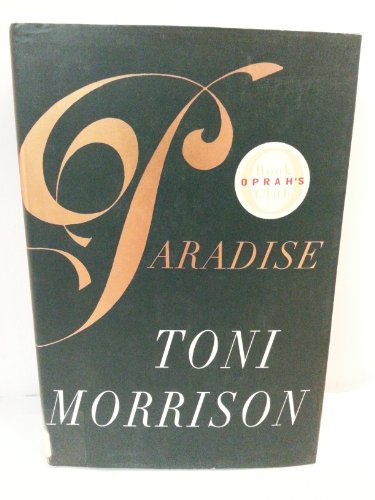
The Nobel Prize-winning author of The Bluest Eye captures the dreams, memories, conflicts, and complex interior lives of the citizens of a small, all-black town as four young women are brutally attacked in a convent near the town during the 1970s, in a novel that blends past, present, and future. 400,000 first printing. Tour.
Die Inhaltsangabe kann sich auf eine andere Ausgabe dieses Titels beziehen.
Über die Autorinnen und Autoren
Toni Morrison is Robert F. Goheen Professor at Princeton University. She has written six previous novels, and has received the National Book Critics Circle Award and the Pulitzer Prize. She won the Nobel Prize for Literature in 1993.
Toni Morrison is Robert F. Goheen Professor at Princeton University.
Auszug. © Genehmigter Nachdruck. Alle Rechte vorbehalten.
Excerpted from the Foreword
FOREWORD
The story goes like this. My grandfather attended school for one day in order to tell the teacher he wouldn’t be back because he had to work. His older sister, he said, would teach him to read. It was one of those details that surface in family lore but it wasn’t long before I wondered where was this “school”? He was born in 1864, a year after the Emancipation Proclamation. Where would a school be in the mid-nineteenth century in rural Alabama? In a church basement? Beneath trees out in the woods? Who was this daring, revolutionary teacher? The location would have to be hidden because black people’s access to education in general and reading specifically was violently discouraged and, in most of the South, teaching African Americans to read had been illegal. Virginia law, in 1831, is instructive and representative. “Any white person assembling to instruct free Negroes to read or write shall be fined not over $50.00 also be imprisoned not exceeding two months.” “It is further enacted that if any white person for pay shall assemble with slaves for the purpose of teaching them to read or write he shall for each offense be fined at the discretion of the justice . . .” ten to one hundred dollars. In short, there would be no teaching, paid or unpaid, of free Negroes or slaves without penalty. Any teacher would have to be aware of the risk he or she was taking.
Nevertheless, my grandfather’s sister was successful because against all odds, he did become literate. The next question was how would he use that skill? What was there for him to read? Books on that poor little farm in Greenville, Alabama? Unlikely. Library? Certainly not. But there was one book available: the Bible. Which is why, I suppose, that among his legendary accomplishments was his boast that he had read the King James Version of the Bible cover to cover five times.
Reading and script writing were prized in my family not only for information and pleasure but also as a defiant political act since historically so much effort had been used to keep us from learning. My mother joined the Literary Guild in the 1940s.We subscribed to newspapers devoted exclusively to African American news and opinions. Issues of The Pittsburgh Courier and the Cleveland Call and Post were worn to shreds with multiple readings and readers. Like other ethnic newspapers ours elicited passionate commentary, questions, argument. We poured over J. A. Rogers’ work, Du Bois’ Souls of Black Folk and whatever we could find that encouraged and informed us about being black in America.
It was inevitable, therefore, that when I edited The Black Book, a complex record of African American life that I solicited from collectors, the earliest newspapers would fascinate me, especially the “colored” ones. There, in photographs and print so much African American history— sad, ironic, resistant, tragic, proud, and triumphant— was on display. Of particular interest were those printed in the nineteenth century when my grandfather spent his few minutes at school. I learned there were some fifty black newspapers produced in the Southwest following Emancipation and the violent displacement of Native Americans from Oklahoma Territory. The opportunity to establish black towns was as feverish as the rush for whites to occupy the land. The “colored” newspapers encouraged the rush and promised a kind of paradise to the newcomers: land, their own government, safety— there were even sustained movements to establish their own state.
One theme in particular in those papers intrigued me. Prominent in their headlines and articles was a clear admonition: Come Prepared or Not at All.
Implicit in those warnings were two commands: 1) If you have nothing, stay away. 2) This new land is Utopia for a few. Translation: no poor former slaves are welcome in the paradise being built here. What could that mean for ex- slaves— threatened, exhausted refugees with no resources? How would they feel having trekked all that way from chains into freedom only to be told, “This here is Paradise but you can’t come in.” I also noticed that the town leaders in the photographs
were invariably light- skinned men. Was skin privilege also a feature of the separation? One that replicated the white racism they abhorred?
I wanted to dig into these matters by exploring the reverse; exclusivity by the very black- skinned; construction of their very own “gated community,” one that refused entrance to the mixed race. Considering the need for progeny in order to last, how would patriarchy play and how might matriarchy threaten? In order to describe and explore these questions I needed 1) to examine the definition of paradise, 2) to delve into the power of colorism, 3) to dramatize the conflict between patriarchy and matriarchy, and 4) disrupt racial discourse altogether by signaling then erasing it.
The idea of paradise is no longer imaginable or, rather, it is over-imagined, which amounts to the same thing— and has therefore become familiar, commercialized, even trivial. Historically, the images of paradise in poetry and prose were intended to be grand but accessible, beyond the routine but imaginatively graspable, seductive as though remembered. Milton speaks of “goodliest trees, loaden with fairest fruit, Blossoms and fruits at once of golden hue . . . with gay enameled colours mixed . . . ; of Native perfumes.” Of “that sapphire fount the crisped brooks, Rolling on orient pearl and sands of gold . . .” of “nectar visiting each plant, and fed flowers worthy of Paradise . . .Groves whose rich trees wept odorous gums and balm; Others whose fruit, burnished with golden rind, Hung amiable, . . . of delicious taste. Betwixt them lawns, or level downs, and flocks Grazing the tender herb.” “Flowers of all hue and without thorn the rose.” “Caves of cool recess, o’er which the mantling vine Lays forth her purple grape and gently creeps Luxuriant . . .”
That beatific, luxurious expanse we recognize in the twenty- first century as bounded real estate owned by the wealthy and envied by the have- nots, or as gorgeous parks visited by tourists. Milton’s Paradise is quite available these days, if not in fact certainly as ordinary, unexceptionable desire. Modern paradise has four of Milton’s characteristics: beauty, plenty, rest, exclusivity. Eternity seems to be forsworn.
Beauty is benevolent, controllable nature combined with precious metal, mansions, finery, and jewelry.
Plenty in a world of excess and attending greed, which tilts resources to the rich and forces others to envy, is an almost obscene feature of a contemporary paradise. In this world of outrageous, shameless wealth squatting, hulking, preening before the dispossessed, the very idea of “plenty” as Utopian ought to make us tremble. Plenty should not be understood as a paradise- only state, but as normal, everyday, humane life.
Rest that is the respite from labor or fighting for rewards or luxury has dwindling currency these days. It is a desire- less- ness that suggests a special kind of death without dying. Rest can suggest isolation, a vacation without pleasant or soothing activity. In other words, punishment and/or willful laziness.
Exclusivity, however is still an attractive, even compelling feature of paradise because so many people— the unworthy— are not there. Boundaries are secure, watchdogs, security systems, and gates are there to verify the legitimacy of the inhabitants. Such enclaves separate from crowded urban areas proliferate. Thus it does not seem possible or desirable for a...
„Über diesen Titel“ kann sich auf eine andere Ausgabe dieses Titels beziehen.
Suchergebnisse für Paradise

Beispielbild für diese ISBN
Paradise
Anbieter: World of Books (was SecondSale), Montgomery, IL, USA
Verkäuferbewertung 5 von 5 Sternen

Hardback. Zustand: Good. They shoot the white girl first. With the rest they can take their time. So begins Toni Morrison's Paradise, which opens with a horrifying scene of mass violence and chronicles its genesis in an all-black small town in rural Oklahoma. Founded by the descendants of freed slaves and survivors in exodus from a hostile world, the patriarchal community of Ruby is built on righteousness, rigidly enforced moral law, and fear. But seventeen miles away, another group of exiles has gathered in a promised land of their own. And it is upon these women in flight from death and despair that nine male citizens of Ruby will lay their pain, their terror, and their murderous rage. In prose that soars with the rhythms, grandeur, and tragic arc of an epic poem, Toni Morrison challenges our most fiercely held beliefs as she weaves folklore and history, memory and myth into an unforgettable meditation on race, religion, gender, and a far-off past that is ever present. Artikel-Nr. 00102166158
Gebraucht kaufen
EUR 3,90
Versand gratis
Versand innerhalb von USA
Versand innerhalb von USA
Anzahl: Mehr als 20 verfügbar
Beispielbild für diese ISBN
Paradise
Anbieter: World of Books (was SecondSale), Montgomery, IL, USA
Verkäuferbewertung 5 von 5 Sternen
Hardback. Zustand: Fair. They shoot the white girl first. With the rest they can take their time. So begins Toni Morrison's Paradise, which opens with a horrifying scene of mass violence and chronicles its genesis in an all-black small town in rural Oklahoma. Founded by the descendants of freed slaves and survivors in exodus from a hostile world, the patriarchal community of Ruby is built on righteousness, rigidly enforced moral law, and fear. But seventeen miles away, another group of exiles has gathered in a promised land of their own. And it is upon these women in flight from death and despair that nine male citizens of Ruby will lay their pain, their terror, and their murderous rage. In prose that soars with the rhythms, grandeur, and tragic arc of an epic poem, Toni Morrison challenges our most fiercely held beliefs as she weaves folklore and history, memory and myth into an unforgettable meditation on race, religion, gender, and a far-off past that is ever present. Artikel-Nr. 00107558773
Gebraucht kaufen
EUR 3,90
Versand gratis
Versand innerhalb von USA
Versand innerhalb von USA
Anzahl: 14 verfügbar
Beispielbild für diese ISBN
Paradise
Verlag:
Knopf (edition First Edition), 1997
ISBN 10: 0679433740
ISBN 13: 9780679433743
Gebraucht
Hardcover
Erstausgabe
Anbieter: BooksRun, Philadelphia, PA, USA
Verkäuferbewertung 5 von 5 Sternen
Hardcover. Zustand: Very Good. First Edition. It's a well-cared-for item that has seen limited use. The item may show minor signs of wear. All the text is legible, with all pages included. It may have slight markings and/or highlighting. Artikel-Nr. 0679433740-11-1
Gebraucht kaufen
EUR 5,11
Versand gratis
Versand innerhalb von USA
Versand innerhalb von USA
Anzahl: 1 verfügbar
Beispielbild für diese ISBN
Paradise
Verlag:
Knopf (edition First Edition), 1997
ISBN 10: 0679433740
ISBN 13: 9780679433743
Gebraucht
Hardcover
Erstausgabe
Anbieter: BooksRun, Philadelphia, PA, USA
Verkäuferbewertung 5 von 5 Sternen
Hardcover. Zustand: Fair. First Edition. With dust jacket. The item might be beaten up but readable. May contain markings or highlighting, as well as stains, bent corners, or any other major defect, but the text is not obscured in any way. Artikel-Nr. 0679433740-7-1-29
Gebraucht kaufen
EUR 5,17
Versand gratis
Versand innerhalb von USA
Versand innerhalb von USA
Anzahl: 1 verfügbar
Beispielbild für diese ISBN
Paradise
Verlag:
Knopf (edition First Edition), 1997
ISBN 10: 0679433740
ISBN 13: 9780679433743
Gebraucht
Hardcover
Erstausgabe
Anbieter: BooksRun, Philadelphia, PA, USA
Verkäuferbewertung 5 von 5 Sternen
Hardcover. Zustand: Very Good. First Edition. With dust jacket. It's a well-cared-for item that has seen limited use. The item may show minor signs of wear. All the text is legible, with all pages included. It may have slight markings and/or highlighting. Artikel-Nr. 0679433740-11-1-29
Gebraucht kaufen
EUR 5,30
Versand gratis
Versand innerhalb von USA
Versand innerhalb von USA
Anzahl: 1 verfügbar
Beispielbild für diese ISBN
Paradise
Anbieter: ThriftBooks-Reno, Reno, NV, USA
Verkäuferbewertung 5 von 5 Sternen
Hardcover. Zustand: Good. No Jacket. Former library book; Missing dust jacket; Pages can have notes/highlighting. Spine may show signs of wear. ~ ThriftBooks: Read More, Spend Less. Artikel-Nr. G0679433740I3N11
Gebraucht kaufen
EUR 5,96
Versand gratis
Versand innerhalb von USA
Versand innerhalb von USA
Anzahl: 1 verfügbar
Beispielbild für diese ISBN
Paradise
Anbieter: ThriftBooks-Atlanta, AUSTELL, GA, USA
Verkäuferbewertung 5 von 5 Sternen
Hardcover. Zustand: Good. No Jacket. Former library book; Missing dust jacket; Pages can have notes/highlighting. Spine may show signs of wear. ~ ThriftBooks: Read More, Spend Less. Artikel-Nr. G0679433740I3N11
Gebraucht kaufen
EUR 5,96
Versand gratis
Versand innerhalb von USA
Versand innerhalb von USA
Anzahl: 1 verfügbar
Beispielbild für diese ISBN
Paradise
Anbieter: ThriftBooks-Reno, Reno, NV, USA
Verkäuferbewertung 5 von 5 Sternen
Hardcover. Zustand: Fair. No Jacket. Readable copy. Pages may have considerable notes/highlighting. ~ ThriftBooks: Read More, Spend Less. Artikel-Nr. G0679433740I5N00
Gebraucht kaufen
EUR 5,96
Versand gratis
Versand innerhalb von USA
Versand innerhalb von USA
Anzahl: 3 verfügbar
Beispielbild für diese ISBN
Paradise
Anbieter: ThriftBooks-Phoenix, Phoenix, AZ, USA
Verkäuferbewertung 5 von 5 Sternen
Hardcover. Zustand: Good. No Jacket. Missing dust jacket; Pages can have notes/highlighting. Spine may show signs of wear. ~ ThriftBooks: Read More, Spend Less. Artikel-Nr. G0679433740I3N01
Gebraucht kaufen
EUR 5,96
Versand gratis
Versand innerhalb von USA
Versand innerhalb von USA
Anzahl: 9 verfügbar
Beispielbild für diese ISBN
Paradise
Anbieter: ThriftBooks-Dallas, Dallas, TX, USA
Verkäuferbewertung 5 von 5 Sternen
Hardcover. Zustand: Good. No Jacket. Missing dust jacket; Pages can have notes/highlighting. Spine may show signs of wear. ~ ThriftBooks: Read More, Spend Less. Artikel-Nr. G0679433740I3N01
Gebraucht kaufen
EUR 5,96
Versand gratis
Versand innerhalb von USA
Versand innerhalb von USA
Anzahl: 10 verfügbar