
Verwandte Artikel zu Life the Movie: How Entertainment Conquered Reality
Inhaltsangabe
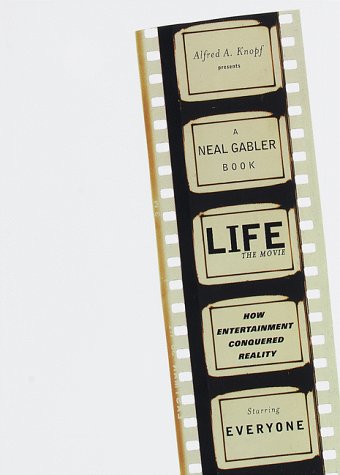
Examines the ways in which the entertainment industry has captivated Americans over the years, turning news into entertainment and performers into role models
Die Inhaltsangabe kann sich auf eine andere Ausgabe dieses Titels beziehen.
Über die Autorin bzw. den Autor
Neal Gabler is the author of <i>An Empire of Their Own: How the Jews Invented Hollywood</i>, for which he won the <i>Los Angeles Times</i> Book Prize for History, and <i>Winchell: Gossip, Power and the Culture of Celebrity</i>, which was a finalist for the National Book Critics Circle Award and was named nonfiction book of the year by <i>Time</i> magazine. Mr. Gabler holds advanced degrees in film and American culture and has been a recipient of a Guggenheim Fellowship and a Freedom Forum Fellowship. He was born in Chicago and lives with his wife and two daughters in Amagansett, New York.
Aus dem Klappentext
ant book that sharply illuminates our obsessions with celebrity, gossip, scandal, and real-life melodrama, Neal Gabler shows us today's astonishing conversion of life itself into Entertainment--Life the Movie.<br><br> Revealing what now unites phenomena as diverse as modern art, President Clinton versus Kenneth Starr, the O. J. Simpson trial, the Unabomber murders, and Elizabeth Taylor's marriages, Gabler demonstrates how our hunger for entertainment and the massive exploitation of that hunger have combined to make everything from religion to politics to painting to the news into branches of show business; how <b>Life the Movie</b> has generated and popularized its own stars--the rich and famous; and how all of us are not only an audience for the life spectacular, but also performance artists acting out our own dramas within it.<br><br> Starting in nineteenth-century America with the theatrics of the popular stage and the sensations of
Auszug. © Genehmigter Nachdruck. Alle Rechte vorbehalten.
Perhaps the most difficult adjustments to the imperatives of entertainment were those undergone by the arts which had, by definition, been arrayed against entertainment and had denied its sensationalist aesthetic. These had tried to hold the line even as everything else seemed to be succumbing around them, but not even art could finally resist the siren call of show business. The arts were forced either to surrender or to be marginalized to the point where they would cease to matter to any but a handful of devotees.
In literature the erosion of will began early. Some critics blamed paperback books for driving publishing into the arms of entertainment, seeing them, in effect, as the television of literature; they made books available, but they also cheapened them. One publisher, complaining about sensational paperback covers, opined, "The contents of the book . . . were relatively unimportant. What mattered was that its lurid exterior should ambush the customer." Others traced the decline even further back to the rise of magazine serialization as a major source of book revenue and the need for books to adapt themselves to this method of distribution, which entailed bold characters, strong plots, cliffhangers and other sensationalist appurtenances.
Still others saw the decline of serious literature in direct proportion to the rise of commerce in publishing. When the Book-of-the-Month Club, itself a commercial institution dedicated to selling books rather than promoting literature, eased out its editor in chief in 1996 and transferred his duties to the head of marketing, a former club juror, Brad Leithauser, dejectedly said they could just as easily be selling kitchen supplies now. It was an increasingly common plaint among writers that books had become another commodity to be marketed, but the blame on commercialism was misplaced. Since no one expected publishing to be an eleemosynary institution, the problem wasn't commercialism per se; it was the kinds of books that commerce demanded. What empowered the forces of marketing was entertainment because quite simply, entertaining books were more likely to sell than nonentertaining ones, or more accurately, books that could become part of an entertainment process were more likely to sell.
In a way the real entertainment hurdle for literature, even trashy popular literature, was the fact of the word. Words, as Neil Postman has written, demanded much more effort than visuals, and even if one were to expend that effort, there were obvious limitations to the sensation generated by words compared with the seemingly limitless sensation generated by the visuals and sounds of the movies, television and computers. None of this was lost on publishers. Just as newspapers realized their insufficiency versus television news, so publishers realized their insufficiency versus the entertainment competition, and they sought to do something about it.
What publishers discovered was that given the right circumstances, a book was ultimately incidental to its own sales. It was yet another macguffin for a larger show. What publishing houses were really selling was a phenomenon--something the media would flog the way media flogged any Hollywood blockbuster. The object was to get people talking about a book, get them feeling that they had missed something if they didn't know about it, even though they were responding not to the book itself, which few of then probably had read or would read, but rather to the frenzy whipped up around the book--a controversy or novel feature or eye-catching angle like a seven-figure advance to the author or a big-money sale of the film rights. The frenzy assumed a life of its own even as the alleged object of the frenzy kept receding further and further into the background. The novelist David Foster Wallace, bemused when the media began championing his immense novel Infinite Jest and making Wallace himself a literary star, called this the "excitement about the excitement." It was one of the principal marketing tools for anything in the Republic of Entertainment.
As far as literature went, most of the initial excitement was stirred not by the book but by its author, whose life movie would promote the book the way Olympic athletes' life movies promoted the Olympics for NBC. The tradition actually stretched back at least as far as Byron, who was canny enough to cultivate a bohemian persona as the Romantic poet and then actively exploit it. As Dwight Macdonald described it, "Byron's reputation was different from that of Chaucer, Spenser, Shakespeare, Milton, Dryden and Pope because it was based on the man--on what the public conceived to be the man--rather than on his work. His poems were taken not as artistic objects in themselves but as expressions of their creator's personality."
Walt Whitman did the same and to the same effect. He wanted to be seen as a character whose personality would advertise his poetry. A friend once described him as a "poseur of truly colossal proportions, one to whom playing a part had long before become so habitual that he ceased to be conscious that he was doing it." In fact, the idea that celebrity could create a best-seller more easily than a best-seller could create celebrity was enough of a commonplace by the end of the nineteenth century that the protagonist of New Grub Street, an 1891 novel, could say, "If I am an unknown man, and publish a wonderful book, it will make its way very slowly, or not at all. If I become a known man, publish that very same book, its praise will echo over both hemispheres "
However true it was then, it became even truer in the age of mass media. No one, though, seemed to have as ready a grasp of this as Ernest Hemingway, who was actually compared to Byron for his flagrant self-promotion. Just as thoroughly as any fictional character he created in his novels, Hemingway created a persona for himself and authored a life movie in which he could star on the screens of the media. This was Hemingway the artist roughneck, expatriate war hero, bullfight lover, big-game hunter, deep-sea fisherman, world-class drinker, womanizer, brawler--a man so outsized that he dwarfed the writer and his books even though this movie was the main reason anyone but litterateurs was likely to pay his books any heed. Critic Edmund Wilson churlishly called this persona "the Hemingway of the handsome photographs with the sportsman's tan and the outdoor grin, with the ominous resemblance to Clark Gable, who poses with giant marlin which he has just hauled off Key West," as opposed to Hemingway the writer.
Of course Hemingway knew the value of all this, and though critics continued to lament that he had sacrificed his art on the altar of celebrity or that he was, as Leo Braudy put it, "the prime case of someone fatally caught between his genius and his publicity," he realized that there might have been very little art if it weren't for the celebrity--at least very little art that anyone would buy, much less read. As he metamorphosed into "Papa Hemingway," the grizzled macho icon with his beard stubble and peak cap, he became more popular than ever and even gained a certain immunity from the critics, who now routinely disparaged his work. The public who defended him didn't really care whether he was a good writer. They cared that he was a bold personality--a movie's idea of a good writer.
In the end, Hemingway would be one of the most influential writers of the twentieth century, but it...
„Über diesen Titel“ kann sich auf eine andere Ausgabe dieses Titels beziehen.
Suchergebnisse für Life the Movie: How Entertainment Conquered Reality

Beispielbild für diese ISBN
Life, the Movie
Anbieter: BooksRun, Philadelphia, PA, USA
Verkäuferbewertung 5 von 5 Sternen

Hardcover. Zustand: Very Good. 1. With dust jacket. It's a well-cared-for item that has seen limited use. The item may show minor signs of wear. All the text is legible, with all pages included. It may have slight markings and/or highlighting. Artikel-Nr. 0679417524-8-1-29
Gebraucht kaufen
EUR 5,06
Versand gratis
Versand innerhalb von USA
Versand innerhalb von USA
Anzahl: 1 verfügbar
Beispielbild für diese ISBN
Life the Movie
Anbieter: World of Books (was SecondSale), Montgomery, IL, USA
Verkäuferbewertung 5 von 5 Sternen
Zustand: Acceptable. Item in acceptable condition! Textbooks may not include supplemental items i.e. CDs, access codes etc. Artikel-Nr. 00108714262
Gebraucht kaufen
EUR 5,51
Versand gratis
Versand innerhalb von USA
Versand innerhalb von USA
Anzahl: 1 verfügbar
Beispielbild für diese ISBN
Life the Movie
Anbieter: World of Books (was SecondSale), Montgomery, IL, USA
Verkäuferbewertung 5 von 5 Sternen
Zustand: Good. Item in good condition. Textbooks may not include supplemental items i.e. CDs, access codes etc. Artikel-Nr. 00105794403
Gebraucht kaufen
EUR 5,51
Versand gratis
Versand innerhalb von USA
Versand innerhalb von USA
Anzahl: 1 verfügbar
Beispielbild für diese ISBN
Life, the Movie
Anbieter: ThriftBooks-Dallas, Dallas, TX, USA
Verkäuferbewertung 5 von 5 Sternen
Hardcover. Zustand: Very Good. No Jacket. Missing dust jacket; May have limited writing in cover pages. Pages are unmarked. ~ ThriftBooks: Read More, Spend Less. Artikel-Nr. G0679417524I4N01
Gebraucht kaufen
EUR 6,10
Versand gratis
Versand innerhalb von USA
Versand innerhalb von USA
Anzahl: 1 verfügbar
Beispielbild für diese ISBN
Life, the Movie
Anbieter: ThriftBooks-Dallas, Dallas, TX, USA
Verkäuferbewertung 5 von 5 Sternen
Hardcover. Zustand: Very Good. No Jacket. May have limited writing in cover pages. Pages are unmarked. ~ ThriftBooks: Read More, Spend Less. Artikel-Nr. G0679417524I4N00
Gebraucht kaufen
EUR 6,10
Versand gratis
Versand innerhalb von USA
Versand innerhalb von USA
Anzahl: 1 verfügbar
Beispielbild für diese ISBN
Life, the Movie
Anbieter: ThriftBooks-Atlanta, AUSTELL, GA, USA
Verkäuferbewertung 5 von 5 Sternen
Hardcover. Zustand: Very Good. No Jacket. May have limited writing in cover pages. Pages are unmarked. ~ ThriftBooks: Read More, Spend Less. Artikel-Nr. G0679417524I4N00
Gebraucht kaufen
EUR 6,10
Versand gratis
Versand innerhalb von USA
Versand innerhalb von USA
Anzahl: 1 verfügbar
Beispielbild für diese ISBN
Life the Movie : How Entertainment Conquered Reality
Verlag:
Knopf Doubleday Publishing Group, 1998
ISBN 10: 0679417524
ISBN 13: 9780679417521
Gebraucht
Hardcover
Erstausgabe
Anbieter: Better World Books, Mishawaka, IN, USA
Verkäuferbewertung 5 von 5 Sternen
Zustand: Good. 1ST. Former library copy. Pages intact with minimal writing/highlighting. The binding may be loose and creased. Dust jackets/supplements are not included. Includes library markings. Stock photo provided. Product includes identifying sticker. Better World Books: Buy Books. Do Good. Artikel-Nr. GRP35282900
Gebraucht kaufen
EUR 6,75
Versand gratis
Versand innerhalb von USA
Versand innerhalb von USA
Anzahl: 2 verfügbar
Beispielbild für diese ISBN
Life the Movie : How Entertainment Conquered Reality
Verlag:
Knopf Doubleday Publishing Group, 1998
ISBN 10: 0679417524
ISBN 13: 9780679417521
Gebraucht
Hardcover
Erstausgabe
Anbieter: Better World Books, Mishawaka, IN, USA
Verkäuferbewertung 5 von 5 Sternen
Zustand: Good. 1ST. Pages intact with minimal writing/highlighting. The binding may be loose and creased. Dust jackets/supplements are not included. Stock photo provided. Product includes identifying sticker. Better World Books: Buy Books. Do Good. Artikel-Nr. 3386494-6
Gebraucht kaufen
EUR 6,75
Versand gratis
Versand innerhalb von USA
Versand innerhalb von USA
Anzahl: 1 verfügbar
Beispielbild für diese ISBN
Life the Movie : How Entertainment Conquered Reality
Verlag:
Knopf Doubleday Publishing Group, 1998
ISBN 10: 0679417524
ISBN 13: 9780679417521
Gebraucht
Hardcover
Erstausgabe
Anbieter: Better World Books, Mishawaka, IN, USA
Verkäuferbewertung 5 von 5 Sternen
Zustand: Very Good. 1ST. Pages intact with possible writing/highlighting. Binding strong with minor wear. Dust jackets/supplements may not be included. Stock photo provided. Product includes identifying sticker. Better World Books: Buy Books. Do Good. Artikel-Nr. 6146638-6
Gebraucht kaufen
EUR 6,75
Versand gratis
Versand innerhalb von USA
Versand innerhalb von USA
Anzahl: 1 verfügbar
Beispielbild für diese ISBN
Life, the Movie
Anbieter: Books From California, Simi Valley, CA, USA
Verkäuferbewertung 4 von 5 Sternen

Hardcover. Zustand: Good. Artikel-Nr. mon0004242552
Gebraucht kaufen
EUR 4,60
EUR 4,45 Versand
Versand innerhalb von USA
Versand innerhalb von USA
Anzahl: 1 verfügbar