
Verwandte Artikel zu 1984: Introduction by Julian Symons (Everyman's...
1984: Introduction by Julian Symons (Everyman's Library) - Hardcover
Buch 3 von 8: The English Edition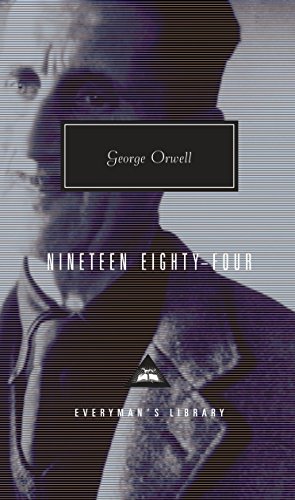
Inhaltsangabe
A deluxe hardcover edition of 1984: one of the most celebrated novels of the twentieth century, Orwell's cautionary tale of a man trapped under the gaze of an authoritarian state feels more relevant now than ever before.
Winston Smith spends his days rewriting history to fit the narrative that his government wants citizens to believe. But as the gap between the propaganda he writes and the reality he lives proves too much for Winston to swallow, he begins to seek some form of escape. His desperate struggle to free himself from an all-encompassing, tyrannical state illuminates the tendencies apparent in every modern society, and makes vivid the universal predicament of the individual.
Everyman's Library pursues the highest production standards, printing on acid-free cream-colored paper, with full-cloth cases with two-color foil stamping, decorative endpapers, silk ribbon markers, European-style half-round spines, and a full-color illustrated jacket. Contemporary Classics include an introduction, a select bibliography, and a chronology of the author's life and times.
Die Inhaltsangabe kann sich auf eine andere Ausgabe dieses Titels beziehen.
Über die Autorin bzw. den Autor
George Orwell (1903–1950) served with the Imperial Police in Burma, fought with the Republicans during the Spanish Civil War, and was a member of the Home Guard and a writer for the BBC during World War II. He is the author of many works of non-fiction and fiction.
Von der hinteren Coverseite
While the totalitarianism that provoked George Orwell into writing 'Nineteen Eighty-Four' seems to be passing into oblivion, his harrowing, cautionary tale of a man trapped in a political nightmare has had the opposite fate, and its relevance and power to disturb our complacency seem to grow decade by decade.
Auszug. © Genehmigter Nachdruck. Alle Rechte vorbehalten.
INTRODUCTION by Julian Symons
George Orwell's life as a writer falls distinctly into two parts, and it happens that he himself dated the change precisely. On 20 August 1939, the night before Stalin's Soviet Union signed a pact of friendship with Hitler's Germany, Orwell dreamed that the war expected by all adults of his generation had begun, and realized that 'I was patriotic at heart, would not sabotage or act against my own side, would support the war, would fight in it if possible.' His dream anticipated the reality of war by no more than a couple of weeks, and although Orwell's health made it impossible for him to enter the armed forces, he supported the aims of the war and was opposed to a negotiated peace.
The decision was a contradiction of much he had said and written up to that time. Only a couple of months earlier he had expressed the view that the British and French so-called democracies were 'in essence nothing but mechanisms for exploiting cheap labour', and had said the only hope of saving Britain from either foreign or home-grown Fascist rule was the emergence of a mass party whose first pledges would be 'to refuse war and to right imperial injustice'. In a letter that must have alarmed the art critic and peaceful anarchist Herbert Read who received it, he suggested that those who were both anti-war and anti-Fascist should buy and secrete printing presses in what he called 'some discreet place' so that they would be ready for the issue ofrevolutionary pamphlets when the time came.
So Orwell was inconsistent: but then his life up to that night in August 1939 had been a pattern of changes in attitude marking changed beliefs. He was born in Bengal in 1903 as Eric Arthur Blair, the only male child (he had an older and younger sister) of a civil servant in the Opium Department of the Indian government. Like many children of what he later called the 'lower-upper-middle class' he was sent as a boarder to a preparatory school, named St Cyprian's, where by an autobiographical account written not long before his death he was very unhappy. The scholarship that took him to Eton did not change his belief that the prime necessities for success in life were 'money, athleticism, tailor-made clothes and a charming smile', and that he possessed none of these attributes, being weak, ugly, unpopular and cowardly. That was not the view of Eton contemporaries like Cyril Connolly, who saw Orwell not as an outcast but a rebel. Yet the teenage rebel retained respect for the standards engendered by St Cyprian's and Eton, and a feeling that may be called sentimental or patriotic for the British Empire. He served five years in Burma with the Imperial Police, and did so by choice and not compulsion, although he said later that 'I hated the imperialism I was serving with a bitterness that I cannot make clear.'
There is no doubt that he ended by hating it, and he was not a man who did things by halves. After turning away from the Imperialist ideal he tried without much success to involve himself with the poorest and most wretched groups in society. 'At that time failure seemed to me the only virtue', and in pursuit of failure he spent some weeks with hop-pickers, lived briefly with tramps, and tried to get himself put in prison as a drunk. He lived for eighteen months in Paris, writing without much commercial success, and the record of that time, Down and Out in Paris and London was his first published book. He was not proud of or very pleased with the result, and decided to use a pseudonym rather than his given name. He suggested four possibilities to the publisher Victor Gollancz, saying 'I rather favour George Orwell.' Gollancz favoured it too, and early in 1933 the name George Orwell came into existence via a book jacket. Thereafter, while early friends continued to call him Eric, later ones like me knew him only as George.
Orwell's career after Down and Out and in the years before the war shows the uncertainties, confusions, fresh starts and false starts almost inescapable for anybody who became seriously involved in Left-wing politics during that very political decade. In that time he published four novels which had reasonable sales and reviews but no outstanding success, and The Road to Wigan Pier. The first part of this commissioned book, which dealt with the hard life of miners, was much approved by the Left intelligentsia, but the second caused shock waves of disapproval for its attack on what Orwell called 'the dreary tribe of high-minded women and sandal wearers and bearded fruit-juice drinkers' who were magnetically drawn to Socialism and the magical word progress 'like bluebottles to a dead cat'.
The Spanish Civil War took him to Spain to fight for the Republic, and his experience there was the basis of his finest work during the decade. Homage to Catalonia appeared in 1938 in an edition of only 1 ,500 copies, 600 of them still unsold when he died in 1950. The story of his life during the thirties might be called 'the education of a Socialist', from the first blundering attempts to understand the poor by living with or like them, through a high-minded period of linking himself with a political party (in Orwell's case the splinter group the Independent Labour Party), into the full understanding of the noble idealism and bitter internecine hatreds within groups that called themselves Socialist, as they were demonstrated to him during his months in Spain. In 1947 he said:
Every line of serious work that I have written since 1936 has been written, directly or indirectly, against totalitarianism and for democratic Socialism as I understand it ... Looking back through my work, I see that it is invariably when I lacked a political purpose that I wrote lifeless books and was betrayed into purple passages, sentences without meaning, decorative adjectives and humbug generally.
It is no wonder that at the time he regarded the Spanish experience as a turning point in his attitude towards society, yet there was one more lesson still to learn. He emerged from Spain an apparent revolutionary, as we have seen in the call for a mass anti-war party and preparation for guerrilla warfare. Yet such a thesis went against the deepest impulses of his nature, the love of his country, its people, customs and landscape, that was the emotional basis of his personality. An understanding of this prompted the final realization of what Eric Blair/George Orwell truly believed: that it was necessary for the war to be fought, with Socialism the end to be achieved when it had been won. By the side of that went the obligation to expose the deceits and villainous practices of Communist parties, as he had seen them in Spain and imagined them in the Soviet Union. He did not stray from those purposes in the last decade of his life.
*
Because George Orwell is now so famous, with all the books consistently appearing in new editions, and the adjective Orwellian stamped on the mind of every politician and leaderwriter for use once a week, it is well to be reminded of the way in which he was regarded during most of his life. Had he died in 1939 (something quite possible, for his health was never good) he would be remembered now as a maverick with some lively but highly eccentric opinions that need not be considered seriously. And if his life had been cut off before his last decade that would not have been an unreasonable view, for the achievements up to then had been minor. The account of life as a plongeur in Down and Out, the description of going down a mine in Wigan Pier and much of Homage To Catalonia have the extraordinary directness of his finest writing, but there are elements in the first two books that leave a sense of the writer being selective, not...
„Über diesen Titel“ kann sich auf eine andere Ausgabe dieses Titels beziehen.
Suchergebnisse für 1984: Introduction by Julian Symons (Everyman's...

Beispielbild für diese ISBN
Nineteen Eighty-Four
Anbieter: World of Books (was SecondSale), Montgomery, IL, USA
Verkäuferbewertung 5 von 5 Sternen

Zustand: Good. Good condition ex-library book with usual library markings and stickers. Artikel-Nr. 00110154765
Gebraucht kaufen
EUR 9,75
Versand gratis
Versand innerhalb von USA
Versand innerhalb von USA
Anzahl: 1 verfügbar
Beispielbild für diese ISBN
1984
Anbieter: Kennys Bookstore, Olney, MD, USA
Verkäuferbewertung 5 von 5 Sternen
Zustand: New. Num Pages: 325 pages. BIC Classification: FA. Category: (G) General (US: Trade). Dimension: 210 x 130 x 27. Weight in Grams: 520. . 1992. 1st Edition. Hardcover. . . . . Books ship from the US and Ireland. Artikel-Nr. V9780679417392
Neu kaufen
EUR 33,35
EUR 9,16 Versand
Versand innerhalb von USA
Versand innerhalb von USA
Anzahl: 1 verfügbar
Foto des Verkäufers
1984: Introduction by Julian Symons
Anbieter: moluna, Greven, Deutschland
Verkäuferbewertung 5 von 5 Sternen
Zustand: New. Über den AutorGeorge Orwell (1903-1950) served with the Imperial Police in Burma, fought with the Republicans during the Spanish Civil War, and was a member of the Home Guard and a writer for the BBC during World War II. He is the a. Artikel-Nr. 898445257
Neu kaufen
EUR 25,34
EUR 48,99 Versand
Versand von Deutschland nach USA
Versand von Deutschland nach USA
Anzahl: Mehr als 20 verfügbar
Foto des Verkäufers
1984 : Introduction by Julian Symons
Verlag:
Knopf Doubleday Publishing Group Nov 1992, 1992
ISBN 10: 0679417397
ISBN 13: 9780679417392
Neu
Hardcover
Anbieter: AHA-BUCH GmbH, Einbeck, Deutschland
Verkäuferbewertung 5 von 5 Sternen
Buch. Zustand: Neu. Neuware - A deluxe hardcover edition of 1984: one of the most celebrated novels of the twentieth century, Orwell's cautionary tale of a man trapped under the gaze of an authoritarian state feels more relevant now than ever before. Winston Smith spends his days rewriting history to fit the narrative that his government wants citizens to believe. But as the gap between the propaganda he writes and the reality he lives proves too much for Winston to swallow, he begins to seek some form of escape. His desperate struggle to free himself from an all-encompassing, tyrannical state illuminates the tendencies apparent in every modern society, and makes vivid the universal predicament of the individual. Everyman's Library pursues the highest production standards, printing on acid-free cream-colored paper, with full-cloth cases with two-color foil stamping, decorative endpapers, silk ribbon markers, European-style half-round spines, and a full-color illustrated jacket. Contemporary Classics include an introduction, a select bibliography, and a chronology of the author's life and times. Artikel-Nr. 9780679417392
Neu kaufen
EUR 46,72
EUR 30,50 Versand
Versand von Deutschland nach USA
Versand von Deutschland nach USA
Anzahl: 2 verfügbar