
Verwandte Artikel zu Stravinsky: A Creative Spring : Russia and France,...
Inhaltsangabe
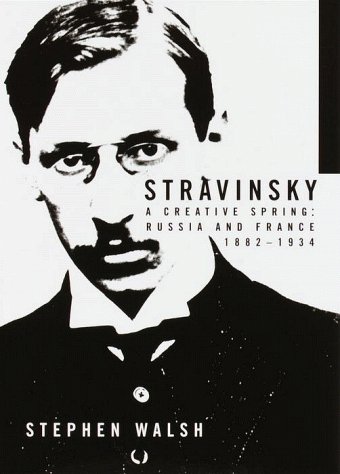
Widely regarded the greatest composer of the twentieth century, Igor Stravinsky was central to the development of modernism in art. Deeply influential and wonderfully productive, he is remembered for dozens of masterworks, from The Firebird and The Rite of Spring to The Rake's Progress, but no dependable biography of him exists. Previous studies have relied too heavily on his own unreliable memoirs and conversations, and until now no biographer has possessed both the musical knowledge to evaluate his art and the linguistic proficiency needed to explore the documentary background of his life--a life whose span extended from tsarist Russia to Switzerland, France, and ultimately the United States.
In this revealing volume, the first of two, Stephen Walsh follows Stravinsky from his birth in 1882 to 1934. He traces the composer's early Russian years in new and fascinating detail, laying bare the complicated relationships within his family and showing how he first displayed his extraordinary talents within the provincial musical circle around his teacher, Nikolay Rimsky-Korsakov. Stravinsky's brilliantly creative involvement with the Ballets Russes is illuminated by a sharp sense of the internal artistic politics that animated the group. Portraying Stravinsky's circumstances as an émigré in France trying to make his living as a conductor and pianist as well as a composer while beset by emotional and financial demands, Walsh reveals the true roots of his notorious obsession with money during the 1920s and describes with sympathy the nature of his long affair with Vera Sudeykina.
While always respecting Stravinsky's own insistence that life and art be kept distinct, Stravinsky makes clear precisely how the development of his music was connected to his life and to the intellectual environment in which he found himself. But at the same time it demonstrates the composer's remarkably pragmatic psychology, which led him to consider the welfare of his art to be of paramount importance, before which everything else had to give way. Hence, for example, his questionable attitude toward Hitler and Mussolini, and his reputation as a touchy, unpredictable man as famous for his enmities as for his friendships.
Stephen Walsh, long established as an expert on Stravinsky's music, has drawn upon a vast array of material, much of it unpublished or unavailable in English, to bring the man himself, in all his color and genius, to glowing life. Written with elegance and energy, comprehensive, balanced, and original, Stravinsky is essential reading for anyone interested in the adventure of art in our time.
Praise from the British press for Stephen Walsh's The Music of Stravinsky
"One of the finest general studies of the composer."
--Wilfrid Mellers, composer, Times Literary Supplement
"The beautiful prose of The Music of Stravinsky is itself a fund of arresting images. For those who already love Stravinsky's music, Walsh's essays on each work will bring a smile of recognition and joy at new kernels of insight. For those unfamiliar with many of the works he discusses, Walsh's commentaries are likely to whet appetites for performances of the works."
--John Shepherd, Notes
"This book sent me scurrying back to the scores and made me want to recommend it to other people. Above all, it is a good read."
--Anthony Pople, Music and Letters
Die Inhaltsangabe kann sich auf eine andere Ausgabe dieses Titels beziehen.
Über die Autorin bzw. den Autor
Stephen Walsh is a critic and musicologist who has written extensively on Stravinsky and other modern composers. He is now Reader in Music at Cardiff University
Auszug. © Genehmigter Nachdruck. Alle Rechte vorbehalten.
The small town of Oranienbaum lies on the southern shore of the Gulf of Finland, some fifty kilometers to the west of St. Petersburg. The ground rises gently from the sea to what remains today the main feature of the place, the great baroque palace of Peter the Great's corrupt favorite Prince Alexander Menshikov, with its rambling Dutch park -- now, alas, somewhat forlorn -- originally laid out in 1714. At one corner of the park a lake debouches into a stream by way of a modest waterfall surrounded by rocks and pine trees, a sufficiently Alpine setting, apparently, for the street which runs east from the park gate nearby to have been christened with the otherwise absurdly fanciful name Shveytsarskaya Ulitsa -- Swiss Street.
But another, less imaginary thread links this provincial Russian street with the land of the cuckoo clock and the numbered bank account. For it was here, in the wooden dacha of one Khudintsev -- Oranienbaum house number 137 -- that Igor Fyodorovich Stravinsky was born at noon on 5/17 June 1882. And while Switzerland may have left its faint mark on Oranienbaum, Oranienbaum was to leave an indelible imprint on Switzerland, a fact also recorded in a street name, no less incongruous -- that of the rue Sacre du Printemps in the suburbs of Clarens, on the northern shore of Lake Geneva.
Like most provincial towns of what was once the Soviet Union, Oranienbaum is today a depressing epitaph to three-quarters of a century of bad management, bad economics, and bad architecture. The Soviets destroyed it by their own unique combination of neglect and vandalism. Menshikov's park, with its palaces and walks, was left to decay; but much of what otherwise remained from tsarist times, and survived the German bombardment of the early forties, was bulldozed and replaced by concrete and gray brick which, as usual, in turn soon crumbled and peeled. The town's name was changed from the too-German, too-Petrine "Orange Tree" to the harder-nosed Lomonosov, in honor of an eighteenth-century philologist from chilly Archangel. Shveytsarskaya Street became Ulitsa Vosstaniya -- Revolution Street. The dacha Khudintseva was heedlessly pulled down and replaced in 1934 by an electricity substation, itself now rusting and decrepit. Of all the great birthplaces of Western art, this must surely be one of the most philistine and dispiriting.
More than seventy-five years later, Stravinsky told Robert Craft that "we never returned to Oranienbaum after my birth . . . and I have never seen it since." But on this, as on countless other points of fact, his memory betrayed him. The Stravinskys went back to Oranienbaum at least twice, in the summers of 1884 and 1885, and Igor's younger brother, Gury, was born there too, on 30 July/11 August 1884, though in a different house. The place was a fashionable summer resort for the Petersburg artistic-literary intelligentsia, and since Igor's father was a singer and a bibliophile, he was merely following a trend by summering there. Tolstoy, Nekrasov, and Fet, among writers, and -- among painters -- the realist peredvizhniki ("wanderers") Savrasov, Shishkin, and Repin, all stayed and worked in Oranienbaum. Stravinsky apart, musicians remember it as the place where Musorgsky spent his last summer (1880), working on Khovanshchina and Sorochintsi Fair, and quietly drinking himself to death. In the second half of the nineteenth century a theatre was built in the station square, and Fyodor Stravinsky performed some of his best-known operatic roles there, including Varlaam in Musorgsky's Boris Godunov, Farlaf in Glinka's Ruslan and Lyudmila, and (a month or two after Gury's birth) Ramfis in Verdi's Aida. Fyodor would transport his entire household to Oranienbaum in about the middle of May, and he himself would commute to and from St. Petersburg, Viborg, or even distant Moscow, according to the pattern of his performance schedule. It so happens that there was a family connection with Oranienbaum, since Fyodor's wife, Anna Kirillovna, had a first cousin, Ivan Ivanovich Kholodovsky, living there, and the account books record at least one subsequent visit by the Stravinsky children (in February 1892). Dyadya (Uncle) Vanya, as he was known to them, was an army general whose uniform braid Igor remembered sucking while he was being held up for a photograph. We may picture Anna and her cousins walking in the Menshikov park in the high summer of 1884 with her four sons: Roman, aged eight, Yury, aged five, the two-year-old Igor, perhaps hand-in-hand with his stout German nyanya (nurse), Bertha Essert, and the tiny Gury, strapped to his wet nurse. Although no such actual photographs have survived from that age of studio portraiture, and although Igor Stravinsky remembered nothing of Oranienbaum itself, we can construct the rather stiff, well-behaved, Victorian family group, matriarchal and unsmiling, from the evidence of somewhat later family portraits which do survive. Or was the reality, in Fyodor's occasional absence, more unruly?
As with every family event of the least importance, Fyodor Stravinsky recorded Igor's birth in painstaking calligraphic detail in his account book, together with the name of a young lady, Tatyana Yakovlev, who was to be his wet nurse for the first twelve months of his life; and he also kept the page of the calendar for that day, carefully inscribed with information about the birth, and with the name of the baby's personal saint -- the Holy Martyr Prince Igor -- pasted onto the page in addition to the official saints and martyrs listed for that day. A mere six days earlier, Fyodor had been in Moscow singing Galitsky's aria from Prince Igor in a concert conducted by Anton Rubinstein, and Richard Taruskin argues that, while conventionally naming his son after a listed (if obscure) saint, the proud father really had in mind the less-than-saintly hero of Borodin's opera. The implication that Fyodor had some special sense of his third son's musical destiny (since, after all, he apparently made no attempt at operatic names for the other three) might seem contradicted by Stravinsky's later recollection of his parents' disdain for his musical talent. But as we shall see, the composer's memories of his family relations are no more to be trusted than his supposed reminiscences of his own baptism in the Nikolsky Cathedral, St. Petersburg, on 29 July/10 August 1882, which he describes in sensational detail, even down to his "intestinal reaction" at being immersed. Of course, we are not really asked to believe that these are personal memories, merely a blend of family tradition with normal Orthodox observance. They do nevertheless draw attention to a contradiction between what Stravinsky tells us he felt about his childhood and what he actually felt about it if we believe surviving contemporary documents. Fyodor's "naming and honoring of the chosen one" -- like the one in The Rite of Spring -- may be a little too emblematic for real life, but it was nevertheless the prelude to a childhood of profound intensity and richness which Stravinsky never forgot and which colored his attitude, both to the world and to art, for the rest of his days.
Like all events and entities, every child is a zero point from which both the past and the future radiate outwards. But with Stravinsky the effect was magnified by war, revolution, and exile, and the sense of severance from the past is, with him, particularly acute. He himself expressed this (rather than any factual truth) when he told Craft that "the real answer to your questions about my childhood is that it was a period of waiting for the moment when I could send everyone and everything connected with it to hell." But who exactly were the objects of this strange and surely retrospective Messianic venom?
The Stravinskys were, in the terms of late tsarist Russia, downgraded...
„Über diesen Titel“ kann sich auf eine andere Ausgabe dieses Titels beziehen.
Suchergebnisse für Stravinsky: A Creative Spring : Russia and France,...

Beispielbild für diese ISBN
Stravinsky: a Creative Spring: Russia and France, 1882-1934
Anbieter: World of Books (was SecondSale), Montgomery, IL, USA
Verkäuferbewertung 5 von 5 Sternen

Hardback. Zustand: Good. Widely regarded as the greatest composer of the twentieth century, Igor Stravinsky was central to the development of modernism in art, yet no dependable biography of him exists. Previous studies have drawn too heavily from his own unreliable memoirs and conversations, and until now no biographer has possessed both the musical knowledge to evaluate his art and the linguistic proficiency needed to explore the documentary background of his life--a life whose span extended from tsarist Russia to Switzerland, France, and ultimately the United States.In this revealing volume, the first of two, Stephen Walsh follows Stravinsky from his birth in 1882 to 1934. He traces the composer's early Russian years, laying bare the complicated relationships within his family and showing how he first displayed his extraordinary talents. Stravinsky's brilliantly creative involvement with the Ballets Russes is illuminated by a sharp sense of the internal artistic politics that animated the group. Portraying Stravinsky's circumstances as an emigr in France trying to make his living as a conductor and pianist as well as a composer, Walsh reveals the true roots of his notorious obsession with money. He also describes the nature of his long affair with Vera Sudeykina.While always respecting Stravinsky's own insistence that life and art be kept distinct, Stravinsky makes clear precisely how the development of his music was connected to his life and to the intellectual environment in which he found himself. But at the same time it demonstrates the composer's remarkably pragmatic psychology, which led him to consider the welfare of his art to be of paramount importance, before which everything else had to give way. Walsh, long established as an expert on Stravinsky's music, has drawn upon a vast array of material, much of it unpublished or unavailable in English, to bring the man himself, in all his color and genius, to glowing life. Artikel-Nr. 00110350502
Gebraucht kaufen
EUR 7,29
Versand gratis
Versand innerhalb von USA
Versand innerhalb von USA
Anzahl: 1 verfügbar
Beispielbild für diese ISBN
Stravinsky : A Creative Spring: Russia and France, 1882-1934
Verlag:
Knopf Doubleday Publishing Group, 1999
ISBN 10: 0679414843
ISBN 13: 9780679414841
Gebraucht
Hardcover
Anbieter: Better World Books: West, Reno, NV, USA
Verkäuferbewertung 5 von 5 Sternen
Zustand: Good. Pages intact with minimal writing/highlighting. The binding may be loose and creased. Dust jackets/supplements are not included. Stock photo provided. Product includes identifying sticker. Better World Books: Buy Books. Do Good. Artikel-Nr. 5445341-6
Gebraucht kaufen
EUR 7,29
Versand gratis
Versand innerhalb von USA
Versand innerhalb von USA
Anzahl: 1 verfügbar
Beispielbild für diese ISBN
Stravinsky : A Creative Spring: Russia and France, 1882-1934
Verlag:
Knopf Doubleday Publishing Group, 1999
ISBN 10: 0679414843
ISBN 13: 9780679414841
Gebraucht
Hardcover
Anbieter: Better World Books, Mishawaka, IN, USA
Verkäuferbewertung 5 von 5 Sternen
Zustand: Good. Former library copy. Pages intact with minimal writing/highlighting. The binding may be loose and creased. Dust jackets/supplements are not included. Includes library markings. Stock photo provided. Product includes identifying sticker. Better World Books: Buy Books. Do Good. Artikel-Nr. 4224748-6
Gebraucht kaufen
EUR 7,29
Versand gratis
Versand innerhalb von USA
Versand innerhalb von USA
Anzahl: 3 verfügbar
Beispielbild für diese ISBN
Stravinsky : A Creative Spring: Russia and France, 1882-1934
Verlag:
Knopf Doubleday Publishing Group, 1999
ISBN 10: 0679414843
ISBN 13: 9780679414841
Gebraucht
Hardcover
Anbieter: Better World Books: West, Reno, NV, USA
Verkäuferbewertung 5 von 5 Sternen
Zustand: Good. Former library copy. Pages intact with minimal writing/highlighting. The binding may be loose and creased. Dust jackets/supplements are not included. Includes library markings. Stock photo provided. Product includes identifying sticker. Better World Books: Buy Books. Do Good. Artikel-Nr. 4224748-6
Gebraucht kaufen
EUR 7,29
Versand gratis
Versand innerhalb von USA
Versand innerhalb von USA
Anzahl: 1 verfügbar
Beispielbild für diese ISBN
Stravinsky: A Creative Spring: Russia and France, 1882-1934
Anbieter: ThriftBooks-Atlanta, AUSTELL, GA, USA
Verkäuferbewertung 5 von 5 Sternen
Hardcover. Zustand: Good. No Jacket. Former library book; Pages can have notes/highlighting. Spine may show signs of wear. ~ ThriftBooks: Read More, Spend Less. Artikel-Nr. G0679414843I3N10
Gebraucht kaufen
EUR 9,12
Versand gratis
Versand innerhalb von USA
Versand innerhalb von USA
Anzahl: 1 verfügbar
Beispielbild für diese ISBN
Stravinsky: A Creative Spring: Russia and France, 1882-1934
Anbieter: ThriftBooks-Atlanta, AUSTELL, GA, USA
Verkäuferbewertung 5 von 5 Sternen
Hardcover. Zustand: Good. No Jacket. Missing dust jacket; Pages can have notes/highlighting. Spine may show signs of wear. ~ ThriftBooks: Read More, Spend Less. Artikel-Nr. G0679414843I3N01
Gebraucht kaufen
EUR 9,12
Versand gratis
Versand innerhalb von USA
Versand innerhalb von USA
Anzahl: 1 verfügbar
Beispielbild für diese ISBN
Stravinsky: A Creative Spring: Russia and France, 1882-1934
Anbieter: Books From California, Simi Valley, CA, USA
Verkäuferbewertung 4 von 5 Sternen

Hardcover. Zustand: Good. First Edition. First edition, foxing to the page edges. Artikel-Nr. mon0003430069
Gebraucht kaufen
EUR 24,39
EUR 4,47 Versand
Versand innerhalb von USA
Versand innerhalb von USA
Anzahl: 1 verfügbar
Beispielbild für diese ISBN
Russia and France, 1882-1934 (Stravinsky: A Creative Spring)
Anbieter: Anybook.com, Lincoln, Vereinigtes Königreich
Verkäuferbewertung 5 von 5 Sternen
Zustand: Fair. This is an ex-library book and may have the usual library/used-book markings inside.This book has hardback covers. In fair condition, suitable as a study copy. Dust jacket in fair condition. Please note the Image in this listing is a stock photo and may not match the covers of the actual item,1300grams, ISBN:0679414843. Artikel-Nr. 4317940
Gebraucht kaufen
EUR 18,74
EUR 15,58 Versand
Versand von Vereinigtes Königreich nach USA
Versand von Vereinigtes Königreich nach USA
Anzahl: 1 verfügbar
Beispielbild für diese ISBN
Stravinsky: A Creative Spring: Russia and France, 1882-1934 Walsh, Stephen
Anbieter: GridFreed, San Diego, CA, USA
Verkäuferbewertung 5 von 5 Sternen
Hardcover. Zustand: New. In shrink wrap. Artikel-Nr. 10-14385
Neu kaufen
EUR 29,89
EUR 6,23 Versand
Versand innerhalb von USA
Versand innerhalb von USA
Anzahl: 1 verfügbar
Foto des Verkäufers
Stravinsky: A Creative Spring: Russia and France, 1882-1934
Anbieter: Southampton Books, Sag Harbor, NY, USA
Verkäuferbewertung 5 von 5 Sternen
Hardcover. Zustand: Like New. First Edition. First Edition, First Printing. Published by Knopf, 1999. Octavo. Hardcover. Book is like new. Dust jacket is like new, with some shelf/edgewear. Has sticker on Fly leaf. Artikel-Nr. 563333
Gebraucht kaufen
EUR 32,30
EUR 4,47 Versand
Versand innerhalb von USA
Versand innerhalb von USA
Anzahl: 1 verfügbar