
Verwandte Artikel zu Faster: The Acceleration of Just About Everything
Inhaltsangabe
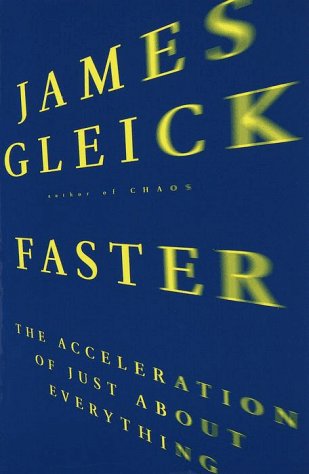
The best-selling author of Chaos and Genius presents an intriguing study of the human fascination with time from a psychological, biological, and cultural perspective tracing the development of measuring time and exploring ways in which we try to stretch our allotted time. 150,000 first printing. Tour.
Die Inhaltsangabe kann sich auf eine andere Ausgabe dieses Titels beziehen.
Über die Autorin bzw. den Autor
James Gleick is the author of <b>Genius: The Life and Science of Richard Feynman</b> (available from Vintage Books) and <b>Chaos: Making a New Science</b>, both of which were National Book Award nominees. He lives in New York.
Aus dem Klappentext
your watches. <br>We have reached the epoch of the nanosecond. This is the heyday of speed.<br>If one quality defines our modern, technocratic age, it is acceleration. We are making haste. Our computers, our movies, our sex lives, our prayers -- they all run faster now than ever before. And the more we fill our lives with time-saving devices and time-saving strategies, the more rushed we feel.<br>In <b>Faster</b>, James Gleick explores nothing less than the human condition at the turn of the millennium. He shines a light of enterprising and analytical reporting -- as well as sly wit -- on the newest paradoxes of time. His journey takes us through the bunkers and trenches of a war we barely knew we were fighting: to the atomic clocks of the Directorate of Time, to the waiting rooms that focus our impatience, to the film production studios that test the high-speed limits of our perception, to the air-traffic command centers that give time pressure new meaning.<br>We have become a quick
Auszug. © Genehmigter Nachdruck. Alle Rechte vorbehalten.
You are in the Directorate of Time. Naturally you are running late. You hurry past a glass-paned vault in which the world's number-one clock is soundlessly assembling each second from nine billion parts. It looks more like a rack of computers than a clock. In its core, atoms of cesium vibrate with a goose-stepping pace so sure, so authoritative, so humbling--but your mind wanders. There is not a moment to lose. Striding onward, you reach the office of the director of the Directorate of Time. He is a craggy, white-haired man called Gernot M. R. Winkler. He glances across the desk and says, "We have to be fast."
The directorate, an agency of the United States military, has scattered dozens of atomic clocks across a calm, manicured hilltop near the Potomac River in Washington. Armed guards stand watch at a security gatehouse down below, mainly because the Vice President's residence occupies the same grounds. Once past their scrutiny you can walk alone up the long drive to the stately 150-year-old Naval Observatory, the first national observatory of the United States. Long ago a four-foot ball of Charles Goodyear's Gumelastic rubber hung from a mast atop the observatory dome and dropped daily at noon to signal the time. Now the signals come more quickly. The Master Clock consults with fifty others in separate climate-controlled vaults--cesium clocks and hydrogen masers powered by diesel generators and backup batteries. They check off the seconds as an ensemble and communicate continuously via fiber-optic cable with counterparts overseas. The clocks monitor one another, and individual devices can come on or off line as their performance warrants. Out-of-sync clocks reveal themselves quickly. Winkler offers an analogy: "It's like a court of law, where you have many slightly different stories and one wildly different story." When the plausible witnesses are chosen and assembled, their output is statistically merged, worldwide, at the Bureau International des Poids et Mesures, outside Paris. The American contribution is the largest.
The result is the exact time. The exact time--by definition, by worldwide consensus and decree. The timekeepers at the directorate like to quote the old saw (Winkler quotes it now): "A man with a watch knows what time it is. A man with two watches is never sure." Humanity is now a species with one watch, and this is it.
Through most of history, time was fixed by astronomical reference points--the Earth spins once, call it a day. No more. The absolute reference has shifted from the stars to the atomic beams in their vaults. Particles are steadier than planets. Never mind the uncertainty principle; it is the heavens that cannot be relied on. Stars drift. The Earth shivers ever so slightly. With the oceanic tides acting as brakes, the planet slows in its rotation by fractions of a second each year. These anomalies do matter, in a time-gripped age. To compensate, the official clocks must every so often perform a grudging two-step, adding an odd second--a "leap second"--to the world's calendar. Most often, leap seconds are inserted at the close of December 31. The New Year clicks in sneakily: 11:59:58 p.m., 11:59:59, 11:59:60 (!), 12:00:00 a.m., 12:00:01. The descendant of the Naval Observatory's old Gumelastic rubber ball drops, studded with light bulbs, in Times Square. Elsewhere, astronomical observatories, television networks, and time-obsessed computer users make an adjustment to catch the leap second. Observatories have been known to get the sign wrong, ruining a night's sky-watching with the difference between +1 second and -1. As the Earth continues to slow, leap seconds will grow more common. Eventually we will need one every year, and then even more. Scientists could have avoided these awkward skips by choosing instead to adjust the duration of the second itself. Who would notice? That is what they did, in fact, until 1955. They defined the second as 1/86,400 of a real day, however long that was. The second had to lengthen a tiny bit each year. The atomic clocks were retuned as necessary. This did not trouble most of us, even subliminally, but it did start to annoy atomic physicists, because they needed a temporal measuring stick that would not stretch: come on, a second is a second--give me a real SECOND.
So here is the real second. Here the technologies of speed reach the ultimate. "Fifty years ago," Winkler says wistfully--he was a schoolboy in Austria--"we made measurements of a tenth of a second from day to day. That was great. Then more and more applications came in with greater refinements. It is like anywhere in life. When you have a capability, people find a use for that.
"Submarines have to surface for communications--they have atomic clocks," Winkler continues. "Television transmitters have atomic clocks. If you have two transmitters on the same channel, and you are between two cities, the picture will go up and down unless they are on exactly the same frequency. All good television stations have a rubidium clock." You are briefly aware of something incongruous about this exactitude--but the hyperprecision is all too familiar, all too closely in step with the rhythms of your more ordinary haunts.
We have reached the epoch of the nanosecond. This is the heyday of speed. "Speed is the form of ecstasy the technical revolution has bestowed on man," laments the Czech novelist Milan Kundera, suggesting by ecstasy a state of simultaneous freedom and imprisonment ("He is caught in a fragment of time cut off from both the past and the future; he is wrenched from the continuity of time; he is outside time . . ."). That is our condition, a culmination of millennia of evolution in human societies, technologies, and habits of mind.
The finicality of the modern timekeepers departs even further from our everyday experience--a fact cheerfully acknowledged here at the directorate. Particle physicists may freeze a second, open it up, and explore its dappled contents like surgeons pawing through an abdomen, but in real life, when events occur within thousandths of a second, our minds cannot distinguish past from future. What can we grasp in a nanosecond--a billionth of a second? "I tell you," Winkler says, "it wasn't on a human scale when we were measuring time to a millisecond, and now we are down to a fraction of a nanosecond." Within the millisecond, the bat presses against the ball; a bullet finds time to enter a skull and exit again; a rock plunges into a still pond, where the unexpected geometry of the splash pattern pops into existence. During a nanosecond, balls, bullets, and droplets are motionless.
Inhuman though these compressed time scales may be, many humans crave the precision. Internet users set their computers to update their clocks according to the directorate's time signal. The directorate fields millions of automatic queries each day. By pinging back and forth across the network, software called NanoSecond or RightTime or Clockwork or TimeSync or Timeset
can correct for propagation delays along the phone lines between the atomic clocks and you. Free connections can be made to modems or to "time servers" with the whimsical pair of addresses, tick.usno.navy.mil and tock.usno.navy.mil. More crudely, anyone with a telephone can dial the Naval Observatory's Master Clock Voice Announcer, for fifty cents the first minute. The time-obsessed used to keep their watches accurate to within seconds; now they keep their computers accurate to within milliseconds.
Nanosecond precision matters for worldwide communications systems. It matters for navigation by Global Positioning System satellite signals: an error of a billionth of a second means an error of just about a foot, the distance light travels in that...
„Über diesen Titel“ kann sich auf eine andere Ausgabe dieses Titels beziehen.
Suchergebnisse für Faster: The Acceleration of Just About Everything

Beispielbild für diese ISBN
Faster: The Acceleration of Just About Everything
Anbieter: World of Books (was SecondSale), Montgomery, IL, USA
Verkäuferbewertung 5 von 5 Sternen

Zustand: Acceptable. Item in good condition. Textbooks may not include supplemental items i.e. CDs, access codes etc. Artikel-Nr. 00064214535
Gebraucht kaufen
EUR 3,45
Versand gratis
Versand innerhalb von USA
Versand innerhalb von USA
Anzahl: 1 verfügbar
Beispielbild für diese ISBN
Faster: The Acceleration of Just About Everything
Anbieter: World of Books (was SecondSale), Montgomery, IL, USA
Verkäuferbewertung 5 von 5 Sternen
Zustand: Acceptable. Item in acceptable condition! Textbooks may not include supplemental items i.e. CDs, access codes etc. Artikel-Nr. 00109903487
Gebraucht kaufen
EUR 3,45
Versand gratis
Versand innerhalb von USA
Versand innerhalb von USA
Anzahl: 1 verfügbar
Beispielbild für diese ISBN
Faster: The Acceleration of Just About Everything
Anbieter: World of Books (was SecondSale), Montgomery, IL, USA
Verkäuferbewertung 5 von 5 Sternen
Zustand: Good. Item in good condition. Textbooks may not include supplemental items i.e. CDs, access codes etc. Artikel-Nr. 00085520665
Gebraucht kaufen
EUR 3,45
Versand gratis
Versand innerhalb von USA
Versand innerhalb von USA
Anzahl: 8 verfügbar
Beispielbild für diese ISBN
Faster: The Acceleration of Just About Everything
Anbieter: World of Books (was SecondSale), Montgomery, IL, USA
Verkäuferbewertung 5 von 5 Sternen
Zustand: Very Good. Item in very good condition! Textbooks may not include supplemental items i.e. CDs, access codes etc. Artikel-Nr. 00108147087
Gebraucht kaufen
EUR 3,45
Versand gratis
Versand innerhalb von USA
Versand innerhalb von USA
Anzahl: 2 verfügbar
Beispielbild für diese ISBN
Faster: The Acceleration of Just About Everything
Anbieter: Wonder Book, Frederick, MD, USA
Verkäuferbewertung 5 von 5 Sternen
Zustand: Good. Good condition. Good dust jacket. A copy that has been read but remains intact. May contain markings such as bookplates, stamps, limited notes and highlighting, or a few light stains. Artikel-Nr. E09A-00895
Gebraucht kaufen
EUR 4,70
Versand gratis
Versand innerhalb von USA
Versand innerhalb von USA
Anzahl: 1 verfügbar
Beispielbild für diese ISBN
Faster: The Acceleration of Just About Everything
Verlag:
Pantheon (edition First Edition), 1999
ISBN 10: 0679408371
ISBN 13: 9780679408376
Gebraucht
Hardcover
Erstausgabe
Anbieter: BooksRun, Philadelphia, PA, USA
Verkäuferbewertung 5 von 5 Sternen
Hardcover. Zustand: Very Good. First Edition. With dust jacket. It's a well-cared-for item that has seen limited use. The item may show minor signs of wear. All the text is legible, with all pages included. It may have slight markings and/or highlighting. Artikel-Nr. 0679408371-11-18-29
Gebraucht kaufen
EUR 5,81
Versand gratis
Versand innerhalb von USA
Versand innerhalb von USA
Anzahl: 1 verfügbar
Beispielbild für diese ISBN
Faster: The Acceleration of Just About Everything
Verlag:
Pantheon (edition First Edition), 1999
ISBN 10: 0679408371
ISBN 13: 9780679408376
Gebraucht
Hardcover
Erstausgabe
Anbieter: BooksRun, Philadelphia, PA, USA
Verkäuferbewertung 5 von 5 Sternen
Hardcover. Zustand: Fair. First Edition. The item might be beaten up but readable. May contain markings or highlighting, as well as stains, bent corners, or any other major defect, but the text is not obscured in any way. Artikel-Nr. 0679408371-7-1
Gebraucht kaufen
EUR 5,84
Versand gratis
Versand innerhalb von USA
Versand innerhalb von USA
Anzahl: 1 verfügbar
Beispielbild für diese ISBN
Faster: The Acceleration of Just About Everything
Anbieter: Wonder Book, Frederick, MD, USA
Verkäuferbewertung 5 von 5 Sternen
Zustand: Very Good. Very Good condition. Very Good dust jacket. A copy that may have a few cosmetic defects. May also contain light spine creasing or a few markings such as an owner's name, short gifter's inscription or light stamp. Artikel-Nr. Z07B-02463
Gebraucht kaufen
EUR 6,21
Versand gratis
Versand innerhalb von USA
Versand innerhalb von USA
Anzahl: 1 verfügbar
Beispielbild für diese ISBN
Faster: The Acceleration of Just About Everything
Anbieter: Wonder Book, Frederick, MD, USA
Verkäuferbewertung 5 von 5 Sternen
Zustand: Very Good. Signed Copy . Good dust jacket. Signed by author on half title page. Artikel-Nr. SB03A-01944
Gebraucht kaufen
EUR 6,21
Versand gratis
Versand innerhalb von USA
Versand innerhalb von USA
Anzahl: 1 verfügbar
Beispielbild für diese ISBN
Faster: The Acceleration of Just About Everything
Anbieter: ThriftBooks-Dallas, Dallas, TX, USA
Verkäuferbewertung 5 von 5 Sternen
Hardcover. Zustand: As New. No Jacket. Pages are clean and are not marred by notes or folds of any kind. ~ ThriftBooks: Read More, Spend Less. Artikel-Nr. G0679408371I2N00
Gebraucht kaufen
EUR 6,47
Versand gratis
Versand innerhalb von USA
Versand innerhalb von USA
Anzahl: 1 verfügbar