
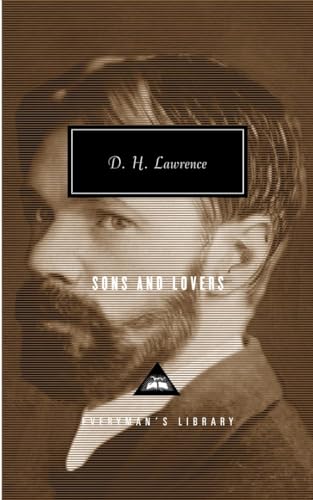
Sons and Lovers: Introduction by David Ellis (Everyman's Library Contemporary Classics Series) - Hardcover
Inhaltsangabe
One of the world's most original works of fiction from one of the greatest writers of the 20th century. • "No one ever wrote better about the power struggles of sex and love." —Doris Lessing, Nobel Prize-winning Author of The Golden Notebook
Gertrude Morel is a refined woman who married beneath her and has come to loathe her brutal, working-class husband. She focuses her passion instead on her two sons, who return her love and despise their father. Trouble begins when Paul Morel, a budding artist, falls in love with a young woman who seems capable of rivaling his mother for possession of his soul. In the ensuing battle, he finds his path to adulthood tragically impeded by the enduring power of his mother’s grasp. SONS AND LOVERS confirmed Lawrence’s genius and inaugurated the controversy over his explicit writing about sexuality and human relationships that would follow him to the end of his career.
Die Inhaltsangabe kann sich auf eine andere Ausgabe dieses Titels beziehen.
Über die Autorin bzw. den Autor
D. H. Lawrence was born on September 11, 1885, in Eastwood, Nottinghamshire, England. His father was a coal miner, his mother a former lace worker and unsuccessful haberdasher. He began school just
before the age of four, but respiratory illness and a weak constitution forced him to remain home intermittently. Two months before his sixteenth birthday, he went to work as a clerk in a badly ventilated factory
that made medical supplies, and eventually contracted pneumonia. After a long convalescence, he got a job as a student teacher, but privately he resolved to become a poet. He began writing seriously in 1906
and entered University College, Nottingham, to earn his teacher's certificate. Two years later he started teaching elementary school full-time. He published his first poems in the English Review in 1909. When
he contracted pneumonia a second time, he gave up teaching.
His first two novels, The White Peacock and The Trespasser, were published in 1911 and 1912. About three weeks after the publication of The Trespasser, he left England with Frieda Weekley, née von
Richthofen, the German wife of Ernest Weekley, a British linguist who had been his French and German instructor at University College. He wrote the final version of his autobiographical novel Sons and
Lovers (1913) - begun when his mother was dying of cancer in 1910 - during his year-long courtship of Frieda in Germany and Italy. Sons and Lovers was immediately recognized as the first great modern
restatement of the Oedipal drama, but, like most of Lawrence's novels during his lifetime, sold poorly. Lawrence and Frieda married in London in July 1914, immediately after Frieda's divorce became final;
they lived peripatetically and in relative poverty.
They spent World War I in England, a country they both essentially disliked, and endured a series of clumsy surveillance and harassment campaigns by local police because of her nationality (several of her
relatives were diplomats, statesmen, and politicians, and she was a cousin of Manfred von Richthofen, the "Red Baron") and his apparent lack of patriotism (among other charges, The Prussian Officer, a
collection of stories, published in November 1914, several months after Great Britain entered the war, was considered politically and morally offensive by conservative booksellers). Exempt from active service
because of his health, Lawrence wrote The Rainbow and Women in Love. The former was seized and burned by the police for indecency in November 1915, two months after publication; Lawrence was
unable to find a publisher for the latter until six years later. Composition of these two novels coincided with bouts of erratic behavior in Lawrence that bordered on mental instability, sexual confusion and
experimentation that threatened to undermine his marriage, and endless health reversals, including a diagnosis of tuberculosis. Twilight in Italy, a collection of acerbic travel essays believed by some to show a
sympathy for fascism that became more explicit in, for example, his novel The Plumed Serpent (1926), was published in 1916. He recorded the vicissitudes of his marriage in an autobiographical poem cycle,
Look! We Have Come Through (1917).
The Lawrences departed for Europe in late 1919 and spent most of the next two years in Italy and Germany. The Lost Girl, a novel, was published in 1920 and received the James Tait Black Memorial Prize
the following year, which also saw the publication of Movements in European History, a text for schoolchildren; Psychoanalysis and the Unconscious, an anti-Freudian tract; Tortoises, a collection of
poems; Sea and Sardinia, a travel book; and, belatedly, Women in Love. Early in 1922 he and Frieda went around the world by boat. They visited Ceylon, lived in Australia for a month and a half, and in the
summer sailed to America, where they settled in New Mexico. Aaron's Rod, a novel; Fantasia of the Unconscious, a sequel to Psychoanalysis and the Unconscious; and England, My England, a collection
of stories, were published that year. In the spring of 1923, after moving to Mexico, he and Frieda separated temporarily. He toured the western United States and briefly returned to Mexico; she moved to
London. Kangaroo, his novel of Australia, and Birds, Beasts, and Flowers, a collection of poems, were published in the fall. He reunited with Frieda in the winter. They went to New Mexico again in the
spring of 1924; he suffered bouts of influenza, malaria, and typhoid fever the next year. The Lawrences eventually resettled in Italy in 1926.
He began writing his last novel, Lady Chatterley's Lover, in 1926. It was published two years later and banned in England and the United States as pornographic. Lawrence was an avid amateur painter, and a
selection of his paintings - grossly rendered, full-figured representational nudes - was exhibited in London in 1929. The show was raided on July 5 by the police, who removed thirteen of the canvases.
Lawrence coincidentally suffered a violent tubercular hemorrhage in Italy the same day. He went to Bavaria to undergo a cure - it was unsuccessful - and in 1930 entered a sanatorium in Vence, France, where
treatment similarly failed. He died in a villa in Vence on the night of March 2, a half year short of his forty-fifth birthday, and was buried in a local cemetery. His body was eventually disinterred and cremated,
and his ashes transported to Frieda Lawrence's ranch outside Taos, New Mexico. In addition to numerous plays, collections of poetry, and other, lesser-known works published during his lifetime, his novels
The Virgin and the Gypsy and Mr. Noon were published posthumously.
Von der hinteren Coverseite
Included here are poems about the tie to the mother, about Miriam, about the trauma of the mother's lingering mortal illness, and about the poignant aftermath of her death during which the son suffered self-abandonment to grief and a sense of desolation described in the novel as a nuit blanche or 'white night.'
Aus dem Klappentext
by David Ellis
Auszug. © Genehmigter Nachdruck. Alle Rechte vorbehalten.
Chapter One
The Early Married Life of the Morels
“The bottoms" succeeded to "Hell Row." Hell Row was a block of thatched, bulging cottages that stood by the brookside on Greenhill Lane. There lived the colliers who worked in the little gin-pits two fields away. The brook ran under the alder trees, scarcely soiled by these small mines, whose coal was drawn to the surface by donkeys that plodded wearily in a circle round a gin. And all over the countryside were these same pits, some of which had been worked in the time of Charles II, the few colliers and the donkeys burrowing down like ants into the earth, making queer mounds and little black places among the corn-fields and the meadows. And the cottages of these coal-miners, in blocks and pairs here and there, together with odd farms and homes of the stockingers, straying over the parish, formed the village of Bestwood.
Then, some sixty years ago, a sudden change took place. The gin-pits were elbowed aside by the large mines of the financiers. The coal and iron field of Nottinghamshire and Derbyshire was discovered. Carston, Waite and Co. appeared. Amid tremendous excitement, Lord Palmerston formally opened the company's first mine at Spinney Park, on the edge of Sherwood Forest.
About this time the notorious Hell Row, which through growing old had acquired an evil reputation, was burned down, and much dirt was cleansed away.
Carston, Waite & Co. found they had struck on a good thing, so, down the valleys of the brooks from Selby and Nuttall, new mines were sunk, until soon there were six pits working. From Nuttall, high up on the sandstone among the woods, the railway ran, past the ruined priory of the Carthusians and past Robin Hood's Well, down to Spinney Park, then on to Minton, a large mine among corn-fields; from Minton across the farmlands of the valleyside to Bunker's Hill, branching off there, and running north to Beggarlee and Selby, that looks over at Crich and the hills of Derbyshire: six mines like black studs on the countryside, linked by a loop of fine chain, the railway.
To accommodate the regiments of miners, Carston, Waite and Co. built the Squares, great quadrangles of dwellings on the hillside of Bestwood, and then, in the brook valley, on the site of Hell Row, they erected the Bottoms.
The Bottoms consisted of six blocks of miners' dwellings, two rows of three, like the dots on a blank-six domino, and twelve houses in a block. This double row of dwellings sat at the foot of the rather sharp slope from Bestwood, and looked out, from the attic windows at least, on the slow climb of the valley towards Selby.
The houses themselves were substantial and very decent. One could walk all round, seeing little front gardens with auriculas and saxifrage in the shadow of the bottom block, sweet-williams and pinks in the sunny top block; seeing neat front windows, little porches, little privet hedges, and dormer windows for the attics. But that was outside; that was the view on to the uninhabited parlours of all the colliers' wives. The dwelling-room, the kitchen, was at the back of the house, facing inward between the blocks, looking at a scrubby back garden, and then at the ash-pits. And between the rows, between the long lines of ash-pits, went the alley, where the children played and the women gossiped and the men smoked. So, the actual conditions of living in the Bottoms, that was so well built and that looked so nice, were quite unsavoury because people must live in the kitchen, and the kitchens opened on to that nasty alley of ash-pits.
Mrs. Morel was not anxious to move into the Bottoms, which was already twelve years old and on the downward path, when she descended to it from Bestwood. But it was the best she could do. Moreover, she had an end house in one of the top blocks, and thus had only one neighbour; on the other side an extra strip of garden. And, having an end house, she enjoyed a kind of aristocracy among the other women of the "between" houses, because her rent was five shillings and sixpence instead of five shillings a week. But this superiority in station was not much consolation to Mrs. Morel.
She was thirty-one years old, and had been married eight years. A rather small woman, of delicate mould but resolute bearing, she shrank a little from the first contact with the Bottoms women. She came down in the July, and in the September expected her third baby.
Her husband was a miner. They had only been in their new home three weeks when the wakes, or fair, began. Morel, she knew, was sure to make a holiday of it. He went off early on the Monday morning, the day of the fair. The two children were highly excited. William, a boy of seven, fled off immediately after breakfast, to prowl round the wakes ground, leaving Annie, who was only five, to whine all morning to go also. Mrs. Morel did her work. She scarcely knew her neighbours yet, and knew no one with whom to trust the little girl. So she promised to take her to the wakes after dinner.
William appeared at half-past twelve. He was a very active lad, fair-haired, freckled, with a touch of the Dane or Norwegian about him.
"Can I have my dinner, mother?" he cried, rushing in with his cap on. " 'Cause it begins at half-past one, the man says so."
"You can have your dinner as soon as it's done," replied the mother.
"Isn't it done?" he cried, his blue eyes staring at her in indignation. "Then I'm goin' be-out it."
"You'll do nothing of the sort. It will be done in five minutes. It is only half-past twelve."
"They'll be beginnin'," the boy half cried, half shouted.
"You won't die if they do," said the mother. "Besides, it's only half-past twelve, so you've a full hour."
The lad began hastily to lay the table, and directly the three sat down. They were eating batter-pudding and jam, when the boy jumped off his chair and stood perfectly still. Some distance away could be heard the first small braying of a merry-go-round, and the tooting of a horn. His face quivered as he looked at his mother.
"I told you!" he said, running to the dresser for his cap.
"Take your pudding in your hand–and it's only five past one, so you were wrong–you haven't got your twopence," cried the mother in a breath.
The boy came back, bitterly disappointed, for his twopence, then went off without a word.
"I want to go, I want to go," said Annie, beginning to cry.
"Well, and you shall go, whining, wizzening little stick!" said the mother. And later in the afternoon she trudged up the hill under the tall hedge with her child. The hay was gathered from the fields, and cattle were turned on to the eddish. It was warm, peaceful.
Mrs. Morel did not like the wakes. There were two sets of horses, one going by steam, one pulled round by a pony; three organs were grinding, and there came odd cracks of pistol-shots, fearful screeching of the cocoanut man's rattle, shouts of the Aunt Sally man, screeches from the peep-show lady. The mother perceived her son gazing enraptured outside the Lion Wallace booth, at the pictures of this famous lion that had killed a negro and maimed for life two white men. She left him alone, and went to get Annie a spin of toffee. Presently the lad stood in front of her, wildly excited.
"You never said you was coming–isn't the' a lot of things?–that lion's killed three men–I've spent my tuppence–an' look here."
He pulled from his pocket two egg-cups, with pink moss-roses on them.
"I got these from that stall where y'ave ter get them marbles in them holes. An' I got these two in two goes–'aepenny a go–they've got...
„Über diesen Titel“ kann sich auf eine andere Ausgabe dieses Titels beziehen.
Weitere beliebte Ausgaben desselben Titels

Suchergebnisse für Sons and Lovers: Introduction by David Ellis (Everyman's...

Beispielbild für diese ISBN
Sons and Lovers: Introduction by David Ellis
Anbieter: ThriftBooks-Atlanta, AUSTELL, GA, USA
Verkäuferbewertung 5 von 5 Sternen

Hardcover. Zustand: Very Good. No Jacket. Former library book; May have limited writing in cover pages. Pages are unmarked. ~ ThriftBooks: Read More, Spend Less. Artikel-Nr. G0679405720I4N10
Gebraucht kaufen
EUR 10,47
Versand gratis
Versand innerhalb von USA
Versand innerhalb von USA
Anzahl: 1 verfügbar
Beispielbild für diese ISBN
Sons and Lovers: Introduction by David Ellis
Anbieter: ThriftBooks-Atlanta, AUSTELL, GA, USA
Verkäuferbewertung 5 von 5 Sternen
Hardcover. Zustand: Fair. No Jacket. Former library book; Readable copy. Pages may have considerable notes/highlighting. ~ ThriftBooks: Read More, Spend Less. Artikel-Nr. G0679405720I5N10
Gebraucht kaufen
EUR 10,47
Versand gratis
Versand innerhalb von USA
Versand innerhalb von USA
Anzahl: 1 verfügbar
Beispielbild für diese ISBN
Sons and Lovers: Introduction by David Ellis
Anbieter: ThriftBooks-Atlanta, AUSTELL, GA, USA
Verkäuferbewertung 5 von 5 Sternen
Hardcover. Zustand: Good. No Jacket. Missing dust jacket; Pages can have notes/highlighting. Spine may show signs of wear. ~ ThriftBooks: Read More, Spend Less. Artikel-Nr. G0679405720I3N01
Gebraucht kaufen
EUR 10,47
Versand gratis
Versand innerhalb von USA
Versand innerhalb von USA
Anzahl: 1 verfügbar
Beispielbild für diese ISBN
Sons and Lovers: Introduction by David Ellis
Anbieter: ThriftBooks-Dallas, Dallas, TX, USA
Verkäuferbewertung 5 von 5 Sternen
Hardcover. Zustand: Very Good. No Jacket. May have limited writing in cover pages. Pages are unmarked. ~ ThriftBooks: Read More, Spend Less. Artikel-Nr. G0679405720I4N00
Gebraucht kaufen
EUR 10,47
Versand gratis
Versand innerhalb von USA
Versand innerhalb von USA
Anzahl: 1 verfügbar
Foto des Verkäufers
Sons and Lovers (Everyman's Library)
Anbieter: Southampton Books, Sag Harbor, NY, USA
Verkäuferbewertung 5 von 5 Sternen
Hardcover. Zustand: Very Good. FIRST THUS. First Edition Thus, Later Printing. Not price-clipped. Published by Alfred a. Knopf, 1991. Octavo. Hardcover. Book is very good with blue ribbon bookmark and light previous owner underlining/margin notes. Dust jacket is very good with acetate cover and light shelf wear.100% positive feedback. 30 day money back guarantee. NEXT DAY SHIPPING! Excellent customer service. Please email with any questions. All books packed carefully and ship with free delivery confirmation/tracking. All books come with free bookmarks. Ships from Sag Harbor, New York. Artikel-Nr. 418309
Gebraucht kaufen
EUR 17,86
EUR 3,46 Versand
Versand innerhalb von USA
Versand innerhalb von USA
Anzahl: 1 verfügbar
Beispielbild für diese ISBN
Sons and Lovers (Everyman's Library (Cloth))
Anbieter: Kennys Bookstore, Olney, MD, USA
Verkäuferbewertung 5 von 5 Sternen
Zustand: New. Artikel-Nr. V9780679405726
Neu kaufen
EUR 35,03
EUR 9,10 Versand
Versand innerhalb von USA
Versand innerhalb von USA
Anzahl: 15 verfügbar
Beispielbild für diese ISBN
Sons and Lovers: Introduction by David Ellis (Everyman's Library Contemporary Classics Series)
Anbieter: Buchmarie, Darmstadt, Deutschland
Verkäuferbewertung 4 von 5 Sternen

Zustand: Good. Artikel-Nr. 2871671_083_2x
Gebraucht kaufen
EUR 16,01
EUR 42,00 Versand
Versand von Deutschland nach USA
Versand von Deutschland nach USA
Anzahl: 1 verfügbar
Foto des Verkäufers
SONS & LOVERS
Verlag:
Knopf Doubleday Publishing Group, 1991
ISBN 10: 0679405720
ISBN 13: 9780679405726
Neu
Hardcover
Anbieter: moluna, Greven, Deutschland
Verkäuferbewertung 5 von 5 Sternen
Zustand: New. D. H. Lawrence was born on September 11, 1885, in Eastwood, Nottinghamshire, England. His father was a coal miner, his mother a former lace worker and unsuccessful haberdasher. He began school justbefore the age of four, but respiratory illness and a we. Artikel-Nr. 1444691757
Neu kaufen
EUR 29,78
EUR 48,99 Versand
Versand von Deutschland nach USA
Versand von Deutschland nach USA
Anzahl: Mehr als 20 verfügbar