
Verwandte Artikel zu The Sexual Paradox: Extreme Men, Gifted Women and the...
Inhaltsangabe
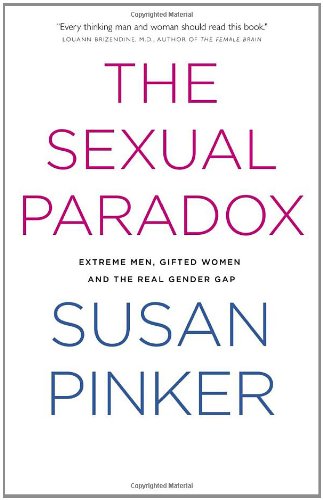
After four decades of eradicating gender barriers at work and in public life, why do men still dominate business, politics and the most highly paid jobs? Why do high-achieving women opt out of successful careers? Psychologist Susan Pinker explores the illuminating answers to these questions in her groundbreaking first book.
In The Sexual Paradox, Susan Pinker takes a hard look at how fundamental sex differences continue to play out in the workplace. By comparing the lives of fragile boys and promising girls, Pinker turns several assumptions upside down: that the sexes are biologically equivalent; that smarts are all it takes to succeed; that men and women have identical goals.
If most children with problems are boys, then why do many of them as adults overcome early obstacles while rafts of competent, even gifted women choose jobs that pay less or decide to opt out at pivotal moments in their careers? Weaving interviews with men and women into the most recent discoveries in psychology, neuroscience and economics, Pinker walks the reader through these minefields: Are men the more fragile sex? Which sex is the happiest at work? What does neuroscience tell us about ambition? Why do some male school drop-outs earn more than the bright, motivated girls who sat beside them in third grade?
Pinker argues that men and women are not clones, and that gender discrimination is just one part of the persistent gender gap. A work world that is satisfying to us all will recognize sex differences, not ignore them or insist that we all be the same.
Die Inhaltsangabe kann sich auf eine andere Ausgabe dieses Titels beziehen.
Über die Autorin bzw. den Autor
Susan Pinker is a developmental psychologist and journalist who writes about interpersonal and ethical issues in the workplace in her Problem Solving column in the Globe and Mail. She has worked as a clinical psychologist for twenty-five years and has taught at the Department of Educational and Counselling Psychology at McGill University. She lives in Montreal with her husband and three children.
Auszug. © Genehmigter Nachdruck. Alle Rechte vorbehalten.
Introduction
Female Puppets and Eunuchs
Why can’t a woman be more like a man?
The question seemed innocent enough in 1964. As sung by Henry Higgins, the lovesick Victorian professor in My Fair Lady, social class was changeable–just a matter of tweaking accent and costume–but the gender divide was completely inscrutable. Four decades later the question is still being asked, but with a different twist. Now it usually means “Shouldn’t a woman be more like a man?” The frustration is still there, now torqued with unfulfilled expectations.
Like Higgins, most of us don’t realize that we think of male as the standard, and of female as a version of this base model–with just a few optional features added on. We have come to expect that there should be no real differences between the sexes. But the science that’s emerging upends the notion that male and female are interchangeable, symmetrical, or the same. To put this book’s question plainly, with what we know about the psychology, neuroscience, and economics of people’s choices and behavior–fields that have exploded with amazing findings in the last ten years alone–how reasonable is it to expect that a woman be more like a man? And how likely is it for a man to be like a woman? This time, it’s more about describing what is, than why can’t, or shouldn’t, because the expectation that male is the starting point seems to have led us astray.
The assumption that female is just a slightly different shade of male was perfectly captured by the predicament the Sesame Street team found itself in when trying to invent a cast of characters for its popular preschool television show. In 2006 The New York Times reported how Sesame Street’s producers had long been stymied in creating a female lead puppet out of the anxiety that any girl-like features would play into stereotypes. “If Cookie Monster was a female character, she’d be accused of being anorexic or bulimic,” said the show’s executive producer. Others on the team agreed that if Elmo were female she’d be seen as ditzy. Especially after the indignant reaction to the Muppet Show’s Miss Piggy, it just seemed safest to reflect the common assumption that male was the default setting for both sexes. Male puppets–whether flightless birds, hairy monsters, or earnest little boys–were not really male, but generically human. But any female puppets would be viewed as deviant, or as having girl-specific traits. As a result, it took thirty-seven years after Big Bird, Cookie Monster, and Elmo were created for the show’s producers to come up with Abby Cadabby, a high-spirited puppet with magical powers and a feminine aesthetic. Her distinctly female persona was a sign that people were beginning to relax about gender, but it still made the news.
I had little idea of how touchy it was when I proposed to combine two areas of personal and professional interest–extreme or distinctive male traits and women’s occupational choices–in a book about men, women, and work. The plan was to profile several unusual men at least twenty years after they’d had problems as children to see what had become of them. Their stories would contrast with those of gifted women with every chance of success. The human stories were compelling, but then so was the science underlying their experiences. Trying to make sense of their stories was how I entered the politically charged world of sex differences, where, as it turned out, almost everyone I would encounter had already taken sides. Along the way, I discovered that sex differences not only colored my work, but had likely affected my own choices. As in Higgins’ song, I started to wonder about myself, my female colleagues and other women I knew, “Why do they do everything their mothers do? Why don’t they grow up like their fathers instead?”
I’d had every opportunity. In 1973, at the age of sixteen, I worked for my father. In those years he was a garment manufacturer’s agent and for two summer months we companionably drove around rural Québec in his wood-paneled station wagon, the back loaded with a dozen navy sample bags filled with women’s uniforms and sleepwear, each bag the size of a fridge and weighing about seventy-five pounds. With new respect I discovered the labor that financed our suburban, middle-class life. His years on the road eventually put three kids through college, my mother through graduate school, and would underwrite his own transition to a successful law career. The work was often lonely and physically exhausting, and like many work landscapes at the time, it was 99 percent male.
By then I was sure that a women could and would do any job a man could. In The Second Sex, Simone de Beauvoir had laid it all out: biology was not destiny. “One is not born, but rather becomes a woman.” There was no such thing as a maternal instinct–humans were not like animals with observable, fixed habits, like rutting deer or baboons who flashed their pink behinds. We were above all that. As humans, we were “forever in a state of change, forever becoming,” an existentialist take that certainly matched my sixteen-year-old worldview. So women could be defined by their current situation and their possibilities, but that was it. If there was a healthy demand for nurses’ smocks and peignoir sets, it was because society defined women as caregivers and sex objects. But soon all this would change. Of course, I knew nothing about the gulf between this feminist classic and the particulars of the writer’s own life, how de Beauvoir allowed herself to be treated by Sartre, not as an equal, but more as an enabler and procurer of pretty young women, some of them as young as I was at the time.But that wouldn’t have mattered. What happened in the forties and fifties was history. This was now.
Coming of age at the cusp of second-wave feminism, my expectations diverged sharply from those of previous generations. Unlike the women who matured during the Depression, I counted on an education and a career, not just a job. And like my friends, I didn’t think getting married and pregnant was a sufficient future plan. It was precisely the one that had trapped our mothers. In 1963 Betty Friedan had shredded the idyll of postwar domesticity in The Feminine Mystique, portraying suburban housewives as burdened by endless chores, whiny children, and an unnamed, enveloping anomie. These were the original desperate housewives, and Friedan’s strident demand that women reject that scenario was not just hot air. “We swallowed it whole,” recalled my mother, who had married at nineteen and then spent the next eighteen years at home “wiping the same stretch of counter over and over.” (According to the sociologist Juliet Schor, a middle-class mother of three did an average of fifty-three hours of housework a week in 1973.)Galvanized by Friedan, Gloria Steinem, and others, that 1973 summer, my mother started a graduate degree. All her friends were doing the same, returning to jobs they had before they married, or seeking professional training that would allow them to work for pay.
There were other signs of a major societal attitude shift.The birth-control pill had been legal since 1969 in Canada, and some of my high school friends were already on it. A robust postwar economy had launched our sense of infinite possibility, but The Pill boosted it skyward, along with the idealism and individualism of the Vietnam era. None of us expected to have our aspirations curtailed by pregnancy or marriage–or...
„Über diesen Titel“ kann sich auf eine andere Ausgabe dieses Titels beziehen.
Suchergebnisse für The Sexual Paradox: Extreme Men, Gifted Women and the...

Beispielbild für diese ISBN
The Sexual Paradox Extreme Men
Anbieter: World of Books (was SecondSale), Montgomery, IL, USA
Verkäuferbewertung 5 von 5 Sternen

Zustand: Good. Item in good condition. Textbooks may not include supplemental items i.e. CDs, access codes etc. Artikel-Nr. 00101416267
Gebraucht kaufen
EUR 3,96
Versand gratis
Versand innerhalb von USA
Versand innerhalb von USA
Anzahl: 3 verfügbar
Beispielbild für diese ISBN
The Sexual Paradox: Extreme Men, Gifted Women and the Real Gender Gap
Anbieter: ThriftBooks-Dallas, Dallas, TX, USA
Verkäuferbewertung 5 von 5 Sternen
Hardcover. Zustand: Very Good. No Jacket. May have limited writing in cover pages. Pages are unmarked. ~ ThriftBooks: Read More, Spend Less. Artikel-Nr. G0679314156I4N00
Gebraucht kaufen
EUR 5,82
Versand gratis
Versand innerhalb von USA
Versand innerhalb von USA
Anzahl: 1 verfügbar
Beispielbild für diese ISBN
Sexual Paradox : Extreme Men, Gifted Women and the Real Gender Gap
Anbieter: Better World Books: West, Reno, NV, USA
Verkäuferbewertung 5 von 5 Sternen
Zustand: Good. Former library copy. Pages intact with minimal writing/highlighting. The binding may be loose and creased. Dust jackets/supplements are not included. Includes library markings. Stock photo provided. Product includes identifying sticker. Better World Books: Buy Books. Do Good. Artikel-Nr. 4416566-75
Gebraucht kaufen
EUR 6,20
Versand gratis
Versand innerhalb von USA
Versand innerhalb von USA
Anzahl: 1 verfügbar
Beispielbild für diese ISBN
Sexual Paradox : Extreme Men, Gifted Women and the Real Gender Gap
Anbieter: Better World Books: West, Reno, NV, USA
Verkäuferbewertung 5 von 5 Sternen
Zustand: Very Good. Pages intact with possible writing/highlighting. Binding strong with minor wear. Dust jackets/supplements may not be included. Stock photo provided. Product includes identifying sticker. Better World Books: Buy Books. Do Good. Artikel-Nr. 4177173-6
Gebraucht kaufen
EUR 6,20
Versand gratis
Versand innerhalb von USA
Versand innerhalb von USA
Anzahl: 1 verfügbar
Beispielbild für diese ISBN
Sexual Paradox : Extreme Men, Gifted Women and the Real Gender Gap
Anbieter: Better World Books, Mishawaka, IN, USA
Verkäuferbewertung 5 von 5 Sternen
Zustand: Good. Former library copy. Pages intact with minimal writing/highlighting. The binding may be loose and creased. Dust jackets/supplements are not included. Includes library markings. Stock photo provided. Product includes identifying sticker. Better World Books: Buy Books. Do Good. Artikel-Nr. 4416566-75
Gebraucht kaufen
EUR 6,20
Versand gratis
Versand innerhalb von USA
Versand innerhalb von USA
Anzahl: 1 verfügbar