
Verwandte Artikel zu Shake Hands with the Devil: The Failure of Humanity...
Inhaltsangabe
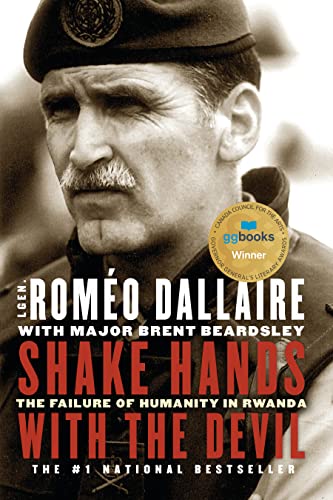
A brave, unforgettable first-hand account of the Rwandan genocide by a man almost literally haunted by the dead and by the spectre of his mission's failure. Marking the twenty-fifth anniversary of this horrific event, this edition includes a new note from Roméo Dallaire.
Serving in Rwanda in 1993, LGen. Roméo Dallaire and his small peacekeeping force found themselves abandoned by the UN in a vortex of civil war and genocide. With meagre resources to stem the killing, General Dallaire was witness to the murder of 800,000 Rwandans in a hundred days, and returned home broken, disillusioned and suicidal. Shake Hands with the Devil is his return to Rwanda: a searing book that is both an eyewitness account of the failure of humanity to stop the genocide, and the story of General Dallaire's own struggle to find a measure of peace, reconciliation and hope.
Die Inhaltsangabe kann sich auf eine andere Ausgabe dieses Titels beziehen.
Über die Autorin bzw. den Autor
ROMÉO DALLAIRE is a retired lieutenant-general, retired Canadian senator, and celebrated humanitarian. In 1993, LGen Dallaire was appointed force commander for UNAMIR, where he bore witness to the Rwandan genocide. His Governor General's Literary Award-winning book, Shake Hands with the Devil, exposed the failures of the international community to stop that genocide. It has been turned into an Emmy Award-winning documentary as well as a feature film; it has also been entered into evidence in war crimes tribunals trying the perpetrators of the Rwandan genocide. Dallaire has received numerous honours and awards, including Officer of the Order of Canada in 2002 and the United Nations Association in Canada’s Pearson Peace Medal in 2005. His second book, They Fight Like Soldiers, They Die Like Children, was also a national bestseller. Since his retirement, he has become an outspoken advocate for human rights, mental health and war-affected children. He founded the Roméo Dallaire Child Soldiers Initiative, an organization committed to progressively ending the use of child soldiers worldwide through a security sector approach.
Auszug. © Genehmigter Nachdruck. Alle Rechte vorbehalten.
Introduction
It was an absolutely magnificent day in May 1994. The blue sky was cloudless, and there was a whiff of breeze stirring the trees. It was hard to believe that in the past weeks an unimaginable evil had turned Rwanda’s gentle green valleys and mist-capped hills into a stinking nightmare of rotting corpses. A nightmare we all had to negotiate every day. A nightmare that, as commander of the UN peacekeeping force in Rwanda, I could not help but feel deeply responsible for.
In relative terms, that day had been a good one. Under the protection of a limited and fragile ceasefire, my troops had successfully escorted about two hundred civilians -- a few of the thousands who had sought refuge with us in Kigali, the capital of Rwanda -- through many government- and militia-manned checkpoints to reach safety behind the Rwandese Patriotic Front (RPF) lines. We were seven weeks into the genocide, and the RPF, the disciplined rebel army (composed largely of the sons of Rwandan refugees who had lived over the border in camps in Uganda since being forced out of their homeland at independence), was making a curved sweep toward Kigali from the north, adding civil war to the chaos and butchery in the country.
Having delivered our precious cargo of innocent souls, we were headed back to Kigali in a white UN Land Cruiser with my force commander pennant on the front hood and the blue UN flag on a staff attached to the right rear. My Ghanaian sharpshooter, armed with a new Canadian C-7 rifle, rode behind me, and my new Senegalese aide-de-camp, Captain Ndiaye, sat to my right. We were driving a particularly dangerous stretch of road, open to sniper fire. Most of the people in the surrounding villages had been slaughtered, the few survivors escaping with little more than the clothes on their backs. In a few short weeks, it had become a lonely and forlorn place.
Suddenly up ahead we saw a child wandering across the road. I stopped the vehicle close to the little boy, worried about scaring him off, but he was quite unfazed. He was about three years old, dressed in a filthy, torn T-shirt, the ragged remnants of underwear, little more than a loincloth, drooping from under his distended belly. He was caked in dirt, his hair white and matted with dust, and he was enveloped in a cloud of flies, which were greedily attacking the open sores that covered him. He stared at us silently, sucking on what I realized was a high-protein biscuit. Where had the boy found food in this wasteland?
I got out of the vehicle and walked toward him. Maybe it was the condition I was in, but to me this child had the face of an angel and eyes of pure innocence. I had seen so many children hacked to pieces that this small, whole, bewildered boy was a vision of hope. Surely he could not have survived all on his own? I motioned for my aide-de-camp to honk the horn, hoping to summon up his parents, but the sound echoed over the empty landscape, startling a few birds and little else. The boy remained transfixed. He did not speak or cry, just stood sucking on his biscuit and staring up at us with his huge, solemn eyes. Still hoping that he wasn’t all alone, I sent my aide-de-camp and the sharpshooter to look for signs of life.
We were in a ravine lush with banana trees and bamboo shoots, which created a dense canopy of foliage. A long straggle of deserted huts stood on either side of the road. As I stood alone with the boy, I felt an anxious knot in my stomach: this would be a perfect place to stage an ambush. My colleagues returned, having found no one. Then a rustling in the undergrowth made us jump. I grabbed the boy and held him firmly to my side as we instinctively took up defensive positions around the vehicle and in the ditch. The bushes parted to reveal a well-armed RPF soldier about fifteen years old. He recognized my uniform and gave me a smart salute and introduced himself. He was part of an advance observation post in the nearby hills. I asked him who the boy was and whether there was anyone left alive in the village who could take care of him. The soldier answered that the boy had no name and no family but that he and his buddies were looking after him. That explained the biscuit but did nothing to allay my concerns over the security and health of the boy. I protested that the child needed proper care and that I could give it to him: we were protecting and supporting orphanages in Kigali where he would be much better off. The soldier quietly insisted that the boy stay where he was, among his own people.
I continued to argue, but this child soldier was in no mood to discuss the situation and with haughty finality stated that his unit would care and provide for the child. I could feel my face flush with anger and frustration, but then noticed that the boy himself had slipped away while we had been arguing over him, and God only knew where he had gone. My aide-de-camp spotted him at the entrance to a hut a short distance away, clambering over a log that had fallen across the doorway. I ran after him, closely followed by my aide-de-camp and the RPF child soldier. By the time I had caught up to the boy, he had disappeared inside. The log in the doorway turned out to be the body of a man, obviously dead for some weeks, his flesh rotten with maggots and beginning to fall away from the bones.
As I stumbled over the body and into the hut, a swarm of flies invaded my nose and mouth. It was so dark inside that at first I smelled rather than saw the horror that lay before me. The hut was a two-room affair, one room serving as a kitchen and living room and the other as a communal bedroom; two rough windows had been cut into the mud-and-stick wall. Very little light penetrated the gloom, but as my eyes became accustomed to the dark, I saw strewn around the living room in a rough circle the decayed bodies of a man, a woman and two children, stark white bone poking through the desiccated, leather-like covering that had once been skin. The little boy was crouched beside what was left of his mother, still sucking on his biscuit. I made my way over to him as slowly and quietly as I could and, lifting him into my arms, carried him out of the hut.
The warmth of his tiny body snuggled against mine filled me with a peace and serenity that elevated me above the chaos. This child was alive yet terribly hungry, beautiful but covered in dirt, bewildered but not fearful. I made up my mind: this boy would be the fourth child in the Dallaire family. I couldn’t save Rwanda, but I could save this child.
Before I had held this boy, I had agreed with the aid workers and representatives of both the warring armies that I would not permit any exporting of Rwandan orphans to foreign places. When confronted by such requests from humanitarian organizations, I would argue that the money to move a hundred kids by plane to France or Belgium could help build, staff and sustain Rwandan orphanages that could house three thousand children. This one boy eradicated all my arguments. I could see myself arriving at the terminal in Montreal like a latter-day St. Christopher with the boy cradled in my arms, and my wife, Beth, there ready to embrace him.
That dream was abruptly destroyed when the young soldier, fast as a wolf, yanked the child from my arms and carried him directly into the bush. Not knowing how many members of his unit might already have their gunsights on us, we reluctantly climbed back into the Land Cruiser. As I slowly drove away, I had much on my mind.
By withdrawing, I had undoubtedly done the wise thing: I had avoided risking the lives of my two soldiers in what would have been a fruitless struggle over one small boy. But in that moment, it seemed to me that I had backed away from a fight for what was right, that this failure stood for all our failures in Rwanda.
Whatever happened to that...
„Über diesen Titel“ kann sich auf eine andere Ausgabe dieses Titels beziehen.
Suchergebnisse für Shake Hands with the Devil: The Failure of Humanity...

Beispielbild für diese ISBN
Shake Hands With the Devil: Th
Anbieter: World of Books (was SecondSale), Montgomery, IL, USA
Verkäuferbewertung 5 von 5 Sternen

Zustand: Good. Item in good condition. Textbooks may not include supplemental items i.e. CDs, access codes etc. Artikel-Nr. 00110470472
Gebraucht kaufen
EUR 3,99
Versand gratis
Versand innerhalb von USA
Versand innerhalb von USA
Anzahl: 2 verfügbar
Beispielbild für diese ISBN
Shake Hands With the Devil: Th
Anbieter: World of Books (was SecondSale), Montgomery, IL, USA
Verkäuferbewertung 5 von 5 Sternen
Zustand: Very Good. Item in very good condition! Textbooks may not include supplemental items i.e. CDs, access codes etc. Artikel-Nr. 00110778613
Gebraucht kaufen
EUR 3,99
Versand gratis
Versand innerhalb von USA
Versand innerhalb von USA
Anzahl: 2 verfügbar
Beispielbild für diese ISBN
Shake Hands With the Devil: Th
Anbieter: World of Books (was SecondSale), Montgomery, IL, USA
Verkäuferbewertung 5 von 5 Sternen
Zustand: Acceptable. Item in good condition. Textbooks may not include supplemental items i.e. CDs, access codes etc. Artikel-Nr. 00070810633
Gebraucht kaufen
EUR 3,99
Versand gratis
Versand innerhalb von USA
Versand innerhalb von USA
Anzahl: 1 verfügbar
Beispielbild für diese ISBN
Shake Hands with the Devil : The Failure of Humanity in Rwanda
Verlag:
Vintage Canada, 2004
ISBN 10: 0679311726
ISBN 13: 9780679311720
Gebraucht
Softcover
Erstausgabe
Anbieter: Better World Books, Mishawaka, IN, USA
Verkäuferbewertung 5 von 5 Sternen
Zustand: Good. 1st Edition. Pages intact with minimal writing/highlighting. The binding may be loose and creased. Dust jackets/supplements are not included. Stock photo provided. Product includes identifying sticker. Better World Books: Buy Books. Do Good. Artikel-Nr. GRP9142729
Gebraucht kaufen
EUR 6,26
Versand gratis
Versand innerhalb von USA
Versand innerhalb von USA
Anzahl: 2 verfügbar
Beispielbild für diese ISBN
Shake Hands with the Devil : The Failure of Humanity in Rwanda
Verlag:
Vintage Canada, 2004
ISBN 10: 0679311726
ISBN 13: 9780679311720
Gebraucht
Softcover
Erstausgabe
Anbieter: Better World Books, Mishawaka, IN, USA
Verkäuferbewertung 5 von 5 Sternen
Zustand: Good. 1st Edition. Former library copy. Pages intact with minimal writing/highlighting. The binding may be loose and creased. Dust jackets/supplements are not included. Includes library markings. Stock photo provided. Product includes identifying sticker. Better World Books: Buy Books. Do Good. Artikel-Nr. GRP84203614
Gebraucht kaufen
EUR 6,26
Versand gratis
Versand innerhalb von USA
Versand innerhalb von USA
Anzahl: 2 verfügbar
Beispielbild für diese ISBN
Shake Hands with the Devil: The Failure of Humanity in Rwanda
Anbieter: ThriftBooks-Dallas, Dallas, TX, USA
Verkäuferbewertung 5 von 5 Sternen
Paperback. Zustand: Very Good. No Jacket. May have limited writing in cover pages. Pages are unmarked. ~ ThriftBooks: Read More, Spend Less. Artikel-Nr. G0679311726I4N00
Gebraucht kaufen
EUR 8,13
Versand gratis
Versand innerhalb von USA
Versand innerhalb von USA
Anzahl: 1 verfügbar