
Verwandte Artikel zu A Sunday at the Pool in Kigali
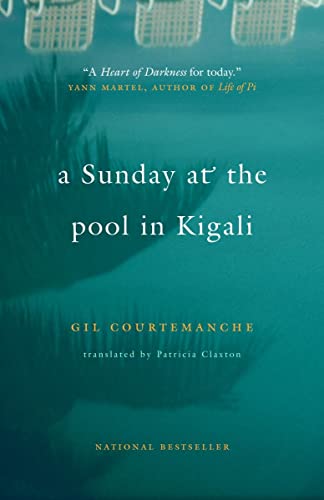
Inhaltsangabe
“Look, for people who’re going to be dead soon, we’re not doing too badly.”
“The novel of the year” is what La Presse called this extraordinary book, a love story that takes place in the days leading up to the 1994 genocide in Rwanda. A first work of fiction by one of French Canada’s most admired journalists, Gil Courtemanche, it was first published in Quebec in 2000, spent more than a year on bestseller lists and won the Prix des Libraires, the booksellers’ award for outstanding book of the year. Rights were sold to publishers in over twenty countries in Europe and around the world. This humanist story of an unlikely love affair set against a holocaust has become an internationally acclaimed phenomenon, worthy of comparison with the work of Graham Greene and Albert Camus.
The swimming pool of the Mille-Collines hotel, Kigali, in the early 1990s, draws a regular crowd of assorted aid workers, strutting Rwandan officials, Belgian businessmen, French paratroops and Canadian expats. Among them is Bernard Valcourt, a documentary filmmaker from Quebec, on a mission to set up a television station in the capital. Valcourt, who for two decades has earned his living from wars and famines, lingers around the pool drinking warm beer and watching football; but most of all, watching Gentille, a beautiful young waitress, who is a Hutu but often mistaken for a Tutsi because of her family’s strange history.
The trouble coming stems from a long conflict, instigated in colonial times by Whites who treated Tutsis as superior to Hutus. The Hutu government is now openly encouraging violence against Tutsis. The physical traits of the Tutsis make them easy prey, but they are not the only ones in danger. Too many people are already dying in Rwanda daily: of AIDS, of malaria, and increasingly at roadblocks at the hands of drunken militia, or pulled from their homes. The hotel staff and prostitutes sense trouble and death drawing closer as they continue providing drinks and meals and sex.
The story of this developing catastrophe is revealed through the lives of a handful of Rwandans who befriend Valcourt. They confide in him because he listens, and because his interviews offer them a chance to try to change the way things are by telling the world. Their candour and warmth begin to make his heart glow. He meets people like Méthode, who knows a bloodbath is brewing and would rather die of AIDS in the comfort of a hotel room than by a machete. Threatened, frightened, sick, they don’t want to talk and act like they’re dying. Poor as they are, they want to have some moments of pleasure and celebrate life.
As Kigali life continues in its resourcefulness and persistence, Valcourt is falling in love with Rwanda, and with Gentille, who loves him because he sees her as no-one has seen her before. Even as the worst horrors begin, as friends are raped and murdered, he starts to feel a strange peace in this land of a thousand hills, though he repudiates the outside world for its failure to intervene. Because Gentille is thought to be Tutsi, her life is in danger. Still, no-one can believe that the extremists will go too far, that brothers and sisters will kill brothers and sisters, and that 800,000 civilians will be massacred.
A hard-hitting chronicle of an overlooked chapter of recent history, told with skill and compassion, A Sunday at the Pool in Kigali is also a celebration of living in the moment, of the integrity of friendship and the courage of everyday heroes. Harrowing, unsettling, challenging, but beautiful and moving, it is a book that cannot leave the reader untouched; as a Quill & Quire reviewer said, it is “full of real people that demand to be remembered.”
Die Inhaltsangabe kann sich auf eine andere Ausgabe dieses Titels beziehen.
Über die Autorin bzw. den Autor
Gil Courtemanche is a journalist in international and third-world politics, and an author of several non-fiction works. Un dimanche à la piscine à Kigali spent more than a year on Quebec bestseller lists. A film version directed by Robert Favreau was released in 2006.
Patricia Claxton is one of Canada’s foremost translators, who has worked with Gabrielle Roy, Nicole Brossard and Pierre Elliott Trudeau, among others.
Auszug. © Genehmigter Nachdruck. Alle Rechte vorbehalten.
Chapter One
In the middle of Kigali there is a swimming pool surrounded by deckchairs and a score of tables all made of white plastic. And forming a huge L overhanging this patch of blue stands the Hôtel des Mille-Collines, with its habitual clientele of international experts and aid workers, middle-class Rwandans, screwed-up or melancholy expatriates of various origins, and prostitutes. All around the pool and hotel in lascivious disorder lies the part of the city that matters, that makes the decisions, that steals, kills, and lives very nicely, thank you. The French Cultural Centre, the UNICEF offices, the Ministry of Information, the embassies, the president’s palace (recognizable by the tanks on guard), the crafts shops popular with departing visitors where one can unload surplus black market currency, the radio station, the World Bank offices, the archbishop’s palace. Encircling this artificial paradise are the obligatory symbols of decolonization: Constitution Square, Development Avenue, Boulevard of the Republic, Justice Avenue, and an ugly, modern cathedral. Farther down, almost in the underbelly of the city, stands the red brick mass of the Church of the Holy Family, disgorging the poor in their Sunday best into crooked mud lanes bordered by houses made of the same clay. Small red houses -- just far enough away from the swimming pool not to offend the nostrils of the important -- filled with shouting, happy children, with men and women dying of AIDS and malaria, thousands of small households that know nothing of the pool around which others plan their lives and, more importantly, their predictable deaths.
Jackdaws as big as eagles and as numerous as house sparrows caw all around the hotel gardens. They circle in the sky, waiting, like the humans they’re observing, for the cocktail hour. Now is when the beers arrive, while the ravens are alighting on the tall eucalyptus trees around the pool. When the ravens have settled, the buzzards appear and take possession of the topmost branches. Woe betide the lowly jackdaw that fails to respect the hierarchy. Birds behave like humans here.
Precisely as the buzzards are establishing their positions around the pool, precisely then, the French paratroopers on the plastic deckchairs begin putting on Rambo airs. They sniff all the feminine flesh splashing around in the heavily chlorinated water of the pool. Its freshness matters little. There is vulture in these soldiers with their shaven heads, watching and waiting beside a pool that is the centrepiece of a meat stall where the reddest, most lovingly garnished morsels are displayed alongside the flabby and scrawny feminine fare whose only diversion is this waterhole. On Sundays, as on every other day of the week at around five o’clock, a number of carcasses -- some plump, some skeletal -- disturb the surface of the pool, well aware that the “paras,” as the paratroopers are known, are not the least daunted either by cellulite or by skin clinging to bones merely from habit. The women, if they knew what danger stalked them, would drown in anticipation of ecstasy or else get themselves to a nunnery.
This tranquil Sunday, a former minister of justice is warming up energetically on the diving board. He does not realize that his strenuous exercises are eliciting giggles from the two prostitutes from whom he is expecting a sign of recognition or interest before diving into the water. He wants to beguile because he doesn’t want to pay. He hits the water like a disjointed clown. The girls laugh. The paras too.
Around the pool, Québécois and Belgian aid workers vie in loud laughter. The Belgians and Québécois aren’t friends; they don’t work together, even though they are working toward the same goal: ‘development.’ That magic word which dresses up the best and most irrelevant of intentions. The two groups are rivals, always explaining to the locals why their kind of development is better than the others’. The only thing they have in common is the din they make. There ought to be a word for the atmosphere surrounding these Whites who talk, laugh and drink in a way that makes the whole pool know their importance -- no, not even that -- just their vacuous existence. Let’s use the word ‘noisiness’ because there’s certainly noise, but it’s continuous, there’s a permanence to it, a perpetual squawking. In this shy, reticent and often deceptive country, they live in a state of noisiness, like noisy animals. They are also in continuous rut. Noise is their breathing, silence their death, and the asses of Rwandan women their territory of exploration. They are noisy explorers of Third World asses. Only the Germans, when they descend on the hotel in force like a battalion of moralizing accountants, can match the Belgians and Québécois in noisiness.
Important Frenchmen don’t stay at this hotel. They dig themselves in at the Méridien with high-class Rwandans and clean hookers who sip whisky. The hookers at this hotel are rarely clean. They drink Pepsi while waiting to be picked up and offered a local beer, which may get them offered a whisky or a vodka later on. But these women are realists, so today they’ll settle for a Pepsi and a john.
Valcourt, who is also Québécois but has almost forgotten it over the years, observes these things and notes them down, muttering as he does so, sometimes angrily, sometimes with tenderness, but always audibly. For all anyone knows or imagines, he’s writing about them, and everyone wants someone to ask him what he’s writing, and worries about this book he’s been writing since the Project left him more or less high and dry. Sometimes he even pretends to be writing, in order to show he’s alive, watchful and serious like the disillusioned philosopher he claims to be when he runs out of excuses for himself. He’s not writing a book. He writes to put in time between mouthfuls of beer, or to signal that he doesn’t want to be disturbed. Rather like a buzzard on a branch, in fact, Valcourt is waiting for a scrap of life to excite him and make him unfold his wings.
At the end of the terrace, walking slowly and grandly, appears a Rwandan just back from Paris. You can tell, because his sporty outfit is so new its yellows and greens are blinding, even for sunglass-protected eyes. There’s sniggering at a table of expatriates. Admiration at several tables of locals. The Rwandan just back from Paris is afloat on a magic carpet. From the handle of his crocodile attaché case dangle First Class and Hermès labels. In his pocket, along with other prestige labels, he probably has an import licence for some product of secondary necessity, which he will sell at a premium price.
He orders a “verbena-mint” at such volume that three ravens depart the nearest tree. Gentille, who has just completed her social service studies and is interning at the hotel, doesn’t know what a verbena-mint is. Intimidated, she whispers -- so softly she can’t even hear herself -- that there are only two brands of beer, Primus and Mutzig. The Rwandan on his magic carpet is not listening and replies that of course he wants the best, even if it’s more expensive. So Gentille will bring him a Mutzig, which for some is the best and for everyone more expensive. Valcourt scribbles feverishly. He describes the scene with indignation, adding some notes about the outrageousness of African corruption, but he does not stir.
„Über diesen Titel“ kann sich auf eine andere Ausgabe dieses Titels beziehen.
Suchergebnisse für A Sunday at the Pool in Kigali

Beispielbild für diese ISBN
A Sunday at the Pool in Kigali
Anbieter: ThriftBooks-Atlanta, AUSTELL, GA, USA
Verkäuferbewertung 5 von 5 Sternen

Paperback. Zustand: Good. No Jacket. Pages can have notes/highlighting. Spine may show signs of wear. ~ ThriftBooks: Read More, Spend Less. Artikel-Nr. G0676974821I3N00
Gebraucht kaufen
EUR 5,74
Versand gratis
Versand innerhalb von USA
Versand innerhalb von USA
Anzahl: 1 verfügbar
Beispielbild für diese ISBN
A Sunday at the Pool in Kigali
Anbieter: Better World Books: West, Reno, NV, USA
Verkäuferbewertung 5 von 5 Sternen
Zustand: Good. Pages intact with minimal writing/highlighting. The binding may be loose and creased. Dust jackets/supplements are not included. Stock photo provided. Product includes identifying sticker. Better World Books: Buy Books. Do Good. Artikel-Nr. GRP72745709
Gebraucht kaufen
EUR 5,96
Versand gratis
Versand innerhalb von USA
Versand innerhalb von USA
Anzahl: 2 verfügbar
Foto des Verkäufers
A Sunday At the Pool in Kigali
Anbieter: True Oak Books, Highland, NY, USA
Verkäuferbewertung 5 von 5 Sternen
Paperback. Zustand: Good. Translation; First Printing. 5.19 X 0.58 X 8.01 inches; 258 pages; slightly cocked spine. Light creasing on spine. Moderate foxing, faint, on the top exterior edge of textblock. Light speckles on the fore-edge. Good condition otherwise. No other noteworthy defects. No markings.; - Your satisfaction is our priority. We offer free returns and respond promptly to all inquiries. Your item will be packaged with care and ship on the same or next business day. Buy with confidence. Artikel-Nr. HVD-77641-A-0
Gebraucht kaufen
EUR 17,71
Versand gratis
Versand innerhalb von USA
Versand innerhalb von USA
Anzahl: 1 verfügbar
Beispielbild für diese ISBN
A Sunday at the Pool in Kigali
Anbieter: Robinson Street Books, IOBA, Binghamton, NY, USA
Verkäuferbewertung 4 von 5 Sternen

Trade Paperbac. Zustand: Very Good. Prompt Shipment, shipped in Boxes, Tracking PROVIDEDContemporary Fiction: Very Good Trade Paperback, Minor creases, clean pages, prompt shipping with tracking. Artikel-Nr. Ware813JM007
Gebraucht kaufen
EUR 11,96
EUR 8,17 Versand
Versand innerhalb von USA
Versand innerhalb von USA
Anzahl: 1 verfügbar
Beispielbild für diese ISBN
Sunday at the Pool in Kigali
Verlag:
Vintage Books Canada April 2004, 2004
ISBN 10: 0676974821
ISBN 13: 9780676974829
Gebraucht
Trade Paperback
Anbieter: Old Goat Books, Waterloo, ON, Kanada
Verkäuferbewertung 3 von 5 Sternen

Trade Paperback. Zustand: Near Fine. Zustand des Schutzumschlags: Near Fine. Condition: 'NF' Notes: Translated by Patricia Claxton. Novel of the Rwandan genocide. Artikel-Nr. 1125939
Gebraucht kaufen
EUR 9,30
EUR 15,48 Versand
Versand von Kanada nach USA
Versand von Kanada nach USA
Anzahl: 1 verfügbar
Beispielbild für diese ISBN
A Sunday at the Pool in Kigali
Anbieter: AwesomeBooks, Wallingford, Vereinigtes Königreich
Verkäuferbewertung 5 von 5 Sternen
Paperback. Zustand: Very Good. A Sunday at the Pool in Kigali This book is in very good condition and will be shipped within 24 hours of ordering. The cover may have some limited signs of wear but the pages are clean, intact and the spine remains undamaged. This book has clearly been well maintained and looked after thus far. Money back guarantee if you are not satisfied. See all our books here, order more than 1 book and get discounted shipping. Artikel-Nr. 7719-9780676974829
Gebraucht kaufen
EUR 21,00
EUR 4,79 Versand
Versand von Vereinigtes Königreich nach USA
Versand von Vereinigtes Königreich nach USA
Anzahl: 2 verfügbar
Beispielbild für diese ISBN
A Sunday at the Pool in Kigali
Anbieter: Bahamut Media, Reading, Vereinigtes Königreich
Verkäuferbewertung 5 von 5 Sternen
Paperback. Zustand: Very Good. This book is in very good condition and will be shipped within 24 hours of ordering. The cover may have some limited signs of wear but the pages are clean, intact and the spine remains undamaged. This book has clearly been well maintained and looked after thus far. Money back guarantee if you are not satisfied. See all our books here, order more than 1 book and get discounted shipping. Artikel-Nr. 6545-9780676974829
Gebraucht kaufen
EUR 21,00
EUR 8,12 Versand
Versand von Vereinigtes Königreich nach USA
Versand von Vereinigtes Königreich nach USA
Anzahl: 2 verfügbar
Beispielbild für diese ISBN
Sunday at the Pool in Kigali,A
Anbieter: Whodunit Bookshop, Winnipeg, MB, Kanada
Verkäuferbewertung 5 von 5 Sternen
Paperback. Zustand: Very Good. Artikel-Nr. 978067697482U
Gebraucht kaufen
EUR 8,83
EUR 45,58 Versand
Versand von Kanada nach USA
Versand von Kanada nach USA
Anzahl: 1 verfügbar