
Verwandte Artikel zu Legible Religion: Books, Gods, and Rituals in Roman...
Inhaltsangabe
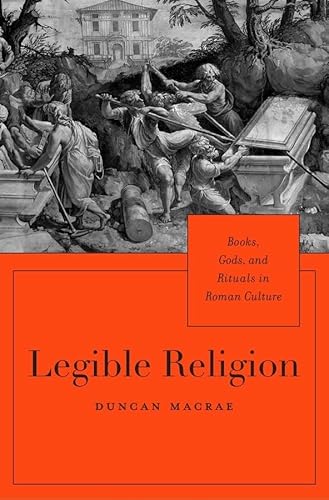
Scholars have long emphasized the importance of scripture in studying religion, tacitly separating a few privileged “religions of the Book” from faiths lacking sacred texts, including ancient Roman religion. Looking beyond this distinction, Duncan MacRae delves into Roman religious culture to grapple with a central question: what was the significance of books in a religion without scripture?
In the last two centuries BCE, Varro and other learned Roman authors wrote treatises on the nature of the Roman gods and the rituals devoted to them. Although these books were not sacred texts, they made Roman religion legible in ways analogous to scripture-based faiths such as Judaism and Christianity. Rather than reflect the astonishingly varied polytheistic practices of the regions under Roman sway, the contents of the books comprise Rome’s “civil theology”—not a description of an official state religion but one limited to the civic role of religion in Roman life. An extended comparison between Roman books and the Mishnah—an early Rabbinic compilation of Jewish practice and law—highlights the important role of nonscriptural texts in the demarcation of religious systems.
Tracing the subsequent influence of Roman religious texts from the late first century BCE to early fifth century CE, Legible Religion shows how two major developments—the establishment of the Roman imperial monarchy and the rise of the Christian Church—shaped the reception and interpretation of Roman civil theology.
Die Inhaltsangabe kann sich auf eine andere Ausgabe dieses Titels beziehen.
Über die Autorin bzw. den Autor
Duncan MacRae is Assistant Professor of Classics at the University of Cincinnati.
„Über diesen Titel“ kann sich auf eine andere Ausgabe dieses Titels beziehen.
Suchergebnisse für Legible Religion: Books, Gods, and Rituals in Roman...

Beispielbild für diese ISBN
Legible Religion. Books, Gods, and Rituals in Roman Culture.
Verlag:
Harvard University Press, 2016
ISBN 10: 0674088719
ISBN 13: 9780674088719
Gebraucht
Hardcover
Anbieter: Scrinium Classical Antiquity, Aalten, Niederlande
Verkäuferbewertung 5 von 5 Sternen

Harvard University Press, Cambridge (Mass.) / London, 2016. 259p. Original grey cloth with dust wrps. Spine gilt titled. 'As Duncan MacRae points out in his intensely thought-provoking debut, one of the many ways in which the ancient Romans were anomalous involved their relationship to the divine: temples abound in their cities, religious rites and offices abound in their societies on every level, and yet they had no sacred text. There were books of recorded prophecies, there were annual compilations like the Annales Maximi functioning as a kind of sacerdotal accounting of which celestial contracts were fulfilled and which weren?t, but there was nothing equivalent to the concept of a divinely-inspired sacred-in-jot-and-tittle central holy book like the Books of Moses were for the Jews or, later, the Koran would be for the Muslims. The Romans may have exhibited a rhetoric of rule-making, but their peculiar brand of public religion, what MacRae winningly dubs their civil theology, has none of the finger-of-God exclusivity to be found in virtually all other contemporary societies: Alongside these markers of sacredness, canonization of Scripture enables practices of religious reading and interpretation. Biblical commentary or midrash, for example, make use of a canon; bibliomancy ? the use of Scripture for divination ? also depends on an articulation of a closed canon. We look in vain for the development of an accepted written canon for Roman religion. The lack of that accepted written canon has led many scholars over the centuries to disparage the Roman religious experience, to relegate it to the mercantile and parvenu where so many aspects of ancient Roman society tend to settle. MacRae very effectively furthers recent calls for a reappraisal of this picture. His book concisely (the thing could have been three times as long, and MacRae is such a companionable author that most readers will wish it were) lays out the case for that most neglected of things: the Roman soul. He does this mainly through one man and one work: Varro?s Divine Antiquities ? which of course means that a prominent seat at this intellectual table is reserved for St. Augustine?s long point-by-point argument with Varro in City of God. As MacRae aptly puts it, [Augustin] 'did not consider Varro simply an authority; instead, he found in him an opponent.' Much like Cicero and other Roman intellectuals, Varro wrote extensively on Roman rituals and religious history, and St. Augustine, while railing against these treatises, preserved enough of them for MacRae to map out an invigorating new appreciation of what and more importantly how Romans approached the religious in their lives. The resulting book will have readers of Roman history and literature re-thinking everything from the scandal of Clodius Pulcher sneaking into the women-only Bona Dea rites to all the barbed religious commentary in the Golden Ass of Apuleius. Those readers will find it amazing and a bit chastising that they could so easily have dismissed something that runs through so much of what they know about ancient Rome; Legible Religion makes such dismissals impossible. (STEVEN DONOGHUE in Open Letters Monthly, July 2016). Artikel-Nr. 48103
Gebraucht kaufen
EUR 45,00
EUR 27,50 Versand
Versand von Niederlande nach USA
Versand von Niederlande nach USA
Anzahl: 1 verfügbar
Beispielbild für diese ISBN
Legible Religion Books, Gods, and Rituals in Roman Culture
Anbieter: Revaluation Books, Exeter, Vereinigtes Königreich
Verkäuferbewertung 5 von 5 Sternen
Hardcover. Zustand: Brand New. 259 pages. 9.50x6.50x1.00 inches. In Stock. Artikel-Nr. x-0674088719
Neu kaufen
EUR 95,81
EUR 14,82 Versand
Versand von Vereinigtes Königreich nach USA
Versand von Vereinigtes Königreich nach USA
Anzahl: 2 verfügbar
Foto des Verkäufers
Legible Religion: Books, Gods, and Rituals in Roman Culture
Anbieter: moluna, Greven, Deutschland
Verkäuferbewertung 5 von 5 Sternen
Zustand: New. Scholars have long separated a few privileged religions of the Book from faiths lacking sacred texts, including ancient Roman religion. Looking beyond this distinction, Duncan MacRae delves into Roman treatises on the nature of gods and rituals to grapple. Artikel-Nr. 594872554
Neu kaufen
EUR 72,11
EUR 48,99 Versand
Versand von Deutschland nach USA
Versand von Deutschland nach USA
Anzahl: Mehr als 20 verfügbar
Foto des Verkäufers
Legible Religion
Verlag:
HARVARD UNIVERSITY PRESS Jun 2016, 2016
ISBN 10: 0674088719
ISBN 13: 9780674088719
Neu
Hardcover
Anbieter: AHA-BUCH GmbH, Einbeck, Deutschland
Verkäuferbewertung 5 von 5 Sternen
Buch. Zustand: Neu. Neuware - Scholars have long separated a few privileged ¿religions of the Book¿ from faiths lacking sacred texts, including ancient Roman religion. Looking beyond this distinction, Duncan MacRae delves into Roman treatises on the nature of gods and rituals to grapple with a central question: what was the significance of books in a religion without scripture. Artikel-Nr. 9780674088719
Neu kaufen
EUR 97,81
EUR 35,00 Versand
Versand von Deutschland nach USA
Versand von Deutschland nach USA
Anzahl: 1 verfügbar
Beispielbild für diese ISBN
Legible Religion: Books, Gods, and Rituals in Roman Culture
Anbieter: Majestic Books, Hounslow, Vereinigtes Königreich
Verkäuferbewertung 4 von 5 Sternen

Zustand: New. pp. 248. Artikel-Nr. 373989196
Neu kaufen
EUR 128,52
EUR 7,71 Versand
Versand von Vereinigtes Königreich nach USA
Versand von Vereinigtes Königreich nach USA
Anzahl: 1 verfügbar