
Verwandte Artikel zu The New Religious Intolerance: Overcoming the Politics...
Inhaltsangabe
What impulse prompted some newspapers to attribute the murder of 77 Norwegians to Islamic extremists, until it became evident that a right-wing Norwegian terrorist was the perpetrator? Why did Switzerland, a country of four minarets, vote to ban those structures? How did a proposed Muslim cultural center in lower Manhattan ignite a fevered political debate across the United States? InThe New Religious Intolerance, Martha C. Nussbaum surveys such developments and identifies the fear behind these reactions. Drawing inspiration from philosophy, history, and literature, she suggests a route past this limiting response and toward a more equitable, imaginative, and free society.
Fear, Nussbaum writes, is "more narcissistic than other emotions." Legitimate anxieties become distorted and displaced, driving laws and policies biased against those different from us. Overcoming intolerance requires consistent application of universal principles of respect for conscience. Just as important, it requires greater understanding. Nussbaum challenges us to embrace freedom of religious observance for all, extending to others what we demand for ourselves. She encourages us to expand our capacity for empathetic imagination by cultivating our curiosity, seeking friendship across religious lines, and establishing a consistent ethic of decency and civility. With this greater understanding and respect, Nussbaum argues, we can rise above the politics of fear and toward a more open and inclusive future.
Die Inhaltsangabe kann sich auf eine andere Ausgabe dieses Titels beziehen.
Über die Autorin bzw. den Autor
Martha C. Nussbaum is Ernst Freund Distinguished Service Professor of Law and Ethics at the University of Chicago and, with Amartya Sen, a Founding President of the Human Development and Capability Association.
Auszug. © Genehmigter Nachdruck. Alle Rechte vorbehalten.
Chapter 3: First Principles: Equal Respect for Conscience
How can we best address the current climate of fear? A good approach has three ingredients: good principles, an emphasis on non-narcissistic consistency, and a cultivation of the “inner eyes,” the capacity to see the world from the perspective of minority experience.
Why principles? Given the distracting and distorting potential of fear, which can so easily render particular judgments self-serving and unreliable, it seems a good idea to approach these delicate and complicated issues armed with some general principles that we can cling to, as we attempt to avoid confusion and panic. If these principles are going to help us address fear’s tendency to self-privileging, they should incorporate a focus on the good of others, correcting for fear’s partiality. Supplying principles to guide democratic political practice has been a central purpose of political philosophy, which, ever since its (Western) start in ancient Athens, has seen its goal as practical, not merely theoretical. I’ll argue that philosophy really does have the sort of practical important that the Greeks claimed for it, offering insight to every person who wants to think about these matters. So what does political philosophy have to say about religious difference and the anxieties it provokes?
The tradition I shall map out is specifically Euro-American, but we’d do well to bear in mind that similar thoughts can be found in the history of India, which developed policies of religious toleration earlier than did the West: at least by the third-second centuries BCE, when the emperor Ashoka, himself a convert to Buddhism from Hinduism, put up a series of edicts mandating toleration throughout his empire. These policies did not endure through the entire pre-modern period, but they were revived and further developed in the Moghul Empire of the sixteenth and seventeenth centuries, particularly in the thought and practice of the Muslim emperor Akbar, who proclaimed toleration among all religions and created a state cult that included elements from all the major religions in his empire. Akbar was a famous figure in Europe, and his ideas had a significant influence on the development of European ideas of toleration – as did the ideas and laws of the Ottoman Empire. I shall say no more about this history here, but we should remember it: our goals are fairness and understanding, and we would be thrown off from the start if we were to think, mistakenly, that the ideas of mutual respect and toleration are exclusively Western. It’s particularly important, perhaps, to be keenly aware that some of their most influential architects were observant Muslims.
„Über diesen Titel“ kann sich auf eine andere Ausgabe dieses Titels beziehen.
Suchergebnisse für The New Religious Intolerance: Overcoming the Politics...

Beispielbild für diese ISBN
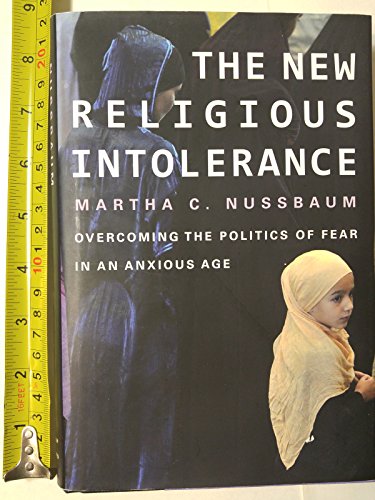
The New Religious Intolerance: Overcoming the Politics of Fear in an Anxious Age
Verlag:
Harvard University Press, 2012
ISBN 10: 0674065905
ISBN 13: 9780674065901
Gebraucht
Hardcover
Anbieter: World of Books (was SecondSale), Montgomery, IL, USA
Verkäuferbewertung 5 von 5 Sternen

Hardback. Zustand: Very Good. Drawing inspiration from philosophy, history, and literature, Martha C. Nussbaum takes us to task for our religious intolerance, identifies the fear behind it, and offers a way past fear toward a more equitable, imaginative, and free society, through the consistent application of universal principles of respect for conscience. Artikel-Nr. 00105445684
Gebraucht kaufen
EUR 6,33
Versand gratis
Versand innerhalb von USA
Versand innerhalb von USA
Anzahl: 1 verfügbar
Beispielbild für diese ISBN
The New Religious Intolerance: Overcoming the Politics of Fear in an Anxious Age
Verlag:
Harvard University Press, 2012
ISBN 10: 0674065905
ISBN 13: 9780674065901
Gebraucht
Hardcover
Anbieter: World of Books (was SecondSale), Montgomery, IL, USA
Verkäuferbewertung 5 von 5 Sternen
Hardback. Zustand: Good. Drawing inspiration from philosophy, history, and literature, Martha C. Nussbaum takes us to task for our religious intolerance, identifies the fear behind it, and offers a way past fear toward a more equitable, imaginative, and free society, through the consistent application of universal principles of respect for conscience. Artikel-Nr. 00110733157
Gebraucht kaufen
EUR 6,33
Versand gratis
Versand innerhalb von USA
Versand innerhalb von USA
Anzahl: 1 verfügbar
Beispielbild für diese ISBN
The New Religious Intolerance : Overcoming the Politics of Fear in an Anxious Age
Verlag:
Harvard University Press, 2012
ISBN 10: 0674065905
ISBN 13: 9780674065901
Gebraucht
Hardcover
Erstausgabe
Anbieter: Better World Books, Mishawaka, IN, USA
Verkäuferbewertung 5 von 5 Sternen
Zustand: Good. 1st. Former library copy. Pages intact with minimal writing/highlighting. The binding may be loose and creased. Dust jackets/supplements are not included. Includes library markings. Stock photo provided. Product includes identifying sticker. Better World Books: Buy Books. Do Good. Artikel-Nr. 727942-6
Gebraucht kaufen
EUR 6,34
Versand gratis
Versand innerhalb von USA
Versand innerhalb von USA
Anzahl: 1 verfügbar
Beispielbild für diese ISBN
The New Religious Intolerance : Overcoming the Politics of Fear in an Anxious Age
Verlag:
Harvard University Press, 2012
ISBN 10: 0674065905
ISBN 13: 9780674065901
Gebraucht
Hardcover
Erstausgabe
Anbieter: Better World Books, Mishawaka, IN, USA
Verkäuferbewertung 5 von 5 Sternen
Zustand: Very Good. 1st. Former library copy. Pages intact with possible writing/highlighting. Binding strong with minor wear. Dust jackets/supplements may not be included. Includes library markings. Stock photo provided. Product includes identifying sticker. Better World Books: Buy Books. Do Good. Artikel-Nr. GRP102394256
Gebraucht kaufen
EUR 6,34
Versand gratis
Versand innerhalb von USA
Versand innerhalb von USA
Anzahl: 2 verfügbar
Beispielbild für diese ISBN
The New Religious Intolerance: Overcoming the Politics of Fear in an Anxious Age
Anbieter: Wonder Book, Frederick, MD, USA
Verkäuferbewertung 5 von 5 Sternen
Zustand: As New. Like New condition. Very Good dust jacket. A near perfect copy that may have very minor cosmetic defects. Artikel-Nr. F01A-05035
Gebraucht kaufen
EUR 6,41
Versand gratis
Versand innerhalb von USA
Versand innerhalb von USA
Anzahl: 1 verfügbar
Beispielbild für diese ISBN
The New Religious Intolerance: Overcoming the Politics of Fear in an Anxious Age
Anbieter: ThriftBooks-Atlanta, AUSTELL, GA, USA
Verkäuferbewertung 5 von 5 Sternen
Hardcover. Zustand: Very Good. No Jacket. May have limited writing in cover pages. Pages are unmarked. ~ ThriftBooks: Read More, Spend Less. Artikel-Nr. G0674065905I4N00
Gebraucht kaufen
EUR 8,12
Versand gratis
Versand innerhalb von USA
Versand innerhalb von USA
Anzahl: 1 verfügbar
Beispielbild für diese ISBN
The New Religious Intolerance: Overcoming the Politics of Fear in an Anxious Age
Anbieter: ThriftBooks-Dallas, Dallas, TX, USA
Verkäuferbewertung 5 von 5 Sternen
Hardcover. Zustand: Very Good. No Jacket. Former library book; May have limited writing in cover pages. Pages are unmarked. ~ ThriftBooks: Read More, Spend Less. Artikel-Nr. G0674065905I4N10
Gebraucht kaufen
EUR 8,12
Versand gratis
Versand innerhalb von USA
Versand innerhalb von USA
Anzahl: 1 verfügbar
Beispielbild für diese ISBN
The New Religious Intolerance: Overcoming the Politics of Fear in an Anxious Age
Anbieter: ThriftBooks-Atlanta, AUSTELL, GA, USA
Verkäuferbewertung 5 von 5 Sternen
Hardcover. Zustand: Fair. No Jacket. Readable copy. Pages may have considerable notes/highlighting. ~ ThriftBooks: Read More, Spend Less. Artikel-Nr. G0674065905I5N00
Gebraucht kaufen
EUR 8,12
Versand gratis
Versand innerhalb von USA
Versand innerhalb von USA
Anzahl: 1 verfügbar
Beispielbild für diese ISBN
The New Religious Intolerance: Overcoming the Politics of Fear in an Anxious Age
Anbieter: ThriftBooks-Phoenix, Phoenix, AZ, USA
Verkäuferbewertung 5 von 5 Sternen
Hardcover. Zustand: Very Good. No Jacket. Former library book; May have limited writing in cover pages. Pages are unmarked. ~ ThriftBooks: Read More, Spend Less. Artikel-Nr. G0674065905I4N10
Gebraucht kaufen
EUR 8,12
Versand gratis
Versand innerhalb von USA
Versand innerhalb von USA
Anzahl: 1 verfügbar
Foto des Verkäufers
The New Religious Intolerance: Overcoming the Politics of Fear in an Anxious Age
Verlag:
The Belknap Press, 2012
ISBN 10: 0674065905
ISBN 13: 9780674065901
Gebraucht
Hardcover
Erstausgabe
Anbieter: Southampton Books, Sag Harbor, NY, USA
Verkäuferbewertung 5 von 5 Sternen
Hardcover. Zustand: Like New. First Edition. First Edition, First Printing. Published by The Belknap Press, 2012. Octavo. Hardcover. Book is like new. Dust jacket is like new. Artikel-Nr. 563832
Gebraucht kaufen
EUR 18,33
EUR 4,44 Versand
Versand innerhalb von USA
Versand innerhalb von USA
Anzahl: 1 verfügbar