
Verwandte Artikel zu D-Day: June 6, 1944 -- The Climactic Battle of WWII:...
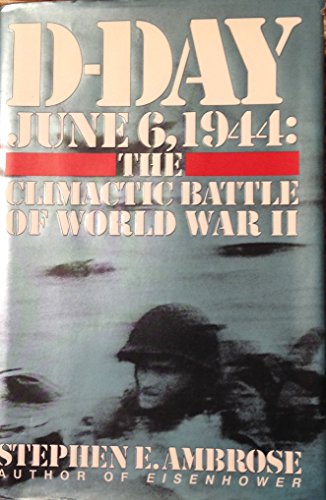
D-Day: June 6, 1944 -- The Climactic Battle of WWII: The Climactic Battle of World War II - Hardcover
Inhaltsangabe
Stephen E. Ambrose draws from hundreds of interviews with US Army veterans and the brave Allied soldiers who fought alongside them to create this exceptional account of the day that shaped the twentieth century. D-Day is above all the epic story of men at the most demanding moment of their existence, when the horrors, complexities and triumphs of life are laid bare and courage and heroism come to the fore.
Die Inhaltsangabe kann sich auf eine andere Ausgabe dieses Titels beziehen.
Über die Autorin bzw. den Autor
Dr. Stephen Ambrose was a renowned historian and acclaimed author of more than thirty books. Among his New York Times bestsellers are Nothing Like It in the World, Citizen Soldiers, Band of Brothers, D-Day - June 6, 1944, and Undaunted Courage. Dr. Ambrose was a retired Boyd Professor of History at the University of New Orleans and a contributing editor for the Quarterly Journal of Military History. He also participated in numerous national television programs, including shows appearing on the History Channel and National Geographic.
Auszug. © Genehmigter Nachdruck. Alle Rechte vorbehalten.
Chapter 1
THE DEFENDERS
At the beginning of 1944, Nazi Germany's fundamental problem was that she had conquered more territory than she could defend, but Hitler had a conqueror's mentality and he insisted on defending every inch of occupied soil. To carry out such orders, the Wehrmacht relied on improvisations, of which the most important were conscripted foreign troops, school-age German youths and old men, and fixed defensive positions. It also changed its tactical doctrine and weapons design, transforming itself from the highly mobile blitzkrieg army of 1940-41 that had featured light, fast tanks and hard-marching infantry into the ponderous, all-but-immobile army of 1944 that featured heavy, slow tanks and dug-in infantry.
Like everything else that happened in Nazi Germany, this was Hitler's doing. He had learned the lesson of World War I -- that Germany could not win a war of attrition -- and his policy in the first two years of World War II had been blitzkrieg. But in the late fall of 1941 his lightning war came a cropper in Russia. He then made the most incomprehensible of his many mistakes when he declared war on the United States -- in the same week that the Red Army launched its counteroffensive outside Moscow!
In the summer of 1942, the Wehrmacht tried blitzkrieg against the Red Army again, but on a much reduced scale (one army group on one front rather than three army groups on three fronts), only to come a cropper once more when the snow began to fall. At the end of January 1943, nearly a quarter of a million German troops at Stalingrad surrendered. In July 1943, the Wehrmacht launched its last offensive on the Eastern Front, at Kursk. The Red Army stopped it cold, inflicting horrendous casualties.
From Kursk on, Hitler had no hope of winning a military victory against the Soviet Union. That did not mean his cause was hopeless. He had a lot of space to trade for time on the Eastern Front, and in time it was inevitable that the strange alliance -- Great Britain, the Soviet Union, and the United States -- that only he could have brought together would split asunder.
His death and the total defeat of Nazi Germany would for certain lead to the breakup of the alliance, but Hitler wanted the breakup to take place while it would still benefit him, and he had good reason to believe that might happen -- if he could convince Stalin that he couldn't depend on the United States and Britain. In that event, Stalin could well conclude that the cost of victory to the Red Army fighting alone was too high. Once the Red Army had returned to the start line of June 1941 -- that is, in occupation of eastern Poland -- Stalin might be willing to negotiate a peace based on a division of Eastern Europe between the Nazis and Soviets.
Between August 1939 and June 1941 the Nazi and Soviet empires had been partners, joined together in an alliance based on a division of Eastern Europe between them. To return to that situation, Hitler had to persuade Stalin that the Wehrmacht was still capable of inflicting unacceptable casualties on the Red Army. To do that, Hitler needed more fighting men and machines. To get them, he had to strip his Western Front. To do that, he had to hurl the forthcoming invasion back into the sea.
That is why D-Day was critical. In a November 3, 1943, Führer Directive (No. 51), Hitler explained it all with crystal clarity: "For the last two and one-half years the bitter and costly struggle against Bolshevism has made the utmost demands upon the bulk of our military resources and energies....The situation has since changed. The threat from the East remains, but an even greater danger looms in the West: the Anglo-American landing! In the East, the vastness of the space will, as a last resort, permit a loss of territory even on a major scale, without suffering a mortal blow to Germany's chance for survival.
"Not so in the West! If the enemy here succeeds in penetrating our defense on a wide front, consequences of staggering proportions will follow within a short time." (What he meant was that a successful Anglo-American offensive in 1944 would pose a direct threat to Germany's industrial heartland, the Rhine-Ruhr region. Southeastern England is closer to Cologne, Düsseldorf, and Essen than they are to Berlin; put another way, in the fall of 1943 the front line in the East was more than 2,000 kilometers from Berlin, while in the West the front line was 500 kilometers from the Rhine-Ruhr, 1,000 kilometers from Berlin. A successful 1944 Red Army offensive would overrun parts of Ukraine and White Russia, areas important but not critical to Germany's war-making capability. A successful 1944 Anglo-American offensive would overrun the Rhine-Ruhr, areas that were indispensable to Germany's warmaking capability.)
Thus, Hitler declared, it was on the French coast that the decisive battle would be fought. "For that reason, I can no longer justify the further weakening of the West in favor of other theaters of war. I have therefore decided to strengthen the defenses in the West...."
This reversed a policy established in the fall of 1940, with the abandonment of preparations for Operation Seelöwe (Sea Lion), the invasion of England. Since that time, the Wehrmacht had stripped down its forces in France, transferring men and equipment to the Eastern Front on an ever-increasing scale.
Hitler's reasons for shifting priority to the West in 1944 were more political than military. On March 20, he told his principal commanders in the West, "The destruction of the enemy's landing attempt means more than a purely local decision on the Western Front. It is the sole decisive factor in the whole conduct of the war and hence in its final result." He went on to explain, "Once defeated, the enemy will never again try to invade. Quite apart from their heavy losses, they would need months to organize a fresh attempt. And an invasion failure would also deliver a crushing blow to British and American morale. For one thing, it would prevent Roosevelt from being reelected -- with any luck he'd finish up in jail somewhere! For another, war weariness would grip Britain even faster and Churchill, already a sick old man with his influence waning, wouldn't be able to carry through a new invasion operation." At that point, the Wehrmacht could transfer forty-five divisions from the West to the East to "revolutionize the situation there....So the whole outcome of the war depends on each man fighting in the West, and that means the fate of the Reich as well!"
This was Germany's only hope. More correctly, it was Hitler's and the Nazis' only hope; for the German people and nation, the decision to continue the struggle spelled catastrophe. In any case, had Hitler's scenario worked out, in the summer of 1945 the U.S. Army Air Force, secure in its bases in England, would have started dropping atomic bombs on Berlin and other German cities. But of course in early 1944 no one knew when, or even if, the American Manhattan Project would be able to produce...
„Über diesen Titel“ kann sich auf eine andere Ausgabe dieses Titels beziehen.
Suchergebnisse für D-Day: June 6, 1944 -- The Climactic Battle of WWII:...

Beispielbild für diese ISBN
D-Day June 6, 1944: The Climactic Battle of World War II
Anbieter: World of Books (was SecondSale), Montgomery, IL, USA
Verkäuferbewertung 5 von 5 Sternen

Zustand: Acceptable. Item in acceptable condition! Textbooks may not include supplemental items i.e. CDs, access codes etc. Artikel-Nr. 00088654233
Gebraucht kaufen
EUR 4,11
Versand gratis
Versand innerhalb von USA
Versand innerhalb von USA
Anzahl: 15 verfügbar
Beispielbild für diese ISBN
D-Day June 6, 1944: The Climactic Battle of World War II
Anbieter: World of Books (was SecondSale), Montgomery, IL, USA
Verkäuferbewertung 5 von 5 Sternen
Zustand: Good. Item in good condition. Textbooks may not include supplemental items i.e. CDs, access codes etc. Artikel-Nr. 00107390927
Gebraucht kaufen
EUR 4,11
Versand gratis
Versand innerhalb von USA
Versand innerhalb von USA
Anzahl: 13 verfügbar
Beispielbild für diese ISBN
D-Day June 6, 1944: The Climactic Battle of World War II
Anbieter: World of Books (was SecondSale), Montgomery, IL, USA
Verkäuferbewertung 5 von 5 Sternen
Zustand: Very Good. Item in very good condition! Textbooks may not include supplemental items i.e. CDs, access codes etc. Artikel-Nr. 00109718695
Gebraucht kaufen
EUR 4,11
Versand gratis
Versand innerhalb von USA
Versand innerhalb von USA
Anzahl: 2 verfügbar
Foto des Verkäufers
D-Day June 6, 1944: The Climactic Battle of World War II
Anbieter: Dream Books Co., Denver, CO, USA
Verkäuferbewertung 5 von 5 Sternen
Zustand: acceptable. This copy has clearly been enjoyedâ"expect noticeable shelf wear and some minor creases to the cover. Binding is strong, and all pages are legible. May contain previous library markings or stamps. Artikel-Nr. DBV.0671673343.A
Gebraucht kaufen
EUR 4,12
Versand gratis
Versand innerhalb von USA
Versand innerhalb von USA
Anzahl: 1 verfügbar
Beispielbild für diese ISBN
D-Day June 6, 1944: The Climactic Battle of World War II
Anbieter: ThriftBooks-Phoenix, Phoenix, AZ, USA
Verkäuferbewertung 5 von 5 Sternen
Hardcover. Zustand: Good. No Jacket. Pages can have notes/highlighting. Spine may show signs of wear. ~ ThriftBooks: Read More, Spend Less. Artikel-Nr. G0671673343I3N00
Gebraucht kaufen
EUR 6,09
Versand gratis
Versand innerhalb von USA
Versand innerhalb von USA
Anzahl: 5 verfügbar
Beispielbild für diese ISBN
D-Day June 6, 1944: The Climactic Battle of World War II
Anbieter: ThriftBooks-Phoenix, Phoenix, AZ, USA
Verkäuferbewertung 5 von 5 Sternen
Hardcover. Zustand: Good. No Jacket. Former library book; Pages can have notes/highlighting. Spine may show signs of wear. ~ ThriftBooks: Read More, Spend Less. Artikel-Nr. G0671673343I3N10
Gebraucht kaufen
EUR 6,09
Versand gratis
Versand innerhalb von USA
Versand innerhalb von USA
Anzahl: 1 verfügbar
Beispielbild für diese ISBN
D-Day June 6, 1944: The Climactic Battle of World War II
Anbieter: ThriftBooks-Atlanta, AUSTELL, GA, USA
Verkäuferbewertung 5 von 5 Sternen
Hardcover. Zustand: Good. No Jacket. Former library book; Pages can have notes/highlighting. Spine may show signs of wear. ~ ThriftBooks: Read More, Spend Less. Artikel-Nr. G0671673343I3N10
Gebraucht kaufen
EUR 6,09
Versand gratis
Versand innerhalb von USA
Versand innerhalb von USA
Anzahl: 1 verfügbar
Beispielbild für diese ISBN
D-Day June 6, 1944: The Climactic Battle of World War II
Anbieter: ThriftBooks-Reno, Reno, NV, USA
Verkäuferbewertung 5 von 5 Sternen
Hardcover. Zustand: Good. No Jacket. Former library book; Pages can have notes/highlighting. Spine may show signs of wear. ~ ThriftBooks: Read More, Spend Less. Artikel-Nr. G0671673343I3N10
Gebraucht kaufen
EUR 6,09
Versand gratis
Versand innerhalb von USA
Versand innerhalb von USA
Anzahl: 1 verfügbar
Beispielbild für diese ISBN
D-Day June 6, 1944: The Climactic Battle of World War II
Anbieter: ThriftBooks-Dallas, Dallas, TX, USA
Verkäuferbewertung 5 von 5 Sternen
Hardcover. Zustand: Fair. No Jacket. Readable copy. Pages may have considerable notes/highlighting. ~ ThriftBooks: Read More, Spend Less. Artikel-Nr. G0671673343I5N00
Gebraucht kaufen
EUR 6,09
Versand gratis
Versand innerhalb von USA
Versand innerhalb von USA
Anzahl: 1 verfügbar
Beispielbild für diese ISBN
D-Day June 6, 1944: The Climactic Battle of World War II
Anbieter: ThriftBooks-Dallas, Dallas, TX, USA
Verkäuferbewertung 5 von 5 Sternen
Hardcover. Zustand: Good. No Jacket. Missing dust jacket; Pages can have notes/highlighting. Spine may show signs of wear. ~ ThriftBooks: Read More, Spend Less. Artikel-Nr. G0671673343I3N01
Gebraucht kaufen
EUR 6,09
Versand gratis
Versand innerhalb von USA
Versand innerhalb von USA
Anzahl: 2 verfügbar