
Verwandte Artikel zu How To Use An Astronomical Telescope: A Beginner's...
Inhaltsangabe
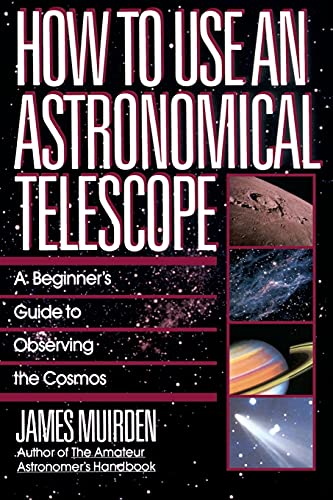
Astronomy has never been a more popular pastime than it is today. The increased availability of less expensive, more powerful, and more sophisticated telescopes has given rise to a new generation of stargazers. And for these beginning astronomers here is the comprehensive book covering everything from the difficult task of selecting an instrument to the equally daunting choices that arise when a telescope is turned to the heavens.
Renowned British astronomer and author James Muirden takes the fledgling astronomer by the hand in his new book, offering tips on:
* the purchase, assembly, and orientation of your new telescope
* how to observe and chart the Sun, Moon, planets, stars and comets
* how to investigate the deep-sky objects -- clusters, nebulae, and other galaxies beyond the Milky Way
The final chapter, "Windows into Space," explores ten carefully selected regions featuring noteworthy examples of double stars, galaxies, and nebulae, as well as more obscure objects seldom examined by astronomers.
How to Use an Astronomical Telescope offers completely revised and updated location charts with detailed coordinates, tables, appendixes, and numerous illustrations and photographs, making it the essential volume for one's first exploration of the cosmos.
Die Inhaltsangabe kann sich auf eine andere Ausgabe dieses Titels beziehen.
Über die Autorin bzw. den Autor
James Muirden is the author of eleven books on astronomy, including The Amateur Astronomer's Handbook. He spent nine years working as an astronomical optician making telescopes before receiving a teaching degree at Exeter University, and is now Project Publications Officer for the Schools Health Education Unit at Exeter. He lives with his wife and two children in Exeter, England.
Von der hinteren Coverseite
For the beginning astronomer here is a comprehensive book covering everything from the difficult task of selecting an instrument to the equally daunting choices that arise when a telescope is turned to the heavens.
Auszug. © Genehmigter Nachdruck. Alle Rechte vorbehalten.
CHAPTER 1
Astronomical Telescopes
What is a telescope? It is an instrument that forms an image of a distant object, and it is thanks to a marvelous property of light rays -- that they can be bent or "refracted" by a piece of glass, or reflected by a shiny surface -- that telescopes are possible. With mirrors, or glass lenses, we can manipulate light rays in any way we wish, casting images of remote objects onto the eye's highly sensitive screen, the retina. Countless nerve endings then transmit the color and intensity responses from different parts of this image to the brain, which in turn decodes the information and presents the viewer with a mental image of the physical image produced by the telescope.
The observer's task The view produced by the telescope will be both larger (the magnification aspect) and brighter (the light-collecting aspect) than what is seen with the unaided eye. However, it must never be forgotten that the telescope's task is only to throw the view onto the retina; it does not, itself, "see" anything. Unscrambling the image is the observer's job. The most perfect image will be wasted if the observer does not put it to good use, and the act of observing is a highly personal one. Set two people down side by side to look at the same object and to draw what they see, and you will notice enormous differences between the results. Some of these differences will be due to fluency with the pencil and general artistic competence, but outside of these effects lie real differences in what is perceived. Some people are very sensitive to color differences, others to symmetry, and so on. Some may try hard to detect fine details while others could rind themselves more concerned with overall proportion.
It is true that some people have such defective eyesight that no reasonable comparison is possible. But the differences outlined above do not refer to the clarity, of vision. It is the way in which the image -- as far as we know, the identical image -- is used by different people that is so intriguing. The reason for mentioning this individuality of vision so early is to emphasize what a telescope cannot do. It can produce an image, but it cannot see; unless it is being used as a camera -- and astronomical photography is a very important branch of amateur astronomy -- it is only as good as the observer who is looking through the eyepiece. Nobody would expect someone who has just passed the driving test to get the most out of a high-performance automobile; on the other hand, someone with particular aptitude for driving will rapidly overtake (in both senses of the word!) another individual who is merely competent. It isn't easy, however, to convince someone buying a fine new telescope that he or she is going to have to work hard and persistently in order to get the best out of it. Advertisements have a habit of making astronomy look easier than it really is!
However, this chapter is about how telescopes work, so let us defer discussion of the observer until the appropriate place, and take a look at the very important considerations of magnification and, to begin with, aperture.
Light-collecting power The eye's light-collecting power is controlled by the pupil, a variable aperture that opens to its widest amount (about 8 mm in diameter) in dim light, and closes down to about 2 mm in sunlight. At night, then, we are observing with an 8-mm aperture "telescope." Even this modest instrument is sufficient to reveal some 2000 stars at any one time if the air is very clear, there are no nearby artificial lights, the Moon is absent, and the eye focuses sharply. However, there are innumerable stars which are too faint to be seen with the keenest unaided eye, and to detect them we have to use an aperture larger than 8 mm, so that more light can be collected and focused, and fainter stars therefore have a chance of energizing the nerve endings.
The area of a circle is proportional to the square of its diameter. Logic suggests, therefore, that a telescope with a light-collecting aperture of 16 mm will collect four times as much light as will the naked eye, making the same stars appear four times as bright, and revealing stars that are only a quarter as bright as the dimmest naked-eye stars. The same reasoning suggests that a telescope with an aperture of 100 mm -- which is modest by amateur standards -- will show the same star looking (100/8)2 or about 156 times as bright as when seen with the naked eye, or reveal stars 156 times fainter than those visible without any optical aid. This is an enormous increase in light-gathering power, and it is not surprising that even a relatively small telescope utterly transforms our view of the universe.
Does 156 times the light-gathering power mean that a 100-mm aperture telescope will reveal 156 times as many stars in the sky? To investigate this question, it is necessary to understand how star brightnesses are graded, and this is important enough to be worth examining straight away. The brightness of a star is called its magnitude, and the magnitude scale is based on an ancient system of measurement in which the brightest naked-eye stars were called "1st magnitude" and the faintest were called "6th magnitude" -- so the higher the magnitude number, the fainter the star. This was, originally, a very approximate grading, but modern brightness-measuring devices known as photometers permit the brightness of a star to be measured to within a hundredth of a magnitude unit. One magnitude step now corresponds to a brightness ratio of 2.512 times. The reason for choosing this number is that five magnitudes correspond to a brightness difference of exactly 100 (or 2.512 to the power of 5).
Theoretically, a 100-mm aperture telescope will gain about 5.2 magnitudes over the unaided eye. Therefore, whereas the naked eye will normally see stars no fainter than the 6th magnitude (although some observers, under extraordinarily good conditions, have reported stars of magnitude 6.5 or even fainter), the eye and telescope combined should reach the 11th magnitude. On any one night, there are several million stars of the 11th magnitude and brighter above the horizon. The telescope will, therefore, reveal perhaps a thousand times as many stars as the naked eye, and not just 156 times as many: far more than you could hope to observe, individually, in a lifetime. Imagine a thousand separate skies full of stars, and that is the girl to your eye of a 100-mm telescope.
We have already stated that this aperture is a modest one by commercial standards. Most amateur-owned telescopes fall in the 75- to 250-mm range, but some are much larger. In any of these instruments, the view is at first bewildering: the crowds of stars cannot be related to anything seen with the naked eye. A small low-power telescope attached to the main instrument, known as a finder, is of great value in locating objects, and an instrument of any reasonable size needs one. The task of the finder is to negotiate between what the eye sees and what the telescope reveals. If it is too small, it won't show enough telescopic stars; if too large, it will defeat its own purpose and confuse the eye with too many. For most amateur instruments, an aperture of about 50 mm and a magnification of about eight times is ideal.
Magnification "How much does it magnify?" is the frequently heard inquiry when a telescope is mentioned. The answer to this is "It depends." With the exception of small hand telescopes and binoculars, which have a fixed magnification, the magnifying power of a telescope depends upon the eyepiece or ocular that is used with it. Most astronomical telescopes are equipped with several eyepieces, giving a range of magnification. A telescope requires several different...
„Über diesen Titel“ kann sich auf eine andere Ausgabe dieses Titels beziehen.
Suchergebnisse für How To Use An Astronomical Telescope: A Beginner's...

Beispielbild für diese ISBN
How To Use An Astronomical Telescope
Anbieter: World of Books (was SecondSale), Montgomery, IL, USA
Verkäuferbewertung 5 von 5 Sternen

Paperback. Zustand: Good. Offers advice on the selection and operation of a telescope and discusses methods for observing the sun, moon, planets, stars, and comets with a telescope. Artikel-Nr. 00100289031
Gebraucht kaufen
EUR 3,82
Versand gratis
Versand innerhalb von USA
Versand innerhalb von USA
Anzahl: 1 verfügbar
Beispielbild für diese ISBN
How To Use An Astronomical Telescope
Anbieter: World of Books (was SecondSale), Montgomery, IL, USA
Verkäuferbewertung 5 von 5 Sternen
Zustand: Acceptable. Item in acceptable condition! Textbooks may not include supplemental items i.e. CDs, access codes etc. Artikel-Nr. 00103036831
Gebraucht kaufen
EUR 3,82
Versand gratis
Versand innerhalb von USA
Versand innerhalb von USA
Anzahl: 1 verfügbar
Beispielbild für diese ISBN
How To Use An Astronomical Telescope
Verlag:
Touchstone (edition Reprint), 1988
ISBN 10: 0671664042
ISBN 13: 9780671664046
Gebraucht
Paperback
Anbieter: BooksRun, Philadelphia, PA, USA
Verkäuferbewertung 5 von 5 Sternen
Paperback. Zustand: Very Good. Reprint. It's a well-cared-for item that has seen limited use. The item may show minor signs of wear. All the text is legible, with all pages included. It may have slight markings and/or highlighting. Artikel-Nr. 0671664042-11-1
Gebraucht kaufen
EUR 4,96
Versand gratis
Versand innerhalb von USA
Versand innerhalb von USA
Anzahl: 1 verfügbar
Beispielbild für diese ISBN
How To Use An Astronomical Telescope
Verlag:
Touchstone (edition Reprint), 1988
ISBN 10: 0671664042
ISBN 13: 9780671664046
Gebraucht
Paperback
Anbieter: BooksRun, Philadelphia, PA, USA
Verkäuferbewertung 5 von 5 Sternen
Paperback. Zustand: Fair. Reprint. The item might be beaten up but readable. May contain markings or highlighting, as well as stains, bent corners, or any other major defect, but the text is not obscured in any way. Artikel-Nr. 0671664042-7-18
Gebraucht kaufen
EUR 5,31
Versand gratis
Versand innerhalb von USA
Versand innerhalb von USA
Anzahl: 1 verfügbar
Beispielbild für diese ISBN
How to Use an Astronomical Telescope: A Beginner's Guide to Observing the Cosmos
Anbieter: ThriftBooks-Atlanta, AUSTELL, GA, USA
Verkäuferbewertung 5 von 5 Sternen
Paperback. Zustand: Very Good. No Jacket. May have limited writing in cover pages. Pages are unmarked. ~ ThriftBooks: Read More, Spend Less. Artikel-Nr. G0671664042I4N00
Gebraucht kaufen
EUR 5,97
Versand gratis
Versand innerhalb von USA
Versand innerhalb von USA
Anzahl: 1 verfügbar
Beispielbild für diese ISBN
How to Use an Astronomical Telescope: A Beginner's Guide to Observing the Cosmos
Anbieter: ThriftBooks-Dallas, Dallas, TX, USA
Verkäuferbewertung 5 von 5 Sternen
Paperback. Zustand: As New. No Jacket. Pages are clean and are not marred by notes or folds of any kind. ~ ThriftBooks: Read More, Spend Less. Artikel-Nr. G0671664042I2N00
Gebraucht kaufen
EUR 5,97
Versand gratis
Versand innerhalb von USA
Versand innerhalb von USA
Anzahl: 1 verfügbar
Beispielbild für diese ISBN
How to Use an Astronomical Telescope
Anbieter: Better World Books, Mishawaka, IN, USA
Verkäuferbewertung 5 von 5 Sternen
Zustand: Good. Reprint. Pages intact with minimal writing/highlighting. The binding may be loose and creased. Dust jackets/supplements are not included. Stock photo provided. Product includes identifying sticker. Better World Books: Buy Books. Do Good. Artikel-Nr. 4227421-75
Gebraucht kaufen
EUR 6,33
Versand gratis
Versand innerhalb von USA
Versand innerhalb von USA
Anzahl: 2 verfügbar
Beispielbild für diese ISBN
How to Use an Astronomical Telescope
Anbieter: Better World Books, Mishawaka, IN, USA
Verkäuferbewertung 5 von 5 Sternen
Zustand: Good. Reprint. Former library copy. Pages intact with minimal writing/highlighting. The binding may be loose and creased. Dust jackets/supplements are not included. Includes library markings. Stock photo provided. Product includes identifying sticker. Better World Books: Buy Books. Do Good. Artikel-Nr. GRP17167072
Gebraucht kaufen
EUR 6,33
Versand gratis
Versand innerhalb von USA
Versand innerhalb von USA
Anzahl: 2 verfügbar
Beispielbild für diese ISBN
How To Use An Astronomical Telescope
Anbieter: Wonder Book, Frederick, MD, USA
Verkäuferbewertung 5 von 5 Sternen
Zustand: Very Good. Very Good condition. A copy that may have a few cosmetic defects. May also contain light spine creasing or a few markings such as an owner's name, short gifter's inscription or light stamp. Artikel-Nr. R10C-03592
Gebraucht kaufen
EUR 6,40
Versand gratis
Versand innerhalb von USA
Versand innerhalb von USA
Anzahl: 2 verfügbar
Beispielbild für diese ISBN
How To Use An Astronomical Telescope
Anbieter: Wonder Book, Frederick, MD, USA
Verkäuferbewertung 5 von 5 Sternen
Zustand: Good. Good condition. A copy that has been read but remains intact. May contain markings such as bookplates, stamps, limited notes and highlighting, or a few light stains. Artikel-Nr. N06D-01677
Gebraucht kaufen
EUR 6,40
Versand gratis
Versand innerhalb von USA
Versand innerhalb von USA
Anzahl: 1 verfügbar