
Verwandte Artikel zu Science of Hitting
Inhaltsangabe
“Baseball’s last .400 hitter share[s] his secrets in this primer still used at all levels of the game.” —Paul Dickson, author of Bill Veeck: Baseball’s Greatest Maverick
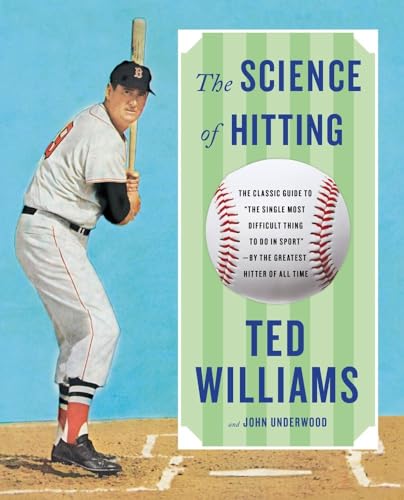
Now fully revised with new illustrations and diagrams, the classic—and still the greatest—book on hitting from the last baseball player to break the magic .400 barrier, Ted Williams.
Ted Williams was arguably the greatest pure hitter who ever lived. A lifelong student of hitting, he sought advice from every great hitter—and pitcher—he met. Drawing on that advice, as well as his own legendary life in baseball, Williams produced the all-time batting classic, The Science of Hitting. Using its detailed illustrations, anecdotes, and concise coaching, players of all skill levels will learn how to improve their fundamentals and gain keen insights into the finer points of hitting, including:
-How to Think Like a Pitcher and Guess the Pitch
-The Three Cardinal Rules for Developing a Smooth Line-Driving Swing
-The Secrets of Hip and Wrist Action
-Pitch Selection
-Bunting
-Hitting the Opposite Way
The Science of Hitting is a must-read for all baseball players looking to improve their turn at bat and for all coaches and parents teaching the sport.
Die Inhaltsangabe kann sich auf eine andere Ausgabe dieses Titels beziehen.
Über die Autorin bzw. den Autor
Ted Williams won the American League batting championship six times and was given a place in the Baseball Hall of Fame in 1966. He was the last man to bat .400 in major league baseball and has been considered America’s leading sports fisherman. With John Underwood, he coauthored Fishing “The Big Three” and his autobiography, My Turn at Bat.
Auszug. © Genehmigter Nachdruck. Alle Rechte vorbehalten.
Chapter 1
Hitting a baseball -- I've said it a thousand times -- is the single most difficult thing to do in sport.
I get raised eyebrows and occasional arguments when I say that, but what is there that is harder to do? What is there that requires more natural ability, more physical dexterity, more mental alertness? That requires a greater finesse to go with physical strength, that has as many variables and as few constants, and that carries with it the continuing frustration of knowing that even if you are a .300 hitter -- which is a rare item these days -- you are going to fail at your job seven out of ten times?
If Joe Montana or Dan Marino completed three of every ten passes they attempted, they would be ex-professional quarterbacks. If Larry Bird or Magic Johnson made three of every ten shots they took, their coaches would take the basketball away from them.
Golf? Somebody always mentions golf. You don't have to have good eyesight to play golf. Tommy Armour was a terrific golfer, and he had no sight in one eye. You have to have good eyesight to hit a baseball. Look at the tragedy of Tony Conigliaro of the Red Sox. Six foot three, beautifully developed, strong, aggressive, stylish, and an injured eye ended his career. When I managed the Washington Senators I insisted that Mike Epstein get his eyes checked. He was having difficulties hitting, and I suspected it might be partially due to his vision. He did, and with new contact lenses he had his best season with the Senators. Just a tiny correction.
You don't have to have speed to succeed at golf, or great strength, or exceptional coordination. You don't have to be quick. You don't have to be young. Golfers win major tournaments into their fifties. I hit .316 when I was forty-two years old, and was considered an old, old man in the game.
You never hear a boo in golf. I know that's a factor. You don't have a pitcher throwing curves and sliders and knuckle balls, and if he doesn't like you, maybe a fast ball at your head. There is nothing to hurt you in golf unless lightning strikes or somebody throws a dub. And there's that golf ball, sitting right there for you to hit, and a flat-faced club to hit it with.
Thousands of guys play par golf. Good young golfers swarm into the pros like lemmings. In 1983, the first eleven tournaments on the U.S. tour were won by eleven different players -- the first twenty-three by twenty different players. Wouldn't it be ironic if Mr. Watson didn't win a tournament all season? Or Mr. Nieklaus? The two biggest names in golf? It could happen. But how many .300 hitters are there? A handful.
I compare golf not to detract from it, because it is a fine game, good fun, sociable and a game, unlike baseball, you can play for life. There have always been great athletes in golf. Sam Snead comes immediately to mind. There are points of similarity in the swings of the two games -- hip action, for one, is a key factor, and the advantage of an inside-out stroke. I will elaborate later.
The thing is, hitting a golf ball has been examined from every angle. Libraries of analysis have been written on the subject, and by experts, true experts, like Snead, Armour, Hogan, Nieklaus and Palmer. I've got their books and I know. There are as many theories as there are tee markers, and for the student a great weight of diagnosis.
Hitting a baseball has had no such barrage of scholarly treatment, and probably that is why there are so many people -- even at the big-league level -- teaching it incorrectly, or not teaching it at all. Everybody knows how to hit but very few really do.
The golfer is all ears when it comes to theories. He is receptive to ideas. There is even more to theorize on and to teach in the hitting of a baseball, but there aren't enough qualified guys who do teach it, or enough willingness on the part of the hitters to listen. Then there are the pitching coaches, standing at the batting cage and yelling at the pitchers to "keep it low" or "how's your arm, Lefty? Don't throw too hard, now," and never mind seeing to it that the hitter gets the kind of practice he needs.
Baseball is crying for good hitters. Hitting is the most important part of the game; it is where the big money is, where much of the status is, and the fan interest. The greatest name in American sports history is Babe Ruth, a hitter. I don't know if the story is true or not, but I have to laugh. Ruth was needled one time about the fact that his salary of $80,000 was higher than President Hoover's. Ruth paused a minute and then said, "Well, I had a better year."
Nowadays a .300-plus power hitter like a Mays or a Clemente or an Aaron or a Frank Robinson can make a million dollars or more. Into that category now would be George Brett of the Royals, Eddie Murray of the Orioles, Dale Murphy of the Braves, Don Mattingly of the Yankees and Wade Boggs of the Red Sox. For an outfielder, hitting is 75 per cent of his worth, in most cases more important than fielding and arm and speed combined. Terry Moore was a great fielder. Dom DiMaggio was a great fielder. Nobody played the outfield any better than Jimmy Piersall. But when it comes down to it, the guys people remember are the hitters.
Yet today there does not seem to be a player in baseball who is going to wind up a lifetime .333 hitter, although Rod Carew will be close. Wade Boggs has made a terrific impression in his first four years, but it's a little early to tell with him. Hank Aaron finished his career at .305, Roberto Clemente at .317, Willie Mays at .302, A1 Kaline at .297 and Frank Robinson at .304. Mickey Mantle, as great as he was, was unable to finish above .300.
In the years from 1950 to 1968, Major League batting averages, figured as a whole, dropped 30 points -- from .266 to .236. They have risen again since then, I think mainly because of two expansions (in 1969 and 1977), which invariably waters down the pitching and makes it easier for the hitters for a while. There were fewer home runs hit per game (1.23) in 1968 than there had been in twenty years. Runs scored per game dropped from 9.73 to 6.84, the lowest in sixty years. Batting averages and runs scored began going up again in 1968 and 1970 when four new teams were added to the big leagues. There were pitchers in the big leagues who other years were not good enough to be there, just as happened again when two teams were added in 1977.
A further help to the hitters was the lowering of the mound from 15 inches to 10. Nobody made a big thing about it, but the ball was hopped up a little, too. Unfortunately, so was the thinking. I heard a lot of talk during that period about the "advantage" of the so-called "down swing," which has never been good batting technique. I'll get to that later.
The longer season is blamed for the decline in hitting, and the pitching overall is supposed to be better. Logistics are definitely a factor -- the increase in night games, the size of the new parks (Chavez Ravine in Los Angeles is a pasture compared to cozy old Ebbets Field), the disturbed routine of cross-country travel that forces you to eat different hours, sleep differently. Certainly a week should be cut off both ends of the season for no other reason than to get away from some of that lousy cold weather. It's hard to hit in cold weather. But I wonder. If it were the longer season you would expect the better hitters to average higher -- .360, .370 or better -- for at least 100 games, but only one or two have been able to do so. When the season's only a couple months old neither league will have ten guys hitting .300.
How, too, can the pitching be better when there are fewer pitchers in organized baseball (fewer leagues, fewer everything, actually)? When expansion has made starters out of sixty or more who would otherwise still be in the minor...
„Über diesen Titel“ kann sich auf eine andere Ausgabe dieses Titels beziehen.
Suchergebnisse für Science of Hitting

Foto des Verkäufers
The Science of Hitting
Anbieter: Dream Books Co., Denver, CO, USA
Verkäuferbewertung 5 von 5 Sternen

Zustand: acceptable. Robert Cupp (illustrator). This copy has clearly been enjoyedâ"expect noticeable shelf wear and some minor creases to the cover. Binding is strong, and all pages are legible. May contain previous library markings or stamps. Artikel-Nr. DBV.0671621033.A
Gebraucht kaufen
EUR 3,92
Versand gratis
Versand innerhalb von USA
Versand innerhalb von USA
Anzahl: 1 verfügbar
Beispielbild für diese ISBN
The Science of Hitting
Verlag:
Prentice Hall (a Pearson Education company), 1986
ISBN 10: 0671621033
ISBN 13: 9780671621032
Gebraucht
Paperback
Anbieter: World of Books (was SecondSale), Montgomery, IL, USA
Verkäuferbewertung 5 von 5 Sternen
Paperback. Zustand: Very Good. Robert Cupp (illustrator). "Baseball's last .400 hitter share[s] his secrets in this primer still used at all levels of the game." --Paul Dickson, author of Bill Veeck: Baseball's Greatest Maverick Now fully revised with new illustrations and diagrams, the classic--and still the greatest--book on hitting from the last baseball player to break the magic .400 barrier, Ted Williams. Ted Williams was arguably the greatest pure hitter who ever lived. A lifelong student of hitting, he sought advice from every great hitter--and pitcher--he met. Drawing on that advice, as well as his own legendary life in baseball, Williams produced the all-time batting classic, The Science of Hitting. Using its detailed illustrations, anecdotes, and concise coaching, players of all skill levels will learn how to improve their fundamentals and gain keen insights into the finer points of hitting, including: -How to Think Like a Pitcher and Guess the Pitch -The Three Cardinal Rules for Developing a Smooth Line-Driving Swing -The Secrets of Hip and Wrist Action -Pitch Selection -Bunting -Hitting the Opposite Way The Science of Hitting is a must-read for all baseball players looking to improve their turn at bat and for all coaches and parents teaching the sport. Artikel-Nr. 00109560232
Gebraucht kaufen
EUR 4,05
Versand gratis
Versand innerhalb von USA
Versand innerhalb von USA
Anzahl: 9 verfügbar
Beispielbild für diese ISBN
The Science of Hitting
Verlag:
Prentice Hall (a Pearson Education company), 1986
ISBN 10: 0671621033
ISBN 13: 9780671621032
Gebraucht
Paperback
Anbieter: World of Books (was SecondSale), Montgomery, IL, USA
Verkäuferbewertung 5 von 5 Sternen
Paperback. Zustand: Good. Robert Cupp (illustrator). "Baseball's last .400 hitter share[s] his secrets in this primer still used at all levels of the game." --Paul Dickson, author of Bill Veeck: Baseball's Greatest Maverick Now fully revised with new illustrations and diagrams, the classic--and still the greatest--book on hitting from the last baseball player to break the magic .400 barrier, Ted Williams. Ted Williams was arguably the greatest pure hitter who ever lived. A lifelong student of hitting, he sought advice from every great hitter--and pitcher--he met. Drawing on that advice, as well as his own legendary life in baseball, Williams produced the all-time batting classic, The Science of Hitting. Using its detailed illustrations, anecdotes, and concise coaching, players of all skill levels will learn how to improve their fundamentals and gain keen insights into the finer points of hitting, including: -How to Think Like a Pitcher and Guess the Pitch -The Three Cardinal Rules for Developing a Smooth Line-Driving Swing -The Secrets of Hip and Wrist Action -Pitch Selection -Bunting -Hitting the Opposite Way The Science of Hitting is a must-read for all baseball players looking to improve their turn at bat and for all coaches and parents teaching the sport. Artikel-Nr. 00108733690
Gebraucht kaufen
EUR 4,05
Versand gratis
Versand innerhalb von USA
Versand innerhalb von USA
Anzahl: 20 verfügbar
Beispielbild für diese ISBN
The Science of Hitting
Verlag:
Prentice Hall (a Pearson Education company), 1986
ISBN 10: 0671621033
ISBN 13: 9780671621032
Gebraucht
Paperback
Anbieter: World of Books (was SecondSale), Montgomery, IL, USA
Verkäuferbewertung 5 von 5 Sternen
Paperback. Zustand: Fair. Robert Cupp (illustrator). "Baseball's last .400 hitter share[s] his secrets in this primer still used at all levels of the game." --Paul Dickson, author of Bill Veeck: Baseball's Greatest Maverick Now fully revised with new illustrations and diagrams, the classic--and still the greatest--book on hitting from the last baseball player to break the magic .400 barrier, Ted Williams. Ted Williams was arguably the greatest pure hitter who ever lived. A lifelong student of hitting, he sought advice from every great hitter--and pitcher--he met. Drawing on that advice, as well as his own legendary life in baseball, Williams produced the all-time batting classic, The Science of Hitting. Using its detailed illustrations, anecdotes, and concise coaching, players of all skill levels will learn how to improve their fundamentals and gain keen insights into the finer points of hitting, including: -How to Think Like a Pitcher and Guess the Pitch -The Three Cardinal Rules for Developing a Smooth Line-Driving Swing -The Secrets of Hip and Wrist Action -Pitch Selection -Bunting -Hitting the Opposite Way The Science of Hitting is a must-read for all baseball players looking to improve their turn at bat and for all coaches and parents teaching the sport. Artikel-Nr. 00104121521
Gebraucht kaufen
EUR 4,05
Versand gratis
Versand innerhalb von USA
Versand innerhalb von USA
Anzahl: 2 verfügbar
Beispielbild für diese ISBN
Science of Hitting
Anbieter: ThriftBooks-Reno, Reno, NV, USA
Verkäuferbewertung 5 von 5 Sternen
Paperback. Zustand: Fair. No Jacket. Robert Cupp (illustrator). Readable copy. Pages may have considerable notes/highlighting. ~ ThriftBooks: Read More, Spend Less. Artikel-Nr. G0671621033I5N00
Gebraucht kaufen
EUR 5,96
Versand gratis
Versand innerhalb von USA
Versand innerhalb von USA
Anzahl: 1 verfügbar
Beispielbild für diese ISBN
Science of Hitting
Anbieter: ThriftBooks-Reno, Reno, NV, USA
Verkäuferbewertung 5 von 5 Sternen
Paperback. Zustand: Very Good. No Jacket. Robert Cupp (illustrator). May have limited writing in cover pages. Pages are unmarked. ~ ThriftBooks: Read More, Spend Less. Artikel-Nr. G0671621033I4N00
Gebraucht kaufen
EUR 5,96
Versand gratis
Versand innerhalb von USA
Versand innerhalb von USA
Anzahl: 2 verfügbar
Beispielbild für diese ISBN
Science of Hitting
Anbieter: ThriftBooks-Reno, Reno, NV, USA
Verkäuferbewertung 5 von 5 Sternen
Paperback. Zustand: Good. No Jacket. Robert Cupp (illustrator). Pages can have notes/highlighting. Spine may show signs of wear. ~ ThriftBooks: Read More, Spend Less. Artikel-Nr. G0671621033I3N00
Gebraucht kaufen
EUR 5,96
Versand gratis
Versand innerhalb von USA
Versand innerhalb von USA
Anzahl: 5 verfügbar
Beispielbild für diese ISBN
Science of Hitting
Anbieter: ThriftBooks-Phoenix, Phoenix, AZ, USA
Verkäuferbewertung 5 von 5 Sternen
Paperback. Zustand: Good. No Jacket. Robert Cupp (illustrator). Pages can have notes/highlighting. Spine may show signs of wear. ~ ThriftBooks: Read More, Spend Less. Artikel-Nr. G0671621033I3N00
Gebraucht kaufen
EUR 5,96
Versand gratis
Versand innerhalb von USA
Versand innerhalb von USA
Anzahl: 5 verfügbar
Beispielbild für diese ISBN
Science of Hitting
Anbieter: ThriftBooks-Phoenix, Phoenix, AZ, USA
Verkäuferbewertung 5 von 5 Sternen
Paperback. Zustand: Very Good. No Jacket. Robert Cupp (illustrator). May have limited writing in cover pages. Pages are unmarked. ~ ThriftBooks: Read More, Spend Less. Artikel-Nr. G0671621033I4N00
Gebraucht kaufen
EUR 5,96
Versand gratis
Versand innerhalb von USA
Versand innerhalb von USA
Anzahl: 2 verfügbar
Beispielbild für diese ISBN
Science of Hitting
Anbieter: ThriftBooks-Phoenix, Phoenix, AZ, USA
Verkäuferbewertung 5 von 5 Sternen
Paperback. Zustand: Very Good. No Jacket. Robert Cupp (illustrator). Former library book; May have limited writing in cover pages. Pages are unmarked. ~ ThriftBooks: Read More, Spend Less. Artikel-Nr. G0671621033I4N10
Gebraucht kaufen
EUR 5,96
Versand gratis
Versand innerhalb von USA
Versand innerhalb von USA
Anzahl: 1 verfügbar