
Verwandte Artikel zu Brothers on the Mend: Guide Managing & Healing...
Inhaltsangabe
At last -- a book, written by a black man, for black men and women who want less conflict in their relationships and better ways to deal with anger.
Although the unique problems of black men are not new, they have been habitually discussed without solid suggestions for change -- until now. Psychologist Ernest Johnson, who has been helping black men cope with anger -- including his own -- for more than a decade, offers hope and answers. He shows how anger can be used -- rather than avoided -- to build a life filled with love, self-respect, and peace. Exploring the sources of frustration particular to black men today, Dr. Johnson offers prescriptions for managing anger and coping with stress. Changing thought patterns -- and actions -- begins with learning how to:
- Identify camouflaged anger -- rage that may be repressed or diverted into harmful behaviors, such as excessive smoking, alcohol or drug use, poor eating habits, or risky sexual conduct
- Build on friendliness, happiness, trust, and compassion to achieve a committed relationship with a black woman
- Recognize the real origins of tense, hurt, or helpless feelings -- the first step toward change
- Use simple techniques, such as meditation and time-outs, to stop anger before it takes control
- Move from anger to problem-solving
- Heal the wounds of the past
Contrary to popular belief, the most powerful part of a man is his feelings. Brothers on the Mend shows African-American men how to heal themselves -- and those who love them -- by embracing the feelings that will set them free.
Die Inhaltsangabe kann sich auf eine andere Ausgabe dieses Titels beziehen.
Über die Autorin bzw. den Autor
Dr. Ernest H. Johnson, a medical and health psychologist, is a former professor and director of behavioral medicine research in the department of family medicine at Morehouse School of Medicine, where he directed a $1.7 million grant from the National Institutes of Health to continue research about the associations among stress, anger, and health problems. He earned his PhD in psychology at the University of South Florida and speaks widely on the subjects of health, anger management, weight loss, and the prevention of HIV. He has given presentations at colleges and universities across the country. Recently, his focus has been to deliver his message about health, particularly the management of anger, obesity, and hypertension, to members of black churches throughout the southeastern United States.
Auszug. © Genehmigter Nachdruck. Alle Rechte vorbehalten.
From Chapter One: Why Are Black Men Angry?
Tony, a thirty-nine-year-old black business executive, had just returned home after dropping his wife and kids off at the airport to visit his mother-in-law. He was carrying grocery bags into his new home in a predominantly white neighborhood when a police car pulled up. Two white officers got out, eyeing Tony suspiciously. A burglary had recently occurred in the area, they explained. Despite Tony's protest that he owned the home, one of the officers demanded to see some identification. Tony discovered he had left his wallet on the kitchen counter, but his explanations seemed only to further convince the officers that something was amiss. Saying that they were being cautious and checking out all strangers, they immediately handcuffed Tony. He felt his muscles start to tighten. His breathing became shallow as he started to perspire and feel both nervous and angry about what was taking place.
Inside the house, the officers made Tony accompany them as they walked through looking in every room and closet for his "accomplice." The feeling of wanting to explode in indignation -- a natural impulse for any man -- seized Tony. But given his situation, he swallowed the urge, feeling his heart race. The tightness in his muscles seemed to spread to his chest. Only after Tony showed them his identification and enough pictures throughout the house of himself and his family did the policemen finally acknowledge that Tony was a homeowner, not a burglar.
The policemen apologized and left, but the anger that Tony had suppressed like a smoldering volcano had built to a white-hot rage.
Alone in his new house, the stress of the incident affected him physically that night as well. He could not sleep. Exhausted and still upset the next day, he took off from work. Try as he has to forget it, the incident is still fresh in Tony's memory, paining at him like a sore that won't heal. He constantly frets about its occurring again, in a setting that could add to his discomfort. "I am especially worried about the impact of being questioned like this in front of my wife and family since I have never told them about the event," he says.
Tony's story is typical of the many situations that cause psychological damage and worry in black men. Like him, many black men prefer to suppress their anger and rage, suffering the consequences, rather than open up and talk out their feelings. These "cool brothers" express their angry feelings in a number of nonproductive ways -- overuse of tobacco, drowning the bile through drinking, or releasing the welled-up feelings in a burst of violence -- often against loved ones. Talking through the feelings is not seen as an option because they want to appear strong and "manly." But understanding the forces that can cause sudden, even murderous rage -- and more important, learning how to manage and control the impulse, may be the most important factors in the survival of African-American men, and, by extension, black people.
Anger, much like emotions such as anxiety and sadness, is a normal, natural, and basic emotional response to stress and provocations. It is experienced in situations that represent a threat or possible loss of some valuable possession (a physical object, right, relationship, or opinion) -- through acts by others (a person, group, or society) that are perceived as being unjustifiable or as a violation of one's expectations and standards. Under these circumstances, especially if the loss is sudden, anger will be intensely experienced. The degree of anger is related to one's temperament, level of personal stress, how one has learned from parents and others to handle provocations, and the value placed on the possessions that are about to be taken away.
Injustices, betrayal, exploitation, manipulation and mistreatment, sexual harassment, and racism will cause anger. Threats to the ego such as a direct put-down or derogatory comments can also produce anger.
When Texas billionaire and former presidential candidate Ross Perot used the phrase "You people" in a speech to a convention of NAACP delegates in 1992, for example, he was startled by a chorus of angry boos from his mostly black audience. Repeated blows to the ego can create an angry black man with low self-esteem, a person who does not care about himself or anyone else. Such a state of despair allows for what appears to be random violent outbursts or withdrawal into hopelessness.
As Tony's case illustrates, angry reactions involve two things: psychological events, consisting of negative feelings and hateful thoughts, and biological reactions, such as elevated adrenaline levels, rapid heart rate, perspiration, muscle tension, and tightness in the chest. Anger is a basic emotion that supports our behavior in times of stress, frustration, and emergency. It alerts us to the presence of danger as well as prepares us to meet the danger through a basic, evolutionary process called the "fight or flight" response.
The fight/flight response is a set of biological changes that prepare the person for either flight from the danger and threat or an attack against it. The purpose of these biological stress responses -- which humans share with all other animals -- is to prepare the individual for the action that is about to occur. Such actions are motivated by a survival instinct. The body is now armed for physical assault, and the person is ready to either face the enemy head-on (fight) or run like hell (flight) to avoid being beat up. But in our civilized world today, often the "enemy" is not even a man but a piece of paper (e.g., an eviction notice, a long-overdue bill, a letter indicating that your position at work will be terminated, divorce papers).
What is the consequence of constantly arming ourselves to deal with events that don't have a real physical threat?
Some psychologists have argued that one of the results is that we become less capable of distinguishing between real and imagined or perceived dangers. Either way, we react to these threats with a set of built-in biological responses that may diminish rather than enhance our survival in these modern times.
Our survival capability is reduced simply because anger was designed to serve as a reaction to physical threats to our survival and not to psychological assaults to our pride, diminished self-respect, unfair criticisms and evaluations, frustration, humiliation, exploitations and manipulations.
Unfortunately, we respond biologically to these psychological attacks as if they were physical. For an entire range of reasons, both historical and contemporary, black men more often than not will harbor more anger than they are willing to admit. Like the temperature gauge in your car, you can either choose to respond to a trouble sign immediately or ignore it as if it were unimportant and will in some magical way start functioning correctly again. Ignoring those little red lights and gauges in the car can become costly. In my case, the engine in my Volkswagen van exploded while I was stuck in rush-hour traffic.
Many black men who disregard the warning signs of repressed anger can suffer similar dire consequences emotionally. The intensity of these hurts grows and becomes the cause of a multitude of explosive interpersonal problems. Many of these men develop adverse psychological symptoms akin to post-traumatic stress -- a condition that is often found among men who have survived the traumatic experiences of war. Even the act of showing anger is deeply embedded in America's pyscho-racial history. Expressing anger is considered an acceptable way for men in the majority culture to cope with feeling out of control. In fact, after the explosion, calmness is restored and men hope that all is forgiven. They would have you believe that their angry outbursts are a way of letting off steam to prevent...
„Über diesen Titel“ kann sich auf eine andere Ausgabe dieses Titels beziehen.
Suchergebnisse für Brothers on the Mend: Guide Managing & Healing...

Beispielbild für diese ISBN
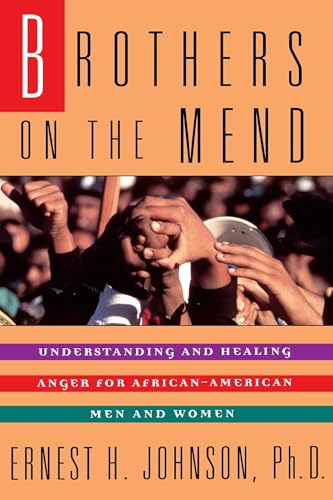
Brothers on the Mend: Understanding and Healing Anger for African-American Men and Women
Anbieter: World of Books (was SecondSale), Montgomery, IL, USA
Verkäuferbewertung 5 von 5 Sternen

Paperback. Zustand: Good. At last -- a book, written by a black man, for black men and women who want less conflict in their relationships and better ways to deal with anger. Although the unique problems of black men are not new, they have been habitually discussed without solid suggestions for change -- until now. Psychologist Ernest Johnson, who has been helping black men cope with anger -- including his own -- for more than a decade, offers hope and answers. He shows how anger can be used -- rather than avoided -- to build a life filled with love, self-respect, and peace. Exploring the sources of frustration particular to black men today, Dr. Johnson offers prescriptions for managing anger and coping with stress. Changing thought patterns -- and actions -- begins with learning how to: Identify camouflaged anger -- rage that may be repressed or diverted into harmful behaviors, such as excessive smoking, alcohol or drug use, poor eating habits, or risky sexual conduct Build on friendliness, happiness, trust, and compassion to achieve a committed relationship with a black woman Recognize the real origins of tense, hurt, or helpless feelings -- the first step toward change Use simple techniques, such as meditation and time-outs, to stop anger before it takes control Move from anger to problem-solving Heal the wounds of the past Contrary to popular belief, the most powerful part of a man is his feelings. Brothers on the Mend shows African-American men how to heal themselves -- and those who love them -- by embracing the feelings that will set them free. Artikel-Nr. 00096665800
Gebraucht kaufen
EUR 12,07
Versand gratis
Versand innerhalb von USA
Versand innerhalb von USA
Anzahl: 2 verfügbar
Beispielbild für diese ISBN
Brothers on the Mend : Understanding and Healing Anger for African-American Men and Women
Anbieter: Robinson Street Books, IOBA, Binghamton, NY, USA
Verkäuferbewertung 4 von 5 Sternen

Paperback. Zustand: Very Good. Prompt Shipment, shipped in Boxes, Tracking PROVIDEDVery good condition, clean pages, sm4to, 265 pages*. Artikel-Nr. ware202ag123
Gebraucht kaufen
EUR 12,41
EUR 8,47 Versand
Versand innerhalb von USA
Versand innerhalb von USA
Anzahl: 3 verfügbar
Foto des Verkäufers
Brothers on the Mend : Understanding and Healing Anger for African-American Men and Women
Anbieter: Robinson Street Books, IOBA, Binghamton, NY, USA
Verkäuferbewertung 4 von 5 Sternen
Paperback. Zustand: Very Good. Prompt Shipment, shipped in Boxes, Tracking PROVIDEDVery good. Some creasing. Artikel-Nr. lower6rsg1178
Gebraucht kaufen
EUR 12,41
EUR 8,47 Versand
Versand innerhalb von USA
Versand innerhalb von USA
Anzahl: Mehr als 20 verfügbar
Beispielbild für diese ISBN
Brothers on the Mend : Understanding and Healing Anger for African-American Men and Women
Anbieter: Robinson Street Books, IOBA, Binghamton, NY, USA
Verkäuferbewertung 4 von 5 Sternen
Paperback. Zustand: As New. Prompt Shipment, shipped in Boxes, Tracking PROVIDED. Artikel-Nr. bing731rrmx5574
Gebraucht kaufen
EUR 12,41
EUR 8,47 Versand
Versand innerhalb von USA
Versand innerhalb von USA
Anzahl: 1 verfügbar
Foto des Verkäufers
Brothers on the Mend: Guide Managing & Healing Anger in African American Men
Anbieter: ThriftBooksVintage, Tukwila, WA, USA
Verkäuferbewertung 5 von 5 Sternen
Paperback. Zustand: Good. No Jacket. SIGNED by the author. Shelf and handling wear to cover and binding, with general signs of previous use. Minor wear and stain on the covers. Minor stain on the center edge. Text is clean. Secure packaging for safe delivery. signed by author. Artikel-Nr. 1782816705
Gebraucht kaufen
EUR 30,31
Versand gratis
Versand innerhalb von USA
Versand innerhalb von USA
Anzahl: 1 verfügbar
Beispielbild für diese ISBN
Brothers on the Mend: Understanding and Healing Anger for African-American Men and Women
Anbieter: Revaluation Books, Exeter, Vereinigtes Königreich
Verkäuferbewertung 5 von 5 Sternen
Paperback. Zustand: Brand New. 288 pages. 9.50x6.25x1.00 inches. In Stock. Artikel-Nr. x-0671511467
Neu kaufen
EUR 25,00
EUR 11,84 Versand
Versand von Vereinigtes Königreich nach USA
Versand von Vereinigtes Königreich nach USA
Anzahl: 2 verfügbar