
Verwandte Artikel zu How to Read a Book
Inhaltsangabe
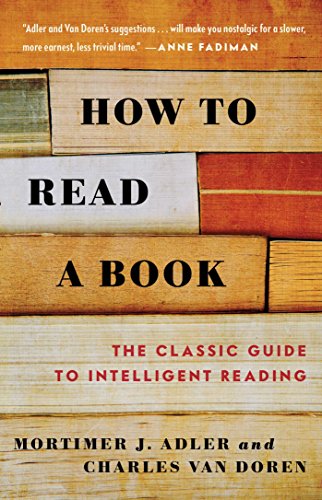
With half a million copies in print, How to Read a Book is the best and most successful guide to reading comprehension for the general reader, completely rewritten and updated with new material.
A CNN Book of the Week: “Explains not just why we should read books, but how we should read them. It's masterfully done.” –Farheed Zakaria
Originally published in 1940, this book is a rare phenomenon, a living classic that introduces and elucidates the various levels of reading and how to achieve them—from elementary reading, through systematic skimming and inspectional reading, to speed reading. Readers will learn when and how to “judge a book by its cover,” and also how to X-ray it, read critically, and extract the author’s message from the text.
Also included is instruction in the different techniques that work best for reading particular genres, such as practical books, imaginative literature, plays, poetry, history, science and mathematics, philosophy and social science works.
Finally, the authors offer a recommended reading list and supply reading tests you can use measure your own progress in reading skills, comprehension, and speed.
Die Inhaltsangabe kann sich auf eine andere Ausgabe dieses Titels beziehen.
Über die Autorinnen und Autoren
Dr. Mortimer J. Adler was Chairman of the Board of the Encyclopedia Britannica, Director of the Institute for Philosophical Research, Honorary Trustee of the Aspen Institute, and authored more than fifty books. He died in 2001.
Dr. Charles Van Doren earned advanced degrees in both literature and mathematics from Columbia University, where he later taught English and was the Assistant Director of the Institute for Philosophical Research. He also worked for Encyclopedia Britannica in Chicago.
Von der hinteren Coverseite
With half a million copies in print, How to Read a Book is the best and most successful guide to reading comprehension for the general reader, completely rewritten and updated with new material.
A CNN Book of the Week: “Explains not just why we should read books, but how we should read them. It's masterfully done.” –Farheed Zakaria
Originally published in 1940, this book is a rare phenomenon, a living classic that introduces and elucidates the various levels of reading and how to achieve them―from elementary reading, through systematic skimming and inspectional reading, to speed reading. Readers will learn when and how to “judge a book by its cover,” and also how to X-ray it, read critically, and extract the author’s message from the text.
Also included is instruction in the different techniques that work best for reading particular genres, such as practical books, imaginative literature, plays, poetry, history, science and mathematics, philosophy and social science works.
Finally, the authors offer a recommended reading list and supply reading tests you can use measure your own progress in reading skills, comprehension, and speed.
Auszug. © Genehmigter Nachdruck. Alle Rechte vorbehalten.
Chapter 1
THE ACTIVITY AND ART OF READING
This is a book for readers and for those who wish to become readers. Particularly, it is for readers of books. Even more particularly, it is for those whose main purpose in reading books is to gain increased understanding.
By "readers" we mean people who are still accustomed, as almost every literate and intelligent person used to be, to gain a large share of their information about and their understanding of the world from the written word. Not all of it, of course; even in the days before radio and television, a certain amount of information and understanding was acquired through spoken words and through observation. But for intelligent and curious people that was never enough. They knew that they had to read too, and they did read.
There is some feeling nowadays that reading is not as necessary as it once was. Radio and especially television have taken over many of the functions once served by print, just as photography has taken over functions once served by painting and other graphic arts. Admittedly, television serves some of these functions extremely well; the visual communication of news events, for example, has enormous impact. The ability of radio to give us information while we are engaged in doing other things -- for instance, driving a caris remarkable, and a great saving of time. But it may be seriously questioned whether the advent of modern communications media has much enhanced our understanding of the world in which we live.
Perhaps we know more about the world than we used to, and insofar as knowledge is prerequisite to understanding, that is all to the good. But knowledge is not as much a prerequisite to understanding as is commonly supposed. We do not have to know everything about something in order to understand it; too many facts are often as much of an obstacle to understanding as too few. There is a sense in which we moderns are inundated with facts to the detriment of understanding.
One of the reasons for this situation is that the very media we have mentioned are so designed as to make thinking seem unnecessary (though this is only an appearance). The packaging of intellectual positions and views is one of the most active enterprises of some of the best minds of our day. The viewer of television, the listener to radio, the reader of magazines, is presented with a whole complex of elements -- all the way from ingenious rhetoric to carefully selected data and statistics -- to make it easy for him to "make up his own mind" with the minimum of difficulty and effort. But the packaging is often done so effectively that the viewer, listener, or reader does not make up his own mind at all. Instead, he inserts a packaged opinion into his mind, somewhat like inserting a cassette into a cassette player. He then pushes a button and "plays back" the opinion whenever it seems appropriate to do so. He has performed acceptably without having had to think.
Active Reading
As we said at the beginning, we will be principally concerned in these pages with the development of skill in reading books; but the rules of reading that, if followed and practiced, develop such skill can be applied also to printed material in general, to any type of reading matter -- to newspapers, magazines, pamphlets, articles, tracts, even advertisements.
Since reading of any sort is an activity, all reading must to some degree be active. Completely passive reading is impossible; we cannot read with our eyes immobilized and our minds asleep. Hence when we contrast active with passive reading, our purpose is, first, to call attention to the fact that reading can be more or less active, and second, to point out that the more active the reading the better. One reader is better than another in proportion as he is capable of a greater range of activity in reading and exerts more effort. He is better if he demands more of himself and of the text before him.
Though, strictly speaking, there can be no absolutely passive reading, many people think that, as compared with writing and speaking, which are obviously active undertakings, reading and listening are entirely passive. The writer or speaker must put out some effort, but no work need be done by the reader or listener. Reading and listening are thought of as receiving communication from someone who is actively engaged in giving or sending it. The mistake here is to suppose that receiving communication is like receiving a blow or a legacy or a judgment from the court. On the contrary, the reader or listener is much more like the catcher in a game of baseball.
Catching the ball is just as much an activity as pitching or hitting it. The pitcher or batter is the sender in the sense that his activity initiates the motion of the ball. The catcher or fielder is the receiver in the sense that his activity terminates it. Both are active, though the activities are different. If anything is passive, it is the ball. It is the inert thing that is put in motion or stopped, whereas the players are active, moving to pitch, hit, or catch. The analogy with writing and reading is almost perfect. The thing that is written and read, like the ball, is the passive object common to the two activities that begin and terminate the process.
We can take this analogy a step further. The art of catching is the skill of catching every kind of pitch -- fast bails and curves, changeups and knucklers. Similarly, the art of reading is the skill of catching every sort of communication as well as possible.
It is noteworthy that the pitcher and catcher are successful only to the extent that they cooperate. The relation of writer and reader is similar. The writer isn't trying not to be caught, although it sometimes seems so. Successful communication occurs in any case where what the writer wanted to have received finds its way into the reader's possession. The writer's skill and the reader's skill converge upon a common end.
Admittedly, writers vary, just as pitchers do. Some writers have excellent "control"; they know exactly what they want to convey, and they convey it precisely and accurately. Other things being equal, they are easier to "catch" than a "wild" writer without "control."
There is one respect in which the analogy breaks down. The ball is a simple unit. It is either completely caught or not. A piece of writing, however, is a complex object. It can be received more or less completely, all the way from very little of what the writer intended to the whole of it. The amount the reader "catches" will usually depend on the amount of activity he puts into the process, as well as upon the skill with which he executes the different mental acts involved.
What does active reading entail? We will return to this question many times in this book. For the moment, it suffices to say that, given the same thing to read, one person reads it better than another, first, by reading it more actively, and second, by performing each of the acts involved more skillfully. These two things are related. Reading is a complex activity, just as writing is. It consists of a large number of separate acts, all of which must be performed in a good reading. The person who can perform more of them is better able to read.
>
The Goals of Reading:
Reading for Information and Reading for Understanding
You have a mind. Now let us suppose that you also have a book that you want to read. The book consists of language written by someone for the sake of communicating something to you. Your success in reading it is determined by the extent to which you receive everything the writer intended to communicate.
That, of course, is too simple. The reason is that there are two possible relations between your mind and...
„Über diesen Titel“ kann sich auf eine andere Ausgabe dieses Titels beziehen.
Suchergebnisse für How to Read a Book

Beispielbild für diese ISBN
How to Read a Book: The Classic Guide to Intelligent Reading
Verlag:
Touchstone (edition Revised), 1972
ISBN 10: 0671212095
ISBN 13: 9780671212094
Gebraucht
Paperback
Anbieter: BooksRun, Philadelphia, PA, USA
Verkäuferbewertung 5 von 5 Sternen

Paperback. Zustand: Fair. Revised. The item might be beaten up but readable. May contain markings or highlighting, as well as stains, bent corners, or any other major defect, but the text is not obscured in any way. Artikel-Nr. 0671212095-7-1
Gebraucht kaufen
EUR 6,95
Versand gratis
Versand innerhalb von USA
Versand innerhalb von USA
Anzahl: 3 verfügbar
Beispielbild für diese ISBN
How to Read a Book
Anbieter: World of Books (was SecondSale), Montgomery, IL, USA
Verkäuferbewertung 5 von 5 Sternen
Paperback. Zustand: Fair. How to Read a Book, originally published in 1940, has become a rare phenomenon, a living classic. Artikel-Nr. 00110139010
Gebraucht kaufen
EUR 8,41
Versand gratis
Versand innerhalb von USA
Versand innerhalb von USA
Anzahl: 4 verfügbar
Beispielbild für diese ISBN
How to Read a Book
Anbieter: World of Books (was SecondSale), Montgomery, IL, USA
Verkäuferbewertung 5 von 5 Sternen
Paperback. Zustand: Very Good. How to Read a Book, originally published in 1940, has become a rare phenomenon, a living classic. Artikel-Nr. 00109627080
Gebraucht kaufen
EUR 8,41
Versand gratis
Versand innerhalb von USA
Versand innerhalb von USA
Anzahl: 7 verfügbar
Beispielbild für diese ISBN
How to Read a Book
Anbieter: World of Books (was SecondSale), Montgomery, IL, USA
Verkäuferbewertung 5 von 5 Sternen
Paperback. Zustand: Good. How to Read a Book, originally published in 1940, has become a rare phenomenon, a living classic. Artikel-Nr. 00108595433
Gebraucht kaufen
EUR 8,41
Versand gratis
Versand innerhalb von USA
Versand innerhalb von USA
Anzahl: Mehr als 20 verfügbar
Beispielbild für diese ISBN
How to Read a Book
Anbieter: Better World Books, Mishawaka, IN, USA
Verkäuferbewertung 5 von 5 Sternen
Zustand: Good. rev Edition. Pages intact with minimal writing/highlighting. The binding may be loose and creased. Dust jackets/supplements are not included. Stock photo provided. Product includes identifying sticker. Better World Books: Buy Books. Do Good. Artikel-Nr. 4060255-6
Gebraucht kaufen
EUR 10,34
Versand gratis
Versand innerhalb von USA
Versand innerhalb von USA
Anzahl: 1 verfügbar
Beispielbild für diese ISBN
How to Read a Book
Anbieter: Better World Books: West, Reno, NV, USA
Verkäuferbewertung 5 von 5 Sternen
Zustand: Very Good. rev Edition. Former library copy. Pages intact with possible writing/highlighting. Binding strong with minor wear. Dust jackets/supplements may not be included. Includes library markings. Stock photo provided. Product includes identifying sticker. Better World Books: Buy Books. Do Good. Artikel-Nr. GRP80323289
Gebraucht kaufen
EUR 10,34
Versand gratis
Versand innerhalb von USA
Versand innerhalb von USA
Anzahl: 2 verfügbar
Beispielbild für diese ISBN
How to Read a Book
Anbieter: Better World Books, Mishawaka, IN, USA
Verkäuferbewertung 5 von 5 Sternen
Zustand: Very Good. rev Edition. Former library copy. Pages intact with possible writing/highlighting. Binding strong with minor wear. Dust jackets/supplements may not be included. Includes library markings. Stock photo provided. Product includes identifying sticker. Better World Books: Buy Books. Do Good. Artikel-Nr. GRP80323289
Gebraucht kaufen
EUR 10,34
Versand gratis
Versand innerhalb von USA
Versand innerhalb von USA
Anzahl: 1 verfügbar
Beispielbild für diese ISBN
How to Read a Book (The Classic Guide to Intelligent Reading)
Verlag:
Touchstone /Simon & Schuster, New York, 1972
ISBN 10: 0671212095
ISBN 13: 9780671212094
Gebraucht
softcover
Anbieter: Abacus Bookshop, Pittsford, NY, USA
Verkäuferbewertung 5 von 5 Sternen
softcover. Zustand: Fine copy. Later prt. 8vo, 426 pp., Revised and updated edition. Artikel-Nr. 067362
Gebraucht kaufen
EUR 6,82
EUR 3,53 Versand
Versand innerhalb von USA
Versand innerhalb von USA
Anzahl: 1 verfügbar
Beispielbild für diese ISBN
How to Read a Book (A Touchstone book)
Anbieter: Books From California, Simi Valley, CA, USA
Verkäuferbewertung 4 von 5 Sternen

Paperback. Zustand: Very Good. Cover and edges may have some wear. Artikel-Nr. mon0004237676
Gebraucht kaufen
EUR 6,61
EUR 4,40 Versand
Versand innerhalb von USA
Versand innerhalb von USA
Anzahl: 1 verfügbar
Beispielbild für diese ISBN
How To Read a Book: The Classic Guide to Intelligent Reading.
Verlag:
Simon & Schuster, New York, 2014
ISBN 10: 0671212095
ISBN 13: 9780671212094
Gebraucht
Softbound
Anbieter: Henry Hollander, Bookseller, Los Angeles, CA, USA
Verkäuferbewertung 4 von 5 Sternen
Softbound. Zustand: Very Good. Small octavo, paper covers, xiv, 430 pp., index. Artikel-Nr. 107944
Gebraucht kaufen
EUR 5,41
EUR 6,17 Versand
Versand innerhalb von USA
Versand innerhalb von USA
Anzahl: 1 verfügbar