
Verwandte Artikel zu Contract Bridge for Beginners: A Simple Concise Guide...
Contract Bridge for Beginners: A Simple Concise Guide on Bidding and Play for the Novice (A Fireside book) - Softcover
Inhaltsangabe
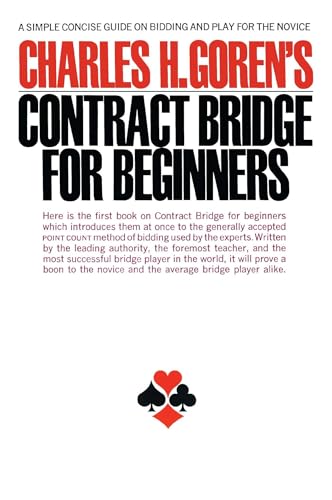
Here is the first book on Contract Bridge for beginners which introduces them at once to the generally accepted Point Count method of bidding used by the experts. Written by the leading authority, the foremost teacher, and the most successful bridge player in the world, it will prove a boon to the novice and the average bridge player alike.
Die Inhaltsangabe kann sich auf eine andere Ausgabe dieses Titels beziehen.
Über die Autorin bzw. den Autor
Charles H. Goren is the Number One ranking player of the United States in the official ratings of the American Contract Bridge League. He holds virtually every record of note on the books of tournament play. He has won more National Championships than anyone in history and holds the record for the most number of National Championships won in a single year (five). Incidentally, he is the only player in the history of Bridge who has ever won every major championship in the United States. Mr. Goren's daily column is syndicated in 150 newspapers which have a combined circulation of over twenty-five million. His books have been translated into French, Spanish, Swedish, and enjoy wide publication throughout the British Empire. His recent book, Point Count Bidding, published by Simon and Schuster, is the most successful bridge book in the last fifteen years and has changed the bidding habits of millions of players throughout the United States and Europe.The point count method introduced by Mr. Goren several years ago has now been adopted by all recognized authorities of the game.
Auszug. © Genehmigter Nachdruck. Alle Rechte vorbehalten.
Chapter 1
PRELIMINARIES
For the purpose of this chapter I am proceeding upon the assumption that the reader is totally unfamiliar with the deck of playing cards. If in your case I have made an incorrect assumption, please do not, out of a sense of courtesy, linger over these pages. Simply skip this chapter on Preliminaries.
The Deck
Before embarking on the study of Contract Bridge one must acquaint oneself thoroughly with the values of the cards which make up the deck. The game can be played with only one deck of cards, but it is more convenient to use two separate packs. Only one pack is in use at a time, and while one is in use the other is being shuffled or mixed to be ready for the next deal. In order to avoid confusion it is better to employ decks with different colored backs.
The standard pack contains 52 cards. It is true that as you take them from the container you will find 54 cards; but two of them are Jokers, which are used in some games, but not in Bridge. So for the immediate future I suggest that you put them out to pasture.
The Four Suits
The deck is divided into four surfs: Spades (*), Hearts (*), Diamonds (*), Clubs (*). Each suit contains 13 cards: Ace, King, Queen, Jack, 10, 9, 8, 7, 6, 5, 4, 3, 2. In designating a card you specify first the number and then the suit.
There are some cards which are more frequently referred to by their nicknames. The three is usually called the TREY, and the two is almost universally designated as the DEUCE.
Rank of the Cards
Each card has its rank. The rank represents the ability to capture other cards of the same suit. The highest-ranking card is the Ace, which can capture any of the other twelve cards in that suit. The King, while it is outranked by the Ace and may be captured by it, has the ability to capture eleven other cards in that suit, from the Queen on down to the Deuce. Next to the Queen comes the Jack, and after that the numbers in descending order from the 10 down through the Deuce. The five highest-ranking cards (Ace, King, Queen, Jack, 10) are called HONOR CARDS. Their significance will become more apparent to you as we progress.
Assuming that you and your opponents are all playing cards of the same suit, any card which is higher in rank will capture any other card which is lower in rank. But as I indicated a moment ago, the question of rank does not come up unless you are playing cards of the same suit. Your Ace of Diamonds will capture someone else's King of Diamonds because it is higher in rank, but that same Ace of Diamonds will not capture someone else's Deuce of Clubs. To capture a Club you would need a higher-ranking Club.
In the preceding paragraphs we have been discussing the rank (capturing power) of cards where all players have played cards of the same suit. Now we come to a more complicated situation where all players are not able to play cards of the same suit. During the bidding period, which we shall take up in a subsequent chapter, one of the suits may be named by the highest bidder to be the TRUMP SUIT. When this is done, that suit becomes invested with certain trick-taking powers which the other suits do not possess. It becomes in a sense the privileged class. The special privilege of this suit is as follows: a player holding a trump card may use it to RUFF or TRUMP any card of some other suit. That means that if that player plays a card of the trump suit, he will capture the played cards of the other suits, even though they are of higher rank. The trump suit in effect has a veto power. It can veto a higher rank of some other suit. A trump card, however low in rank, will capture the highest-ranking card of any other suit. If Clubs are trump, the Deuce of Clubs will prevail over the Ace of Spades. The only cards which can beat the Deuce of Clubs (trumps) are the Clubs (trumps) of higher rank.
However, it may be pointed out at this time that players are at all times required to follow suit if they can. That is to say, if the first player plays a Spade, everyone else must play a Spade, if able to, and may not use a trump unless he has no Spades. If any player has no Spades he may trump, if he chooses, or he may throw a card of some other suit, in which case the four cards played are taken in by the one who played the highest card of the suit which was led. (These four cards constitute what is known as a TRICKS.)
The suits also have ranks. Their rank is:
Spades
Hearts
Diamonds
Clubs
The Game
Contract Bridge is divided into two major parts: (1) the bidding; (2) the play. I shall temporarily refrain from discussing the bidding until I have given you some idea of the play, which in turn will simplify the problem of bidding. The bidding takes place at the beginning, but for the reasons outlined above we shall start with the mechanics of the play of the cards.
During the bidding there is an auction to determine the right to name the final trump. The rank of the suits has an important bearing on this bidding, and we shall discuss this presently.
The active participants at the Bridge table are always four players, but they do not play individually, for two of them are pitted against the two players sitting in the opposite direction, each partner facing the other partner. The partners share in the responsibility for anything done by either member of the partnership. All gains are credited to both members of the partnership, and all losses are charged in the same manner.
Partnerships are chosen by drawing cards. A deck of cards is spread face down on the table and each player draws one card. The two players drawing the high cards become partners. They sit facing each other and play against the other two. If two cards of the same denomination are drawn, the higher is determined by the rank of the suits and for this purpose the suits rank: Spades, Hearts, Diamonds and Clubs.
The player who cuts the highest card becomes the dealer and has the choice of seats and cards. Remember, Contract Bridge should be played with two decks with different backs, and while one partner deals, his partner should shuffle the other deck for the next dealer and place the deck to his own right so that it will be readily available for the next dealer.
The dealer presents the cards to his right-hand opponent for the CUT. The cut is merely the process of lifting off a portion of the deck and placing it on the table toward the dealer, just beside the bottom portion. However, each portion must contain at least four cards. That is to say, the player making the cut must remove at least four cards or at most forty-eight. The dealer then completes the cut by placing the bottom portion on top of the portion which the cutter has removed. The dealer then deals thirteen cards to each player, one at a time in a clockwise direction, that is, to his left. Each player then picks up his thirteen cards. This distribution of the cards is known as the DEAL.
After the cards have been dealt, there is a period during which the BIDDING takes place. This bidding is known as the AUCTION. When a player makes a bid, he offers to win a certain number of tricks.
When a player makes the highest bid, he and his partner win the contract, and we may for purposes of identification refer to them as the CONTRACTING SIDE. They have just contracted to win the number of tricks specified in their final bid.
Then comes the play period. One of the contracting players is called the DECLARER. He might be considered the active partner. The other member is called the DUMMY. The declarer is always that member of the partnership who first mentioned the trump suit in which the hand is to be played (not necessarily the last bidder).
When the bidding ends, the player to the left of the declarer places one of...
„Über diesen Titel“ kann sich auf eine andere Ausgabe dieses Titels beziehen.
Suchergebnisse für Contract Bridge for Beginners: A Simple Concise Guide...

Beispielbild für diese ISBN
Charles H. Goren's Contract Br
Anbieter: World of Books (was SecondSale), Montgomery, IL, USA
Verkäuferbewertung 5 von 5 Sternen

Zustand: Very Good. Item in very good condition! Textbooks may not include supplemental items i.e. CDs, access codes etc. Artikel-Nr. 00106314478
Gebraucht kaufen
EUR 3,66
Versand gratis
Versand innerhalb von USA
Versand innerhalb von USA
Anzahl: 2 verfügbar
Beispielbild für diese ISBN
Charles H. Goren's Contract Bridge for Beginners: A Simple Concise Guide for the Novice (Including Point Count Bidding)
Verlag:
Prentice Hall (a Pearson Education company), 1997
ISBN 10: 0671210521
ISBN 13: 9780671210526
Gebraucht
Paperback
Anbieter: World of Books (was SecondSale), Montgomery, IL, USA
Verkäuferbewertung 5 von 5 Sternen
Paperback. Zustand: Fair. Here is the first book on Contract Bridge for beginners which introduces them at once to the generally accepted Point Count method of bidding used by the experts. Written by the leading authority, the foremost teacher, and the most successful bridge player in the world, it will prove a boon to the novice and the average bridge player alike. Artikel-Nr. 00106793812
Gebraucht kaufen
EUR 3,66
Versand gratis
Versand innerhalb von USA
Versand innerhalb von USA
Anzahl: 1 verfügbar
Beispielbild für diese ISBN
Charles H. Goren's Contract Br
Anbieter: World of Books (was SecondSale), Montgomery, IL, USA
Verkäuferbewertung 5 von 5 Sternen
Zustand: Good. Item in good condition. Textbooks may not include supplemental items i.e. CDs, access codes etc. Artikel-Nr. 00085959414
Gebraucht kaufen
EUR 3,66
Versand gratis
Versand innerhalb von USA
Versand innerhalb von USA
Anzahl: 18 verfügbar
Beispielbild für diese ISBN
Contract Bridge for Beginners: A Simple Concise Guide for the Novice (Including Point Count Bidding)
Anbieter: ThriftBooks-Atlanta, AUSTELL, GA, USA
Verkäuferbewertung 5 von 5 Sternen
Paperback. Zustand: Very Good. No Jacket. May have limited writing in cover pages. Pages are unmarked. ~ ThriftBooks: Read More, Spend Less. Artikel-Nr. G0671210521I4N00
Gebraucht kaufen
EUR 5,86
Versand gratis
Versand innerhalb von USA
Versand innerhalb von USA
Anzahl: 1 verfügbar
Beispielbild für diese ISBN
Contract Bridge for Beginners: A Simple Concise Guide on Bidding and Play for the Novice (Including Point Count Bidding)
Anbieter: Wonder Book, Frederick, MD, USA
Verkäuferbewertung 5 von 5 Sternen
Zustand: Good. Good condition. A copy that has been read but remains intact. May contain markings such as bookplates, stamps, limited notes and highlighting, or a few light stains. Artikel-Nr. V12B-03875
Gebraucht kaufen
EUR 6,32
Versand gratis
Versand innerhalb von USA
Versand innerhalb von USA
Anzahl: 3 verfügbar
Beispielbild für diese ISBN
Contract Bridge for Beginners: A Simple Concise Guide on Bidding and Play for the Novice (Including Point Count Bidding)
Anbieter: Wonder Book, Frederick, MD, USA
Verkäuferbewertung 5 von 5 Sternen
Zustand: Very Good. Very Good condition. A copy that may have a few cosmetic defects. May also contain light spine creasing or a few markings such as an owner's name, short gifter's inscription or light stamp. Artikel-Nr. I22A-09808
Gebraucht kaufen
EUR 6,32
Versand gratis
Versand innerhalb von USA
Versand innerhalb von USA
Anzahl: 2 verfügbar
Beispielbild für diese ISBN
Contract Bridge for Beginners: A Simple Concise Guide on Bidding and Play for the Novice
Verlag:
Touchstone (edition Later Printing), 1971
ISBN 10: 0671210521
ISBN 13: 9780671210526
Gebraucht
Paperback
Anbieter: BooksRun, Philadelphia, PA, USA
Verkäuferbewertung 5 von 5 Sternen
Paperback. Zustand: Very Good. Later Printing. It's a well-cared-for item that has seen limited use. The item may show minor signs of wear. All the text is legible, with all pages included. It may have slight markings and/or highlighting. Artikel-Nr. 0671210521-11-6
Gebraucht kaufen
EUR 6,65
Versand gratis
Versand innerhalb von USA
Versand innerhalb von USA
Anzahl: 1 verfügbar
Beispielbild für diese ISBN
Contract Bridge for Beginners : A Simple Concise Guide on Bidding and Play for the Novice
Anbieter: Better World Books, Mishawaka, IN, USA
Verkäuferbewertung 5 von 5 Sternen
Zustand: Very Good. 1 Edition. Pages intact with possible writing/highlighting. Binding strong with minor wear. Dust jackets/supplements may not be included. Stock photo provided. Product includes identifying sticker. Better World Books: Buy Books. Do Good. Artikel-Nr. 12382522-6
Gebraucht kaufen
EUR 6,90
Versand gratis
Versand innerhalb von USA
Versand innerhalb von USA
Anzahl: 1 verfügbar
Beispielbild für diese ISBN
Contract Bridge for Beginners : A Simple Concise Guide on Bidding and Play for the Novice
Anbieter: Better World Books, Mishawaka, IN, USA
Verkäuferbewertung 5 von 5 Sternen
Zustand: Good. 1 Edition. Former library copy. Pages intact with minimal writing/highlighting. The binding may be loose and creased. Dust jackets/supplements are not included. Includes library markings. Stock photo provided. Product includes identifying sticker. Better World Books: Buy Books. Do Good. Artikel-Nr. 3373397-75
Gebraucht kaufen
EUR 6,90
Versand gratis
Versand innerhalb von USA
Versand innerhalb von USA
Anzahl: 1 verfügbar
Beispielbild für diese ISBN
Contract Bridge for Beginners : A Simple Concise Guide on Bidding and Play for the Novice
Anbieter: Better World Books, Mishawaka, IN, USA
Verkäuferbewertung 5 von 5 Sternen
Zustand: Good. 1 Edition. Pages intact with minimal writing/highlighting. The binding may be loose and creased. Dust jackets/supplements are not included. Stock photo provided. Product includes identifying sticker. Better World Books: Buy Books. Do Good. Artikel-Nr. GRP73180541
Gebraucht kaufen
EUR 6,90
Versand gratis
Versand innerhalb von USA
Versand innerhalb von USA
Anzahl: 2 verfügbar