
Verwandte Artikel zu Smarter Than You Think: A Revolutionary Approach to...
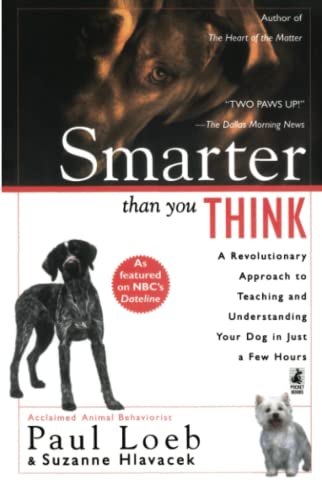
Smarter Than You Think: A Revolutionary Approach to Teaching and Understanding Your Dog in Just a Few Hours - Softcover
Inhaltsangabe
Imagine a dog who listens to you, comes to you, follows you, and looks to you for guidance. This ideal relationship is possible with the techniques of veteran trainer Paul Loeb. His revolutionary philosophy is simple: your dog can learn more -- and more quickly -- if information is delivered properly. Loeb's groundbreaking theories and humane, holistic teaching style will get visible results in approximately three hours. Not only will you find step-by-step methods to teach housebreaking, paper training, and the basic commands, but you'll also discover:
- Why one-word commands, including "No," are ineffective
- Why food rewards and choke chains are not good training tools
- Why teaching your dog to come to you is essential -- and teaching your dog to sit is not
- How to adapt your dog's behavior to your lifestyle -- whether you need your dog to walk without a leash, ride politely in a car, remain on your property...or do just about anything else you can imagine!
Now you can have the well-behaved dog you've always wanted -- and your dog will have an owner who understands his or her language.
With Smarter Than You Think, you and your dog can share the special bond of true understanding.
Die Inhaltsangabe kann sich auf eine andere Ausgabe dieses Titels beziehen.
Über die Autorin bzw. den Autor
Paul Loeb is a nationally recognized animal behaviorist who was featured along with Jane Goodall and Konrad Lorenz in National Geographic's Behavioral Education series. He has also been featured in articles in The Wall Street Journal, Esquire, Glamour, Newsweek, Family Circle, The New York Times, The Christian Science Monitor, and others. In 1974, Paul Loeb introduced the idea of using animals to comfort the sick and elderly at New York's Bellevue Hospital; he is also recognized as a leader in the training of companion aide dogs. The author of several books, he lives in New York City.
Auszug. © Genehmigter Nachdruck. Alle Rechte vorbehalten.
from Chapter 2: The Magic Touch
The Old Way
For many years, I followed the long line principle. I put a six-foot cotton training lead on the dog and pulled him and called him and pulled him and called him, until I felt he understood what I wanted. Then I would take the lead off the dog and using an enclosed area somewhere, I would chase the dog to his owner. This eventually worked but it took a long time, usually four or five weeks, and even then I was never truly certain that it would work 100 percent of the time. But I was certain of keeping my weight down because I burned a lot of calories chasing dogs.
Even though chasing the dog to his owner without a leash was a new twist on an old technique, and worked, it was still limited, it still took too long, and in my mind, I wasn't 100 percent certain of having the control that I wanted over the dog with this behavior.
All this racing around, chasing, pulling, and complicated, involved, primitive form of teaching used to drive me up a wall, because I knew dogs were smarter than all this archaic teaching implied. The lack was in these traditional teachings, not in the dog. There had to be a simpler, faster, and more direct way to communicate this all-important command. After all, the mother dog teaches this quickly and permanently to her puppies without all this sweat and effort.
The Accidental Discovery
One day I was walking my dog Plum in Central Park. He was a puppy then and not yet the famous dog he was to become later. I let him free so he could run around and get some exercise. When I wanted to leave the park I called him to me. He looked at me, wagged his tail, and smiled as if to say, "No way." Turning around he bounced and bounded in any direction he pleased, doing whatever he felt like doing, as long as he didn't have to come to me. I chased him, I called after him, "Plum, come here! No! Sit, stay!!!" And of course he couldn't have cared less. He did whatever he wanted to do. He was free, he was faster than me, and he was in charge.
Out of frustration and now fearful of losing my dog, I threw my leash at him, and to my surprise, it hit him. It also surprised him, and he stopped in his tracks. He then smelled the leash, and looked at me. Again to my surprise, he came back to me. I was so relieved to get him back that I didn't think too much about the mechanics of what had just happened. I put his lead back on and we went home.
While walking home, I went over the episode in my mind. He was running, I threw the lead, he stopped, he smelled the lead and came back to me. The lead had become an extension of me, and he had immediately listened to that extension. It was as if I had reached out across a long distance to tap him on the shoulder and say, "Hey, Plum, remember me? Come over here." I was amazed at how simply and how quickly it had worked, this magic long-distance touch.
It's hard to believe that this simple, accidental toss of Plum's leash became the key that would unlock a door that allowed me in a flash to move from the past into a future that had unlimited possibilities in all dimensions of training and behavior. The change was total. It was revolutionary. This toss was the catalyst for how all of my training would evolve to this very day.
I had been looking for this answer, and Plum, with the help of Mother Nature, had given it to me.
Reached at a Distance Anytime and from Anywhere
Imagine this. You open the window to let in some air. Along with the air, a strange-looking two-foot being with large eyes and one large forefinger floats into your living room. Staring at you, he comes to rest about three feet off the floor, nose to nose with you. Are you nervous? Are you frightened? Are you angry? Are you annoyed? Or are you just plain curious? This creature then floats backwards a few feet, points a long finger at you, and you start to levitate. You're now suspended in space, a little frightened and nervous. You could possibly even be pants-wetting nervous. He moves you around a bit and then places you back on the floor. He asks you in a very nice way to come over to him. Do you listen to him? Or do you stamp your foot on the floor and obstinately tell him, "No, I won't." We think you will do as he asked. We know we would. We think you will listen to him not only because he's doing things that you can't understand, but he is asserting a power that you can't even believe exists. It's mindboggling to you.
When you learn how to use our throwing technique to show your dog how powerful you are, that you can reach him and touch him from anywhere and at anytime, it will have the same affect on him as the strange-looking two-foot being had on you. Your dog will listen. He might even be pants-wetting nervous at first, but he will listen. And listen perfectly, as if you truly were a respected parent. We don't know if you would love and trust the alien; we do know your dog will still love and trust you.
When the throwing technique teaches your dog to come to you, you are not simply teaching a solitary command. That's old thinking and old doings. The magic touch changes everything forever in the way you and your dog look and act toward one another. In this one swift move you will dramatically change forever your standing in the eyes of your dog. Why?
Two different species of animal are coexisting in your environment. Your dog and a strange-looking being, you. One of you is going to have to adapt to the other's lifestyle. One of you must become the dominant species. Right now your dog feels that he is, and this is with good reason. His sense of smell is better than yours, his sight and hearing are better than yours, he can run faster and jump higher than you. So why should he listen to you? Why should he be the one to adapt? You can show him your bank account or your new car, but he won't be impressed. What can you do to so impress your dog that he will hand the reins of dominance back to you?
Because your dog is not a primate, he has no idea how to throw or what a throw is and how you were able to accomplish this incredible feat. He is not physically able to throw an object; he's not built that way. If he were a primate, he would imitate you and throw the object back at you, probably with a better aim and much harder.
The throwing technique is a very powerful tool when used properly. In your dog's eyes you will become his total security blanket. You will be able to get his attention and teach him anything. Your dog will look to you for direction at all times and without a question. He won't play the come-and-catch me-if- you-can game anymore. Because now your reach extends beyond your fingertips. And far beyond the length of any leash. It's like tapping him on the shoulder from twenty feet away and reminding him to pay attention to you and to come to you if that's what you want. He will never understand your magic, he will just listen to it.
You will notice that when you toss an object at him, first he will look at it, then he will smell it. He will try to identify the object and how it got there. Since he knows your smell he knows you were the source of the thrown object. He will come to you. This will give you total control over your dog.
Here are a few helpful pointers to keep in mind; they are essential elements.
1. Use positive reinforcement. Means first your dog does what you want him to do, then you reward him by praising him. He should want to learn from you because he knows he is secure with you, he can trust you, and that by doing the right things for you, he makes you happy, and therefore you will make him happy. Then you can give him the whole wide world. Remember, any animal will mistake kindness for weakness and will look to take advantage of it. So only be a pushover and a softy when your dog listens to you.
2....
„Über diesen Titel“ kann sich auf eine andere Ausgabe dieses Titels beziehen.
Suchergebnisse für Smarter Than You Think: A Revolutionary Approach to...

Beispielbild für diese ISBN
Smarter Than You Think: A Revolutionary Approach to Teaching and Understanding your Dog in just
Anbieter: World of Books (was SecondSale), Montgomery, IL, USA
Verkäuferbewertung 5 von 5 Sternen

Paperback. Zustand: Fair. Presents the techniques of a veteran dog trainer and his groundbreaking theories on humane and holistic communication with animals, debunking currently accepted methods. Artikel-Nr. 00110892336
Gebraucht kaufen
EUR 3,79
Versand gratis
Versand innerhalb von USA
Versand innerhalb von USA
Anzahl: 1 verfügbar
Beispielbild für diese ISBN
Smarter Than You Think: A Revolutionary Approach to Teaching and Understanding your Dog in just
Anbieter: World of Books (was SecondSale), Montgomery, IL, USA
Verkäuferbewertung 5 von 5 Sternen
Paperback. Zustand: Very Good. Presents the techniques of a veteran dog trainer and his groundbreaking theories on humane and holistic communication with animals, debunking currently accepted methods. Artikel-Nr. 00103144272
Gebraucht kaufen
EUR 3,79
Versand gratis
Versand innerhalb von USA
Versand innerhalb von USA
Anzahl: 5 verfügbar
Beispielbild für diese ISBN
Smarter Than You Think: A Revolutionary Approach to Teaching and Understanding your Dog in just
Anbieter: World of Books (was SecondSale), Montgomery, IL, USA
Verkäuferbewertung 5 von 5 Sternen
Paperback. Zustand: Good. Presents the techniques of a veteran dog trainer and his groundbreaking theories on humane and holistic communication with animals, debunking currently accepted methods. Artikel-Nr. 00091046125
Gebraucht kaufen
EUR 3,79
Versand gratis
Versand innerhalb von USA
Versand innerhalb von USA
Anzahl: 16 verfügbar
Foto des Verkäufers
Smarter Than You Think: A Revolutionary Approach to Teaching and Understanding Your Dog in Just a Few Hours
Anbieter: Dream Books Co., Denver, CO, USA
Verkäuferbewertung 5 von 5 Sternen
Zustand: good. Gently used with minimal wear on the corners and cover. A few pages may contain light highlighting or writing, but the text remains fully legible. Dust jacket may be missing, and supplemental materials like CDs or codes may not be included. May be ex-library with library markings. Ships promptly! Artikel-Nr. DBV.0671023284.G
Gebraucht kaufen
EUR 3,79
Versand gratis
Versand innerhalb von USA
Versand innerhalb von USA
Anzahl: 1 verfügbar
Beispielbild für diese ISBN
Smarter Than You Think: A Revolutionary Approach to Teaching and Understanding Your Dog in Just a Few Hours
Verlag:
Gallery Books (edition First Edition), 1998
ISBN 10: 0671023284
ISBN 13: 9780671023287
Gebraucht
Paperback
Erstausgabe
Anbieter: BooksRun, Philadelphia, PA, USA
Verkäuferbewertung 5 von 5 Sternen
Paperback. Zustand: Very Good. First Edition. It's a well-cared-for item that has seen limited use. The item may show minor signs of wear. All the text is legible, with all pages included. It may have slight markings and/or highlighting. Artikel-Nr. 0671023284-11-1
Gebraucht kaufen
EUR 4,37
Versand gratis
Versand innerhalb von USA
Versand innerhalb von USA
Anzahl: 2 verfügbar
Beispielbild für diese ISBN
Smarter Than You Think: A Revolutionary Approach to Teaching and Understanding Your Dog in Just a Few Hours
Verlag:
Gallery Books (edition First Edition), 1998
ISBN 10: 0671023284
ISBN 13: 9780671023287
Gebraucht
Paperback
Erstausgabe
Anbieter: BooksRun, Philadelphia, PA, USA
Verkäuferbewertung 5 von 5 Sternen
Paperback. Zustand: Very Good. First Edition. It's a well-cared-for item that has seen limited use. The item may show minor signs of wear. All the text is legible, with all pages included. It may have slight markings and/or highlighting. Artikel-Nr. 0671023284-11-18
Gebraucht kaufen
EUR 4,77
Versand gratis
Versand innerhalb von USA
Versand innerhalb von USA
Anzahl: 2 verfügbar
Beispielbild für diese ISBN
Smarter Than You Think: A Revolutionary Approach to Teaching and Understanding Your Dog in Just a Few Hours
Verlag:
Gallery Books (edition First Edition), 1998
ISBN 10: 0671023284
ISBN 13: 9780671023287
Gebraucht
Paperback
Erstausgabe
Anbieter: BooksRun, Philadelphia, PA, USA
Verkäuferbewertung 5 von 5 Sternen
Paperback. Zustand: Very Good. First Edition. It's a well-cared-for item that has seen limited use. The item may show minor signs of wear. All the text is legible, with all pages included. It may have slight markings and/or highlighting. Artikel-Nr. 0671023284-11-6
Gebraucht kaufen
EUR 4,93
Versand gratis
Versand innerhalb von USA
Versand innerhalb von USA
Anzahl: 1 verfügbar
Beispielbild für diese ISBN
Smarter Than You Think: A Revolutionary Approach to Teaching and Understanding Your Dog in Just a Few Hours
Anbieter: ThriftBooks-Dallas, Dallas, TX, USA
Verkäuferbewertung 5 von 5 Sternen
Paperback. Zustand: Very Good. No Jacket. May have limited writing in cover pages. Pages are unmarked. ~ ThriftBooks: Read More, Spend Less. Artikel-Nr. G0671023284I4N00
Gebraucht kaufen
EUR 6,32
Versand gratis
Versand innerhalb von USA
Versand innerhalb von USA
Anzahl: 1 verfügbar
Beispielbild für diese ISBN
Smarter Than You Think: A Revolutionary Approach to Teaching and Understanding Your Dog in Just a Few Hours
Anbieter: Wonder Book, Frederick, MD, USA
Verkäuferbewertung 5 von 5 Sternen
Zustand: Good. Good condition. A copy that has been read but remains intact. May contain markings such as bookplates, stamps, limited notes and highlighting, or a few light stains. Artikel-Nr. G12I-00912
Gebraucht kaufen
EUR 6,41
Versand gratis
Versand innerhalb von USA
Versand innerhalb von USA
Anzahl: 2 verfügbar
Beispielbild für diese ISBN
Smarter Than You Think: A Revolutionary Approach to Teaching and Understanding Your Dog in Just a Few Hours
Anbieter: Wonder Book, Frederick, MD, USA
Verkäuferbewertung 5 von 5 Sternen
Zustand: Very Good. Very Good condition. A copy that may have a few cosmetic defects. May also contain light spine creasing or a few markings such as an owner's name, short gifter's inscription or light stamp. Artikel-Nr. I06D-01954
Gebraucht kaufen
EUR 6,41
Versand gratis
Versand innerhalb von USA
Versand innerhalb von USA
Anzahl: 2 verfügbar