
Verwandte Artikel zu The Tibetan Book of the Dead: First Complete Translation
Inhaltsangabe
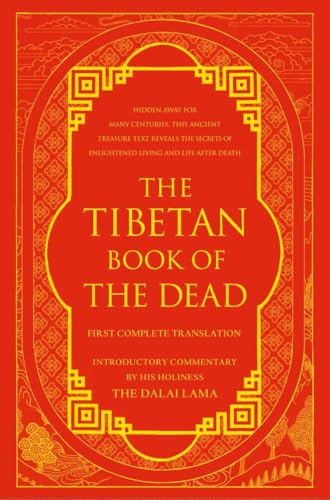
One of the greatest works created by any culture and overwhelmingly the most significant of all Tibetan Buddhist texts in the West, The Tibetan Book of the Dead has had a number of distinguished translations, but none encompassed the work in its entirety. Now, in one of the year's most important publishing events, the entire text has not only been made available in English but in a translation of quite remarkable clarity and beauty.
With an introductory commentary by His Holiness The Dalai Lama, who calls this translation "an extraordinary accomplishment undertaken with great care over many years" this complete edition faithfully presents the insights and intentions of the original work. It includes one of the most detailed and compelling descriptions of the after-death state in world literature, exquisitely written practices that can transform our experience of daily life, guidance on helping those who are dying, and an inspirational perspective on coping with bereavement. Translated with the close support of leading contemporary masters, including HH Dilgo Khyentse Rinpoche, and learned scholars such as Khamtrul Rinpoche and Zenkar Rinpoche, His Holiness the Dalai Lama says, "I hope that the profound insights contained in this work will be a source of inspiration and support to many interested people around the world."
Die Inhaltsangabe kann sich auf eine andere Ausgabe dieses Titels beziehen.
Über die Autorinnen und Autoren
Gyurme Dorje, Ph.D., is a leading scholar of the Nyingma tradition of Tibetan Buddhism.
Thupten Jinpa, Ph.D., is the senior translator to His Holiness The Dalai Lama and president of the Institute of Tibetan Classics.
Gyurme Dorje, Ph.D., is a leading scholar of the Nyingma tradition of Tibetan Buddhism.
Thupten Jinpa, Ph.D., is the senior translator to His Holiness The Dalai Lama and president of the Institute of Tibetan Classics.
Auszug. © Genehmigter Nachdruck. Alle Rechte vorbehalten.
The question of whether or not there exists a continuity of consciousness after death has been an important aspect of philosophical reflection and debate from ancient Indian times to the present. When considering these matters from a Buddhist point of view, however, we have to bear in mind that the understanding of the nature of continuity of consciousness and the understanding of the nature of the ‘I’ or ‘self’ are closely interlinked. Therefore, let us first look at what it is that can be said to constitute a person.
According to Buddhist classical literature, a person can be seen as possessing five interrelated aggregates, technically known as the five psycho-physical aggregates.a These are the aggregate of consciousness, the aggregate of form (which includes our physical body and senses), the aggregate of feeling, the aggregate of discrimination, and the aggregate of motivational tendencies. That is to say, there is our body, the physical world and our five senses, and there are the various processes of mental activity, our motivational tendencies, our labelling of and discrimination between objects, our feelings, and the underlying awareness or consciousness.
Among the ancient schools of thought, which accepted the notion of continuity of consciousness, there were several non-Buddhist philosophical schools which regarded the entity, the ‘I’ or ‘self’, which migrated from existence to existence as being unitary and permanent. They also suggested that this ‘self’ was autonomous in its relationship to the psycho-physical components that constitute a person. In other words they believed or posited that there is an essence or ‘soul’ of the person, which exists independently from the body and the mind of the person.
However, Buddhist philosophy does not accept the existence of such an independent, autonomous entity. In the Buddhist view, the self or the person is understood in terms of a dynamic interdependent relationship of both mental and physical attributes, that is to say the psycho-physical components which constitute a person. In other words our sense of self can, upon examination, be seen as a complex flow of mental and physical events, clustered in clearly identifiable patterns, including our physical features, instincts, emotions, and attitudes, etc., continuing through time. Further, according to Prasa'gika-Madhyamaka philosophy, which has become the prevailing philosophical view of Tibetan Buddhism today, this sense of self is simply a mental construct, a mere label given to this cluster of dependently arising mental and physical events in dependence on their continuity.
Now, when we look at this interdependence of mental and physical constituents from the perspective of Highest Yoga Tantra,b there are two concepts of a person. One is the temporary person or self, that is as we exist at the moment, and this is labelled on the basis of our coarse or gross physical body and conditioned mind, and, at the same time, there is a subtle person or self which is designated in dependence on the subtle body and subtle mind. This subtle body and subtle mind are seen as a single entity that has two facets. The aspect which has the quality of awareness, which can reflect and has the power of cognition, is the subtle mind. Simultaneously, there is its energy, the force that activates the mind towards its object - this is the subtle body or subtle wind. These two inextricably conjoined qualities are regarded, in Highest Yoga Tantra, as the ultimate nature of a person and are identified as buddha nature, the essential or actual nature of mind.
Now, before we look more closely at the nature of the subtle body and mind, let us look at how the gross body and mind are thought to originate. The notion of dependent origination lies at the very heart of Buddhist philosophy. The principle of dependent origination asserts that nothing exists in its own right independent of other factors. Things and events come into being only in dependence on the aggregation of multiple causes and conditions. The process through which the external world and the sentient beings within it revolve in a cycle of existence propelled by karmic propensities and their interaction with misapprehension, attraction and aversion and conditions is described in terms of twelve interdependent links. Each cycle of the process begins with a misapprehension of the nature of actual reality. This fundamental ignorance acts as a condition for the arising of the propensities created by our past actions, mental, verbal and physical, which condition our dualising consciousness. Our dualising consciousness, in turn, conditions the qualities and mode of interaction of our psycho-physical aggregates, which condition our sensory fields, which generate contact, which generates sensations, and then in turn attachment, grasping, and maturation towards rebirth. At this point there is an interaction with the genetic constituents of the parents and subsequent interaction with the environment, and then finally we have birth, ageing and death. This cycle can be viewed as both illustrating the underlying processes of life, death and rebirth and as an illustration of the processes to be transformed on the path to liberation from suffering in cyclic existence.
The notion that there is a connection between this life and the events of both our previous existence and our future existence, follows from the Buddhist understanding of the natural law of cause and effect. For example, although we can speak of yesterday’s weather and today’s weather as distinct, today’s weather is inextricably linked with the weather patterns of yesterday. Even at the bodily level, in the case of our physical health for example, we know that events in the past affect the present and those of the present the future. Similarly, in the realm of consciousness the Buddhist view is that there is also this same causal continuum between the events of the past, present and future.
The Buddhist understanding of the continuity of personal experience, including our memories, can also be considered here. The Buddhist view is that the continuity of personal experience is primarily founded on the capacity for retention, which can be further developed during one’s meditative practice in this life. However, generally speaking, it is thought that if a person dies after a prolonged period of illness that has led to a prolonged degeneration of both physical and mental capacities, there will be a greater chance of many of the personal characteristics, including memories etc., being lost. On the other hand, in the case of someone who dies a sudden death, when the mind-body relationship at the gross level is still very firm, it is thought that there is a greater chance of carrying forward the acquired characteristics and memories, etc. Nonetheless, in both cases, the characteristics carried forward from a previous life are generally thought to be most strongly felt at an early stage of one’s rebirth. This is because the personal characteristics of the previous life are thought, generally speaking, to be quickly overwhelmed by the developing characteristics inherited from the parents of the present life. Nonetheless, as I have mentioned, much depends in this respect on the individual’s capacity for recall and this capacity for recall is dependent on a deepened retentive training acquired in this lifetime.
Now, let us look at the possible states of existence one can be born into. From the Buddhist perspective, rebirth in conditioned existence can take place in one of three realms: the formless realm, the form realm or the desire realm. The form and formless realms are fruits of subtle states of consciousness, attained upon the realisation of certain meditative concentrations. Our realm, the desire...
„Über diesen Titel“ kann sich auf eine andere Ausgabe dieses Titels beziehen.
Suchergebnisse für The Tibetan Book of the Dead: First Complete Translation

Beispielbild für diese ISBN
The Tibetan Book of the Dead
Anbieter: Revaluation Books, Exeter, Vereinigtes Königreich
Verkäuferbewertung 5 von 5 Sternen

Hardcover. Zustand: Brand New. 592 pages. 9.00x6.00x1.75 inches. In Stock. Artikel-Nr. 0670858862
Neu kaufen
EUR 45,09
EUR 14,80 Versand
Versand von Vereinigtes Königreich nach USA
Versand von Vereinigtes Königreich nach USA
Anzahl: 1 verfügbar
Beispielbild für diese ISBN
The Tibetan Book of the Dead
Anbieter: Revaluation Books, Exeter, Vereinigtes Königreich
Verkäuferbewertung 5 von 5 Sternen
Hardcover. Zustand: Brand New. 592 pages. 9.00x6.00x1.75 inches. In Stock. Artikel-Nr. __0670858862
Neu kaufen
EUR 46,91
EUR 14,80 Versand
Versand von Vereinigtes Königreich nach USA
Versand von Vereinigtes Königreich nach USA
Anzahl: 1 verfügbar
Beispielbild für diese ISBN
The Tibetan Book of the Dead: First Complete Translation
Anbieter: Kennys Bookstore, Olney, MD, USA
Verkäuferbewertung 5 von 5 Sternen
Zustand: New. Artikel-Nr. V9780670858866
Neu kaufen
EUR 59,70
EUR 9,41 Versand
Versand innerhalb von USA
Versand innerhalb von USA
Anzahl: 15 verfügbar
Beispielbild für diese ISBN
The Tibetan Book of the Dead
Anbieter: Revaluation Books, Exeter, Vereinigtes Königreich
Verkäuferbewertung 5 von 5 Sternen
Hardcover. Zustand: Brand New. 592 pages. 9.00x6.00x1.75 inches. In Stock. Artikel-Nr. xr0670858862
Neu kaufen
EUR 56,81
EUR 14,80 Versand
Versand von Vereinigtes Königreich nach USA
Versand von Vereinigtes Königreich nach USA
Anzahl: 2 verfügbar
Beispielbild für diese ISBN
The Tibetan Book of the Dead
Anbieter: Revaluation Books, Exeter, Vereinigtes Königreich
Verkäuferbewertung 5 von 5 Sternen
Hardcover. Zustand: Brand New. 592 pages. 9.00x6.00x1.75 inches. In Stock. Artikel-Nr. xi0670858862
Neu kaufen
EUR 56,81
EUR 14,80 Versand
Versand von Vereinigtes Königreich nach USA
Versand von Vereinigtes Königreich nach USA
Anzahl: 2 verfügbar
Foto des Verkäufers
The Tibetan Book of the Dead : First Complete Translation
Verlag:
Penguin Publishing Group Jan 2006, 2006
ISBN 10: 0670858862
ISBN 13: 9780670858866
Neu
Hardcover
Anbieter: AHA-BUCH GmbH, Einbeck, Deutschland
Verkäuferbewertung 5 von 5 Sternen
Buch. Zustand: Neu. Neuware - One of the greatest works created by any culture and overwhelmingly the most significant of all Tibetan Buddhist texts in the West, The Tibetan Book of the Dead has had a number of distinguished translations, but none encompassed the work in its entirety. Now, in one of the year's most important publishing events, the entire text has not only been made available in English but in a translation of quite remarkable clarity and beauty. With an introductory commentary by His Holiness The Dalai Lama, who calls this translation 'an extraordinary accomplishment undertaken with great care over many years' this complete edition faithfully presents the insights and intentions of the original work. It includes one of the most detailed and compelling descriptions of the after-death state in world literature, exquisitely written practices that can transform our experience of daily life, guidance on helping those who are dying, and an inspirational perspective on coping with bereavement. Translated with the close support of leading contemporary masters, including HH Dilgo Khyentse Rinpoche, and learned scholars such as Khamtrul Rinpoche and Zenkar Rinpoche, His Holiness the Dalai Lama says, 'I hope that the profound insights contained in this work will be a source of inspiration and support to many interested people around the world.'. Artikel-Nr. 9780670858866
Neu kaufen
EUR 54,09
EUR 35,00 Versand
Versand von Deutschland nach USA
Versand von Deutschland nach USA
Anzahl: 2 verfügbar
Foto des Verkäufers
The Tibetan Book of the Dead: First Complete Translation
Anbieter: moluna, Greven, Deutschland
Verkäuferbewertung 5 von 5 Sternen
Gebunden. Zustand: New. Über den AutorGyurme Dorje, Ph.D., is a leading scholar of the Nyingma tradition of Tibetan Buddhism. Thupten Jinpa, Ph.D., is the senior translator to His Holiness The Dalai Lama and president of the Institute of Tibetan Class. Artikel-Nr. 885748001
Neu kaufen
EUR 44,91
EUR 48,99 Versand
Versand von Deutschland nach USA
Versand von Deutschland nach USA
Anzahl: Mehr als 20 verfügbar