
Verwandte Artikel zu Red Tile Style: America's Spanish Revival Architecture
Inhaltsangabe
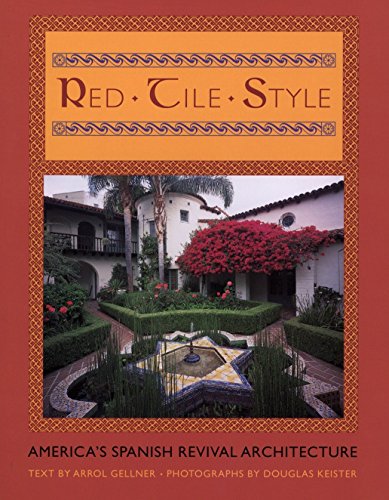
Virtually no other form of American architecture is as widespread or as popular as the Spanish Revival style. From bungalows and mansions to gas stations and government buildings, its influence—and its fans—can be found everywhere. Yet there has never been a single comprehensive survey of this diverse category of design.
In Red Tile Style, Arrol Gellner describes the rich history and fertile permutations of Spanish Revival architecture. Packed with more than 250 lush color photographs taken by Douglas Keister, this handsome volume ranges from the style's origins in the Spanish colonial churches of the Southwest to its emergence as a commercial form in late-nineteenth-century railroad stations to the nationwide explosion in popularity sparked by the 1915 Panama-California Exposition in San Diego. Learned, lucid, and pleasing to the eye, Red Tile Style explores the far-reaching Spanish Revival influence in today's architecture in all its variations and adaptations. For the serious student and architecture fan alike, this book is truly a landmark.
Die Inhaltsangabe kann sich auf eine andere Ausgabe dieses Titels beziehen.
Über die Autorin bzw. den Autor
Arrol Gellner, a residential architect, lives in Emeryville, California.
Auszug. © Genehmigter Nachdruck. Alle Rechte vorbehalten.
CHAPTER 1 INTRODUCCIÓN
THE SPANISH WEST
The earliest incarnation of Spanish Revival architecture in America comes down to us, not from Spain, but through the West's own Spanish Colonial heritage. Spain's first voyage to Alta California was made by Juan Rodríguez Cabrillo in 1542, and though he claimed the territory for the Spanish crown, his report regarding the colony's prospects apparently left the monarchy unimpressed. With no lure of gold to stir interest, California languished.
In 1579, an English expedition headed by Sir Francis Drake rather rudely claimed California for Queen Elizabeth I. There was no Spanish response to this affront until the voyage of Sebastián Vizcaíno in 1602, but thereafter, Spain's interest in the nascent colony began to rise. In 1769, Gaspar de Portolá established a colony on San Diego Bay in the process of searching out the harbor of Monterey.
Accompanying Portolá's expedition was a man destined to have a lasting impact upon California's history, both architectural and otherwise: the Spanish Franciscan missionary Junipero Serra (1713-1784) (ILLUS xxx). Born Miguel José Serra in Majorca, Spain, Serra taught philosophy at the college at Palma for fifteen years. In 1749 he was sent to America, where he spent the next two decades in Mexico teaching, proselytizing, and working among the native Indian population of the Sierra Gorda.
When Portolá's expedition reached San Diego in 1769, Serra remained behind, and on July 16, he founded Mission San Diego de Alcalá, considered by many the birthplace of modern California history. Portolá's party ultimately returned to San Diego having failed to locate Monterey's harbor. Serra was among those determined to organize another attempt, and this expedition duly reached Monterey the following year. There Serra founded Mission San Carlos Borroméo del Carmelo, established his headquarters, and remained as president of the Alta California missions. Not long afterward, he moved the mission to nearby Carmel-By-The-Sea, where he would spend the rest of his life. Under Serra's presidency, seven more missions were founded in comparatively short order: San Antonio de Padua and San Gabriel Arcángel (both in 1771); San Luis Obispo (1772); San Juan Capistrano and San Francisco de Asís (both in 1776); Santa Clara de Asís (1777); and San Buenaventura (1782).
LAYING THE FOUNDATIONS
The string of missions founded by Serra, as well as others throughout the West, combined ecclesiastical, agricultural, and frequently defensive functions in a straightforward and easily repeatable format. The original California mission of San Diego Alcalá, for example, formed a presidio consisting of perimeter structures accommodating barracks, storehouses, and livestock corrals; the mission chapel occupied only a modest portion at the center of one side. In 1774, however, the religious function was separated from this group, with the mission chapel being reconstructed on a separate site six miles inland.
Perhaps the finest mission of the Spanish Colonial era is San Xavier del Bac (ILLUS sp056), the "White Dove of the Desert", whose snow-white domes still rise majestically from the desert floor nine miles south of Tucson. The Spanish Jesuit missionary and explorer Eusebio Francisco Kino first visited the desolate site in 1692; he returned to lay the foundations of the original church in 1700, naming it in honor of Saint Francis Xavier, the Basque Jesuit missionary known as The Apostle of the Indies.
The present structure was begun in 1783 under the administration of Father Juan Bautista Llorenz, and was not completed until fourteen years later. Unlike most mission churches, the interior volume of San Xavier del Bac is not spanned by roof beams, but rather by domes in the Byzantine manner. The elaborate, naively painted decoration of the interior emulates that of Mexican churches of the late Renaissance (ILLUS spc22), which in turn were based upon Spanish Renaissance examples.
For the most part, the missions constructed in the West and Southwest were considerably more chaste than San Xavier del Bac; yet it was precisely this quality of simplicity and naiveté that proponents of the Mission Revival would eventually find so refreshing compared to the turgid works of the Victorian era.
SPAIN'S CONTROL OF THE SOUTHEAST
Spanish rule in the southeastern United States was equally far-reaching, if slightly shorter-lived. In April 1513, Juan Ponce de LeÓn landed near present-day Saint Augustine, Florida, and claimed what he believed to be an island for the Spanish crown. The explorers Pánfilo de Narváez and Hernando de Soto eventually determined that Florida was in fact a peninsula, and accordingly expanded Spain's claim to include most of the Southeastern United States. In fact, however, Spanish settlement of the region was virtually nil until the French made incursions in 1562 and again in 1564. This alarmed the Spanish crown sufficiently to commission the ruthless Pedro Menéndez de Avilés to drive them out, and led to Spain's founding of Saint Augustine the following year.
With the Florida peninsula having neither precious metals nor even much arable land, Spain's interest lay mainly in its strategic position athwart the Straits of Florida, through which the Crown's treasure-laden ships sailed from the south. By the early 1700s, however, Spain's control of the territory came under increasing pressure from the rapidly expanding British colonies to the north, a situation which worsened after the founding of Georgia in 1733. The French, who had designs on the region's fur trade, were also giving Spain troubles by the mid-1700s. In 1763, Spain lost the Floridas altogether after siding with France in its inevitable war with England. After twenty years of British tenure, however, the Florida territory was once again returned to Spain under the terms of the Treaty of Paris. Yet by this time, the steady influx of Anglo settlers had decided the region's future. In 1819, after years of political wrangling, Spain ceded Florida to the United States in return for the assumption of a $5 million debt. Thanks to the intervening twenty years of British presence and Spain's earlier departure from the region, the traces of the Spanish colonial era would be far less evident in Florida than in the West. By the time the state assumed its modern boundaries in 1822, American settlers were flooding in, and Anglo architecture would predominate until the arrival of architect Addison Mizner almost a century later.
THE : OF SPANISH RULE IN THE WEST
By the 1830s, the Mexican Republic's control over its territories in western United States had also begun to unravel. In 1803, the Louisiana Purchase gave the United States a common border with Texas, and Mexico's lands to the west were increasingly coveted by the U. S. during subsequent decades. One of the most famous battles of this period took place at the mission of San Antonio de Valero, better known to history as the Alamo (ILLUS spc32). The mission had been founded by the Franciscans in 1718, and was later converted into a fortress; the Alamo, from the Spanish word for cottonwood, was built as a chapel sometime after 1744. In December 1835, the mission was taken over by the Texas revolutionaries. Two months later, 150 men, later aided by 32 volunteers who slipped through enemy lines, attempted to defend the structure against a Mexican army numbering several thousand. A siege began on February 24, 1836.
On March 2, at a convention called at Washington-on-the-Brazos, Texas declared its independence from the Mexican Republic. Four days later, the siege of the Alamo culminated in hand-to-hand fighting within the walls of the storied old fort. The revolutionaries,...
„Über diesen Titel“ kann sich auf eine andere Ausgabe dieses Titels beziehen.
Suchergebnisse für Red Tile Style: America's Spanish Revival Architecture

Beispielbild für diese ISBN
Red-Tile Style
Anbieter: ThriftBooks-Reno, Reno, NV, USA
Verkäuferbewertung 5 von 5 Sternen

Hardcover. Zustand: Good. No Jacket. Pages can have notes/highlighting. Spine may show signs of wear. ~ ThriftBooks: Read More, Spend Less. Artikel-Nr. G0670030503I3N00
Gebraucht kaufen
EUR 11,50
Versand gratis
Versand innerhalb von USA
Versand innerhalb von USA
Anzahl: 1 verfügbar
Beispielbild für diese ISBN
Red-Tile Style
Anbieter: ThriftBooks-Dallas, Dallas, TX, USA
Verkäuferbewertung 5 von 5 Sternen
Hardcover. Zustand: Good. No Jacket. Missing dust jacket; Pages can have notes/highlighting. Spine may show signs of wear. ~ ThriftBooks: Read More, Spend Less. Artikel-Nr. G0670030503I3N01
Gebraucht kaufen
EUR 11,50
Versand gratis
Versand innerhalb von USA
Versand innerhalb von USA
Anzahl: 1 verfügbar
Beispielbild für diese ISBN
Red-Tile Style
Anbieter: ThriftBooks-Dallas, Dallas, TX, USA
Verkäuferbewertung 5 von 5 Sternen
Hardcover. Zustand: Fair. No Jacket. Readable copy. Pages may have considerable notes/highlighting. ~ ThriftBooks: Read More, Spend Less. Artikel-Nr. G0670030503I5N00
Gebraucht kaufen
EUR 11,50
Versand gratis
Versand innerhalb von USA
Versand innerhalb von USA
Anzahl: 1 verfügbar
Beispielbild für diese ISBN
Red-Tile Style
Anbieter: ThriftBooks-Phoenix, Phoenix, AZ, USA
Verkäuferbewertung 5 von 5 Sternen
Hardcover. Zustand: Good. No Jacket. Pages can have notes/highlighting. Spine may show signs of wear. ~ ThriftBooks: Read More, Spend Less. Artikel-Nr. G0670030503I3N00
Gebraucht kaufen
EUR 11,50
Versand gratis
Versand innerhalb von USA
Versand innerhalb von USA
Anzahl: 1 verfügbar
Beispielbild für diese ISBN
Red-Tile Style
Anbieter: ThriftBooks-Reno, Reno, NV, USA
Verkäuferbewertung 5 von 5 Sternen
Hardcover. Zustand: Good. No Jacket. Missing dust jacket; Pages can have notes/highlighting. Spine may show signs of wear. ~ ThriftBooks: Read More, Spend Less. Artikel-Nr. G0670030503I3N01
Gebraucht kaufen
EUR 11,50
Versand gratis
Versand innerhalb von USA
Versand innerhalb von USA
Anzahl: 1 verfügbar
Beispielbild für diese ISBN
Red-Tile Style
Anbieter: ThriftBooks-Atlanta, AUSTELL, GA, USA
Verkäuferbewertung 5 von 5 Sternen
Hardcover. Zustand: Good. No Jacket. Missing dust jacket; Pages can have notes/highlighting. Spine may show signs of wear. ~ ThriftBooks: Read More, Spend Less. Artikel-Nr. G0670030503I3N01
Gebraucht kaufen
EUR 11,50
Versand gratis
Versand innerhalb von USA
Versand innerhalb von USA
Anzahl: 1 verfügbar
Beispielbild für diese ISBN
Red-Tile Style
Anbieter: ThriftBooks-Atlanta, AUSTELL, GA, USA
Verkäuferbewertung 5 von 5 Sternen
Hardcover. Zustand: Good. No Jacket. Pages can have notes/highlighting. Spine may show signs of wear. ~ ThriftBooks: Read More, Spend Less. Artikel-Nr. G0670030503I3N00
Gebraucht kaufen
EUR 11,50
Versand gratis
Versand innerhalb von USA
Versand innerhalb von USA
Anzahl: 2 verfügbar
Beispielbild für diese ISBN
Red-Tile Style
Anbieter: ThriftBooks-Dallas, Dallas, TX, USA
Verkäuferbewertung 5 von 5 Sternen
Hardcover. Zustand: Good. No Jacket. Pages can have notes/highlighting. Spine may show signs of wear. ~ ThriftBooks: Read More, Spend Less. Artikel-Nr. G0670030503I3N00
Gebraucht kaufen
EUR 11,50
Versand gratis
Versand innerhalb von USA
Versand innerhalb von USA
Anzahl: 1 verfügbar
Beispielbild für diese ISBN
Red Tile Style: America's Spanish Revival Architecture
Anbieter: World of Books (was SecondSale), Montgomery, IL, USA
Verkäuferbewertung 5 von 5 Sternen
Hardback. Zustand: Good. Virtually no other form of American architecture is as widespread or as popular as the Spanish Revival style. From bungalows and mansions to gas stations and government buildings, its influence--and its fans--can be found everywhere. Yet there has never been a single comprehensive survey of this diverse category of design.In Red Tile Style, Arrol Gellner describes the rich history and fertile permutations of Spanish Revival architecture. Packed with more than 250 lush color photographs taken by Douglas Keister, this handsome volume ranges from the style's origins in the Spanish colonial churches of the Southwest to its emergence as a commercial form in late-nineteenth-century railroad stations to the nationwide explosion in popularity sparked by the 1915 Panama-California Exposition in San Diego. Learned, lucid, and pleasing to the eye, Red Tile Style explores the far-reaching Spanish Revival influence in today's architecture in all its variations and adaptations. For the serious student and architecture fan alike, this book is truly a landmark. Artikel-Nr. 00110749749
Gebraucht kaufen
EUR 11,55
Versand gratis
Versand innerhalb von USA
Versand innerhalb von USA
Anzahl: 2 verfügbar
Beispielbild für diese ISBN
Red Tile Style : America's Spanish Revival Architecture
Verlag:
Penguin Publishing Group, 2002
ISBN 10: 0670030503
ISBN 13: 9780670030507
Gebraucht
Hardcover
Anbieter: Better World Books, Mishawaka, IN, USA
Verkäuferbewertung 5 von 5 Sternen
Zustand: Good. F First Edition. Former library copy. Pages intact with minimal writing/highlighting. The binding may be loose and creased. Dust jackets/supplements are not included. Includes library markings. Stock photo provided. Product includes identifying sticker. Better World Books: Buy Books. Do Good. Artikel-Nr. 5226938-20
Gebraucht kaufen
EUR 13,74
Versand gratis
Versand innerhalb von USA
Versand innerhalb von USA
Anzahl: 1 verfügbar