
Verwandte Artikel zu Escape from Camp 14: One Man's Remarkable Odyssey...
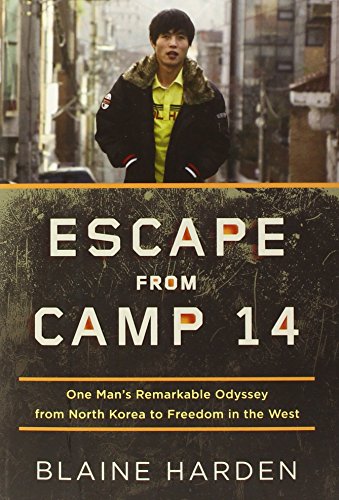
Escape from Camp 14: One Man's Remarkable Odyssey from North Korea to Freedom in the West - Hardcover
Inhaltsangabe
A New York Times bestseller, the shocking story of one of the few people born in a North Korean political prison to have escaped and survived. Blaine Harden's latest book, King of Spies , will be available from Viking in Fall 2017.
North Korea is isolated and hungry, bankrupt and belligerent. It is also armed with nuclear weapons. Between 150,000 and 200,000 people are being held in its political prison camps, which have existed twice as long as Stalin's Soviet gulags and twelve times as long as the Nazi concentration camps. Very few born and raised in these camps have escaped. But Shin Donghyuk did.
In Escape from Camp 14 , acclaimed journalist Blaine Harden tells the story of Shin Dong-hyuk and through the lens of Shin's life unlocks the secrets of the world's most repressive totalitarian state. Shin knew nothing of civilized existence-he saw his mother as a competitor for food, guards raised him to be a snitch, and he witnessed the execution of his own family. Through Harden's harrowing narrative of Shin's life and remarkable escape, he offers an unequaled inside account of one of the world's darkest nations and a riveting tale of endurance, courage, and survival.
Die Inhaltsangabe kann sich auf eine andere Ausgabe dieses Titels beziehen.
Über die Autorin bzw. den Autor
Blaine Harden is a reporter for PBS's FRONTLINE and a contributor to the Economist, and has served as The Washington Post's bureau chief in East Asia, Eastern Europe, and Africa. He is the author of Africa: Dispatches from a Fragile Continent and A River Lost: The Life and Death of the Columbia. He lives in Seattle, Washington.
Auszug. © Genehmigter Nachdruck. Alle Rechte vorbehalten.
FOREWORD
SEOUL, SOUTH KOREA
Early in 2015, Shin Dong-hyuk changed his story. He told me by telephone that his life in the North Korean gulag differed from what he had been telling government leaders, human rights activists, and journalists like me. As his biographer, it was a stomach-wrenching revelation.
It was also news. In the nearly three years since Escape from Camp 14 was published, Shin had become the single most famous witness to North Korea's cruelty to its own people. He posed for photographs with the American secretary of state, received human rights awards, and traveled the world to appear on television news programs like 60 Minutes . His story helped launch an unprecedented United Nations inquiry that accused North Korea's leaders of crimes against humanity.
When I got off the phone with Shin, I contacted the Washington Post (for which I had first written about him) and released all I then knew about his revised story. Then I flew to Seoul, where Shin lives, to find out more. This foreword explains what I learned. In two weeks of conversations, Shin was less secretive and more talkative than he had ever been during long rounds of interviews with me dating back to 2008. He seemed relieved to be correcting a story he felt had become a kind of prison.
Shin told me that when he defected to South Korea in 2006, he made a panicky, shame-driven decision to conceal and reorder pivotal episodes of his life in the gulag. He hid his role in the execution of his mother and brother. He omitted a singularly painful session of torture that shattered his faith in himself. He did not mention that he lived most of his youth in a political prison that was not Camp 14. He told this version of his life to interrogators from South Korean intelligence and the U.S. Army. He then repeated the narrative for nearly nine years, rarely changing a single detail.
Shin told me he is now determined to tell the truth. Regrettably, he has told me this before. It seems prudent to expect more revisions.
Other survivors of the camps are angry at Shin, accusing him of undermining their truthfulness and weakening the international campaign to pressure North Korea to shut down the gulag.
In assessing Shin's credibility and the changes in his story, it is important to know that he has multiple scars consistent with extreme torture.1 Trauma victims like him tend to struggle with the truth, especially in the linear narrative form that journalists, judges, and policy makers are best able to understand. The memories of trauma victims are often fragmented and out of sequence,2 and the stories they tell can be shields behind which they try to hide.
"The most genuine narratives of going through political violence are never completely coherent or finalized," said Dr. Stevan M. Weine, a specialist on the impact of political violence and a professor of psychiatry at the University of Illinois at Chicago. He has treated trauma and studied trauma victims from Bosnia, Kosovo, Central Asia, and Africa. Between conversations with Shin in Seoul, I telephoned Weine and told him about Shin's evolving story.
"When someone goes through profound trauma and I don't hear a disjointed story, I am suspicious," he told me. "Shin appears to have been exposed to prolonged and repeated torture. We can expect that this would have a major impact on every aspect of who he is, on his memory, his emotional regulation, his ability to relate to others, his willingness to trust, his sense of place in the world, and the way he gives his testimony."
In Escape from Camp 14 , I wrote that there was no way to fact-check many parts of Shin's story because North Korea is largely closed to the outside world and it denies that political labor camps exist. But other gulag survivors had told me Shin knew things only an insider could know. Human rights investigators who had talked with scores of camp
„Über diesen Titel“ kann sich auf eine andere Ausgabe dieses Titels beziehen.
Suchergebnisse für Escape from Camp 14: One Man's Remarkable Odyssey...

Foto des Verkäufers
Escape from Camp 14: One Man's Remarkable Odyssey from North Korea to Freedom in the West
Anbieter: Dream Books Co., Denver, CO, USA
Verkäuferbewertung 5 von 5 Sternen

Zustand: good. Gently used with minimal wear on the corners and cover. A few pages may contain light highlighting or writing, but the text remains fully legible. Dust jacket may be missing, and supplemental materials like CDs or codes may not be included. May be ex-library with library markings. Ships promptly! Artikel-Nr. DBV.0670023329.G
Gebraucht kaufen
EUR 3,84
Versand gratis
Versand innerhalb von USA
Versand innerhalb von USA
Anzahl: 1 verfügbar
Beispielbild für diese ISBN
Escape from Camp 14 One Mans R
Anbieter: World of Books (was SecondSale), Montgomery, IL, USA
Verkäuferbewertung 5 von 5 Sternen
Zustand: Acceptable. Item in acceptable condition! Textbooks may not include supplemental items i.e. CDs, access codes etc. Artikel-Nr. 00108542395
Gebraucht kaufen
EUR 4,02
Versand gratis
Versand innerhalb von USA
Versand innerhalb von USA
Anzahl: 1 verfügbar
Beispielbild für diese ISBN
Escape from Camp 14 One Mans R
Anbieter: World of Books (was SecondSale), Montgomery, IL, USA
Verkäuferbewertung 5 von 5 Sternen
Zustand: Good. Item in good condition. Textbooks may not include supplemental items i.e. CDs, access codes etc. Artikel-Nr. 00094239883
Gebraucht kaufen
EUR 4,02
Versand gratis
Versand innerhalb von USA
Versand innerhalb von USA
Anzahl: Mehr als 20 verfügbar
Beispielbild für diese ISBN
Escape from Camp 14: One Man's Remarkable Odyssey from North Korea to Freedom in the West
Verlag:
Viking (edition First Edition), 2012
ISBN 10: 0670023329
ISBN 13: 9780670023325
Gebraucht
Hardcover
Erstausgabe
Anbieter: BooksRun, Philadelphia, PA, USA
Verkäuferbewertung 5 von 5 Sternen
Hardcover. Zustand: Fair. First Edition. With dust jacket. The item might be beaten up but readable. May contain markings or highlighting, as well as stains, bent corners, or any other major defect, but the text is not obscured in any way. Artikel-Nr. 0670023329-7-1-29
Gebraucht kaufen
EUR 5,22
Versand gratis
Versand innerhalb von USA
Versand innerhalb von USA
Anzahl: 1 verfügbar
Beispielbild für diese ISBN
Escape from Camp 14: One Man's Remarkable Odyssey from North Korea to Freedom in the West
Anbieter: ThriftBooks-Atlanta, AUSTELL, GA, USA
Verkäuferbewertung 5 von 5 Sternen
Hardcover. Zustand: Good. No Jacket. Pages can have notes/highlighting. Spine may show signs of wear. ~ ThriftBooks: Read More, Spend Less. Artikel-Nr. G0670023329I3N00
Gebraucht kaufen
EUR 5,82
Versand gratis
Versand innerhalb von USA
Versand innerhalb von USA
Anzahl: 1 verfügbar
Beispielbild für diese ISBN
Escape from Camp 14: One Man's Remarkable Odyssey from North Korea to Freedom in the West
Anbieter: ThriftBooks-Atlanta, AUSTELL, GA, USA
Verkäuferbewertung 5 von 5 Sternen
Hardcover. Zustand: Very Good. No Jacket. May have limited writing in cover pages. Pages are unmarked. ~ ThriftBooks: Read More, Spend Less. Artikel-Nr. G0670023329I4N00
Gebraucht kaufen
EUR 5,82
Versand gratis
Versand innerhalb von USA
Versand innerhalb von USA
Anzahl: 1 verfügbar
Beispielbild für diese ISBN
Escape from Camp 14: One Man's Remarkable Odyssey from North Korea to Freedom in the West
Anbieter: ThriftBooks-Dallas, Dallas, TX, USA
Verkäuferbewertung 5 von 5 Sternen
Hardcover. Zustand: Good. No Jacket. Former library book; Pages can have notes/highlighting. Spine may show signs of wear. ~ ThriftBooks: Read More, Spend Less. Artikel-Nr. G0670023329I3N10
Gebraucht kaufen
EUR 5,82
Versand gratis
Versand innerhalb von USA
Versand innerhalb von USA
Anzahl: 1 verfügbar
Beispielbild für diese ISBN
Escape from Camp 14: One Man's Remarkable Odyssey from North Korea to Freedom in the West
Anbieter: ThriftBooks-Reno, Reno, NV, USA
Verkäuferbewertung 5 von 5 Sternen
Hardcover. Zustand: Good. No Jacket. Former library book; Pages can have notes/highlighting. Spine may show signs of wear. ~ ThriftBooks: Read More, Spend Less. Artikel-Nr. G0670023329I3N10
Gebraucht kaufen
EUR 5,82
Versand gratis
Versand innerhalb von USA
Versand innerhalb von USA
Anzahl: 1 verfügbar
Beispielbild für diese ISBN
Escape from Camp 14: One Man's Remarkable Odyssey from North Korea to Freedom in the West
Anbieter: ThriftBooks-Phoenix, Phoenix, AZ, USA
Verkäuferbewertung 5 von 5 Sternen
Hardcover. Zustand: Good. No Jacket. Pages can have notes/highlighting. Spine may show signs of wear. ~ ThriftBooks: Read More, Spend Less. Artikel-Nr. G0670023329I3N00
Gebraucht kaufen
EUR 5,82
Versand gratis
Versand innerhalb von USA
Versand innerhalb von USA
Anzahl: 1 verfügbar
Beispielbild für diese ISBN
Escape from Camp 14: One Man's Remarkable Odyssey from North Korea to Freedom in the West
Anbieter: ThriftBooks-Atlanta, AUSTELL, GA, USA
Verkäuferbewertung 5 von 5 Sternen
Hardcover. Zustand: Good. No Jacket. Former library book; Pages can have notes/highlighting. Spine may show signs of wear. ~ ThriftBooks: Read More, Spend Less. Artikel-Nr. G0670023329I3N10
Gebraucht kaufen
EUR 5,82
Versand gratis
Versand innerhalb von USA
Versand innerhalb von USA
Anzahl: 2 verfügbar