
Verwandte Artikel zu There Is Simply Too Much To Think About: Collected...
Inhaltsangabe
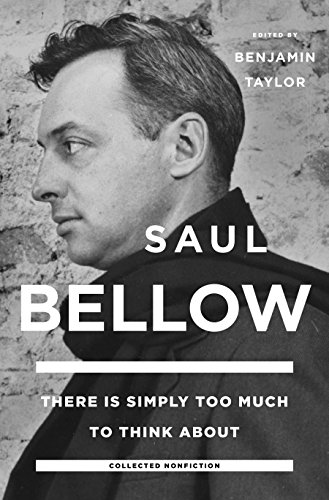
Arranged chronologically, this literary time capsule displays the full extent of Bellow's nonfiction, including criticism, interviews, speeches and other reflections, tracing his career from his initial success as a novelist until the end of his life. Bringing together six classic pieces with an abundance of previously uncollected material, There is Simply Too Much to Think About is a powerful reminder not only of Bellow's genius but also of his enduring place in the western canon. It is sure to be widely reviewed and talked about for years to come.
Die Inhaltsangabe kann sich auf eine andere Ausgabe dieses Titels beziehen.
Über die Autorin bzw. den Autor
Saul Bellow (1915-2005) is the only novelist to receive three National Book Awards, for The Adventures of Augie March, Herzog, and Mr. Sammler's Planet. In 1976, he won the Pulitzer Prize for his novel Humboldt's Gift. The Nobel Prize in Literature was also awarded to him in 1976 "for the human understanding and subtle analysis of contemporary culture that are combined in his work." In 1990, Mr. Bellow was presented the National Book Award Foundation Medal for distinguished contribution to American letters. He also received the National Medal of Arts.
Benjamin Taylor, editor, is the author of Naples Declared: A Walk Around the Bay, named a Best Book of 2012 by The New Yorker, and of two award-winning novels, Tales Out of School and The Book of Getting Even. He previously edited Saul Bellow: Letters, named a Best Book of 2010 by Michiko Kakutani of The New York Times and Jonathan Yardley of The Washington Post. A faculty member in The New School's Graduate School of Writing, Taylor also teaches in the Graduate Writing Division of the School of the Arts at Columbia University. He is a past Fellow and current Trustee of the John Simon Guggenheim Memorial Foundation.
Auszug. © Genehmigter Nachdruck. Alle Rechte vorbehalten.
Prologue: Starting Out in Chicago
What was it, in the Thirties, that drew an adolescent in Chicago to the writing of books? How did a young American of the Depression period decide that he was, of all things, a literary artist? I use the pretentious term literary artist simply to emphasize the contrast between such an ambition and the external facts. A colossal industrial and business center, knocked flat by unemployment, its factories and even its schools closing, decided to hold a World's Fair on the shore of Lake Michigan, with towers, high rides, exhibits, Chinese rickshaws, a midget village in which there was a midget wedding every day, and other lively attractions including whores and con men and fan dancers. There was a bit of gaiety, there was quite a lot of amoebic dysentery. Prosperity did not come back. Several millions of dollars were invested in vain by businessmen and politicians. If they could be quixotic, there was no reason why college students shouldn't be impractical too. And what was the most impractical of choices in somber, heavy, growling, lowbrow Chicago? Why, it was to be the representative of beauty, the interpreter of the human heart, the hero of ingenuity, playfulness, personal freedom, generosity and love. I cannot even now say that this was a bad sort of crackpot to be.
The difference between that time and this is that in the Thirties crackpots were not subsidized by their families. They had to go it alone for several years. Or at least until the New Deal (thanks largely to Harry Hopkins) recognized that a great government could buy the solution of any problem and opened WPA projects in many parts of the country. I think it possible that Hopkins and Roosevelt, seeing how much trouble unhappy intellectuals had made in Russia, Germany and Italy between 1905 and 1935, thought it a bargain to pay people twenty-three dollars a week for painting post office murals and editing guidebooks. This plan succeeded admirably. If I am not mistaken, America continued to follow the Hopkins hint in postwar Europe and perhaps in Vietnam.
I know, for instance, that John Cheever has been conducting creative writing courses at Sing Sing. Writers and criminals have often found that they had much in common. And correctional officials seem to understand, thanks to the psychology courses they take in the universities, that it is excellent therapy to write books and that it may soften the hearts of criminals to record their experiences. Politicians, too, when they fall from power or retire, become writers or university professors. Thus Hubert Humphrey and Dean Rusk became lecturers, Eugene McCarthy became a poet and an altogether different sort of politician, Spiro Agnew, a novelist. Interviewed not long ago in The New York Times, Mr. Agnew said that, having suffered greatly, he felt the need to do something creative to recover his spirits and was setting to work writing a novel because he was not yet strong enough to do serious mental work.
But I started out to recall what it was like to set oneself up to be a writer in the Midwest during the Thirties. For I thought of myself as a Midwesterner and not as a Jew. I am often described as a Jewish writer; in much the same way, one might be called a Samoan astronomer or an Eskimo cellist or a Zulu Gainsborough expert. There is some oddity about it. I am a Jew, and I have written some books. I have tried to fit my soul into the Jewish-writer category, but it does not feel comfortably accommodated there. I wonder now and then whether Philip Roth and Bernard Malamud and I have not become the Hart Schaffner and Marx of our trade. We have made it in the field of culture as Bernard Baruch made it on a park bench, as Polly Adler made it in prostitution, as Two-Gun Cohen, the personal bodyguard of Sun Yat-Sen, made it in China. My joke is not broad enough to cover the contempt I feel for the opportunists, wise guys and career types who impose suc
„Über diesen Titel“ kann sich auf eine andere Ausgabe dieses Titels beziehen.
Suchergebnisse für There Is Simply Too Much To Think About: Collected...

Beispielbild für diese ISBN
There Is Simply Too Much to Think About : Collected Nonfiction
Verlag:
Penguin Publishing Group, 2015
ISBN 10: 0670016691
ISBN 13: 9780670016693
Gebraucht
Hardcover
Anbieter: Better World Books, Mishawaka, IN, USA
Verkäuferbewertung 5 von 5 Sternen

Zustand: Good. Former library copy. Pages intact with minimal writing/highlighting. The binding may be loose and creased. Dust jackets/supplements are not included. Includes library markings. Stock photo provided. Product includes identifying sticker. Better World Books: Buy Books. Do Good. Artikel-Nr. 9221207-6
Gebraucht kaufen
EUR 6,49
Versand gratis
Versand innerhalb von USA
Versand innerhalb von USA
Anzahl: 1 verfügbar
Beispielbild für diese ISBN
There Is Simply Too Much to Think About : Collected Nonfiction
Verlag:
Penguin Publishing Group, 2015
ISBN 10: 0670016691
ISBN 13: 9780670016693
Gebraucht
Hardcover
Anbieter: Better World Books, Mishawaka, IN, USA
Verkäuferbewertung 5 von 5 Sternen
Zustand: Very Good. Former library copy. Pages intact with possible writing/highlighting. Binding strong with minor wear. Dust jackets/supplements may not be included. Includes library markings. Stock photo provided. Product includes identifying sticker. Better World Books: Buy Books. Do Good. Artikel-Nr. 8141955-6
Gebraucht kaufen
EUR 6,49
Versand gratis
Versand innerhalb von USA
Versand innerhalb von USA
Anzahl: 2 verfügbar
Beispielbild für diese ISBN
There Is Simply Too Much to Think About: Collected Nonfiction
Verlag:
Viking (edition First Edition), 2015
ISBN 10: 0670016691
ISBN 13: 9780670016693
Gebraucht
Hardcover
Erstausgabe
Anbieter: BooksRun, Philadelphia, PA, USA
Verkäuferbewertung 5 von 5 Sternen
Hardcover. Zustand: Very Good. First Edition. With dust jacket. It's a well-cared-for item that has seen limited use. The item may show minor signs of wear. All the text is legible, with all pages included. It may have slight markings and/or highlighting. Artikel-Nr. 0670016691-8-1-29
Gebraucht kaufen
EUR 6,77
Versand gratis
Versand innerhalb von USA
Versand innerhalb von USA
Anzahl: 1 verfügbar
Beispielbild für diese ISBN
There Is Simply Too Much to Think About: Collected Nonfiction
Anbieter: ThriftBooks-Dallas, Dallas, TX, USA
Verkäuferbewertung 5 von 5 Sternen
Hardcover. Zustand: Very Good. No Jacket. May have limited writing in cover pages. Pages are unmarked. ~ ThriftBooks: Read More, Spend Less. Artikel-Nr. G0670016691I4N00
Gebraucht kaufen
EUR 7,75
Versand gratis
Versand innerhalb von USA
Versand innerhalb von USA
Anzahl: 1 verfügbar
Beispielbild für diese ISBN
There Is Simply Too Much to Think About: Collected Nonfiction
Anbieter: ThriftBooks-Atlanta, AUSTELL, GA, USA
Verkäuferbewertung 5 von 5 Sternen
Hardcover. Zustand: Good. No Jacket. Pages can have notes/highlighting. Spine may show signs of wear. ~ ThriftBooks: Read More, Spend Less. Artikel-Nr. G0670016691I3N00
Gebraucht kaufen
EUR 7,75
Versand gratis
Versand innerhalb von USA
Versand innerhalb von USA
Anzahl: 1 verfügbar
Beispielbild für diese ISBN
There Is Simply Too Much to Think About: Collected Nonfiction
Anbieter: ThriftBooks-Phoenix, Phoenix, AZ, USA
Verkäuferbewertung 5 von 5 Sternen
Hardcover. Zustand: Very Good. No Jacket. Former library book; May have limited writing in cover pages. Pages are unmarked. ~ ThriftBooks: Read More, Spend Less. Artikel-Nr. G0670016691I4N10
Gebraucht kaufen
EUR 7,75
Versand gratis
Versand innerhalb von USA
Versand innerhalb von USA
Anzahl: 1 verfügbar
Beispielbild für diese ISBN
There Is Simply Too Much to Think About: Collected Nonfiction
Anbieter: ThriftBooks-Atlanta, AUSTELL, GA, USA
Verkäuferbewertung 5 von 5 Sternen
Hardcover. Zustand: Very Good. No Jacket. Former library book; May have limited writing in cover pages. Pages are unmarked. ~ ThriftBooks: Read More, Spend Less. Artikel-Nr. G0670016691I4N10
Gebraucht kaufen
EUR 7,75
Versand gratis
Versand innerhalb von USA
Versand innerhalb von USA
Anzahl: 1 verfügbar
Beispielbild für diese ISBN
There Is Simply Too Much to Think About: Collected Nonfiction
Anbieter: Magers and Quinn Booksellers, Minneapolis, MN, USA
Verkäuferbewertung 5 von 5 Sternen
hardcover. Zustand: Very Good. May have light to moderate shelf wear and/or a remainder mark. Complete. Clean pages. Artikel-Nr. 1194826
Gebraucht kaufen
EUR 5,95
EUR 3,55 Versand
Versand innerhalb von USA
Versand innerhalb von USA
Anzahl: 1 verfügbar
Beispielbild für diese ISBN
There Is Simply Too Much To Think About: Collected Nonfiction
Anbieter: World of Books (was SecondSale), Montgomery, IL, USA
Verkäuferbewertung 5 von 5 Sternen
Hardback. Zustand: Good. Arranged chronologically, this literary time capsule displays the full extent of Bellow's nonfiction, including criticism, interviews, speeches and other reflections, tracing his career from his initial success as a novelist until the end of his life. Bringing together six classic pieces with an abundance of previously uncollected material, There is Simply Too Much to Think About is a powerful reminder not only of Bellow's genius but also of his enduring place in the western canon. It is sure to be widely reviewed and talked about for years to come. Artikel-Nr. 00108440478
Gebraucht kaufen
EUR 10,41
Versand gratis
Versand innerhalb von USA
Versand innerhalb von USA
Anzahl: 1 verfügbar
Beispielbild für diese ISBN
There Is Simply Too Much to Think About: Collected Nonfiction
Verlag:
Viking, New York, 2015
ISBN 10: 0670016691
ISBN 13: 9780670016693
Gebraucht
Hardcover
Erstausgabe
Anbieter: Abacus Bookshop, Pittsford, NY, USA
Verkäuferbewertung 5 von 5 Sternen
hardcover. Zustand: Fine copy in fine dust jacket. 1st. 8vo, 532 pp., Edited by Benjamin Taylor. Artikel-Nr. 103805
Gebraucht kaufen
EUR 18,34
EUR 3,56 Versand
Versand innerhalb von USA
Versand innerhalb von USA
Anzahl: 1 verfügbar