
Verwandte Artikel zu Touch: The Science of Hand, Heart, and Mind
Inhaltsangabe
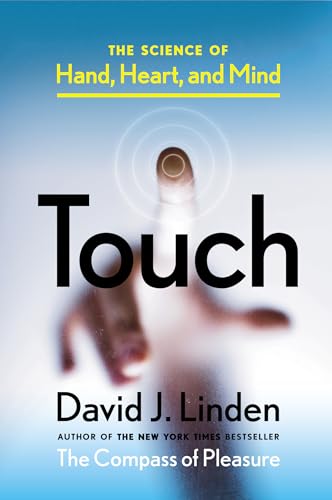
The New York Times bestselling author examines how our sense of touch and emotion are interconnected
Johns Hopkins neuroscientist and bestselling author of The Compass of Pleasure David J. Linden presents an engaging and fascinating examination of how the interface between our sense of touch and our emotional responses affects our social interactions as well as our general health and development. Accessible in its wit and clarity,Touch explores scientific advances in the understanding of touch that help explain our sense of self and our experience of the world.
From skin to nerves to brain, the organization of the body’s touch circuits powerfully influences our lives—affecting everything from consumer choice to sexual intercourse, tool use to the origins of language, chronic pain to healing. Interpersonal touch is crucial to social bonding and individual development. Linden lucidly explains how sensory and emotional context work together to distinguish between perceptions of what feels good and what feels bad. Linking biology and behavioral science, Linden offers an entertaining and enlightening answer to how we feel in every sense of the word.
Die Inhaltsangabe kann sich auf eine andere Ausgabe dieses Titels beziehen.
Über die Autorinnen und Autoren
DAVID J. LINDEN is a professor of neuroscience at the Johns Hopkins University School of Medicine and theNew York Times bestselling author of The Compass of Pleasure and The Accidental Mind. He lives in Baltimore with his two children.
DAVID J. LINDEN is a professor of neuroscience at the Johns Hopkins University School of Medicine and theNew York Times bestselling author of The Compass of Pleasure and The Accidental Mind. He lives in Baltimore with his two children.
Auszug. © Genehmigter Nachdruck. Alle Rechte vorbehalten.
PROLOGUE
Malibu, Summer 1975
We’re eight teenage campers huddled around a fire ring, late at night. Piled up like puppies, spilling over rocks and stumps and the dusty bare dirt of the Santa Monica mountains, we smell of black sage and acorns and unwashed T-shirts. With no adults in sight and the soft cover of darkness, we give voice to our innermost pubescent thoughts.
“Your turn, Sam.”
“Okay . . . this is for Caroline. Would you rather give an open-mouth kiss to the camp director or eat a live cockroach?”
Our voices rise in a disgusted, delighted Greek chorus, “Eeeeeeeeeeeew!”
“You’re so gross, Sam. I’m not answering that one.”
“But you have to. Those are the rules.”
“No way, you pervert.”
“You’re so prickly. I didn’t mean to hurt your feelings.”
“Yeah, right.”
“Okay, here’s a clean one. Would you rather die of cold in Antarctica or heat in the Sahara Desert?”
“I’m not allowed to bring a parka to Antarctica?”
“No, you’re naked.”
“Then I choose the desert. I want to go out with a good tan.”
Good-natured howling erupts. Caroline raises her arm and shimmies, vamping it up.
Sam smiles. “You’re so vain. And . . . I’ve gotta go.” Everyone knows that this is bogus. It’s obvious that he’s crazy about Caroline.
“No, you don’t, you slippery sonofabitch. Now it’s my turn. You must give up all of your senses except one. Which do you pick to save?”
“Oh, man. That’s rough. I’d keep sight. Then, at least I could get around. Uh, no, hearing—I need my music. Shit. I dunno. That would just suck.”
“Yeah, it would.”
“I’m touched by your concern.”
“Bite me.”
Later, lying in my sleeping bag and mulling over this flirtatious banter, I was puzzled. Flush with hormones, we all hungered for interpersonal touch, for kisses and caresses and more. I was typical of this group, so consumed with the idea of holding and kissing a lovely dark-haired girl named Lorelei that I could barely speak. Touch was central to our obsessions and fantasies, yet none of us ever chose to preserve it when, in the nights that followed, Caroline’s question about losing one of our senses returned in the “Would you rather . . . ?” game. Did we simply not think the ramifications through? It’s certainly true that a bunch of horny sleep-deprived amped-up teenagers sitting around a campfire is not the ideal forum for contemplation. Or was it that we could easily imagine what it would be like to experience the loss of sight or hearing (we had all shut our eyes or plugged our ears), or even of taste or smell, yet none of us had ever actually been able to re-create the sensation of the loss of touch. Perhaps touch was woven so deeply into our sense of self that we could not truly imagine life without it. Years later when I read Lolita, I discovered that Vladimir Nabokov had, as usual, raised this very issue many years before: “It is strange that the tactile sense, which is so infinitely less precious to men than sight, becomes at critical moments our main, if not only, handle to reality.”
For Nabokov’s Humbert Humbert, touch was so infinitely precious an experience that even the merest tactile contact with his beloved Lolita aroused overwhelming passions. For all of us, the experience of touch is intrinsically emotional, and this is reflected in common expressions in English. Read the dialogue that opens this chapter and notice that phrases like “I’m touched by your concern” or “I didn’t mean to hurt your feelings” and texture metaphors like “you’re so prickly” or “that’s rough” or “you slippery sonofabitch” didn’t stand out at all. We are completely accustomed to describing a wide range of human emotions, actions, and personalities in terms of our skin senses:
“I was touched by her thoughtfulness.”
“It’s a sticky situation.”
“That’s enough of that coarse language.”
“That is one hairy problem.”
“He rubs me the wrong way.”
In everyday speech, the tactile is so entangled with the emotional that when we encounter someone who is emotionally clumsy, we call him tactless: Literally, he lacks touch.
This may seem like a silly question, but it’s not: Why are emotions called feelings and not sightings or smellings? Do touch metaphors really tell us something about the skin senses and their relationship to human cognition, or are they merely a common usage of present-day English? In fact, the constructions “I’m touched” to mean “I’m emotionally affected” and “my feelings” to mean “my tender emotions” have been in use in the language since at least the late thirteenth century. And such expressions are not unique to English, or even the Indo-European language group, as they are found in tongues as diverse as Basque and Chinese.
People who are blind or deaf from birth will for the most part develop normal bodies and brains (apart from the visual or auditory areas) and can live rich and fruitful lives. But deprive a newborn of social touch, as occurred in grossly understaffed Romanian orphanages in the 1980s and 1990s, and a disaster unfolds: Growth is slowed, compulsive rocking and other self-soothing behaviors emerge, and, if not rectified, emergent disorders of mood, cognition, and self-control can persist through adulthood. Fortunately, even a relatively minor intervention—an hour per day of touch and limb manipulation from a caregiver—can reverse this terrible course if applied early in life. Touch is not optional for human development. We have the longest childhoods of any animal—there is no other creature whose five-year-old offspring cannot live independently. If our long childhoods are not filled with touch, particularly loving, interpersonal touch, the consequences are dramatic.
The critical role of touch in early development has not always been appreciated. Child-rearing advice of the 1920s from the psychologist John B. Watson (the founder of the psychological movement called behaviorism) cautioned parents about spoiling their children with physical affection: “Let your behavior always be objective and kindly firm. Never hug and kiss them. Never let them sit on your lap. If you must, kiss them once on the forehead when they say goodnight. Shake hands with them in the morning. Give them a pat on the head if they have made an extraordinarily good job of a difficult task.”1
While most parents today do not restrict contact with their children to an occasional pat on the head, it’s a different story outside the family. In our zeal to protect kids from sexual predators, we have promoted no-touch policies for teachers, coaches, and other supervisory adults that, while well meaning, have the inadvertent effect of adding to the touch deprivation of our children. As these kids have grown up in a touch-phobic environment and propagated these fears to their own children, our society as a whole has become further impoverished.
You may ask, “Okay, I understand that kids are sensitive, but once we’ve become adults, why does it matter if we’re touch-deprived? This touchy-feely stuff is for hippies and time wasters. Just squirt out another glob of...
„Über diesen Titel“ kann sich auf eine andere Ausgabe dieses Titels beziehen.
Suchergebnisse für Touch: The Science of Hand, Heart, and Mind

Beispielbild für diese ISBN
Touch: The Science of Hand, Heart, and Mind
Anbieter: BooksRun, Philadelphia, PA, USA
Verkäuferbewertung 5 von 5 Sternen

Hardcover. Zustand: Very Good. 1. It's a well-cared-for item that has seen limited use. The item may show minor signs of wear. All the text is legible, with all pages included. It may have slight markings and/or highlighting. Artikel-Nr. 0670014877-11-1
Gebraucht kaufen
EUR 4,86
Versand gratis
Versand innerhalb von USA
Versand innerhalb von USA
Anzahl: 1 verfügbar
Beispielbild für diese ISBN
Touch: The Science of Hand, Heart, and Mind
Anbieter: World of Books (was SecondSale), Montgomery, IL, USA
Verkäuferbewertung 5 von 5 Sternen
Hardback. Zustand: Good. The New York Times-bestselling author of The Compass of Pleasure examines how our sense of touch is interconnected with our emotions Dual-function receptors in our skin make mint feel cool and chili peppers hot. Without the brain's dedicated centers for emotional touch, an orgasm would feel more like a sneeze--convulsive, but not especially nice. From skin to nerves to brain, the organization of our body's touch circuits is a complex and often counterintuitive system that affects everything from our social interactions to our general health and development. In Touch, neuroscientist and bestselling author David J. Linden explores this critical interface between our bodies and the outside world, between ourselves and others. Along the way, he answers such questions as: Why do women have more refined detection with their fingertips than men? Is there a biological basis for the use of acupuncture to relieve pain? How do drugs like Ecstasy heighten and motivate sensual touch? Why can't we tickle ourselves? Linking biology and behavioral science, Touch offers an entertaining and enlightening answer to how we feel in every sense of the word. Artikel-Nr. 00091496278
Gebraucht kaufen
EUR 5,55
Versand gratis
Versand innerhalb von USA
Versand innerhalb von USA
Anzahl: 2 verfügbar
Beispielbild für diese ISBN
Touch: The Science of Hand, Heart, and Mind
Anbieter: ThriftBooks-Atlanta, AUSTELL, GA, USA
Verkäuferbewertung 5 von 5 Sternen
Hardcover. Zustand: Good. No Jacket. Pages can have notes/highlighting. Spine may show signs of wear. ~ ThriftBooks: Read More, Spend Less. Artikel-Nr. G0670014877I3N00
Gebraucht kaufen
EUR 6,83
Versand gratis
Versand innerhalb von USA
Versand innerhalb von USA
Anzahl: 1 verfügbar
Beispielbild für diese ISBN
Touch: The Science of Hand, Heart, and Mind
Anbieter: ThriftBooks-Dallas, Dallas, TX, USA
Verkäuferbewertung 5 von 5 Sternen
Hardcover. Zustand: Good. No Jacket. Former library book; Pages can have notes/highlighting. Spine may show signs of wear. ~ ThriftBooks: Read More, Spend Less. Artikel-Nr. G0670014877I3N10
Gebraucht kaufen
EUR 6,83
Versand gratis
Versand innerhalb von USA
Versand innerhalb von USA
Anzahl: 1 verfügbar
Beispielbild für diese ISBN
Touch: The Science of Hand, Heart, and Mind
Anbieter: ThriftBooks-Reno, Reno, NV, USA
Verkäuferbewertung 5 von 5 Sternen
Hardcover. Zustand: Good. No Jacket. Pages can have notes/highlighting. Spine may show signs of wear. ~ ThriftBooks: Read More, Spend Less. Artikel-Nr. G0670014877I3N00
Gebraucht kaufen
EUR 6,83
Versand gratis
Versand innerhalb von USA
Versand innerhalb von USA
Anzahl: 1 verfügbar
Beispielbild für diese ISBN
Touch: The Science of Hand, Heart, and Mind
Anbieter: ThriftBooks-Dallas, Dallas, TX, USA
Verkäuferbewertung 5 von 5 Sternen
Hardcover. Zustand: Very Good. No Jacket. May have limited writing in cover pages. Pages are unmarked. ~ ThriftBooks: Read More, Spend Less. Artikel-Nr. G0670014877I4N00
Gebraucht kaufen
EUR 6,83
Versand gratis
Versand innerhalb von USA
Versand innerhalb von USA
Anzahl: 1 verfügbar
Beispielbild für diese ISBN
Touch: The Science of Hand, Heart, and Mind
Anbieter: ThriftBooks-Dallas, Dallas, TX, USA
Verkäuferbewertung 5 von 5 Sternen
Hardcover. Zustand: Very Good. No Jacket. Former library book; May have limited writing in cover pages. Pages are unmarked. ~ ThriftBooks: Read More, Spend Less. Artikel-Nr. G0670014877I4N10
Gebraucht kaufen
EUR 6,83
Versand gratis
Versand innerhalb von USA
Versand innerhalb von USA
Anzahl: 1 verfügbar
Beispielbild für diese ISBN
Touch: The Science of Hand, Heart, and Mind
Anbieter: ThriftBooks-Reno, Reno, NV, USA
Verkäuferbewertung 5 von 5 Sternen
Hardcover. Zustand: Fair. No Jacket. Former library book; Readable copy. Pages may have considerable notes/highlighting. ~ ThriftBooks: Read More, Spend Less. Artikel-Nr. G0670014877I5N10
Gebraucht kaufen
EUR 6,83
Versand gratis
Versand innerhalb von USA
Versand innerhalb von USA
Anzahl: 1 verfügbar
Beispielbild für diese ISBN
Touch : The Science of the Hand, Heart, and Mind
Verlag:
Penguin Publishing Group, 2015
ISBN 10: 0670014877
ISBN 13: 9780670014873
Gebraucht
Hardcover
Erstausgabe
Anbieter: Better World Books, Mishawaka, IN, USA
Verkäuferbewertung 5 von 5 Sternen
Zustand: Fine. 1st Edition. Used book that is in almost brand-new condition. May contain a remainder mark. Better World Books: Buy Books. Do Good. Artikel-Nr. 11331651-6
Gebraucht kaufen
EUR 7,12
Versand gratis
Versand innerhalb von USA
Versand innerhalb von USA
Anzahl: 1 verfügbar
Beispielbild für diese ISBN
Touch : The Science of the Hand, Heart, and Mind
Verlag:
Penguin Publishing Group, 2015
ISBN 10: 0670014877
ISBN 13: 9780670014873
Gebraucht
Hardcover
Erstausgabe
Anbieter: Better World Books, Mishawaka, IN, USA
Verkäuferbewertung 5 von 5 Sternen
Zustand: Very Good. 1st Edition. Former library copy. Pages intact with possible writing/highlighting. Binding strong with minor wear. Dust jackets/supplements may not be included. Includes library markings. Stock photo provided. Product includes identifying sticker. Better World Books: Buy Books. Do Good. Artikel-Nr. 5741498-6
Gebraucht kaufen
EUR 7,12
Versand gratis
Versand innerhalb von USA
Versand innerhalb von USA
Anzahl: 1 verfügbar