
Verwandte Artikel zu Friendship: An Expose: An Expose – A Wickedly...
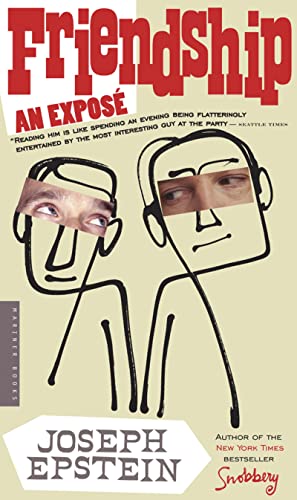
Friendship: An Expose: An Expose – A Wickedly Entertaining Anatomy of the Relationships We Call Companions - Softcover
Inhaltsangabe
Is it possible to have too many friends? Is your spouse supposed to be your best friend? How far should you go to help a friend in need? And how do you end a friendship that has run its course?
In a wickedly entertaining anatomy of friendship in its contemporary guises, Joseph Epstein uncovers the rich and surprising truths about our favored companions. Friendship illuminates those complex, wonderful relationships without which we'd all be lost.
In a wickedly entertaining anatomy of friendship in its contemporary guises, Joseph Epstein uncovers the rich and surprising truths about our favored companions. Friendship illuminates those complex, wonderful relationships without which we'd all be lost.
Die Inhaltsangabe kann sich auf eine andere Ausgabe dieses Titels beziehen.
Über die Autorin bzw. den Autor
JOSEPH EPSTEIN is the author of the best-selling Snobbery and of Friendship, among other books, and was formerly editor of the American Scholar. His work has appeared in The New Yorker, Harper’s Magazine, the Atlantic Monthly, and other magazines. He lives in Evanston, Illinois.
Auszug. © Genehmigter Nachdruck. Alle Rechte vorbehalten.
Friendship
An ExposeBy Joseph EpsteinHoughton Mifflin Company
Copyright © 2007 Joseph EpsteinAll right reserved.
ISBN: 9780618872152
1 A Little Taxonomy of Friends
The beauty of the word "friend" is that it's so ambiguous," wrote Miss
Manners in one of her columns. I take Miss Manners's meaning, though
ambiguity is not necessarily a beautiful quality for someone who is
attempting to understand what friendship is and how it works, and at book
length no less. How much better if the meaning, implications, and
significance of the word were nicely locked into a firm and easy definition!
Alas, they aren't, and perhaps never will be.
Friendship is the strongest of relationships not bound by or
hostage to biology, which is to say, blood. It is, in this sense, as C. S. Lewis
writes in The Four Loves, "the least natural of loves; the least instinctive,
organic, biological, gregarious and necessary." As Lewis goes on to point
out, we can breed without friendship and carry on existence without it.
Friendship does not arise out of necessity, but out of preference. Unlike our
family, which we have no say in choosing, our friendships are based almost
entirely on personal selection. "God's apology," the English essayist Hugh
Kingsmill amusingly called friends; by which he meant that, by way of
apology, and to make amends to us for the families He has burdened us
with, God has also supplied us with friends.
The breadth of meanings the word "friend" takes in is such that all
one can safely say through definition is that a friend is someone one likes
and wishes to see again, though I can think of exceptions and qualifications
even to this innocuous formulation. Rather than attempt to define "friend"
straightaway, perhaps I do better to begin by distinguishing between the
kinds and degrees of friendship.
The first necessary distinction is that between a friend and an
acquaintance. Dictionaries aren't of much help here either. An acquaintance,
I should say, is someone you know, may even have known for a long while,
but almost never plan to meet, unless for some very specific reason. He or
she may be someone pleasing enough to encounter—on the street, at a
party or professional function, even in a hospital—but one generally does so
with a slight element of surprise. A relationship with an acquaintance doesn't
postulate a future. You may or may not meet again, no obligation on either
side, nothing owed but recognition and civility. You might dislike, in fact
despise, an acquaintance, and do so with a clear conscience, something one
is not permitted to do with a person one claims to call a friend. Yet there are
some who prefer acquaintances to friends, as does the narrator of Julian
Fellowes's recent novel Snobs, who remarks that he much prefers
acquaintances over friends, for they offer more variety and require so much
less in the way of participation and obligation, leaving one's life less clogged
with human complication.
"Comrade" was a word much in vogue under Communism, which
tried to foist equality even on friendship by making all men and women
equally one's friend in the forthcoming (it hasn't quite arrived yet) just society.
But in the social sense friendship isn't about equality. Quite the reverse. By
its nature friendship is preferential: one chooses one person over another to
draw closer to; an element of exclusivity is implied in the word "friend."
"Companion" is too neutral a word to be of much help in
establishing what a friend is or isn't. A companion is, as it sounds, someone
who happens to be in one's company. He or she may be someone on one's
payroll; for example, someone an older person pays to stay with her during
recovery from an illness. Sometimes "companion" is used as a code word for
a lover, which also isn't much help. A "great good friend" was the old Time
magazine euphemism for someone a person wasn't married to but was
sleeping with.
Closer to the matter are the categories of Old Friends, Out-of-
Town Friends, Professional Friends, Secondary Friends, Male-Female
Friends, and Ex-Friends. I won't bother to add Fair-Weather Friends, though I
have a friend I call my Foul- Weather Friend, because we chiefly meet in the
winter or on rainy days, since on all his other free days he is out playing golf.
Old friends include friends from one's past whom one may or may
not any longer see regularly. Old friends often include friends from as far back
as one's grade school or high school or college days. They might also
include friends made in the military. Often these are friendships that have
gone not so much sour as inactive: one of the parties to the friendship has
moved to another area of the country, or perhaps once shared interests or
causes or outlooks have changed, respective fortunes may have radically
altered, and in the mix of all these possibilities the previous basis for the
friendship has become diluted or has dissolved. A common past, or at any
rate a patch of the past, is what usually unites old friends. At their best,
school reunions are sustained by the feeling supplied by old friendships.
Sometimes meeting an old friend can be terribly disappointing, not
to say sad, so far apart might friends have grown or so differently might they
now view the world and therefore each other. Sometimes such meetings can
be very sweet, especially when one still finds in an old friend, after a long
lapse of time, the qualities one first liked in him or her twenty, thirty, forty,
fifty and more years ago. But perhaps as often as not one finds nothing of the
kind, and is left to wonder, God, what did we ever, in those distant days, find
attractive in each other to begin with. Many old friendships are best left to
lapse, without the drama of a final break, but simply allowed to sputter and
gutter out. This becomes all the more poignant when only one party to the
old friendship feels the friendship is better ended and the other wishes, hope
against hope, to keep it alive. One friend may feel he has outgrown the other,
to cite a common example, while the other is still entranced by the fond
memories of past days and wants the friendship continued on the old basis.
Owing to American mobility—people moving about the country for
work, a more pleasing environment, retirement, and much else—the category
of out-of-town friend has become a larger one than perhaps at any previous
time. Some friends are not merely out of town, but out of the country. One
usually makes such friends through one's professional associations:
scientists often meet in faraway places with colleagues from around the
world; connections get made, and out of them friendships begin to form. The
main—it may be a crucial— distinction between out-of-town and other friends
is that the element of regularity plays a much smaller, or sometimes almost
no, part in out-of-town friendships.
Good feelings can certainly stay alive with friends who live in
Paris, London, Bombay, and South America, but friendship doesn't get much
of a workout at such distances. The element of longing can also enter into
out-of-town friendships—a longing to see the persons in question in the flesh,
for which...
„Über diesen Titel“ kann sich auf eine andere Ausgabe dieses Titels beziehen.
Suchergebnisse für Friendship: An Expose: An Expose – A Wickedly...

Beispielbild für diese ISBN
Friendship: An Expose
Anbieter: World of Books (was SecondSale), Montgomery, IL, USA
Verkäuferbewertung 5 von 5 Sternen

Paperback. Zustand: Good. Is it possible to have too many friends? Is your spouse supposed to be your best friend? How far should you go to help a friend in need? And how do you end a friendship that has run its course? In a wickedly entertaining anatomy of friendship in its contemporary guises, Joseph Epstein uncovers the rich and surprising truths about our favored companions. Friendship illuminates those complex, wonderful relationships without which we'd all be lost. Artikel-Nr. 00070752625
Gebraucht kaufen
EUR 5,32
Versand gratis
Versand innerhalb von USA
Versand innerhalb von USA
Anzahl: 4 verfügbar
Beispielbild für diese ISBN
Friendship : An Expose
Verlag:
HarperCollins Publishers, 2007
ISBN 10: 0618872159
ISBN 13: 9780618872152
Gebraucht
Softcover
Anbieter: Better World Books, Mishawaka, IN, USA
Verkäuferbewertung 5 von 5 Sternen
Zustand: Very Good. Pages intact with possible writing/highlighting. Binding strong with minor wear. Dust jackets/supplements may not be included. Stock photo provided. Product includes identifying sticker. Better World Books: Buy Books. Do Good. Artikel-Nr. 3362235-6
Gebraucht kaufen
EUR 6,46
Versand gratis
Versand innerhalb von USA
Versand innerhalb von USA
Anzahl: 2 verfügbar
Beispielbild für diese ISBN
Friendship : An Expose
Verlag:
HarperCollins Publishers, 2007
ISBN 10: 0618872159
ISBN 13: 9780618872152
Gebraucht
Softcover
Anbieter: Better World Books, Mishawaka, IN, USA
Verkäuferbewertung 5 von 5 Sternen
Zustand: Good. Pages intact with minimal writing/highlighting. The binding may be loose and creased. Dust jackets/supplements are not included. Stock photo provided. Product includes identifying sticker. Better World Books: Buy Books. Do Good. Artikel-Nr. 8458449-6
Gebraucht kaufen
EUR 6,46
Versand gratis
Versand innerhalb von USA
Versand innerhalb von USA
Anzahl: 2 verfügbar
Beispielbild für diese ISBN
Friendship: An Expose [Paperback] Epstein, Joseph
Anbieter: GridFreed, San Diego, CA, USA
Verkäuferbewertung 5 von 5 Sternen
Paperback. Zustand: New. In shrink wrap. Artikel-Nr. 50-14842
Neu kaufen
EUR 17,14
EUR 6,10 Versand
Versand innerhalb von USA
Versand innerhalb von USA
Anzahl: 2 verfügbar
Beispielbild für diese ISBN
Friendship: An Expose
Anbieter: Majestic Books, Hounslow, Vereinigtes Königreich
Verkäuferbewertung 4 von 5 Sternen

Zustand: New. pp. 288. Artikel-Nr. 8112657
Neu kaufen
EUR 17,82
EUR 7,56 Versand
Versand von Vereinigtes Königreich nach USA
Versand von Vereinigtes Königreich nach USA
Anzahl: 1 verfügbar
Beispielbild für diese ISBN
Friendship: An Expose
Anbieter: medimops, Berlin, Deutschland
Verkäuferbewertung 5 von 5 Sternen
Zustand: very good. Gut/Very good: Buch bzw. Schutzumschlag mit wenigen Gebrauchsspuren an Einband, Schutzumschlag oder Seiten. / Describes a book or dust jacket that does show some signs of wear on either the binding, dust jacket or pages. Artikel-Nr. M00618872159-V
Gebraucht kaufen
EUR 15,50
EUR 10,00 Versand
Versand von Deutschland nach USA
Versand von Deutschland nach USA
Anzahl: 1 verfügbar
Beispielbild für diese ISBN
Friendship: An Expose
Anbieter: Revaluation Books, Exeter, Vereinigtes Königreich
Verkäuferbewertung 5 von 5 Sternen
Paperback. Zustand: Brand New. reprint edition. 270 pages. 8.75x5.25x0.75 inches. In Stock. Artikel-Nr. x-0618872159
Neu kaufen
EUR 20,87
EUR 11,63 Versand
Versand von Vereinigtes Königreich nach USA
Versand von Vereinigtes Königreich nach USA
Anzahl: 2 verfügbar
Beispielbild für diese ISBN
Friendship An Expose
Anbieter: Mooney's bookstore, Den Helder, Niederlande
Verkäuferbewertung 4 von 5 Sternen
Zustand: Very Good. Artikel-Nr. 3842012B5952439
Gebraucht kaufen
EUR 27,74
EUR 14,95 Versand
Versand von Niederlande nach USA
Versand von Niederlande nach USA
Anzahl: 1 verfügbar