
Verwandte Artikel zu Merchants of Immortality Pa: Chasing the Dream of Human...
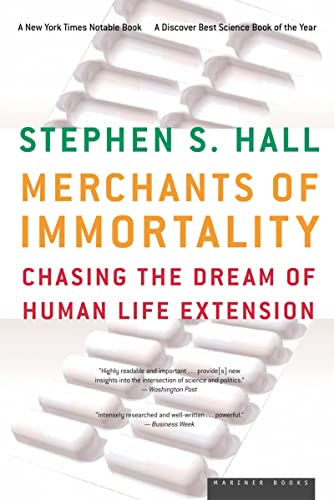
Merchants of Immortality Pa: Chasing the Dream of Human Life Extension – The New Frontier of Regenerative Medicine - Softcover
Inhaltsangabe
Regenerative medicine and human life extension are among the most cutting-edge pursuits in science, and potentially among the most profitable. In Merchants of Immortality, Stephen S. Hall offers both an expose<acute accent> of this fascinating science and a case study of the billion-dollar industry that has grown up around it. At the center of the field are stem cell research and cloning -- topics of continuous ethical debate -- and the stem cell legislation that has unintentionally created a strange and thriving private-sector business niche.
Merchants of Immortality is a captivating, incisive account of a new frontier at the intersection of biology and business.
Merchants of Immortality is a captivating, incisive account of a new frontier at the intersection of biology and business.
Die Inhaltsangabe kann sich auf eine andere Ausgabe dieses Titels beziehen.
Über die Autorin bzw. den Autor
STEPHEN S. HALL is the author of Merchants of Immortality and three other acclaimed works of science reportage. He writes frequently for the New York Times Magazine, Discover, and other magazines. He is 5’53⁄4” and lives in Brooklyn, New York, with his 5’9” wife and their two average-size children.
Auszug. © Genehmigter Nachdruck. Alle Rechte vorbehalten.
Merchants of Immortality
Chasing the Dream of Human Life ExtensionBy Stephen S. HallMariner Books
Copyright © 2005 Stephen S. HallAll right reserved.
ISBN: 0618492216
Excerpt
Prologue
The Never-Ending Life
Several years ago, while spending a weekend in the country with my family,
I stepped out onto the porch of the cabin where we were staying one night
and looked up into the sky. It was unusually clear for a summer night in the
Catskills, and every familiar jot and scrawl of the firmament was writ large—
the Polestar, Little Bear, filaments of the Milky Way strewn like pulled
cotton right down the middle of the dome, the entire landscape "apparelled in
celestial light," as Wordsworth put it in his "Ode: Intimations of Immortality."
A field of tall grass and wildflowers sloped down from the porch, and
hundreds of fireflies blinked on and off in the middle distance, so that the
line where our earthly, mortal light yielded to the celestial became beautifully
blurred in the darkness. As I stood at the rail, I could hear the uniquely
peaceful sound of untroubled sleep behind me in the cabin— my wife and
two children. I scanned the dark sky for a shooting star. I even had a wish
ready.
Since I didn"t happen to see a shooting star that night, I don"t
think it will betray any cosmic confidences to reveal what my wish would
have been, especially since it was so predictable. I wished for long, healthy,
productive lives for my family, especially my children. In doing so, I know I
was indulging a desire as ancient as our fascination with the heavens, a
longing as timeless and fierce as the biological instinct to protect one"s
brood. A desire so old, in fact, that it is not only about nature, but a part of
human nature, at least for the only species of life on earth known to be
aware of its own mortality. And as an amateur student of aging, I also knew,
as I stood at that porch rail, that my Darwinian warranty was about to run out.
In strictly evolutionary terms, I"d just about outlived my biological usefulness
to the species and would not much longer enjoy the built-in genetic
protections crafted by eons of natural selection. Indeed, those two cherubs
sleeping inside were the agents of my inevitable demise. Evolution protected
me long enough for me (and my wife) to have children, but became
biologically (and, in a sense, lethally) indifferent to us once we reached a
certain age. From paramecia to primates, from the single-celled denizens of
pond scum to poet laureates, natural selection stops caring about us once
we have lived long enough to reproduce. Evolution in that sense is a strange
ship: it moves ever forward through dark waters, keeping the species alive,
even as it throws each and every member of the species overboard. I was
nearing fifty years of age. My primary care physician had retired and I"d been
forced to switch to a new doctor. His name—no joke—was Dr. Faust. And so
this midsummer night"s wish of mine, stripped of its conflicted humility and
its faux altruism, revealed itself to be transparently self-referential. And here
I"m tempted to add "like most of the wishes of my generation." Because what
I was really saying was: Let us all live a long time, we"re not quite ready
to . . . to . . . I couldn"t bring myself to utter the D word, even in a
conversation with myself. I was content to reiterate the ancient ritual of
submitting a time-honored petition to indifferent gods on dark, starry nights.
In the same way, I feel that an entire generation—a generation
new to mortality, you might say—has been poised to file that same petition
as a kind of generational class-action suit against the laws of nature. Many
of us have been similarly poised at the railing of middle age, in the twilight of
something more permanent than a summer night, launching that same
fervent petition on behalf of our parents, our children, and, of course,
ourselves. I am speaking in part of the baby boomers, 75 million strong in
the United States alone, as well as our similarly entitled post–World War II
siblings spread throughout the developed world. This is a generation, it goes
without saying, that thinks of its petitions as somewhat special, a
generation that is perhaps a little more insistent about answered prayers.
Or so it appears superficially. If you think beyond the
demographic clichés, however, it"s hard to believe with much conviction that
the baby boomers are any more concerned about their mortality than
previous generations and previous cultures. Can we possibly experience
more feral emotions than the hunters and gatherers of 10,000 years ago,
whose very mortality attached to the success of finding their next meal? Can
we summon more urban angst than the average citizen of ancient Rome, who
could expect to live only about twenty or twenty-five years? Can we
honestly argue that we feel a more exalted fear of death than the soldiers of
the greatest generation, teenage boys like my father, huddled in foxholes,
dodging bullets? I have a hard time convincing myself that this is so. What
makes this particular moment so unusual in the age-old posting of these
timeless wishes is that they might actually be answered in an altogether
different way, with altogether unexpected consequences, in the not-too-
distant future. Perhaps I was looking in the wrong place for my shooting
star, because in a sense the truly meteoric agency capable of delivering on
these wishes may be found not in the world of cosmology but biology; the
high priests of our secular age, the molecular biologists, have begun to
address mortality in a way no group, no generation, and no society has ever
dreamed of before.
They may not succeed, of course, and the purpose of this book is
not to conflate promising science with the wishful thinking of an entire
generation. It is enough to note that in the last decade the most skilled,
ambitious, and indeed arrogant of our sciences has lined up to tackle
the "problem" of aging (and its faithful sidekick, death) in a way
fundamentally different from that of any previous era of medical intervention.
This is happening at the very same time that an enormous demographic
bulge in our population is burying parents and picking out gray hairs in the
mirror. If nothing else, these trends make for a fascinating convergence of
social desire and scientific ambition; of deeply personal psychological needs
(and fears) and the shamelessly public promissory notes that issue from the
lips of biologists, businesspeople, and other incurable optimists; of the
inevitable decline of the human body (or soma) and the almost alchemical,
regenerative capabilities of bland cells in plastic dishes; of the highest
intellectual aspiration for basic knowledge that contemporary civilization can
muster, alongside the most common and infinite capacity for greed and
personal advantage that has ever sullied the name of human nature. Looking
at this intersection from one perspective, nothing less is at stake than a
partial or nearly total repeal of mortality; from another perspective, we might
be witnessing a postmodern, molecular version of the Fountain of Youth tale,
a spectacle of...
„Über diesen Titel“ kann sich auf eine andere Ausgabe dieses Titels beziehen.
Suchergebnisse für Merchants of Immortality Pa: Chasing the Dream of Human...

Beispielbild für diese ISBN
Merchants Of Immortality: Chasing the Dream of Human Life Extension - The New Frontier of Regenerative Medicine
Anbieter: World of Books (was SecondSale), Montgomery, IL, USA
Verkäuferbewertung 5 von 5 Sternen

Zustand: Good. Item in good condition. Textbooks may not include supplemental items i.e. CDs, access codes etc. Artikel-Nr. 00098315672
Gebraucht kaufen
EUR 5,15
Versand gratis
Versand innerhalb von USA
Versand innerhalb von USA
Anzahl: 2 verfügbar
Beispielbild für diese ISBN
Merchants Of Immortality: Chasing the Dream of Human Life Extension
Anbieter: World of Books (was SecondSale), Montgomery, IL, USA
Verkäuferbewertung 5 von 5 Sternen
Zustand: Good. Item in very good condition! Textbooks may not include supplemental items i.e. CDs, access codes etc. Artikel-Nr. 00072472022
Gebraucht kaufen
EUR 5,45
Versand gratis
Versand innerhalb von USA
Versand innerhalb von USA
Anzahl: 1 verfügbar
Beispielbild für diese ISBN
Merchants of Immortality : Chasing the Dream of Human Life Extension
Verlag:
HarperCollins Publishers, 2005
ISBN 10: 0618492216
ISBN 13: 9780618492213
Gebraucht
Softcover
Anbieter: Better World Books, Mishawaka, IN, USA
Verkäuferbewertung 5 von 5 Sternen
Zustand: Good. 1 Edition. Former library copy. Pages intact with minimal writing/highlighting. The binding may be loose and creased. Dust jackets/supplements are not included. Includes library markings. Stock photo provided. Product includes identifying sticker. Better World Books: Buy Books. Do Good. Artikel-Nr. GRP101741873
Gebraucht kaufen
EUR 5,96
Versand gratis
Versand innerhalb von USA
Versand innerhalb von USA
Anzahl: 1 verfügbar
Beispielbild für diese ISBN
Merchants of Immortality : Chasing the Dream of Human Life Extension
Verlag:
HarperCollins Publishers, 2005
ISBN 10: 0618492216
ISBN 13: 9780618492213
Gebraucht
Softcover
Anbieter: Better World Books, Mishawaka, IN, USA
Verkäuferbewertung 5 von 5 Sternen
Zustand: Good. 1 Edition. Pages intact with minimal writing/highlighting. The binding may be loose and creased. Dust jackets/supplements are not included. Stock photo provided. Product includes identifying sticker. Better World Books: Buy Books. Do Good. Artikel-Nr. 2397619-6
Gebraucht kaufen
EUR 5,96
Versand gratis
Versand innerhalb von USA
Versand innerhalb von USA
Anzahl: 2 verfügbar
Beispielbild für diese ISBN
Merchants of Immortality: Chasing the Dream of Human Life Extension
Anbieter: ThriftBooks-Dallas, Dallas, TX, USA
Verkäuferbewertung 5 von 5 Sternen
Paperback. Zustand: Good. No Jacket. Pages can have notes/highlighting. Spine may show signs of wear. ~ ThriftBooks: Read More, Spend Less. Artikel-Nr. G0618492216I3N00
Gebraucht kaufen
EUR 6,45
Versand gratis
Versand innerhalb von USA
Versand innerhalb von USA
Anzahl: 1 verfügbar
Beispielbild für diese ISBN
Merchants Of Immortality: Chasing The Dream Of Human Life Extension
Anbieter: Books From California, Simi Valley, CA, USA
Verkäuferbewertung 4 von 5 Sternen

Paperback. Zustand: Very Good. Artikel-Nr. mon0003630774
Gebraucht kaufen
EUR 5,77
EUR 4,29 Versand
Versand innerhalb von USA
Versand innerhalb von USA
Anzahl: 1 verfügbar
Beispielbild für diese ISBN
Merchants Of Immortality: Chasing The Dream Of Human Life Extension
Anbieter: Revaluation Books, Exeter, Vereinigtes Königreich
Verkäuferbewertung 5 von 5 Sternen
Paperback. Zustand: Brand New. reprint edition. 439 pages. 8.50x5.50x1.00 inches. In Stock. Artikel-Nr. x-0618492216
Neu kaufen
EUR 30,61
EUR 14,56 Versand
Versand von Vereinigtes Königreich nach USA
Versand von Vereinigtes Königreich nach USA
Anzahl: 2 verfügbar
Beispielbild für diese ISBN
Merchants of Immortality Pa: Chasing the Dream of Human Life Extension
Anbieter: Studibuch, Stuttgart, Deutschland
Verkäuferbewertung 5 von 5 Sternen
paperback. Zustand: Befriedigend. 450 Seiten; 9780618492213.4 Gewicht in Gramm: 1. Artikel-Nr. 926812
Gebraucht kaufen
EUR 6,99
EUR 62,30 Versand
Versand von Deutschland nach USA
Versand von Deutschland nach USA
Anzahl: 1 verfügbar