
Verwandte Artikel zu Redesigning Humans: Choosing our genes, changing our...
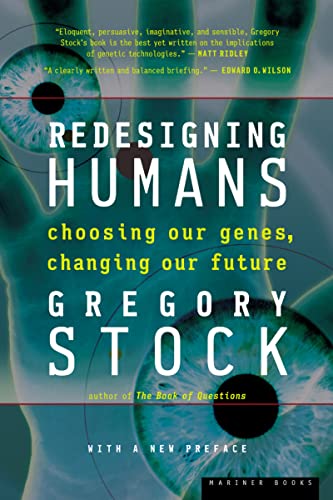
Redesigning Humans: Choosing our genes, changing our future – An Expert Assessment of Biotechnology, DNA, and the Scientific Revolution - Softcover
Inhaltsangabe
A groundbreaking work, Redesigning Humans tackles the controversial subject of engineering the human germline -- the process of permanently altering the genetic code of an individual so that the changes are passed on to the offspring. Gregory Stock, an expert on the implications of recent advances in reproductive biology, has glimpsed the inevitable future of biomedical engineering. Within decades, Stock asserts, technological advances will bring meaningful changes to our offspring; this scientific revolution promises to fundamentally alter the human species. With recent findings presented in a new afterword, Stock's provocative assessment cuts through the debate to envision an age of radical biotechnological advancement and unprecedented human choice.
Die Inhaltsangabe kann sich auf eine andere Ausgabe dieses Titels beziehen.
Über die Autorin bzw. den Autor
Gregory Stock, director of the Program of Medicine, Technology, and Society at the University of California at Los Angeles School of Medicine, has also written, among other books, Metaman: The Merging of Humans and Machines into a Global Superorganism and the best-selling volume on ethical dilemmas, The Book of Questions.
Auszug. © Genehmigter Nachdruck. Alle Rechte vorbehalten.
Redesigning Humans
Choosing Our Genes, Changing Our FutureBy Gregory StockMariner Books
Copyright © 2003 Gregory StockAll right reserved.
ISBN: 0618340831
1
The Last Human
God and Nature first made us what we are, and then out of our own
created genius we make ourselves what we want to be . . . Let the sky
and God be our limit and Eternity our measurement.
—Marcus Garvey (1887–1940)
We know that Homo sapiens is not the final word in primate evolution,
but few have yet grasped that we are on the cusp of profound
biological change, poised to transcend our current form and character
on a journey to destinations of new imagination.
At first glance, the very notion that we might become more
than "human" seems preposterous. After all, we are still biologically
identical in virtually every respect to our cave-dwelling ancestors.
But this lack of change is deceptive. Never before have we had the
power to manipulate human genetics to alter our biology in
meaningful, predictable ways.
Bioethicists and scientists alike worry about the
consequences of coming genetic technologies, but few have thought
through the larger implications of the wave of new developments
arriving in reproductive biology. Today in vitro fertilization is
responsible for fewer than 1 percent of births in the United States;
embryo selection numbers only in the hundreds of cases; cloning and
human genetic modification still lie ahead. But give these emerging
technologies a decade and they will be the cutting edge of human
biological change.
These developments will write a new page in the history of
life, allowing us to seize control of our evolutionary future. Our
coming ability to choose our children"s genes will have immense
social impact and raise difficult ethical dilemmas. Biological
enhancement will lead us into unexplored realms, eventually
challenging our basic ideas about what it means to be human.
Some imagine we will see the perils, come to our senses, and
turn away from such possibilities. But when we imagine Prometheus
stealing fire from the gods, we are not incredulous or shocked by his
act. It is too characteristically human. To forgo the powerful
technologies that genomics and molecular biology are bringing would
be as out of character for humanity as it would be to use them
without concern for the dangers they pose. We will do neither. The
question is no longer whether we will manipulate embryos, but when,
where, and how.
We have already felt the impact of previous advances in
reproductive technology. Without the broad access to birth control
that we take so for granted, the populations of Italy, Japan, and
Germany would not be shrinking; birth rates in the developing world
would not be falling. These are major shifts, yet unlike the public
response to today"s high-tech developments, no impassioned voices
protest birth control as an immense and dangerous experiment with our
genetic future. Those opposing family planning seem more worried
about the immorality of recreational sex than about human evolution.
In this book, we will examine the emerging reproductive
technologies for selecting and altering human embryos. These
developments, culminating in germline engineering — the manipulation
of the genetics of egg or sperm (our "germinal" cells) to modify
future generations — will have large consequences. Already,
procedures that influence the germline are routine in labs working on
fruit flies and mice, and researchers have done early procedures on
nonhuman primates. Direct human germline manipulations may still be a
decade or two away, but methods of choosing specific genes in an
embryo are in use today to prevent disease, and sophisticated methods
for making broader choices are arriving every year, bringing with
them a taste of the ethical and social questions that will accompany
comprehensive germline engineering.
The arrival of safe, reliable germline technology will signal
the beginning of human self-design. We do not know where this
development will ultimately take us, but it will transform the
evolutionary process by drawing reproduction into a highly selective
social process that is far more rapid and effective at spreading
successful genes than traditional sexual competition and mate
selection.
Human cloning has been a topic of passionate debate recently,
but germline engineering and embryo selection have implications that
are far more profound. When cloning becomes safe and reliable enough
to use in humans — which is clearly not yet the case — it will be
inherently conservative, if not extremely so. It will bring no new
genetic constitutions into being, but will create genetic copies of
people who already exist. The idea of a delayed identical twin is
strange and unfamiliar, but not earthshattering. Most of us have met
identical twins. They are very similar, yet different.
Dismissal of technology"s role in humanity"s genetic future
is common even among biologists who use advanced technologies in
their work. Perhaps the notion that we will control our evolutionary
future seems too audacious. Perhaps the idea that humans might one
day differ from us in fundamental ways is too disorienting. Most mass-
media science fiction doesn"t challenge our thinking about this
either. One of the last major sci-fi movies of the second millennium
was The Phantom Menace, George Lucas"s 1999 prequel to Star Wars. Its
vision of human biological enhancement was simple: there won"t be
any. Lucas reveled in special effects and fantastical life forms, but
altered us not a jot. Despite reptilian sidekicks with pedestal eyes
and hard-bargaining insectoids that might have escaped from a Raid
commercial, the film"s humans were no different from us. With the
right accent and a coat and tie, the leader of the Galactic Republic
might have been the president of France.
Such a vision of human continuity is reassuring. It lets us
imagine a future in which we feel at home. Space pods, holographic
telephones, laser pistols, and other amazing gadgets are enticing to
many of us, but pondering a time when humans no longer exist is
another story, one far too alien and unappealing to arouse our
dramatic sympathies. We"ve seen too many apocalyptic images of
nuclear, biological, and environmental disaster to think that the
path to human extinction could be anything but horrific.
Yet the road to our eventual disappearance might be paved not
by humanity"s failure but by its success. Progressive self-
transformation could change our descendants into something
sufficiently different from our present selves to not be human in the
sense we use the term now. Such an occurrence would more aptly be
termed a pseudoextinction, since it would not end our lineage. Unlike
the saber-toothed tiger and other large mammals that left no
descendants when our ancestors drove them to extinction, Homo sapiens
would spawn its own successors by fast-forwarding its evolution.
Some disaster, of course, might derail our technological
advance, or our biology might prove too complex to rework. But our
recent deciphering of the human genome (the entirety of our genetic
constitution) and our massive push to...
„Über diesen Titel“ kann sich auf eine andere Ausgabe dieses Titels beziehen.
Suchergebnisse für Redesigning Humans: Choosing our genes, changing our...

Beispielbild für diese ISBN
Redesigning Humans: Choosing our genes, changing our future
Anbieter: World of Books (was SecondSale), Montgomery, IL, USA
Verkäuferbewertung 5 von 5 Sternen

Zustand: Very Good. Item in very good condition! Textbooks may not include supplemental items i.e. CDs, access codes etc. Artikel-Nr. 00105779155
Gebraucht kaufen
EUR 3,76
Versand gratis
Versand innerhalb von USA
Versand innerhalb von USA
Anzahl: 1 verfügbar
Beispielbild für diese ISBN
Redesigning Humans: Choosing our genes, changing our future
Anbieter: World of Books (was SecondSale), Montgomery, IL, USA
Verkäuferbewertung 5 von 5 Sternen
Zustand: Good. Item in good condition. Textbooks may not include supplemental items i.e. CDs, access codes etc. Artikel-Nr. 00104452522
Gebraucht kaufen
EUR 3,76
Versand gratis
Versand innerhalb von USA
Versand innerhalb von USA
Anzahl: 5 verfügbar
Beispielbild für diese ISBN
Redesigning Humans: Choosing our genes, changing our future
Anbieter: World of Books (was SecondSale), Montgomery, IL, USA
Verkäuferbewertung 5 von 5 Sternen
Zustand: Acceptable. Item in acceptable condition! Textbooks may not include supplemental items i.e. CDs, access codes etc. Artikel-Nr. 00104629389
Gebraucht kaufen
EUR 3,76
Versand gratis
Versand innerhalb von USA
Versand innerhalb von USA
Anzahl: 2 verfügbar
Beispielbild für diese ISBN
Redesigning Humans: Choosing Our Genes, Changing Our Future
Anbieter: ThriftBooks-Atlanta, AUSTELL, GA, USA
Verkäuferbewertung 5 von 5 Sternen
Paperback. Zustand: Very Good. No Jacket. Former library book; May have limited writing in cover pages. Pages are unmarked. ~ ThriftBooks: Read More, Spend Less. Artikel-Nr. G0618340831I4N10
Gebraucht kaufen
EUR 8,08
Versand gratis
Versand innerhalb von USA
Versand innerhalb von USA
Anzahl: 1 verfügbar
Beispielbild für diese ISBN
Redesigning Humans: Choosing our genes, changing our future â" An Expert Assessment of Biotechnology, DNA, and the Scientific Revolution
Verlag:
Mariner Books (edition Reprint), 2003
ISBN 10: 0618340831
ISBN 13: 9780618340835
Gebraucht
Paperback
Anbieter: BooksRun, Philadelphia, PA, USA
Verkäuferbewertung 5 von 5 Sternen
Paperback. Zustand: Very Good. Reprint. It's a well-cared-for item that has seen limited use. The item may show minor signs of wear. All the text is legible, with all pages included. It may have slight markings and/or highlighting. Artikel-Nr. 0618340831-8-1
Gebraucht kaufen
EUR 17,84
Versand gratis
Versand innerhalb von USA
Versand innerhalb von USA
Anzahl: 1 verfügbar
Beispielbild für diese ISBN
Redesigning Humans: Choosing Our Genes, Choosing Our Future (A Mariner Book)
Verlag:
Houghton Mifflin Company, 2003
ISBN 10: 0618340831
ISBN 13: 9780618340835
Gebraucht
Softcover
Anbieter: Anybook.com, Lincoln, Vereinigtes Königreich
Verkäuferbewertung 5 von 5 Sternen
Zustand: Fair. This is an ex-library book and may have the usual library/used-book markings inside.This book has soft covers. Book contains pencil markings. In fair condition, suitable as a study copy. Please note the Image in this listing is a stock photo and may not match the covers of the actual item,350grams, ISBN:9780618340835. Artikel-Nr. 7086811
Gebraucht kaufen
EUR 6,31
EUR 15,84 Versand
Versand von Vereinigtes Königreich nach USA
Versand von Vereinigtes Königreich nach USA
Anzahl: 1 verfügbar
Beispielbild für diese ISBN
Redesigning Humans: Choosing Our Genes, Changing Our Future
Anbieter: Revaluation Books, Exeter, Vereinigtes Königreich
Verkäuferbewertung 5 von 5 Sternen
Paperback. Zustand: Brand New. reprint edition. 277 pages. 8.00x5.25x0.75 inches. In Stock. Artikel-Nr. x-0618340831
Neu kaufen
EUR 22,69
EUR 11,65 Versand
Versand von Vereinigtes Königreich nach USA
Versand von Vereinigtes Königreich nach USA
Anzahl: 2 verfügbar