
Snobbery: The American Version: The American Version – The National Bestseller Skewering Elitism in Food, Fashion, and Politics - Softcover
Inhaltsangabe
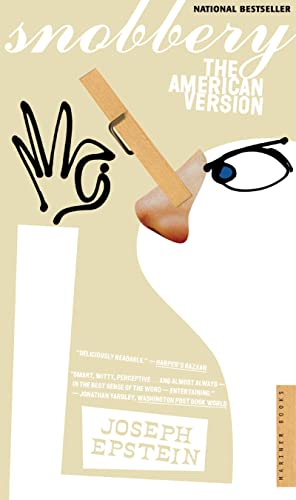
A national bestseller, Snobbery examines the discriminating qualities in all of us. With dishy detail, Joseph Epstein skewers all manner of elitism in contemporary America. He offers his arch observations of the new footholds of snobbery: food, fashion, high-achieving children, schools, politics, being with-it, name-dropping, and much more. Clever, incisive, and immensely entertaining, Snobberyexplores the shallows and depths of status and taste -- with enviable results.
Die Inhaltsangabe kann sich auf eine andere Ausgabe dieses Titels beziehen.
Über die Autorin bzw. den Autor
JOSEPH EPSTEIN is the author of the best-selling Snobbery and of Friendship, among other books, and was formerly editor of the American Scholar. His work has appeared in The New Yorker, Harper’s Magazine, the Atlantic Monthly, and other magazines. He lives in Evanston, Illinois.
Auszug. © Genehmigter Nachdruck. Alle Rechte vorbehalten.
Snobbery
The American VersionBy Joseph EpsteinMariner Books
Copyright © 2003 Joseph EpsteinAll right reserved.
ISBN: 0618340734
Excerpt
1
It Takes One to Know One
Rather than imply his superiority to his subject, the author of a
book about snobbery ought to set out, fairly briefly, his own
experience of snobbery. He ought to let his readers know if he has
been a victim of snobbery, and of the sorts of snobbery to which he
is susceptible, to allow them to judge his own relationship to the
subject.
Perhaps the best way for me to begin, then, is to explain my
social origins. These are a bit complicated. They seem to have been
culturally lower middle class but with middle- and, later, upper-
middle-class financial backing. Neither of my parents went to
college. My father, growing up in Canada, in fact never finished high
school; my mother took what was then known as "the commercial course"
at John Marshall (public) High School in Chicago. They were both
Jewish, but, against the positive stereotype of Jews loving culture
and things of the mind, my parents had almost no cultural interests
apart from occasionally going to musical comedies or, in later years,
watching the Boston Pops on television. Magazines — Life, Look, later
Time — and local newspapers came into our apartment, but no books. I
don"t recall our owning an English dictionary, though both my parents
were well spoken, always grammatical and jargon-free.
Politics was not a great subject of family conversation. The
behavior of our extended family and neighbors, money, my father"s
relations with customers at his business, these made up the main
conversational fare — unspeculative, nonhypothetical, all very
specific. Education was another subject of little interest; no time
was spent, say, discussing the differences between Amherst and
Williams colleges, for the good reason that neither of my parents had
ever heard of such places.
My father, I believe, hadn"t a speck of snobbery. It would
not have occurred to him to want to rise socially in the world, and
the only people he looked down upon — apart from crooks of one kind
or another — were people who seemed to be without the ambition to
take measured risks in business. We had a distant cousin who was a
lieutenant colonel in the U.S. Army, and my father was baffled by the
notion of a Jewish man settling for a career in the regular army. It
pleased my father to give ample sums to charities (many of them
Jewish charities) and, in later years, to travel to foreign
countries — once, with my mother, to Paris on the Concorde and back
from London on the QE2. Above all, it pleased him to have made enough
money to help out his family and be able to establish his financial
independence, which he did at the age of seventeen. But he barely
acknowledged the social realm in which snobbery takes place. For him
the world of status, where style, rank, and social climbing were
central, was a mystery he felt no need to fathom.
My mother, though no snob either, had a greater awareness of
snobbery. She was on the alert for snobberies used against her, and
could be vulnerable to them. In her friendships she sought out women
who were goodhearted, for she was goodhearted and generous herself.
She also had an unashamed taste for what, by her standard, passed for
luxe, which meant driving big cars (Cadillacs), owning lavish
furniture, dressing well (furs, expensive dresses, Italian shoes,
jewelry). She was made a bit nervous by people who had more money
than she, and tended to arrange her social life among people who were
her financial equals or inferiors. But I never saw my mother — or my
father — commit a single socially mean act: I never saw them fawn
over anyone better off than they, or put down anyone beneath them for
reasons one would think to call snobbish.
Why, then, did the eldest of their two sons, the author of
this book, have so keen a sense, almost from the outset of his
consciousness, of the various arrangements that make for snobbery:
social class, money, taste, religion, admired attainments, status of
all kinds. As a small boy, I sensed who was richer than whom, noted
people who lived more grandly and more poorly than we, immediately
grasped what excited the envy of others, felt stirrings of incipient
envy of my own. Where this came from I cannot even now say, but it
was, beyond argument, in place. Nor, to this day, has it ever left me.
When men gathered in my parents" apartment to talk about
world affairs, I could not help noticing that the wealthier ones
generally did most of the talking, or at least talked most
authoritatively and were listened to most closely. A pleasant man
named Sam Cowling, living in the apartment building next to ours, was
a comedian on a popular radio show called The Breakfast Club, and
this, clearly, lent him a certain allure. Money and celebrity, I
early recognized, counted for quite a bit in the world. Some work in
life carried greater prestige than other work — as in baseball,
shortstop was a more admired position than second base, and in
football, quarterback was more admired than interior lineman.
In grammar school I was able to arrange to play both
shortstop and quarterback. I also became a fair tennis player, a
sport with all sorts of interesting connections to snobbery, from its
then country-club settings to its emphasis on stylishness, which
tends to vaunt appearance over reality — a phenomenon at the heart of
much snobbery.
I went to a high school where status was spelled out with a
brute clarity I have not since encountered elsewhere. At Nicholas
Senn High School on the North Side of Chicago, status was at least as
carefully calibrated as at the court of the Sun King at Versailles,
though the food was less good and the clothing nowhere near so
elegant. The school had roughly fifty clubs, fraternities, and
sororities for boys and for girls, each with its own colorful
jackets. Some had Greek-letter names — Alpha, Beta, Delta; some had
the names of animals, real and mythological — Ravens, Condors,
Gargoyles; some had names with aristocratic shadings — Dukes,
Majestics, Imperials, Gentry; some had neologisms for names —
Raynors, Chiquitas, Fidels, Iaetas. But each club, each fraternity
and sorority had a social character that was distinct and apparent to
the student body: this club represented the best athletes, this
sorority the cutest girls, this fraternity the most fearsome thugs,
this the dreariest nerds ("science bores," we called them).
It didn"t take me long — perhaps a couple of months at the
outside — to decode all these groups with their various social
gradations. Because I had in those days a superficial charm that
allowed me to make friends easily, I was soon invited to join the
best of the clubs and fraternities, which meant those whose members
were among the best athletes and most socially fluent of the school"s
male students. The ease with which I was able to do this may have
left me a touch jaded. Sufficiently so, at any rate, so that during
my senior year in high school I was invited to join a boys" honor
society called Green...
„Über diesen Titel“ kann sich auf eine andere Ausgabe dieses Titels beziehen.
Suchergebnisse für Snobbery: The American Version: The American Version...

Beispielbild für diese ISBN
Snobbery The American Version
Anbieter: World of Books (was SecondSale), Montgomery, IL, USA
Verkäuferbewertung 5 von 5 Sternen

Zustand: Good. Item in good condition. Textbooks may not include supplemental items i.e. CDs, access codes etc. Artikel-Nr. 00093772415
Gebraucht kaufen
EUR 4,42
Versand gratis
Versand innerhalb von USA
Versand innerhalb von USA
Anzahl: 8 verfügbar
Beispielbild für diese ISBN
Snobbery: The American Version - The National Bestseller Skewering Elitism in Food, Fashion, and Politics
Anbieter: World of Books (was SecondSale), Montgomery, IL, USA
Verkäuferbewertung 5 von 5 Sternen
Zustand: Acceptable. Item in good condition. Textbooks may not include supplemental items i.e. CDs, access codes etc. Artikel-Nr. 00069608605
Gebraucht kaufen
EUR 4,42
Versand gratis
Versand innerhalb von USA
Versand innerhalb von USA
Anzahl: 1 verfügbar
Beispielbild für diese ISBN
Snobbery: The American Version
Anbieter: ThriftBooks-Dallas, Dallas, TX, USA
Verkäuferbewertung 5 von 5 Sternen
Paperback. Zustand: Very Good. No Jacket. May have limited writing in cover pages. Pages are unmarked. ~ ThriftBooks: Read More, Spend Less. Artikel-Nr. G0618340734I4N00
Gebraucht kaufen
EUR 5,85
Versand gratis
Versand innerhalb von USA
Versand innerhalb von USA
Anzahl: 1 verfügbar
Beispielbild für diese ISBN
Snobbery: The American Version
Anbieter: ThriftBooks-Reno, Reno, NV, USA
Verkäuferbewertung 5 von 5 Sternen
Paperback. Zustand: Very Good. No Jacket. May have limited writing in cover pages. Pages are unmarked. ~ ThriftBooks: Read More, Spend Less. Artikel-Nr. G0618340734I4N00
Gebraucht kaufen
EUR 5,85
Versand gratis
Versand innerhalb von USA
Versand innerhalb von USA
Anzahl: 1 verfügbar
Beispielbild für diese ISBN
Snobbery: The American Version
Anbieter: ThriftBooks-Atlanta, AUSTELL, GA, USA
Verkäuferbewertung 5 von 5 Sternen
Paperback. Zustand: Very Good. No Jacket. May have limited writing in cover pages. Pages are unmarked. ~ ThriftBooks: Read More, Spend Less. Artikel-Nr. G0618340734I4N00
Gebraucht kaufen
EUR 5,85
Versand gratis
Versand innerhalb von USA
Versand innerhalb von USA
Anzahl: 1 verfügbar
Beispielbild für diese ISBN
Snobbery : The American Version
Verlag:
HarperCollins Publishers, 2003
ISBN 10: 0618340734
ISBN 13: 9780618340736
Gebraucht
Softcover
Anbieter: Better World Books, Mishawaka, IN, USA
Verkäuferbewertung 5 von 5 Sternen
Zustand: Very Good. Reprint. Pages intact with possible writing/highlighting. Binding strong with minor wear. Dust jackets/supplements may not be included. Stock photo provided. Product includes identifying sticker. Better World Books: Buy Books. Do Good. Artikel-Nr. 8009530-6
Gebraucht kaufen
EUR 5,88
Versand gratis
Versand innerhalb von USA
Versand innerhalb von USA
Anzahl: 1 verfügbar
Beispielbild für diese ISBN
Snobbery : The American Version
Verlag:
HarperCollins Publishers, 2003
ISBN 10: 0618340734
ISBN 13: 9780618340736
Gebraucht
Softcover
Anbieter: Better World Books: West, Reno, NV, USA
Verkäuferbewertung 5 von 5 Sternen
Zustand: Good. Reprint. Pages intact with minimal writing/highlighting. The binding may be loose and creased. Dust jackets/supplements are not included. Stock photo provided. Product includes identifying sticker. Better World Books: Buy Books. Do Good. Artikel-Nr. 3361147-6
Gebraucht kaufen
EUR 6,06
Versand gratis
Versand innerhalb von USA
Versand innerhalb von USA
Anzahl: 1 verfügbar
Beispielbild für diese ISBN
Snobbery: The American Version
Anbieter: Wonder Book, Frederick, MD, USA
Verkäuferbewertung 5 von 5 Sternen
Zustand: Good. Good condition. A copy that has been read but remains intact. May contain markings such as bookplates, stamps, limited notes and highlighting, or a few light stains. Bundled media such as CDs, DVDs, floppy disks or access codes may not be included. Artikel-Nr. D16M-01457
Gebraucht kaufen
EUR 6,74
Versand gratis
Versand innerhalb von USA
Versand innerhalb von USA
Anzahl: 1 verfügbar
Beispielbild für diese ISBN
SNOBBERY : THE AMERICAN VERSION
Anbieter: Magers and Quinn Booksellers, Minneapolis, MN, USA
Verkäuferbewertung 5 von 5 Sternen
paperback. Zustand: Very Good. May have light to moderate shelf wear and/or a remainder mark. Complete. Clean pages. Artikel-Nr. 1221215
Gebraucht kaufen
EUR 5,84
EUR 3,49 Versand
Versand innerhalb von USA
Versand innerhalb von USA
Anzahl: 1 verfügbar
Beispielbild für diese ISBN
Snobbery: The American Version
Anbieter: WorldofBooks, Goring-By-Sea, WS, Vereinigtes Königreich
Verkäuferbewertung 5 von 5 Sternen
Paperback. Zustand: Very Good. The book has been read, but is in excellent condition. Pages are intact and not marred by notes or highlighting. The spine remains undamaged. Artikel-Nr. GOR004583656
Gebraucht kaufen
EUR 3,27
EUR 6,59 Versand
Versand von Vereinigtes Königreich nach USA
Versand von Vereinigtes Königreich nach USA
Anzahl: 4 verfügbar