
Inhaltsangabe
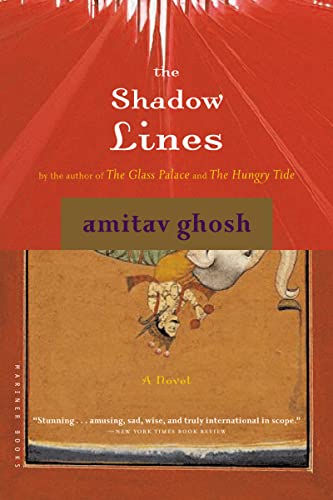
From the acclaimed author of Sea of Poppies, a novel weaving history and memory together to create “a rare work that balances formal ingenuity, heart, and mind” (New Republic)
Opening in Calcutta in the 1960s, Amitav Ghosh's radiant second novel follows two families—one English, one Bengali—as their lives intertwine in tragic and comic ways. The narrator, Indian born and English educated, traces events back and forth in time, from the outbreak of World War II to the late twentieth century, through years of Bengali partition and violence, observing the ways in which political events invade private lives.
Die Inhaltsangabe kann sich auf eine andere Ausgabe dieses Titels beziehen.
Über die Autorin bzw. den Autor
Amitav Ghosh was born in Calcutta in 1956 and raised and educated in Bangladesh, Sri Lanka, Iran, Egypt, India, and the United Kingdom, where he received his Ph.D. in social anthropology from Oxford. Acclaimed for fiction, travel writing, and journalism, his books include The Circle of Reason, The Shadow Lines, In an Antique Land, and Dancing in Cambodia. Ghosh has won France’s Prix Medici Etranger, India’s prestigious Sahitya Akademi Award, the Arthur C. Clarke Award, and the Pushcart Prize. He now divides his time between Harvard University, where he is a visiting professor, and his homes in India and Brooklyn, New York.
Auszug. © Genehmigter Nachdruck. Alle Rechte vorbehalten.
The Shadow Lines
By Amitav GhoshHoughton Mifflin Harcourt Publishing Company
Copyright © 1988 Amitav Ghosh
All rights reserved.
ISBN: 978-0-618-32996-0All rights reserved.
Contents
Title Page,
Contents,
Copyright,
Dedication,
GOING AWAY,
COMING HOME,
About the Author,
CHAPTER 1
GOING AWAY
In 1939, thirteen years before I was born, my father's aunt, Mayadebi, went to England with her husband and her son, Tridib.
It startles me now to discover how readily the name comes off my pen as 'Mayadebi' for I have never spoken of her thus; not aloud, at any rate: as my grandmother's only sister, she was always Mayathakuma to me. But still, from as far back as I can remember, I have known her, in the secrecy of my mind, as 'Mayadebi'— as though she were a well-known stranger, like a film star or a politician whose picture I had seen in a newspaper. Perhaps it was merely because I knew her very little, for she was not often in Calcutta. That explanation seems likely enough, but I know it to be untrue. The truth is that I did not want to think of her as a relative: to have done that would have diminished her and her family — I could not bring myself to believe that their worth in my eyes could be reduced to something so arbitrary and unimportant as a blood relationship.
Mayadebi was twenty-nine when they left, and Tridib was eight.
Over the years, although I cannot remember when it happened any more than I can remember when I first learnt to tell the time or tie my shoelaces, I have come to believe that I was eight too when Tridib first talked to me about that journey. I remember trying very hard to imagine him back to my age, to reduce his height to mine, and to think away the spectacles that were so much a part of him that I really believed he had been born with them. It wasn't easy, for to me he looked old, impossibly old, and I could not remember him looking anything other than old — though, in fact, at that time he could not have been much older than twenty-nine. In the end, since I had nothing to go on, I had decided that he had looked like me.
But my grandmother, when I asked her, was very quick to contradict me. She shook her head firmly, looking up from her schoolbooks, and said: No, he looked completely different — not at all like you.
My grandmother didn't approve of Tridib. He's a loafer and a wastrel, I would sometimes hear her saying to my parents; he doesn't do any proper work, lives off his father's money.
To me, she would only allow herself to say with a sardonic little twist of her mouth: I don't want to see you loafing about with Tridib; Tridib wastes his time.
It didn't sound terrible, but in fact, in my grandmother's usage, there was nothing very much worse that could be said of anyone. For her, time was like a toothbrush: it went mouldy if it wasn't used. I asked her once what happened to wasted time. She tossed her small silvery head, screwed up her long nose and said: It begins to stink.
As for herself, she had been careful to rid our little flat of everything that might encourage us to let our time stink. No chessboard nor any pack of cards ever came through our door; there was a battered Ludo set somewhere but I was allowed to play with it only when I was ill. She didn't even approve of my mother listening to the afternoon radio play more than once a week. In our flat we all worked hard at whatever we did: my grandmother at her schoolmistressing; I at my homework; my mother at her housekeeping; my father at his job as a junior executive in a company which dealt in vulcanised rubber.
Our time wasn't given the slightest opportunity to grow mouldy.
That was why I loved to listen to Tridib: he never seemed to use his time, but his time didn't stink.
Sometimes Tridib would drop in to see us without warning. My grandmother, for all her disapproval of him, would be delighted whenever he came — partly because she was fond of him in her own way, but mainly because Tridib and his family were our only rich relatives, and it flattered her to think that he had gone out of his way to come and see her.
But of course, she knew, though she wouldn't admit it, that he had really come to nurse his stomach. The truth was that his digestion was a mess; ruined by the rivers of hard-boiled tea he had drunk at roadside stalls all over south Calcutta. Every once in a while a rumble in his bowels would catch him unawares on the streets and he would have to sprint for the nearest clean lavatory.
This condition was known to us as Tridib's Gastric.
Once every few months or so we would answer the doorbell and find him leaning against the wall, his legs tightly crossed, the sweat starting from his forehead. But he wouldn't come in right away: there was a careful etiquette attached to these occasions. My parents and grandmother would collect at the doorway and, ignoring his writhings, would proceed to ask him about his family's doings and whereabouts, and he in turn, smiling fixedly, would ask them how they were, and how I was, and finally, when it had been established to everyone's satisfaction that he had come on a Family Visit, he would shoot through the door straight into the lavatory. When he emerged again he would be his usual nonchalant, collected self; he would sink into our 'good' sofa and the ritual of the Family Visit would begin. My grandmother would hurry into the kitchen to make him an omelette — a leathery little squiggle studded with green chillies, which would lie balefully on its plate, silently challenging Gastric to battle. This was the greatest sign of favour she could show to a visitor — an omelette made with her own hands (it fell to the less favoured to feast on my mother's masterly tidbits — hot shingaras stuffed with mincemeat and raisins, or crisp little dalpuris).
Sometimes, watching him as he chewed upon her omelette, she would ask: And how is Gastric? or: Is Gastric better now? Tridib would merely nod casually and change the subject; he didn't like to talk about his digestion — it was the only evidence of prudery I ever saw in him. But since I always heard my grandmother using that word as a proper noun, I grew up believing that 'Gastric' was the name of an organ peculiar to Tridib — a kind of aching tooth that grew out of his belly button. Of course, I never dared ask to see it.
Despite the special omelette, however, my grandmother would not let him stay long. She believed him to be capable of exerting his influence at a distance, like a baneful planet — and since she also believed the male, as a species, to be naturally frail and wayward, she would not allow herself to take the risk of having him for long in our flat where I, or my father, might be tempted to move into his orbit.
I didn't mind particularly, for Tridib was never at his best in our flat. I far preferred to run into him at the street corners in our neighbourhood. It didn't happen very often — no more than once a month perhaps — but still, I took his presence on these streets so much for granted that it never occurred to me that I was lucky to have him in Calcutta at all.
Tridib's father was a diplomat, an officer in the Foreign Service. He and Mayadebi were always away, abroad or in Delhi; after intervals of two or three years they would sometimes spend a couple of months in Calcutta, but that was all. Of Tridib's two brothers, Jatin-kaku, the elder, who was two years older than Tridib, was an economist with the UN. He was always away too, somewhere in Africa or South...
„Über diesen Titel“ kann sich auf eine andere Ausgabe dieses Titels beziehen.
Weitere beliebte Ausgaben desselben Titels

Suchergebnisse für The Shadow Lines: A Novel

Beispielbild für diese ISBN
The Shadow Lines
Anbieter: ThriftBooks-Reno, Reno, NV, USA
Verkäuferbewertung 5 von 5 Sternen

Paperback. Zustand: Good. No Jacket. Pages can have notes/highlighting. Spine may show signs of wear. ~ ThriftBooks: Read More, Spend Less. Artikel-Nr. G061832996XI3N00
Gebraucht kaufen
EUR 5,87
Versand gratis
Versand innerhalb von USA
Versand innerhalb von USA
Anzahl: 4 verfügbar
Beispielbild für diese ISBN
The Shadow Lines
Anbieter: ThriftBooks-Reno, Reno, NV, USA
Verkäuferbewertung 5 von 5 Sternen
Paperback. Zustand: Fair. No Jacket. Readable copy. Pages may have considerable notes/highlighting. ~ ThriftBooks: Read More, Spend Less. Artikel-Nr. G061832996XI5N00
Gebraucht kaufen
EUR 5,87
Versand gratis
Versand innerhalb von USA
Versand innerhalb von USA
Anzahl: 1 verfügbar
Beispielbild für diese ISBN
The Shadow Lines
Anbieter: ThriftBooks-Atlanta, AUSTELL, GA, USA
Verkäuferbewertung 5 von 5 Sternen
Paperback. Zustand: Fair. No Jacket. Readable copy. Pages may have considerable notes/highlighting. ~ ThriftBooks: Read More, Spend Less. Artikel-Nr. G061832996XI5N00
Gebraucht kaufen
EUR 5,87
Versand gratis
Versand innerhalb von USA
Versand innerhalb von USA
Anzahl: 1 verfügbar
Beispielbild für diese ISBN
The Shadow Lines
Anbieter: ThriftBooks-Atlanta, AUSTELL, GA, USA
Verkäuferbewertung 5 von 5 Sternen
Paperback. Zustand: Very Good. No Jacket. Former library book; May have limited writing in cover pages. Pages are unmarked. ~ ThriftBooks: Read More, Spend Less. Artikel-Nr. G061832996XI4N10
Gebraucht kaufen
EUR 5,87
Versand gratis
Versand innerhalb von USA
Versand innerhalb von USA
Anzahl: 1 verfügbar
Beispielbild für diese ISBN
The Shadow Lines
Anbieter: ThriftBooks-Phoenix, Phoenix, AZ, USA
Verkäuferbewertung 5 von 5 Sternen
Paperback. Zustand: Good. No Jacket. Pages can have notes/highlighting. Spine may show signs of wear. ~ ThriftBooks: Read More, Spend Less. Artikel-Nr. G061832996XI3N00
Gebraucht kaufen
EUR 5,87
Versand gratis
Versand innerhalb von USA
Versand innerhalb von USA
Anzahl: 3 verfügbar
Beispielbild für diese ISBN
The Shadow Lines
Anbieter: ThriftBooks-Dallas, Dallas, TX, USA
Verkäuferbewertung 5 von 5 Sternen
Paperback. Zustand: Fair. No Jacket. Readable copy. Pages may have considerable notes/highlighting. ~ ThriftBooks: Read More, Spend Less. Artikel-Nr. G061832996XI5N00
Gebraucht kaufen
EUR 5,87
Versand gratis
Versand innerhalb von USA
Versand innerhalb von USA
Anzahl: 2 verfügbar
Beispielbild für diese ISBN
The Shadow Lines
Anbieter: ThriftBooks-Atlanta, AUSTELL, GA, USA
Verkäuferbewertung 5 von 5 Sternen
Paperback. Zustand: Good. No Jacket. Pages can have notes/highlighting. Spine may show signs of wear. ~ ThriftBooks: Read More, Spend Less. Artikel-Nr. G061832996XI3N00
Gebraucht kaufen
EUR 5,87
Versand gratis
Versand innerhalb von USA
Versand innerhalb von USA
Anzahl: 4 verfügbar
Beispielbild für diese ISBN
The Shadow Lines
Anbieter: ThriftBooks-Dallas, Dallas, TX, USA
Verkäuferbewertung 5 von 5 Sternen
Paperback. Zustand: Very Good. No Jacket. May have limited writing in cover pages. Pages are unmarked. ~ ThriftBooks: Read More, Spend Less. Artikel-Nr. G061832996XI4N00
Gebraucht kaufen
EUR 5,87
Versand gratis
Versand innerhalb von USA
Versand innerhalb von USA
Anzahl: 1 verfügbar
Beispielbild für diese ISBN
The Shadow Lines
Anbieter: ThriftBooks-Phoenix, Phoenix, AZ, USA
Verkäuferbewertung 5 von 5 Sternen
Paperback. Zustand: Fair. No Jacket. Readable copy. Pages may have considerable notes/highlighting. ~ ThriftBooks: Read More, Spend Less. Artikel-Nr. G061832996XI5N00
Gebraucht kaufen
EUR 5,87
Versand gratis
Versand innerhalb von USA
Versand innerhalb von USA
Anzahl: 1 verfügbar
Beispielbild für diese ISBN
The Shadow Lines
Anbieter: ThriftBooks-Dallas, Dallas, TX, USA
Verkäuferbewertung 5 von 5 Sternen
Paperback. Zustand: Good. No Jacket. Pages can have notes/highlighting. Spine may show signs of wear. ~ ThriftBooks: Read More, Spend Less. Artikel-Nr. G061832996XI3N00
Gebraucht kaufen
EUR 5,87
Versand gratis
Versand innerhalb von USA
Versand innerhalb von USA
Anzahl: 4 verfügbar