
Verwandte Artikel zu The Ninemile Wolves: An Eloquent Inquiry into Man and...
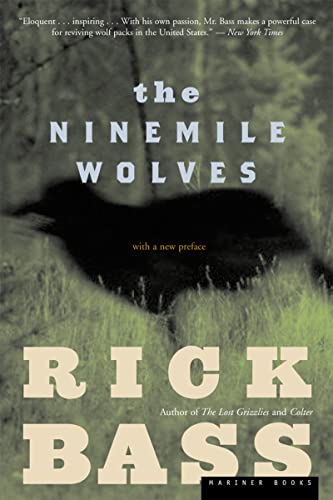
The Ninemile Wolves: An Eloquent Inquiry into Man and Nature Through Wolf Reintroduction in the American West - Softcover
Inhaltsangabe
One of Rick Bass's most widely respected works of natural history, The Ninemile Wolves follows the fate of a modern wolf pack, the first known group of wolves to attempt to settle in Montana outside protected national park territory. The wolf inspires hatred, affection, myth, fear, and pity; its return polarizes the whole of the West -- igniting the passions of cattle ranchers and environmentalists, wildlife biologists and hunters. One man's vigorous, emotional inquiry into the proper relationship between man and nature, The Ninemile Wolves eloquently advocates wolf reintroduction in the West. In a new preface, Bass discusses the enduring lessons of the Ninemile story.
Die Inhaltsangabe kann sich auf eine andere Ausgabe dieses Titels beziehen.
Über die Autorin bzw. den Autor
RICK BASS’s fiction has received O. Henry Awards, numerous Pushcart Prizes, awards from the Texas Institute of Letters, fellowships from the National Endowment for the Arts and the Guggenheim Foundation, and his memoir, Why I Came West, was a finalist for a National Book Critics Circle Award.
Auszug. © Genehmigter Nachdruck. Alle Rechte vorbehalten.
The Ninemile Wolves
By Rick BassMariner Books
Copyright © 2003 Rick BassAll right reserved.
ISBN: 0618263020
Chapter One
"IRON! IRON!"
The shout drifted up through the forest out of the tumult ahead, near the entrance to the gem mines. Birds settled in the branches of the cedar trees shrilled and rose from their perches. I urged my horses on, the wheels of the chariot stirring up clouds of fine dust from the path behind me. Then I pulled on the reins, slowing the chariot down as the path twisted abruptly around a tree.
Ahead of me the trees gave way to grass, falling away down the slopes of the foothills. To the right was the stone wall around the compound of the gem mines, its guard towers deserted. I could see a large knot of people in the entranceway where the gates hung wide open. What were they doing there? Had there been an accident? A riot? That was all we needed.
As I slowed down in the empty space of the killing field around the mines and wheeled the chariot around, they spotted me. I stopped the chariot a few feet from them.
A tall man, one of only a few wearing robes rather than laborers' tunics, stepped out of the crowd as they turned toward me, excitement showing on his face. It wasn't a riot, then, or an accident.
"Escount Cathan, it's fortunate that you have arrived; may Ranthas be with you." His beard was cut quite short, and his oiled hair was overlaid with powdery dust. His face was thin and gaunt, his eyes deep-sunk but alight with the same interest as the others'.
"What's all the commotion, Maal?" I asked. "What's so important that work's been interrupted, with the ship due to arrive any day now?" Any day now, that was, as long as the coriolis storm out over the ocean dissipated soon. It was the second this month, and the ship had already been delayed once.
"Master, we have found iron! The priest of Ranthas who offered to help our mining operations has discovered a huge seam of the red ore!"
I almost refused to believe him at first. Iron? Had we been sitting on top of one of the most valuable commodities of all for these last few ailing months and neglected it? Iron was in short supply across Aquasilva; the floating islands simply didn't hold enough of the ore to meet the demands of the steel foundries -- and, ultimately, of the continents' armies. After flamewood and its derivatives, iron was the most highly prized of all the raw materials.
"Is this certain?" I demanded, keeping my face impassive. I didn't want to show too much excitement in front of the mine workers.
In answer, Maal called to someone in the throng. There weren't as many of them as I'd thought at first; about twelve or fifteen people were clustered there, mostly overseers and foremen. Someone at the back tossed a lump of rock over their heads. Maal deftly caught it and handed it to me.
One of the horses whickered as I turned the rock over in my hand, noting the gray-black crystals in it.
"Is it mineable?"
"The priest thinks so. He's in the mine with Haaluk."
"Someone come and hold the reins," I said. One of the men moved over and took them, and I stepped out of the chariot.
"Take me to the priest," I said to Maal. "The rest of you continue with your work."
A path opened for me to pass through them. Maal led me across the court inside the palisade. There were buildings along one side, and the opencast trenches on the other. Opposite us yawned the black hole of the mine entrance. I wasn't particularly fond of going in there -- I hate caves -- but this was important, so I'd have to try not to think about being underground. This gemstone mine was the principal reason for the existence of Clan Lepidor, the northernmost of the fifteen clans on the continent of Oceanus, and by a small margin the northernmost continental clan in the world. There hadn't been a city here before the Tuonetar War, but a hundred and fifty-eight years ago a prospecting party had discovered rich gem seams and shortly afterward a group of Oceanian and Archipelagan refugees had settled in the area and founded a new clan.
We were rather lucky, in fact -- there were rich fishing grounds nearby, and the mountains gave better than usual protection from the storms, allowing a lush forest to grow up along the coast. I was glad of that -- it made Lepidor territory a lot less bleak than the lands of some of the more southerly clans, which were too exposed for trees to grow there, and hence were very depressing places to be.
My House had been in power since its founding, after some distant ancestor or other had performed an extraordinary service for the city and the other Houses had unanimously chosen him to lead them. At least, that was the official story. It sounded rather dubious to me, and I guessed the reality had been somewhat less honorable. Still, that was history now, and my father, Count Elnibal II, was known as one of the most upstanding of the present fifteen Counts of Oceanus.
The problem for us at the moment was that over the last few years the price of gemstones had been dropping and the mine had become less profitable, and in recent months the Count and the merchants had been struggling to make ends meet. We could survive, of course, without the mine: there was fertile farmland along the coast and extensive fisheries for food, and the forests would supply us with wood and keep some exports going.
But without the gems there was nothing worthwhile to trade, and so Clan Lepidor would degenerate into a farming combine, not fit to be called a clan. And since I didn't want to inherit a mere combine, nor see my clan's fortunes plummet, I'd been as worried about the future as anyone.
Until now. My head was suddenly full of possibilities. If there was enough iron, and it could be exploited, we'd be rich again as soon as the first cargo was sold in the markets of Oceanus's capital, Pharassa. We might even be able to sign a contract with a Great House to carry it across the ocean to Taneth, Aquasilva's trading capital. It was a long journey, and I knew it was much more dangerous, but the iron prices would be much higher there.
I ducked under the wooden framework of the gateway and into the tunnel of the mine, lit by three flamewood torches. I heard two voices a little way ahead.
"...Seam extends out for hundreds of feet, I tell you."
"I know the rock around here, Domine, and there's no possible way it can." The voice of the mine's manager, Haaluk-Itti, coarser than the smooth, modulated tones of the priest of Ranthas. Haaluk had been exiled from Mons Ferranis two years ago after a quarrel with a merchant, and would spend another year supervising Lepidor's mines before we lost him again to his homeland. It would be a pity: despite his abrasive bitterness, he was a good manager.
"Ah, Escount Cathan," the priest said, as he saw me. His face was in shadow.
Haaluk, who was standing with his back to the entrance, swung around. "Doubtless you've heard," he said. "I have found myself forced to disagree with Domine Istiq, despite all his wisdom, on the extent of the deposit." Priests were always called Domine, a title from the old tongue.
"What's the difference in your estimates?" I ask Haaluk.
"His are twice as large as mine."
"Is the mine workable with your figure?"
"By all means. The Domine will tell you," he said gruffly.
"My calculations are rough guesses, you understand," Domine Istiq said, "but I would estimate you have enough here to sell ten thousand corons' worth every month, for more than a century and a half."
I attempted to calculate the resulting profit figures in my head,...
„Über diesen Titel“ kann sich auf eine andere Ausgabe dieses Titels beziehen.
Suchergebnisse für The Ninemile Wolves: An Eloquent Inquiry into Man and...

Beispielbild für diese ISBN
The Ninemile Wolves: An Eloquent Inquiry into Man and Nature Through Wolf Reintroduction in the American West
Verlag:
Mariner Books (edition Reprint), 2003
ISBN 10: 0618263020
ISBN 13: 9780618263028
Gebraucht
Paperback
Anbieter: BooksRun, Philadelphia, PA, USA
Verkäuferbewertung 5 von 5 Sternen

Paperback. Zustand: Fair. Reprint. The item might be beaten up but readable. May contain markings or highlighting, as well as stains, bent corners, or any other major defect, but the text is not obscured in any way. Artikel-Nr. 0618263020-7-1
Gebraucht kaufen
EUR 4,70
Versand gratis
Versand innerhalb von USA
Versand innerhalb von USA
Anzahl: 1 verfügbar
Beispielbild für diese ISBN
Ninemile Wolves, The
Anbieter: World of Books (was SecondSale), Montgomery, IL, USA
Verkäuferbewertung 5 von 5 Sternen
Paperback. Zustand: Very Good. Heralded by Science Fiction Chronicle as one of the Best Books of 2001. Across the waterworld of Aquasilva, change is being fought and ruthlessly suppressed by the Domain and its ferocious holy warriors, the Sacri. When Cathan, a count's son, inadvertently stumbles across a terrifying Domain plot to wipe out the rising discontent, he is thrust headlong into a fight beyond his control. Artikel-Nr. 00097450761
Gebraucht kaufen
EUR 5,95
Versand gratis
Versand innerhalb von USA
Versand innerhalb von USA
Anzahl: Mehr als 20 verfügbar
Beispielbild für diese ISBN
Ninemile Wolves, The
Anbieter: World of Books (was SecondSale), Montgomery, IL, USA
Verkäuferbewertung 5 von 5 Sternen
Paperback. Zustand: Good. Heralded by Science Fiction Chronicle as one of the Best Books of 2001. Across the waterworld of Aquasilva, change is being fought and ruthlessly suppressed by the Domain and its ferocious holy warriors, the Sacri. When Cathan, a count's son, inadvertently stumbles across a terrifying Domain plot to wipe out the rising discontent, he is thrust headlong into a fight beyond his control. Artikel-Nr. 00097450504
Gebraucht kaufen
EUR 5,95
Versand gratis
Versand innerhalb von USA
Versand innerhalb von USA
Anzahl: 5 verfügbar
Beispielbild für diese ISBN
The Ninemile Wolves
Anbieter: ThriftBooks-Dallas, Dallas, TX, USA
Verkäuferbewertung 5 von 5 Sternen
Paperback. Zustand: Very Good. No Jacket. May have limited writing in cover pages. Pages are unmarked. ~ ThriftBooks: Read More, Spend Less. Artikel-Nr. G0618263020I4N00
Gebraucht kaufen
EUR 5,96
Versand gratis
Versand innerhalb von USA
Versand innerhalb von USA
Anzahl: 1 verfügbar
Beispielbild für diese ISBN
The Ninemile Wolves
Anbieter: ThriftBooks-Atlanta, AUSTELL, GA, USA
Verkäuferbewertung 5 von 5 Sternen
Paperback. Zustand: Good. No Jacket. Pages can have notes/highlighting. Spine may show signs of wear. ~ ThriftBooks: Read More, Spend Less. Artikel-Nr. G0618263020I3N00
Gebraucht kaufen
EUR 5,96
Versand gratis
Versand innerhalb von USA
Versand innerhalb von USA
Anzahl: 1 verfügbar
Beispielbild für diese ISBN
The Ninemile Wolves
Anbieter: ThriftBooks-Dallas, Dallas, TX, USA
Verkäuferbewertung 5 von 5 Sternen
Paperback. Zustand: Good. No Jacket. Pages can have notes/highlighting. Spine may show signs of wear. ~ ThriftBooks: Read More, Spend Less. Artikel-Nr. G0618263020I3N00
Gebraucht kaufen
EUR 5,96
Versand gratis
Versand innerhalb von USA
Versand innerhalb von USA
Anzahl: 1 verfügbar
Beispielbild für diese ISBN
The Ninemile Wolves
Anbieter: ThriftBooks-Atlanta, AUSTELL, GA, USA
Verkäuferbewertung 5 von 5 Sternen
Paperback. Zustand: Fair. No Jacket. Former library book; Readable copy. Pages may have considerable notes/highlighting. ~ ThriftBooks: Read More, Spend Less. Artikel-Nr. G0618263020I5N10
Gebraucht kaufen
EUR 5,96
Versand gratis
Versand innerhalb von USA
Versand innerhalb von USA
Anzahl: 1 verfügbar
Beispielbild für diese ISBN
The Ninemile Wolves
Verlag:
HarperCollins Publishers, 2003
ISBN 10: 0618263020
ISBN 13: 9780618263028
Gebraucht
Softcover
Anbieter: Better World Books, Mishawaka, IN, USA
Verkäuferbewertung 5 von 5 Sternen
Zustand: Very Good. 1 Edition. Former library copy. Pages intact with possible writing/highlighting. Binding strong with minor wear. Dust jackets/supplements may not be included. Includes library markings. Stock photo provided. Product includes identifying sticker. Better World Books: Buy Books. Do Good. Artikel-Nr. 12813514-6
Gebraucht kaufen
EUR 6,19
Versand gratis
Versand innerhalb von USA
Versand innerhalb von USA
Anzahl: 1 verfügbar
Beispielbild für diese ISBN
The Ninemile Wolves
Verlag:
HarperCollins Publishers, 2003
ISBN 10: 0618263020
ISBN 13: 9780618263028
Gebraucht
Softcover
Anbieter: Better World Books, Mishawaka, IN, USA
Verkäuferbewertung 5 von 5 Sternen
Zustand: Good. 1 Edition. Pages intact with minimal writing/highlighting. The binding may be loose and creased. Dust jackets/supplements are not included. Stock photo provided. Product includes identifying sticker. Better World Books: Buy Books. Do Good. Artikel-Nr. 4478466-6
Gebraucht kaufen
EUR 6,19
Versand gratis
Versand innerhalb von USA
Versand innerhalb von USA
Anzahl: 1 verfügbar
Beispielbild für diese ISBN
The Ninemile Wolves
Verlag:
HarperCollins Publishers, 2003
ISBN 10: 0618263020
ISBN 13: 9780618263028
Gebraucht
Softcover
Anbieter: Better World Books, Mishawaka, IN, USA
Verkäuferbewertung 5 von 5 Sternen
Zustand: Good. 1 Edition. Former library copy. Pages intact with minimal writing/highlighting. The binding may be loose and creased. Dust jackets/supplements are not included. Includes library markings. Stock photo provided. Product includes identifying sticker. Better World Books: Buy Books. Do Good. Artikel-Nr. 5197653-75
Gebraucht kaufen
EUR 6,19
Versand gratis
Versand innerhalb von USA
Versand innerhalb von USA
Anzahl: 1 verfügbar