
Verwandte Artikel zu Best American Science And Nature Writing 04 Pa: Outstanding...
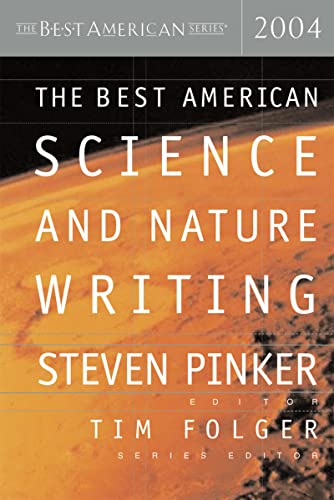
Best American Science And Nature Writing 04 Pa: Outstanding Essays on Psychology, Linguistics, and Cloning―Edited by Steven Pinker (The Best American Series ®) - Softcover
Inhaltsangabe
Since its inception in 1915, the Best American series has become the premier annual showcase for the country's finest short fiction and nonfiction. For each volume, a series editor reads pieces from hundreds of periodicals, then selects between fifty and a hundred outstanding works. That selection is pared down to the twenty or so very best pieces by a guest editor who is widely recognized as a leading writer in his or her field. This unique system has helped make the Best American series the most respected -- and most popular -- of its kind.
The Best American Science and Nature Writing 2004, edited by Steven Pinker, is another "provocative and thoroughly enjoyable [collection] from start to finish" (Publishers Weekly). Here is the best and newest on science and nature: the psychology of suicide terrorism, desperate measures in surgery, the weird world of octopuses, Sex Week at Yale, the linguistics of click languages, the worst news about cloning, and much more.
The Best American Science and Nature Writing 2004, edited by Steven Pinker, is another "provocative and thoroughly enjoyable [collection] from start to finish" (Publishers Weekly). Here is the best and newest on science and nature: the psychology of suicide terrorism, desperate measures in surgery, the weird world of octopuses, Sex Week at Yale, the linguistics of click languages, the worst news about cloning, and much more.
Die Inhaltsangabe kann sich auf eine andere Ausgabe dieses Titels beziehen.
Über die Autorin bzw. den Autor
TIM FOLGER is a contributing editor at Discover and writes about science for several magazines. He lives in New Mexico.
Auszug. © Genehmigter Nachdruck. Alle Rechte vorbehalten.
The Best American Science and Nature Writing 2004
By Tim FolgerHoughton Mifflin Company
Copyright © 2004 Tim FolgerAll right reserved.
ISBN: 9780618246984
Introduction
Horace"s summary of the purpose of literature, "to delight
and instruct," is also not a bad summary of the purpose of science
and nature writing. The difference is not so much that a science essay
gives more weight to the second in?nitive as that it unites the
two. The best science writing delights by instructing. A good science
essay, like any good essay, must be written with structure and
style, but the best science essays accomplish something else. They
give readers the blissful click, the satisfying aha!, of seeing a puzzling
phenomenon explained.
A good example of what I have in mind comes from my days as a
graduate student. Not from an experience in graduate school but
from an experience living in the kind of apartment that graduate
students can afford. One day its antiquated plumbing sprang a
leak, and an articulate plumber (perhaps an underemployed
Ph.D., I feared) explained what caused it. Water obeys Newton"s
second law.Water is dense.Water is incompressible. When you shut
off a tap, a large incompressible mass moving at high speed has to
decelerate very quickly. This imparts a substantial force to the
pipes, like a car slamming into a wall, which eventually damages
the threads and causes a leak. To deal with this problem, plumbers
used to install a closed vertical section of pipe, a "pipe riser," near
each faucet. When the faucet is shut, the water compresses the column
of air in the riser, which acts like a shock absorber. Unfortunately,
Henry"s Law applies: Gas under pressure is absorbed by a
liquid. Over time, the air in the column dissolves into the water,
which ?lls the pipe riser, rendering it useless. So every now and
then a plumber has to bleed the system and let air back into the risers,
a bit of preventive maintenance the landlord had neglected. It
may not be the harmony of the spheres or the grandeur in this view
of life, but the plumber"s disquisition captured what I treasure
most in science writing: the ability to show how a seemingly capricious
occurrence falls out of laws of greater generality.
Good science writing has to be good writing, and another graduate
school experience led me to appreciate its ?rst priority, clarity.
The great Harvard psychologist Gordon Allport had died years before
I entered the program, but he had written an "Epistle to Thesis
Writers" that was still being handed down from generation to
generation of doctoral candidates. Allport tried to steer students
away from the clutter and fog of professional science prose and offered
as a model an essay by a ten-year-old girl, who, he wrote, merited
a higher degree "if not for the accuracy of her knowledge,
then at least for the clarity of her diction":
The bird that I am going to write about is the Owl. The Owl cannot see
at all by day and at night is as blind as a bat.
I do not know much about the Owl, so I will go on to the beast I am
going to choose. It is the Cow. The Cow is a mammal. It has six sides —
right, left, an upper and below. At the back it has a tail on which hangs a
brush. With this it sends the ?ies away so that they do not fall into the
milk. The head is for the purpose of growing horns and so that the
mouth can be somewhere. The horns are to butt with, and the mouth is
to moo with. Under the cow hangs the milk. It is arranged for milking.
When people milk, the milk comes through and there is never any end
to the supply. How the cow does it I have not yet realized, but it makes
more and more. The cow has a ?ne sense of smell; one can smell it far
away. This is the reason for the fresh air in the country.
The man cow is called an ox. It is not a mammal. The cow does not eat
much, but what it eats it eats twice, so that it gets enough. When it is hungry
it moos, and when it says nothing it is because its inside is all full up
with grass.
In assembling this collection I looked for essays that combined
the explanatory depth of the plumber with the limpid prose of the
young zoologist. Explanatory depth, surprisingly, is not that easy to
?nd. The most common specimen is the science news story. A jour-
nalist ?ips through the contents of Science, Nature, and the New England
Journal of Medicine, ?nds the article with the weirdest or most
alarming or most bite-sized ?nding, gets a quote from an author, a
supporter, and a critic, and reports that the discovery has overturned
everything that scientists had always believed. I understand
the pressures that shape this formula: the drama of iconoclasm, the
demand by editors for news rather than pedagogy, a desire to show
that science is a human activity among spirited antagonists rather
than a revelation of the truth by white-coated priests.
But just as presidential campaigns can be distorted by the press"s
obsession with minute-by-minute changes in popularity polls, an
understanding of science can be poorly served by news from the
front about continual revolution. Conclusions from individual experiments,
especially the most surprising ones, are more ephemeral
than conclusions from the reviews and syntheses that can"t be
squeezed into a brief report in Science. The discovery-du-jour approach
can whipsaw readers between contradictory claims of uneven
worth or leave them with lasting misimpressions, such as that
everything that is pleasurable is deadly for one reason or another.
And contrary to the idea (commonly associated with Karl Popper)
that science is a kind of skeet shooting whose goal is to put a bullet
through one hypothesis after another, the best science weaves observations
into an explanatory narrative. "All the Old Sciences
Have Starring Roles" by Chet Raymo (whose weekly science column
graced the Boston Globe until his retirement this year) makes
the point succinctly. Max Tegmark"s mind-expanding "Parallel
Universes" shows, by example and argument, how a powerful theory
can not only organize sundry data but also lead to an exhilarating
new conception of reality itself. Horace Judson"s "The Stuff of
Genes" re?ects on the far-?ung implications — for science and life
— of the discovery of the structure of DNA, whose golden jubilee
was marked in the year these essays appeared.
Clarity and style, happily, are not in short supply in today"s science
writing (though in professional journals their frequency is
commensurate with galliformes" dentition). The genre continues
to attract ?ne writers of all ages, belying the plaint that the younger
generation no longer cares about language. Of all the things that
go into good science writing, I am fondest of prose that airs out a
stuffy hall of scholarship and conveys its insights (or its absurdities)
with irreverent wit, like Gregg Easterbrook"s "We"re All Gonna
Die!," Jonathan Rauch"s "Caring for Your Introvert," Ron Rosenbaum"s
"Sex Week at Yale," and Robert Sapolsky"s "Bugs in the
Brain." But pride of place goes to the Bird Folks (the nom de
plume of Mike O"Connor) at the Bird Watcher"s General Store in
Orleans, Massachusetts, whose informative weekly column strikes a
tone that is opposite to the worshipful sonorities found in much
nature writing (parodied by Mark Twain as "Far in the empty sky a
solitary esophagus slept upon motionless...
„Über diesen Titel“ kann sich auf eine andere Ausgabe dieses Titels beziehen.
Suchergebnisse für Best American Science And Nature Writing 04 Pa: Outstanding...

Beispielbild für diese ISBN
The Best American Science and Nature Writing 2004
Anbieter: World of Books (was SecondSale), Montgomery, IL, USA
Verkäuferbewertung 5 von 5 Sternen

Paperback. Zustand: Very Good. Since its inception in 1915, the Best American series has become the premier annual showcase for the country's finest short fiction and nonfiction. For each volume, a series editor reads pieces from hundreds of periodicals, then selects between fifty and a hundred outstanding works. That selection is pared down to the twenty or so very best pieces by a guest editor who is widely recognized as a leading writer in his or her field. This unique system has helped make the Best American series the most respected -- and most popular -- of its kind. The Best American Science and Nature Writing 2004, edited by Steven Pinker, is another "provocative and thoroughly enjoyable [collection] from start to finish" (Publishers Weekly). Here is the best and newest on science and nature: the psychology of suicide terrorism, desperate measures in surgery, the weird world of octopuses, Sex Week at Yale, the linguistics of click languages, the worst news about cloning, and much more. Artikel-Nr. 00075407354
Gebraucht kaufen
EUR 4,84
Versand gratis
Versand innerhalb von USA
Versand innerhalb von USA
Anzahl: 1 verfügbar
Beispielbild für diese ISBN
The Best American Science and Nature Writing 2004
Anbieter: World of Books (was SecondSale), Montgomery, IL, USA
Verkäuferbewertung 5 von 5 Sternen
Paperback. Zustand: Good. Since its inception in 1915, the Best American series has become the premier annual showcase for the country's finest short fiction and nonfiction. For each volume, a series editor reads pieces from hundreds of periodicals, then selects between fifty and a hundred outstanding works. That selection is pared down to the twenty or so very best pieces by a guest editor who is widely recognized as a leading writer in his or her field. This unique system has helped make the Best American series the most respected -- and most popular -- of its kind. The Best American Science and Nature Writing 2004, edited by Steven Pinker, is another "provocative and thoroughly enjoyable [collection] from start to finish" (Publishers Weekly). Here is the best and newest on science and nature: the psychology of suicide terrorism, desperate measures in surgery, the weird world of octopuses, Sex Week at Yale, the linguistics of click languages, the worst news about cloning, and much more. Artikel-Nr. 00098603179
Gebraucht kaufen
EUR 4,84
Versand gratis
Versand innerhalb von USA
Versand innerhalb von USA
Anzahl: 4 verfügbar
Beispielbild für diese ISBN
The Best American Science and Nature Writing 2004 (The Best American Series)
Verlag:
Mariner Books (edition 2004 ed.), 2004
ISBN 10: 0618246983
ISBN 13: 9780618246984
Gebraucht
Paperback
Anbieter: BooksRun, Philadelphia, PA, USA
Verkäuferbewertung 5 von 5 Sternen
Paperback. Zustand: Very Good. 2004 ed. It's a well-cared-for item that has seen limited use. The item may show minor signs of wear. All the text is legible, with all pages included. It may have slight markings and/or highlighting. Artikel-Nr. 0618246983-11-1
Gebraucht kaufen
EUR 4,85
Versand gratis
Versand innerhalb von USA
Versand innerhalb von USA
Anzahl: 1 verfügbar
Beispielbild für diese ISBN
The Best American Science and Nature Writing 2004 (The Best American Series)
Anbieter: Wonder Book, Frederick, MD, USA
Verkäuferbewertung 5 von 5 Sternen
Zustand: Very Good. Very Good condition. A copy that may have a few cosmetic defects. May also contain light spine creasing or a few markings such as an owner's name, short gifter's inscription or light stamp. Artikel-Nr. Q15O-00879
Gebraucht kaufen
EUR 6,44
Versand gratis
Versand innerhalb von USA
Versand innerhalb von USA
Anzahl: 2 verfügbar
Beispielbild für diese ISBN
The Best American Science and Nature Writing 2004
Anbieter: ThriftBooks-Dallas, Dallas, TX, USA
Verkäuferbewertung 5 von 5 Sternen
Paperback. Zustand: Very Good. No Jacket. May have limited writing in cover pages. Pages are unmarked. ~ ThriftBooks: Read More, Spend Less. Artikel-Nr. G0618246983I4N00
Gebraucht kaufen
EUR 6,47
Versand gratis
Versand innerhalb von USA
Versand innerhalb von USA
Anzahl: 1 verfügbar
Beispielbild für diese ISBN
The Best American Science and Nature Writing 2004
Anbieter: ThriftBooks-Atlanta, AUSTELL, GA, USA
Verkäuferbewertung 5 von 5 Sternen
Paperback. Zustand: As New. No Jacket. Pages are clean and are not marred by notes or folds of any kind. ~ ThriftBooks: Read More, Spend Less. Artikel-Nr. G0618246983I2N00
Gebraucht kaufen
EUR 6,47
Versand gratis
Versand innerhalb von USA
Versand innerhalb von USA
Anzahl: 1 verfügbar
Beispielbild für diese ISBN
The Best American Science and Nature Writing 2004
Verlag:
HarperCollins Publishers, 2004
ISBN 10: 0618246983
ISBN 13: 9780618246984
Gebraucht
Softcover
Anbieter: Better World Books, Mishawaka, IN, USA
Verkäuferbewertung 5 von 5 Sternen
Zustand: Very Good. Pages intact with possible writing/highlighting. Binding strong with minor wear. Dust jackets/supplements may not be included. Stock photo provided. Product includes identifying sticker. Better World Books: Buy Books. Do Good. Artikel-Nr. 2397647-6
Gebraucht kaufen
EUR 7,23
Versand gratis
Versand innerhalb von USA
Versand innerhalb von USA
Anzahl: 1 verfügbar
Beispielbild für diese ISBN
The Best American Science and Nature Writing 2004
Verlag:
HarperCollins Publishers, 2004
ISBN 10: 0618246983
ISBN 13: 9780618246984
Gebraucht
Softcover
Anbieter: Better World Books, Mishawaka, IN, USA
Verkäuferbewertung 5 von 5 Sternen
Zustand: Good. Pages intact with minimal writing/highlighting. The binding may be loose and creased. Dust jackets/supplements are not included. Stock photo provided. Product includes identifying sticker. Better World Books: Buy Books. Do Good. Artikel-Nr. GRP101803064
Gebraucht kaufen
EUR 7,23
Versand gratis
Versand innerhalb von USA
Versand innerhalb von USA
Anzahl: 2 verfügbar
Foto des Verkäufers
Best American Science And Nature Writing 04 Pa
Anbieter: WeBuyBooks, Rossendale, LANCS, Vereinigtes Königreich
Verkäuferbewertung 5 von 5 Sternen
paperback. Zustand: Good. Most items will be dispatched the same or the next working day. A copy that has been read but remains in clean condition. All of the pages are intact and the cover is intact and the spine may show signs of wear. The book may have minor markings which are not specifically mentioned. Artikel-Nr. rev2273953435
Gebraucht kaufen
EUR 1,50
EUR 6,41 Versand
Versand von Vereinigtes Königreich nach USA
Versand von Vereinigtes Königreich nach USA
Anzahl: 1 verfügbar
Foto des Verkäufers
Best American Science And Nature Writing 04 Pa
Anbieter: WeBuyBooks, Rossendale, LANCS, Vereinigtes Königreich
Verkäuferbewertung 5 von 5 Sternen
paperback. Zustand: Very Good. Most items will be dispatched the same or the next working day. A copy that has been read, but is in excellent condition. Pages are intact and not marred by notes or highlighting. The spine remains undamaged. Artikel-Nr. rev9642829436
Gebraucht kaufen
EUR 1,50
EUR 6,41 Versand
Versand von Vereinigtes Königreich nach USA
Versand von Vereinigtes Königreich nach USA
Anzahl: 1 verfügbar