
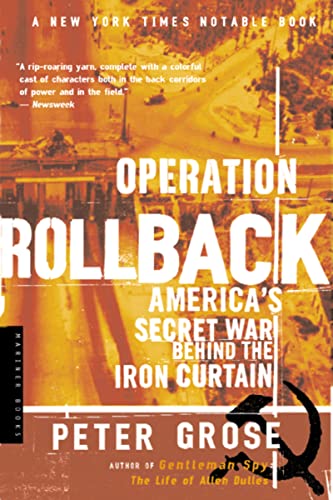
Operation Rollback: America's Secret War Behind the Iron Curtain: America's Secret War Behind the Iron Curtain – Espionage, Subversion, and Sabotage in the Struggle Against the Soviet Union - Softcover
Inhaltsangabe
Fascinating . . . well-documented . . . thought-provoking and entertaining” (Publishers Weekly), Operation Rollback is a tale of intrigue and espionage that reveals how and why suspicions on both sides drove the world into the Cold War. In 1945 the United States and the Soviet Union started secretly mobilizing forces against each other, building intricate intelligence networks of spies and digging in for the postwar era. America’s secret action plan, known as Rollback, was an audacious strategy of espionage, subversion, and sabotage. Concealed for four decades by all involved, the dangerous episodes of the Rollback campaign have only now come to light.
Die Inhaltsangabe kann sich auf eine andere Ausgabe dieses Titels beziehen.
Über die Autorin bzw. den Autor
Peter Grose is the author of the critically acclaimed GENTLEMAN SPY: THE LIFE OF ALLEN DULLES. A long-time foreign and diplomatic correspondent for the NEW YORK TIMES, then an executive editor of FOREIGN AFFAIRS, he is now a fellow at the John F. Kennedy School of Government at Harvard University. He resides in Massachusetts.
Auszug. © Genehmigter Nachdruck. Alle Rechte vorbehalten.
1
Nazis and Communists
As the nazi reich was crumbling all around him early in 1945, Joseph
Goebbels, creative propagandist for Hitler, shared his forebodings
with the German people in an editorial. The Russians were poised to
occupy all of eastern Europe, Goebbels declared in late February,
and "an iron curtain would at once descend."
Goebbels's warning, carried on shortwave radio, caught the
attention of a literary stylist on the other side of the war: Winston
Churchill, prime minister of Britain. Perhaps without remembering its
source, Churchill used the ominous image in his first message to
President Truman not three months later: "An iron curtain is drawn
down upon [the Soviet] front; we do not know what is going on
behind." Striving to impress the new president, with whom he yet had
no personal rapport, he then cabled on June 4: "I view with profound
misgivings . . . the descent of an iron curtain between us and
everything to the eastward." And nine months later, when Churchill,
by then out of office, spoke at a small college in Fulton, Missouri,
Truman's home state, the image finally caught on, to become the
singular metaphor for the gathering Cold War. Churchill declared:
From Stettin in the Baltic to Trieste in the Adriatic, an
Iron Curtain has descended across the continent. Behind that line lie
all the capitals of the ancient states of central and eastern Europe--
Warsaw, Berlin, Prague, Vienna, Budapest, Bucharest, and Sofia; all
these famous cities and their populations around them lie in what I
might call the Soviet sphere, and all are subject, in one form or
another, not only to Soviet influence but to a very high and in some
cases increasing measure of control from Moscow.
Few Americans who heard Churchill that day could have
confidently placed Stettin, Trieste, or any of the other named cities
on the map. If one drew a 600-mile-long line from Stettin in the
north to Trieste in the south, dividing the European continent at its
narrowest, all of the cities except Berlin would be east of the line.
Stettin, by then known as Polish Szczecin, was the capital of
Pomerania, on the western bank of the Oder, less than a hundred miles
northeast of Berlin. German settlers had built the town in the
twelfth century. In 1945 nearly four million Pomeranian Germans had
fled toward the West to escape the Red Army in its advance against
the disintegrating Third Reich. Cosmopolitan Trieste was the Adriatic
port that had given the old Austro-Hungarian Empire access to the
seas. By the end of World War II, it was effectively integrated into
Yugoslavia under the control of the communist partisans led by Josip
Broz Tito.
For the purposes of Churchill's rhetoric, the line was a
natural demarcation, but the realities on the ground in 1946 required
modest adjustments. Vienna, capital of Austria, was east of the
direct line, as Churchill said, yet American, British, and French
troops, as well as Russians, controlled the venerable (and
vulnerable) city under a four-power occupation authority. Prague and
the lands of the Czechs--Bohemia and Moravia--were actually a little
to the west of Churchill's line, but they were occupied by the Red
Army alone. Also to the west were the German länder around Berlin;
under Soviet occupation, they soon would become the German Democratic
Republic (East Germany).
With those adjustments, the line that Churchill drew that day
in Missouri endured intact for forty years, for all the overt and
covert efforts of the most anticommunist Americans to roll it back.
What had over time been called central Europe disappeared for half a
century, absorbed into a rigid delineation between East and West.
Just eight years before, Churchill's predecessor, Neville
Chamberlain, had dismissed a crisis in this central ground as "a
quarrel in a faraway country between people of whom we know
nothing."2 (Chamberlain's dismissive statement was uttered only 650
miles from Czechoslovakia; Americans were another 3,600 miles farther
away.) The disparate nations behind this curtain were not prominent
in United States foreign policy, save among ethnic and academic
specialists whose interests rarely intruded upon general public
perceptions. The diverse nations of eastern Europe faded into an
undifferentiated and hostile land mass under communism, monolithic
and, it was said, dangerous to America's global interests.
To be sure, Poland enjoyed an enduring hold on the American
imagination--tenacious, throbbing, and Roman Catholic, fabled for
Chopin and Paderewski and its nineteenth-century struggle for
nationhood against the vise grip of Russia and Germany. From the
waves of migration early in the twentieth century, Polish immigrants
had built a strong political presence in the United States, backed by
the Roman Catholic hierarchy, as Roosevelt and Democratic Party
strategists were ever mindful. The acts of the traditional predators
upon Poland drew Britain and France into the war against Hitler; once
the war was won some five years later, Stalin's designs moved the
Polish state bodily westward. Poland absorbed Pomerania and the
Baltic coast; in return, Polish lands in the east passed into the
Soviet Union. Polish nationalism was a culture resting on a shifting
territorial base.
Czechoslovakia, by contrast, was a relatively new cause. From
his years as a practicing historian, Woodrow Wilson had been
intrigued by the Slavs, predominant in central Europe before the
invasions of the German knights and merchants. At the Paris Peace
Conference of 1919, the uneasy merger of Czech and Slovak
nationalisms found voice in the remarkable political skills of Tomaš
Masaryk and Edvard Beneš, diplomatic charmers who knew how to flatter
the sensitivities of the western democracies to gain privileged
status for their artificial homeland. Yet by the time Hitler sought
to unite into his Reich the long-established and industrious German
population of the Sudetenland, ringing the Czech heartland, Britain
and the western democracies could not summon up sufficient sympathy
to bestir themselves for this "far-away" land.
Hungarians were Magyars, not Slavs, remembered by Americans
of idealistic inclination for the uprising of Lajos Kossuth in the
heady revolutions of 1848. The Magyars had allied themselves uneasily
with the triumphant Germanic culture of the Hapsburg Empire in the
mid nineteenth century, and they joined the Nazis at the start in
fighting the western allies and Russia. Hungary was occupied by Nazi
Germany in 1944. Though Hungary was well to the east of Churchill's
line, the western allies did not initially regard it as lost to a
Soviet sphere of influence.
Hugging the eastern shore of the Baltic, Lutheran Estonia and
Latvia, geographically and politically beholden to Soviet power,
clung to the vision of independent nationhood that they had enjoyed
between the two world wars. Like neighboring but Catholic Lithuania,
with its cultural and political ties to Poland, they hoped for
western support against Soviet Russia.
The South Slavs, joined together in the Yugoslav Federation,
were nonetheless fractured between Orthodox Serbs, who had resisted
Hitler, and Catholic Croatians, who had readily embraced Nazism in
its local manifestations. The Slavs farther east, Ukrainians and
Belorussians, lived on lands truly uncharted to most Americans--save
the active Ukrainian population in the United States (and Canada),
which struggled to make their national identity a cause of interest.
Given this...
„Über diesen Titel“ kann sich auf eine andere Ausgabe dieses Titels beziehen.
Weitere beliebte Ausgaben desselben Titels

Suchergebnisse für Operation Rollback: America's Secret War Behind the...

Beispielbild für diese ISBN
Operation Rollback: America's Secret War Behind the Iron Curtain
Anbieter: Books From California, Simi Valley, CA, USA
Verkäuferbewertung 4 von 5 Sternen

paperback. Zustand: Good. Some markings/ underlining to the pages. Artikel-Nr. mon0003764453
Gebraucht kaufen
EUR 4,45
EUR 4,36 Versand
Versand innerhalb von USA
Versand innerhalb von USA
Anzahl: 1 verfügbar
Beispielbild für diese ISBN
Operation Rollback: America's Secret War Behind the Iron Curtain
Anbieter: Ria Christie Collections, Uxbridge, Vereinigtes Königreich
Verkäuferbewertung 5 von 5 Sternen

Zustand: New. In. Artikel-Nr. ria9780618154586_new
Neu kaufen
EUR 17,67
EUR 13,98 Versand
Versand von Vereinigtes Königreich nach USA
Versand von Vereinigtes Königreich nach USA
Anzahl: Mehr als 20 verfügbar
Beispielbild für diese ISBN
Operation Rollback: America's Secret War Behind the Iron Curtain
Anbieter: Revaluation Books, Exeter, Vereinigtes Königreich
Verkäuferbewertung 5 von 5 Sternen
Paperback. Zustand: Brand New. 272 pages. 8.50x5.75x0.75 inches. In Stock. Artikel-Nr. x-0618154582
Neu kaufen
EUR 20,66
EUR 11,67 Versand
Versand von Vereinigtes Königreich nach USA
Versand von Vereinigtes Königreich nach USA
Anzahl: 2 verfügbar